Yes, the speed rating matters on tires because it identifies the tire’s tested ability to carry a specified load at a sustained speed while controlling heat and deformation. The correct replacement must meet the vehicle manufacturer’s speed and load specifications, although a higher rating can change ride comfort, price, treadwear, and steering response.
Key Facts at a Glance
- A tire speed rating is the letter in the service description, such as the V in 225/45R17 91V.
- Speed ratings apply only when the tire has the correct inflation pressure, load, condition, and test configuration.
- A higher rating is not automatically a better tire for every vehicle or driver.
- The vehicle door placard and owner’s manual establish the starting specification for replacement tires.
- Load index and speed rating work together; matching the letter while using an inadequate load index is unsafe.
- Underinflation, overloading, heat, damage, and worn tread can make a tire unsafe below its published speed rating.
What Does a Tire Speed Rating Mean?
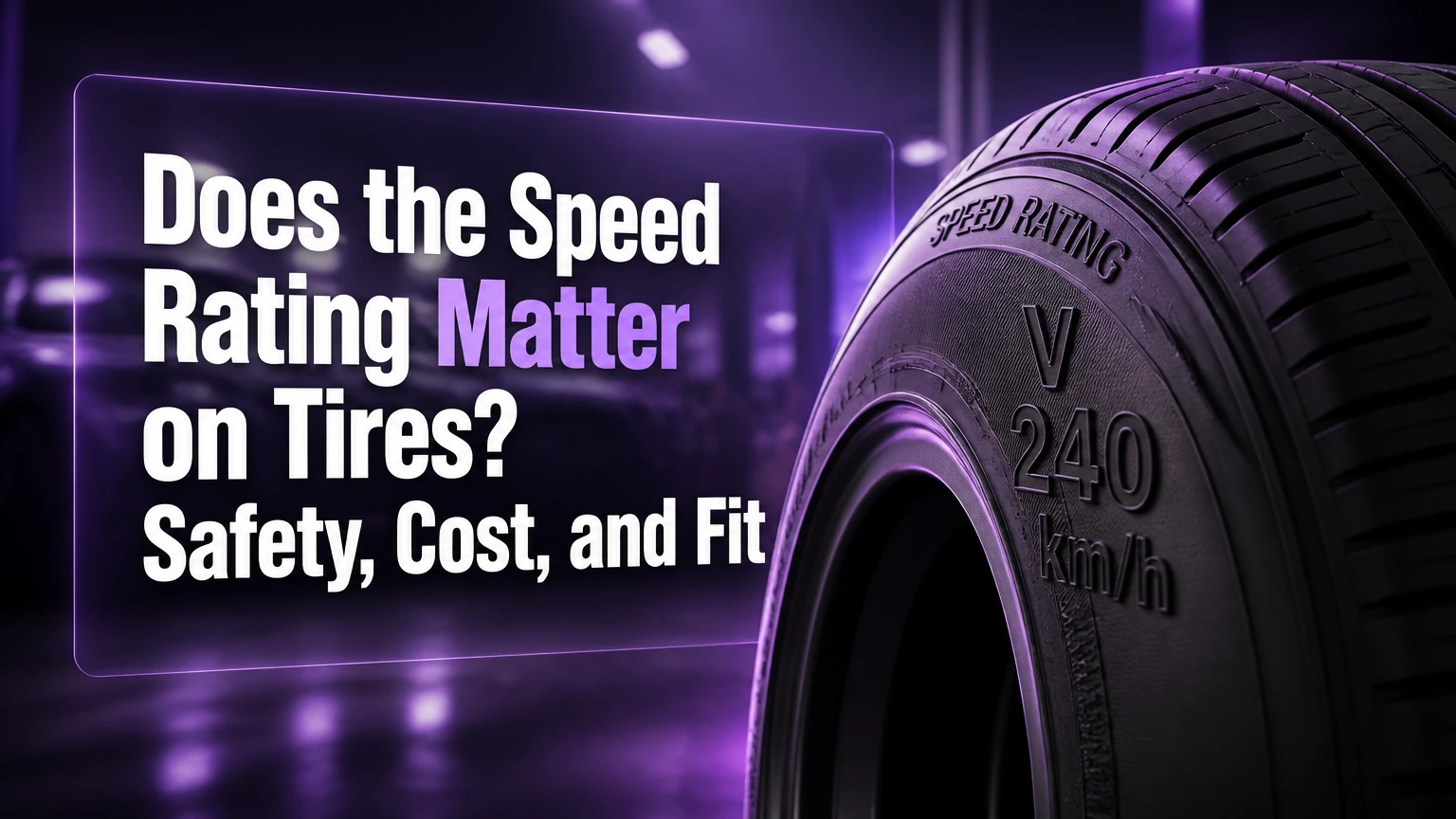
A tire speed rating is an alphabetical code that represents the maximum speed at which a properly maintained tire can carry its assigned load under specified test conditions. The rating is not a recommended driving speed, a guarantee of safe handling at that speed, or permission to exceed posted limits.
The letter appears near the end of the tire service description. In 225/45R17 91V, the number 91 is the load index and V is the speed symbol. The load index and speed symbol must be interpreted together because the tire’s certified performance depends on both load and inflation.
Speed testing is performed under controlled conditions that do not reproduce every road situation. Real-world performance changes with ambient temperature, pavement, tire pressure, wheel alignment, tread depth, vehicle weight, and tire age. A tire rated for 149 mph is not safe at that speed when it is underinflated or damaged.
Why Does Speed Rating Affect Tire Safety?
Speed rating affects safety through heat control, casing stability, and predictable force transmission. A rotating tire flexes continuously in its sidewall and tread, and that flexing creates heat; higher-rated designs generally use construction, compounds, and reinforcement that tolerate greater thermal and mechanical stress.
The American Automobile Association has repeatedly emphasized tire pressure and condition as basic safety controls, while the National Highway Traffic Safety Administration describes tires as “the only parts of your vehicle that touch the road.” That short description explains why the sidewall specification matters: tire capability directly limits the forces available for braking, cornering, and emergency avoidance.
A speed symbol does not measure every aspect of performance. A premium H-rated tire can outperform a cheap V-rated tire in wet braking, while a winter tire may have a lower speed symbol but provide much greater snow traction. The letter is one specification within the whole tire system.
How Do Speed-Rated Tires Handle Heat and Force?
Higher-rated tires typically manage heat through a combination of casing stiffness, belt design, cap plies, rubber compounds, and tread construction. These elements reduce excessive deformation as speed rises, which helps the tire maintain its shape and avoid damaging temperature buildup.
A tire’s tread and sidewall do not rotate as a perfectly rigid wheel. Each section compresses when it contacts the road, then rebounds as it leaves the contact patch. At highway speed, that cycle occurs many times per second. Low pressure, heavy loading, hot weather, and high speed increase deformation and thermal stress.
The rating also affects steering behavior. A stiffer high-performance tire usually gives quicker steering response and less sidewall delay, but the same stiffness can transmit more impact harshness through the suspension. Tire engineers balance grip, noise, rolling resistance, wear, and comfort rather than maximizing the speed symbol alone.
What the Speed Rating Does Not Tell You
A speed rating does not tell you the tire’s stopping distance, wet-weather ranking, treadwear warranty, snow traction, noise level, or mileage. It also does not establish the safe speed for a particular road, vehicle, driver, or weather condition.
The rating does not compensate for incorrect pressure. NHTSA recommends checking cold tire pressure monthly and before long trips, using the vehicle placard or manual rather than the maximum pressure molded into the tire sidewall. The placard pressure is the vehicle manufacturer’s operating specification.
The rating also does not override the load index. A replacement tire with the correct V symbol but a lower load index may not support the vehicle’s required axle load. A tire marked 91V and one marked 95V share a speed symbol, but the 95-load-index tire supports more weight under its standardized table.
What Are the Main Tire Speed Rating Codes?
The most common passenger-car speed symbols range from S through Y. The speed value is a test classification, not a target speed, and several symbols used on specialty tires require careful interpretation.
| Speed symbol | Maximum rated speed | Typical use or note |
|---|---|---|
| M | 81 mph, 130 km/h | Temporary spare applications |
| N | 87 mph, 140 km/h | Some temporary or specialty tires |
| P | 93 mph, 150 km/h | Older or specialty applications |
| Q | 99 mph, 160 km/h | Some winter and off-road tires |
| R | 106 mph, 170 km/h | Certain light-truck and commercial tires |
| S | 112 mph, 180 km/h | Basic passenger-car tires |
| T | 118 mph, 190 km/h | Family sedans, minivans, and crossovers |
| H | 130 mph, 210 km/h | Touring and sport-oriented passenger cars |
| V | 149 mph, 240 km/h | Performance sedans and SUVs |
| W | 168 mph, 270 km/h | Ultra-high-performance vehicles |
| Y | 186 mph, 300 km/h | Very high-performance applications |
| (Y) | Above 186 mph, 300 km/h | Specialized vehicles and fitments |
The older Z designation can appear in tire sizes such as 225/45ZR17. Z indicates a high-speed category but does not always communicate the exact speed capacity by itself. The adjacent service description or manufacturer documentation may specify whether the tire is V-, W-, or Y-rated.
How Do You Find the Correct Rating for Your Vehicle?
Find the vehicle manufacturer’s specification before comparing brands or prices. The driver-side doorjamb placard normally lists the approved tire size, load requirement, cold inflation pressure, and sometimes the speed rating; the owner’s manual may list additional approved sizes.
Use this process:
- Read the door placard. Record every listed size and the recommended cold pressure.
- Check the owner’s manual. Look for alternate wheel sizes, spare-tire instructions, and winter-tire guidance.
- Decode the service description. Separate tire size, construction, load index, and speed symbol.
- Inspect all four current tires. Confirm that the installed size and load index are appropriate.
- Compare the proposed tire. Match or exceed the manufacturer’s speed symbol and load index unless the manufacturer explicitly permits an exception.
- Confirm vehicle compatibility. Check wheel diameter, approved width, run-flat requirements, TPMS compatibility, and clearance.
- Verify the final installation. Have the shop set cold pressure to the placard value and place the best-matched pair on the rear axle when only two tires are replaced.
A worked example makes the code easier to read:
| Marking | Meaning | Practical implication |
|---|---|---|
| 225 | Section width, 225 millimeters | Tire is approximately 225 mm wide |
| 45 | Aspect ratio, 45% | Sidewall height is about 101 mm |
| R | Radial construction | Standard modern passenger construction |
| 17 | Wheel diameter, 17 inches | Fits a 17-inch wheel |
| 91 | Load index | Use the manufacturer’s load table |
| V | Speed symbol | Rated to 149 mph, 240 km/h |
Is a Higher Speed Rating Better?
A higher speed rating is better when the vehicle requires it or when the driver values sharper response and higher heat tolerance. It is not automatically better for comfort, wet traction, winter performance, fuel economy, or total cost.
A higher-rated tire often has a stiffer casing and a more performance-oriented tread compound. Those properties can improve steering precision, but the result depends on the complete tire design. A high-rated grand-touring tire may ride smoothly, while a low-profile performance tire can ride harshly even on the same vehicle.
A higher rating is usually an acceptable upgrade when the tire remains compatible with the vehicle, load index, wheel, clearance, and manufacturer requirements. The upgrade may add cost without delivering a noticeable benefit to a low-speed commuter.
Does the Speed Rating Matter on Tires If You Never Drive Fast?
Yes, the speed rating still matters even when normal driving stays below the rating. The specification influences heat margin, casing behavior, steering response, and compatibility with the vehicle’s original suspension and tire calibration.
The “I only drive 70 mph” argument overlooks several factors. A tire can experience high heat during a loaded summer highway trip, repeated acceleration and braking, a long sweeping curve, or an emergency lane change. Speed rating is not solely about the driver’s chosen top speed.
However, the safety margin does not justify unlimited speed. A T-rated tire can be entirely appropriate for a vehicle designed around T-rated tires, provided its load index, pressure, condition, and fitment are correct. Installing a Y-rated tire does not make speeding safe or legal.
Does Speed Rating Affect Ride Comfort and Handling?
Speed rating commonly affects ride and handling because stronger, stiffer construction reduces sidewall flex. H-, V-, W-, and Y-rated tires can feel more immediate during steering and braking, while S- and T-rated touring tires often prioritize cushioning and low noise.
The actual difference depends on sidewall height, tire pressure, wheel diameter, tread pattern, and suspension tuning. Moving from a 17-inch T-rated tire to a 19-inch W-rated tire changes several variables at once, so attributing every ride change to the letter alone is incorrect.
| Typical priority | More likely tire characteristic | Common result |
|---|---|---|
| Steering response | Stiffer casing, lower flex | Faster turn-in |
| Impact comfort | Taller sidewall, softer construction | Better bump absorption |
| Highway stability | Stronger casing, controlled deformation | More consistent tracking |
| Tread life | Harder compound, lower heat generation | Often longer wear |
| Wet grip | Silica compound and groove design | Depends on model, not symbol alone |
| Snow traction | Flexible tread blocks and winter compound | Often lower speed symbol |
Can You Use a Higher or Lower Speed Rating?
A higher speed rating is generally acceptable if the replacement tire preserves the required load index and all physical fitment requirements. A lower speed rating should not be installed unless the vehicle manufacturer, tire manufacturer, or applicable local rules specifically permit it for that use.
Winter tires create the most common exception. Some manufacturers permit a lower winter speed symbol because winter tires trade high-speed capability for cold-weather flexibility and snow traction. The driver must follow the tire maker’s speed limit, fit all tires consistently according to the manufacturer’s instructions, and use a visible reminder when required.
Do not assume a lower rating is harmless because posted limits are lower. The vehicle manufacturer may have calibrated braking, stability control, steering response, and load performance around the original tire specification. Legal inspection and insurance treatment also varies by country, state, and policy, so blanket claims about automatic insurance cancellation are unreliable.
What Happens When Tires Have Different Speed Ratings?
If tires with different speed ratings are installed, the lowest-rated tire generally limits the safe operating capability of the set, but the arrangement can also change handling balance. Differences between front and rear tires may affect understeer, oversteer, electronic stability-control behavior, and wet-road response.
Install identical size, load index, speed rating, construction type, and tread pattern across the vehicle whenever possible. If only two tires are replaced, many tire-industry and vehicle-safety recommendations favor placing the newer tires on the rear axle, regardless of whether the vehicle is front-wheel drive or rear-wheel drive.
All-wheel-drive vehicles require extra caution. Some manufacturers specify a narrow circumference difference between tires because mismatched rolling radius can stress the center differential or transfer case. Consult the vehicle manual before replacing fewer than four AWD tires.
How Much More Do Higher-Rated Tires Cost?
Higher speed ratings can add approximately $10-$80 per tire in common passenger sizes, while switching from touring to ultra-high-performance construction can add $40-$150 or more per tire. The model, size, brand, seasonal category, retailer, and warranty often influence price more than the speed symbol.
Typical installed ranges in the United States are broad and not a universal quote:
| Tire category | Common rating range | Typical installed price per tire | Typical trade-off |
|---|---|---|---|
| Basic all-season | S or T | $90-$170 | Lower purchase cost, softer response |
| Touring all-season | T or H | $120-$220 | Comfort, noise control, long warranties |
| Grand touring | H or V | $150-$280 | Stability with moderate comfort |
| Ultra-high-performance | V, W, or Y | $180-$400 | Response and grip, faster wear risk |
| Winter passenger tire | Q, T, or H | $130-$280 | Cold and snow traction, seasonal storage |
Speed rating alone does not determine tread life. A W-rated tire may wear sooner because its compound and tread design favor grip, but a V-rated touring tire can outlast a T-rated performance tire. Compare the manufacturer’s treadwear warranty, UTQG information where applicable, alignment condition, and driving pattern.
Does a Higher Rating Reduce Fuel Economy or Tread Life?
A higher rating can reduce fuel economy or tread life, but neither outcome is guaranteed. Additional casing material, greater mass, wider tread, softer compound, and higher rolling resistance can increase energy use and wear, while correct pressure and a low-rolling-resistance design can offset some of that effect.
Treadwear depends on alignment, inflation, torque, road surface, temperature, rotation, braking, and compound. A practical replacement interval is determined by tread depth, damage, age, and wear pattern, not by a fixed two-year or six-year rule based on speed symbol.
Inspect tires monthly and before long trips. Replace a tire when it reaches the manufacturer’s wear indicator, develops damage, or becomes too old under the tire maker’s guidance. The U.S. Tire Manufacturers Association advises consumers to inspect tires regularly and follow replacement recommendations from the vehicle and tire manufacturers.
Which Rating Fits Different Driving Situations?
The best rating is the manufacturer-approved rating that matches the vehicle, load, climate, and driving priorities. A commuter should not select a tire solely because its letter is higher, and a performance-car owner should not trade away the specified rating for a cheaper touring tire.
| Driving situation | Usually suitable starting point | Why it fits | Check before purchase |
|---|---|---|---|
| Compact commuter | T or H | Comfort and predictable highway use | Door-placard load index |
| Sport sedan | H or V | Response and stable high-speed travel | OE handling specification |
| Performance coupe | V, W, or Y | Heat and cornering demands | Exact size and construction |
| Snow-belt daily driver | Manufacturer-approved winter symbol | Cold-weather traction | Winter speed limit |
| Loaded crossover | T, H, or V | Capacity depends on axle load | Load index and pressure |
| Light truck or van | R, S, T, or higher | Commercial casing requirements | LT marking and load range |
Are Winter Tires Allowed to Have a Lower Rating?
Winter tires may have a lower speed rating when the vehicle and tire manufacturers allow the substitution. The lower symbol reflects the winter tire’s intended operating limit, not poor quality; the compound remains flexible in cold temperatures, and the tread is designed for snow, ice, and slush.
Never exceed the winter tire’s posted speed capability. Some vehicles require a minimum winter rating, and some jurisdictions require a dashboard label or other warning. Verify the rule for the vehicle’s market and location.
What Common Tire-Rating Mistakes Cause Problems?
The most frequent errors involve reading only the letter, ignoring load index, or treating the sidewall maximum pressure as the vehicle’s correct pressure. These mistakes can produce a technically familiar tire that is still unsuitable for the vehicle.
- Matching the size but not the load index: A 225/45R17 tire can have different load capacities. Match the complete service description.
- Using the sidewall maximum pressure: Set cold pressure from the door placard, not the maximum molded value.
- Mixing performance categories: Combining a winter tire with an all-season tire can change grip balance even when the speed symbols match.
- Replacing only one AWD tire: Circumference differences can create drivetrain stress.
- Assuming a higher letter fixes poor alignment: Uneven wear remains an alignment problem.
- Buying a lower-rated winter tire without a speed reminder: The driver may unknowingly exceed the tire’s limit.
- Treating speed rating as a wet-grip score: Wet braking depends heavily on compound, grooves, tread depth, and pavement.
An expert rule of thumb is simple: compare the complete tire specification before comparing the price. The letter is important, but it is only one part of the fitment.
What Should You Check Before Buying Replacement Tires?
Use the vehicle placard as the controlling reference, then verify the replacement tire’s complete specification with a qualified retailer or installer. A five-minute sidewall comparison can prevent an expensive mismatch.
Confirm these items:
- Tire size and approved wheel diameter.
- Load index and, where applicable, XL, Reinforced, or LT construction.
- Speed symbol and any manufacturer-specific requirement.
- Seasonal category, such as all-season, summer, or winter.
- Run-flat or self-supporting construction.
- Treadwear, traction, and temperature information where supplied.
- Manufacturing date and storage condition.
- TPMS compatibility and valve-stem condition.
- Alignment, suspension, and brake condition.
- Rotation direction and outside/inside mounting marks.
The tire with the highest speed symbol is not necessarily the safest choice. A correctly sized, correctly inflated, age-appropriate tire with strong wet braking and adequate load capacity is usually more valuable than an oversized rating upgrade.
Frequently Asked Questions
Can I put V-rated tires on a car that came with H-rated tires?
Usually, yes, if the V-rated tires have the correct size, equal or greater load index, suitable construction, and adequate wheel and vehicle clearance. The upgrade may sharpen steering response and increase cost or ride firmness. Confirm the vehicle manufacturer’s fitment guidance before installation.
Does tire speed rating affect stopping distance?
Speed rating can influence braking stability and tire deformation, but it does not predict stopping distance by itself. Wet braking depends on the specific tread compound, tread depth, pavement, temperature, anti-lock braking system, pressure, and driver input. Compare independent test data for the exact tire model when available.
Can I mix H-rated and V-rated tires?
Avoid mixing different ratings when possible. If a temporary or permitted fitment requires it, follow the vehicle and tire manufacturers’ placement instructions, keep the same size and load requirements, and treat the lowest-rated tire as the limiting component. AWD vehicles may require all four tires to match closely.
Is a T-rated tire safe on the highway?
A T-rated tire is safe for highway use when T is approved for the vehicle, the load index is adequate, pressure is correct, and the tire is undamaged and properly maintained. Its 118 mph, 190 km/h classification does not mean drivers should approach that speed.
Do speed-rated tires need special inflation pressure?
Speed-rated tires use the vehicle manufacturer’s specified cold pressure unless the tire or vehicle documentation states otherwise. Heavy loads, towing, or unusual operating conditions may require a manufacturer-approved adjustment. Never reduce pressure to improve comfort without checking the placard and manual.
How long do high-speed tires last?
High-speed tires do not have one predictable lifespan. Typical service life can range from 20,000-50,000 miles for soft ultra-high-performance designs and 40,000-80,000 miles for long-wearing touring designs, but alignment, pressure, climate, storage, and driving style can change those figures substantially.
The Bottom Line
Does the speed rating matter on tires? Yes, because the rating affects heat tolerance, casing stability, handling behavior, and vehicle compatibility. Match or exceed the door-placard speed symbol and load index, except where a documented winter-tire exception applies. Then choose the exact tire model based on wet grip, tread life, comfort, climate, price, and maintenance rather than assuming the highest letter is automatically best.