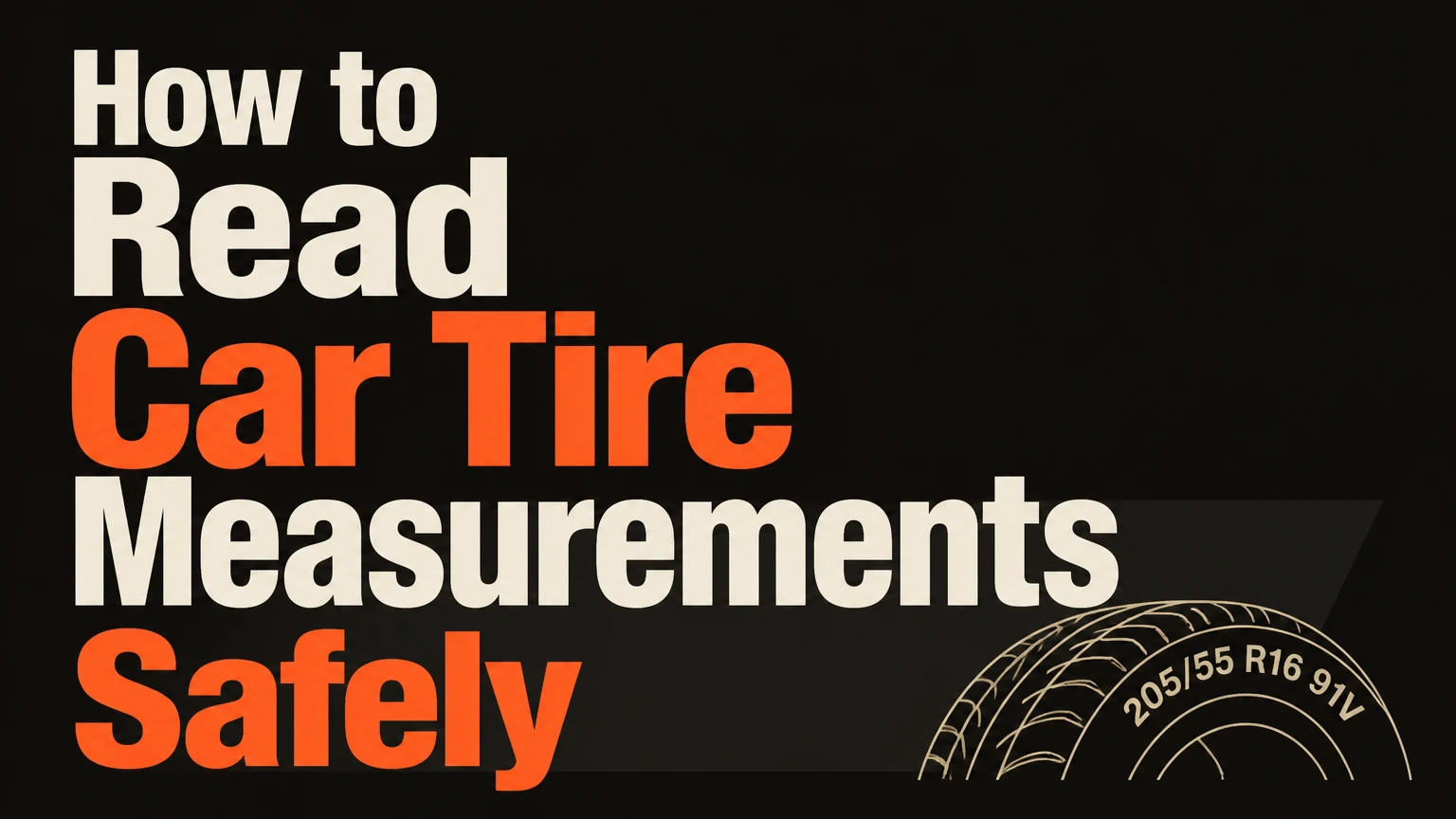
To read car tire measurements, decode the sidewall from left to right, then verify the complete code against the driver-door placard or owner’s manual. In P215/65R15 95H, P identifies passenger use, 215 is width in millimeters, 65 is aspect ratio, R is radial construction, 15 is rim diameter in inches, 95 is load index, and H is speed rating.
Key facts at a glance
215/65R15 describes tire width, sidewall proportion, construction, and wheel diameter.
The 65 aspect ratio means the sidewall is 65% of 215 mm, or approximately 140 mm.
Load index 95 permits 690 kg, or 1,521 lb, per tire when properly inflated.
Speed rating H corresponds to 210 km/h, or 130 mph, under specified test conditions.
The four-digit DOT date code uses WWYY, such as 2425 for production in week 24 of 2025.
The vehicle placard determines recommended size and cold inflation pressure, not the tire sidewall’s maximum PSI.
What Does a Tire Size Code Mean?
A tire size code connects a tire’s physical dimensions with its service limits. The code does not describe every fitment requirement, because wheel width, offset, brake clearance, suspension space, axle load, and vehicle programming also affect compatibility.
Consider P215/65R15 95H:
| Marking | Meaning | Example value |
|---|---|---|
| Service prefix | Intended vehicle or service category | P, passenger car |
| Section width | Approximate mounted width | 215 mm |
| Aspect ratio | Sidewall height as a percentage of width | 65% |
| Construction | Internal carcass arrangement | R, radial |
| Rim diameter | Wheel bead-seat diameter | 15 inches |
| Load index | Maximum load code per tire | 95, 690 kg |
| Speed symbol | Certified maximum speed category | H, 210 km/h |
The sidewall is the fastest place to identify the tire currently installed, but it is not always the correct source for the replacement specification. A previous owner may have installed an unsuitable size, and a spare tire may carry a different temporary-use code.
How do you read 215/65R15 95H?
Read 215/65R15 95H as a passenger tire approximately 215 mm wide, with a sidewall height equal to 65% of its width, built with radial construction for a 15-inch wheel, carrying load index 95 and speed rating H. The number sequence describes the tire; the vehicle placard confirms whether that tire belongs on the car.
The first three size components are dimensional. The last two are service ratings. Width and aspect ratio influence the tire’s outside diameter, while load and speed ratings describe structural capability.
Before You Start: What Information Do You Need?
You need the tire sidewall, a flashlight, the driver-door placard, and the owner’s manual. Reading takes approximately 5-10 minutes and costs nothing, but buying a replacement requires checking all four tires, not only the most visible sidewall.
Before starting, gather:
- A flashlight for raised or dirty lettering.
- A phone camera to enlarge markings.
- The driver-door jamb label or fuel-door label.
- The owner’s manual, especially for front and rear staggered sizes.
- A tire-pressure gauge if checking inflation.
- The full DOT code from at least one sidewall.
Tire shops can identify a size from the vehicle identification number, but the VIN lookup should supplement, not replace, the physical placard. Performance trims, towing packages, winter wheel sets, and factory staggered fitments can produce different specifications within one model year.
Step 1: Find the Complete Sidewall String
Locate the largest alphanumeric string on the sidewall, usually near the brand and model name. Record every character before interpreting the code, because 225/50R17 94W, 225/50ZR17 94W, and 225/50R17 98W XL do not communicate exactly the same service information.
Tire manufacturers may place the full service description on only one sidewall. The opposite side may show a simplified size or an asymmetrical design label. Rotate the wheel or inspect the inner sidewall if the outer marking appears incomplete.
Do not confuse these items:
- Tire model: a product name such as Michelin Primacy 4.
- Size code: a string such as 225/50R17.
- Service description: load index and speed symbol, such as 98W.
- Option marking: XL, run-flat, acoustic foam, or manufacturer approval.
Step 2: Identify the Service Type
The letter before the width identifies the sizing system or intended service. A P tire follows North American passenger-car conventions, while an LT tire is designed for light-truck applications and can use different load assumptions.
| Prefix or suffix | Meaning | Typical application | Important limitation |
|---|---|---|---|
| P | P-metric passenger tire | Sedan, crossover, minivan | Must meet placard load requirement |
| No prefix | Euro-metric passenger tire | European and global passenger cars | Load calculation conventions differ |
| LT | Light Truck | Pickup, heavy SUV, commercial van | Often needs higher pressure and load capacity |
| ST | Special Trailer | Boat, cargo, utility trailer | Not intended for passenger vehicles |
| T | Temporary spare | Compact or emergency spare | Usually limited speed and distance |
| XL or Reinforced | Extra load construction | Heavy sedan, crossover, performance car | Requires approved wheel and pressure |
The absence of P does not automatically mean a tire is inferior or incompatible. Euro-metric tires can be correct original equipment, but P-metric and Euro-metric versions with similar dimensions may have different load capacities.
Practitioner rule: never substitute an LT tire for a P tire solely because the LT version looks tougher. The heavier casing can alter ride, steering response, rolling resistance, and required inflation pressure.
Step 3: Read Section Width in Millimeters
The first number is the nominal section width, measured from one sidewall’s widest point to the other when mounted on an approved measuring rim. A 215 tire is approximately 215 mm wide, although the actual fitted width changes with rim width and tire manufacturer.
Section width is not the same as tread width. A 215 mm tire may have a tread contact width several millimeters narrower, while sidewall bulges can extend beyond the tread. The body, suspension, and wheel-well clearance must accommodate the complete mounted tire.
| Nominal size | Width in inches | Common effect versus 215 mm |
|---|---|---|
| 195 | 7.7 in | Narrower, often lower rolling resistance |
| 205 | 8.1 in | 10 mm narrower |
| 215 | 8.5 in | Reference example |
| 225 | 8.9 in | 10 mm wider |
| 245 | 9.6 in | 30 mm wider |
A wider tire can increase dry-road contact potential, but it can also follow road grooves, weigh more, hydroplane differently, and rub suspension components. Width changes should follow an approved vehicle fitment chart rather than appearance preference.
Step 4: Calculate the Aspect Ratio
The aspect ratio is the sidewall height expressed as a percentage of section width. For 215/65, calculate 215 × 0.65 = 139.75 mm, so one sidewall is approximately 140 mm tall before normal measurement variation.
| Size | Sidewall calculation | Approximate sidewall |
|---|---|---|
| 205/55R16 | 205 × 0.55 | 113 mm |
| 215/65R15 | 215 × 0.65 | 140 mm |
| 225/50R17 | 225 × 0.50 | 113 mm |
| 245/45R18 | 245 × 0.45 | 110 mm |
| 265/70R17 | 265 × 0.70 | 186 mm |
A lower aspect ratio normally creates a shorter, stiffer sidewall and sharper steering response, but it reduces protection against pothole impacts. A taller profile generally improves impact absorption and winter-road durability, although steering response may feel less immediate.
The aspect ratio is not a direct measurement of total tire height. Overall diameter also includes the wheel diameter and both sidewalls.
Step 5: Read the Construction Letter
The R in a modern passenger-car size means radial construction. Radial tire cords run from bead to bead in a radial orientation, with belt packages beneath the tread that stabilize the contact patch.
| Marking | Construction | Current use | Typical characteristic |
|---|---|---|---|
| R | Radial | Nearly all modern cars | Stable tread and efficient highway operation |
| D | Diagonal or bias-ply | Vintage, specialty, some trailers | Flexible carcass with different handling |
| B | Belted bias | Rare specialty applications | Bias carcass with stabilizing belts |
Radial construction does not indicate a speed rating. A tire can be radial and still have a low speed symbol, while a high-performance tire can also use radial construction.
Step 6: Match the Rim Diameter
The number after the construction letter is the wheel’s nominal bead-seat diameter in inches. A tire marked R15 fits a 15-inch rim, not a 15-inch outside-diameter wheel.
A 15-inch tire cannot safely mount on a 16-inch wheel. The bead seat must match exactly, and forcing an incorrect diameter can cause sudden air loss or bead failure.
Wheel diameter alone does not establish fitment. Confirm wheel width, bolt pattern, offset, center bore, brake clearance, and the tire manufacturer’s approved rim-width range. A 225/50R17 tire may fit several rim widths, but its measured dimensions and handling can change across that range.
Step 7: Decode the Load Index
The load index is a code, not the number of pounds or kilograms. Load index 95 equals 690 kg, or 1,521 lb, per tire in standard load-index tables, giving a theoretical four-tire total of 2,760 kg before vehicle limits are considered.
| Load index | Load per tire | Four-tire mathematical total |
|---|---|---|
| load index 88 | 560 kg, 1,ักษ? lb | 2,240 kg |
| load index 91 | 615 kg, 1,356 lb | 2,460 kg |
| load index 95 | 690 kg, 1,521 lb | 2,760 kg |
| load index 98 | 750 kg, 1,653 lb | 3,000 kg |
| load index 104 | 900 kg, 1,984 lb | 3,600 kg |
The vehicle’s gross axle weight ratings, gross vehicle weight rating, and placard specification still control. A mathematical total does not authorize loading the vehicle beyond its chassis, axle, or suspension limits.
Never choose a lower load index than the vehicle requires. A higher index may be acceptable only when the tire, wheel, pressure, clearance, and vehicle manufacturer guidance support it.
Step 8: Interpret the Speed Rating
The speed symbol indicates the tire’s tested speed category under specified conditions, including correct load, inflation, temperature, and tire condition. It is not a recommended road speed and does not make public-road speeding safe.
| Symbol | Rated speed | Common context |
|---|---|---|
| Q | 160 km/h, 99 mph | Some winter tires |
| S | 180 km/h, 112 mph | Some passenger and winter tires |
| T | 190 km/h, 118 mph | Touring passenger cars |
| H | 210 km/h, 130 mph | Sport touring vehicles |
| V | 240 km/h, 149 mph | Performance passenger cars |
| W | 270 km/h, 168 mph | High-performance vehicles |
| Y | 300 km/h, 186 mph | Certain performance applications |
Speed ratings affect steering feel, heat resistance, ride, and tread compound. Replacement tires should normally meet or exceed the vehicle manufacturer’s specified rating, except where local rules and seasonal tire guidance permit a lower winter rating.
Use the lowest speed-rated tire on an axle when assessing that axle’s capability. Do not mix different speed ratings across the same axle because handling response can differ during abrupt lane changes.
Step 9: Read the DOT Date Code
The final four digits of the DOT Tire Identification Number identify the production week and year. 2425 means week 24 of 2025, while a two-digit date code indicates manufacture before 2000 and signals an extremely old tire.
The full DOT code may appear on only one sidewall. Look for DOT, then move to the final four digits of the complete string rather than stopping at the first group of numbers.
The National Highway Traffic Safety Administration recommends replacing tires that are 10 years old, regardless of tread remaining, and several tire manufacturers recommend inspection or replacement around six years from service depending on condition and use. Heat, ultraviolet exposure, underinflation, storage, and ozone accelerate aging.
Replace or professionally inspect a tire with:
- Cracks in sidewall grooves or between tread blocks.
- Bulges, impact separations, or exposed cords.
- Repeated pressure loss without a clear puncture.
- A date approaching the manufacturer’s service-age limit.
- Severe weather exposure or long-term storage history.
Step 10: Interpret UTQG Ratings
Uniform Tire Quality Grading, or UTQG, lists treadwear, traction, and temperature information for many passenger tires sold in the United States. UTQG is useful for comparing similar tires, but it does not predict a guaranteed mileage figure.
| UTQG element | Example marking | What it evaluates | What it does not promise |
|---|---|---|---|
| Treadwear | 400 | Relative wear rate against a government test tire | 40,000 miles |
| Traction | AA, A, B, C | Straight-line wet braking performance | Cornering or snow grip |
| Temperature | A, B, C | Heat-generation and dissipation resistance | Guaranteed lifespan |
A treadwear grade of 600 is not reliably “three times longer” than 200 in ordinary driving. The rating is comparative, and manufacturer testing, road surfaces, alignment, inflation, climate, driving style, and tire rotation change actual wear.
Step 11: Check Weather and Special-Use Symbols
M+S means Mud and Snow, but it does not certify severe-snow performance. The 3PMSF symbol, a snowflake inside a three-peak mountain, identifies a tire that meets a defined severe-snow performance test.
| Marking | Meaning | Suitable interpretation |
|---|---|---|
| M+S | Mud and Snow tread designation | Mild snow capability; not a winter certification |
| 3PMSF | Three-Peak Mountain Snowflake | Tested severe-snow performance |
| Rotation arrow | Directional tread requirement | Mount and rotate only as marked |
| Outside or Inside | Asymmetric tire orientation | Correct side must face outward or inward |
| Run-flat symbol | Reinforced limited-distance operation | Follow manufacturer distance and speed limits |
A 3PMSF tire is not automatically superior on glare ice. Dedicated winter tires usually use compounds and tread designs optimized for cold conditions, while all-weather tires balance warm-weather use with certified severe-snow capability.
Step 12: Verify Pressure and Vehicle Fitment
The driver-door placard gives the vehicle manufacturer’s recommended cold pressure and approved tire size. The maximum PSI molded into the sidewall is the pressure associated with the tire’s maximum rated load, not the routine pressure for that vehicle.
Check pressure when the tires are cold, meaning the car has been parked for several hours. Pressure changes with temperature, so a reading after highway driving is not directly comparable with a cold placard value.
The placard may list:
- Front and rear pressures separately.
- A full-load pressure.
- One or more approved tire sizes.
- A temporary-spare pressure.
- Cold inflation values in PSI, kPa, or bar.
Tire Pressure Monitoring System sensors may require relearning after installation. Correct pressure does not compensate for an incorrect load index, damaged tire, wrong wheel diameter, or inadequate clearance.
Which Tire Types Match Different Driving Conditions?
The best tire category depends on temperature, road surface, vehicle load, and steering priorities. All-season tires suit moderate climates, while dedicated winter tires provide a stronger cold-weather margin below approximately 7°C, or 45°F.
| Tire category | Typical profile | Common speed range | Main advantage | Main limitation |
|---|---|---|---|---|
| All-season | 55-75 series | T-H | Long service in moderate climates | Reduced ice and deep-snow grip |
| Summer performance | 30-50 series | V-Y | Dry and warm-wet-road response | Poor cold-weather flexibility |
| Winter | 50-70 series | Q-T | Cold, snow, and ice traction | Faster wear on warm pavement |
| All-terrain | 65-85 series | S-T | Gravel and light off-road durability | Noise, weight, and fuel penalty |
| Highway truck | 60-80 series | S-T | Load carrying and highway stability | Less aggressive off-road traction |
Typical retail pricing ranges from approximately $70-$130 for basic commuter tires and $200-$450 or more for large truck or ultra-high-performance tires. Mounting, balancing, valve service, disposal, and alignment may add roughly $20-$50 per tire, depending on location and wheel size.
A professional shop commonly needs 45-60 minutes for a four-tire mount and balance, excluding alignment or repairs. Actual tread life varies widely, but typical all-season service falls near 40,000-80,000 miles, while aggressive summer performance tires may last 15,000-30,000 miles.
What Changes When You Use a Different Tire Size?
Changing size alters diameter, gearing, ground clearance, speedometer accuracy, load capacity, and clearance. A replacement should remain within the vehicle manufacturer’s approved range and preserve adequate brake, suspension, and body clearance.
Calculate approximate outside diameter with:
Diameter = wheel diameter + 2 × (section width × aspect ratio)
Convert millimeters to inches by dividing by 25.4. For 215/65R15, the calculation is:
- Sidewall: 215 × 0.65 = 139.75 mm.
- Two sidewalls: 279.5 mm, or 11.0 inches.
- Total diameter: 15 + 11.0 = approximately 26.0 inches.
A plus-size package usually combines a larger wheel with a shorter sidewall to keep overall diameter close to the original. For example, changing from 215/65R15 to 225/50R17 changes width, sidewall height, diameter, load requirements, and wheel clearance, so the arithmetic alone cannot approve the conversion.
Expert insight: maintaining diameter does not preserve handling. A wider tire, stiffer casing, heavier wheel, and different offset can increase steering effort and reduce ride quality even when the speedometer remains accurate.
Common Mistakes and How to Fix Them
Mistake 1: Reading only the first three numbers
Problem: The buyer matches 225/50R17 but ignores 94W, XL, or the vehicle’s required load rating.
Fix: Match the complete size and service description, including load index, speed symbol, and extra-load designation.
Mistake 2: Using the sidewall maximum PSI
Problem: The tire is inflated to 50 PSI because the sidewall lists 50 PSI maximum.
Fix: Use the cold pressure on the vehicle placard unless a qualified manufacturer procedure specifies otherwise.
Mistake 3: Assuming a higher load index always improves safety
Problem: A heavy LT tire is installed on a sedan without checking wheel range, pressure, or handling.
Fix: Confirm the complete fitment and vehicle recommendation. More capacity can bring higher mass and a harsher ride.
Mistake 4: Treating M+S as a winter certification
Problem: An M+S all-season tire is used on icy roads as a substitute for a 3PMSF winter tire.
Fix: Choose 3PMSF or dedicated winter tires when severe snow and sustained cold are expected.
Mistake 5: Ignoring axle matching
Problem: Different tread designs, sizes, or speed ratings are mixed on one axle.
Fix: Keep identical tires on each axle whenever possible and follow the vehicle manual for AWD replacement limits.
Uneven wear supplies diagnostic evidence. Wear on both shoulders commonly indicates underinflation or excessive cornering; center wear often indicates overinflation; one-sided wear points toward alignment or suspension geometry; cupping can indicate imbalance, worn dampers, or another mechanical fault.
Which Markings Matter for Common Scenarios?
Daily commuter: Match the placard size, load index, speed rating, and cold pressure. Prioritize wet braking, noise, tread warranty, and climate suitability over the highest UTQG number.
Snow-belt driver: Use dedicated winter tires or 3PMSF all-weather tires when temperatures remain low. A narrower winter package with a taller sidewall can improve pothole resilience if the wheel and brake package permit it.
Pickup or heavy SUV owner: Check whether the placard specifies P-metric, XL, LT, or a load range. Load Range C, D, and E are not interchangeable labels for every vehicle because each requires a defined pressure and capacity relationship.
Trailer owner: Use ST tires with the correct load index and inflation. ST tires are designed for trailer service and should not be substituted for passenger-car tires on the towing vehicle.
Performance driver: Preserve the original or approved speed rating, rim width, diameter, and load index. A lower-profile tire may sharpen steering but offers less impact protection and can be more vulnerable to wheel damage.
FAQ
Can I use a tire with a higher speed rating?
Usually, yes, if the size, load index, wheel fitment, clearance, and pressure requirements remain correct. A higher speed rating may change ride comfort, tread compound, cost, and wet-weather behavior. The higher symbol does not increase the vehicle’s legal or safe road speed.
How many tires should I replace at once?
Replace all four when tread depth, age, or wear differs substantially, especially on all-wheel-drive vehicles. If replacing two tires, many manufacturers recommend placing the newer pair on the rear axle, but the vehicle manual and tire professional should determine the final arrangement.
Does a wider tire improve braking?
A wider tire can provide more potential dry-road contact, but braking depends on compound, tread, temperature, road surface, ABS calibration, inflation, and load. Width alone does not guarantee shorter stopping distance, and excessive width can reduce wet-weather performance in standing water.
How old is too old for a tire?
There is no single age that overrides condition and manufacturer guidance, but NHTSA recommends replacement at 10 years from manufacture, while several manufacturers advise inspection or replacement around six years in service. Date, cracking, heat exposure, repairs, and storage history should all influence the decision.
What does XL mean on a tire?
XL means Extra Load, also called Reinforced in some markets. The tire can carry more load than a standard-load version of the same nominal size when inflated to its approved pressure. XL does not mean extra-large dimensions, and it does not replace the vehicle’s required load index.
Can I mix P-metric and Euro-metric tires?
Mixing them can be unsafe if their load capacities, dimensions, construction, or handling differ. Use the vehicle manufacturer’s approved specification and keep matching tires on each axle. A tire retailer should verify the complete service description rather than comparing width and wheel diameter alone.
The Bottom Line
Learning how to read car tire measurements starts with the complete sidewall code, but safe replacement requires more than decoding width and wheel diameter. Match the vehicle placard’s size, load index, speed rating, pressure, and seasonal requirements, then check DOT age, construction, weather symbols, clearance, and axle compatibility before mounting the tire.