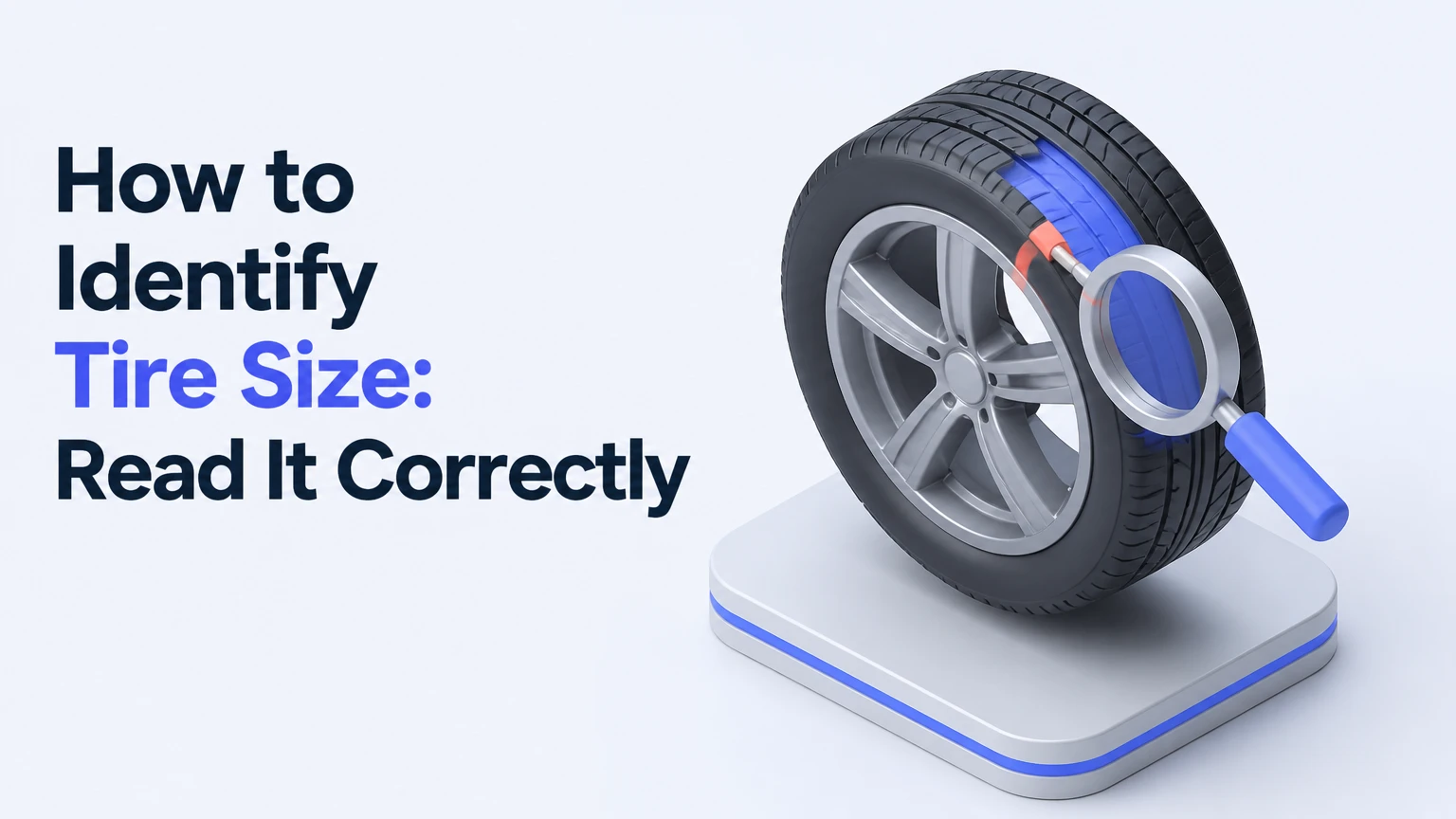
To identify tire size, read the alphanumeric code molded into the tire sidewall, then verify it against the vehicle manufacturer’s tire placard or owner’s manual. In a marking such as P225/65R17 102H, the code specifies service type, width, aspect ratio, construction, wheel diameter, load index, and speed rating.
Key Facts at a Glance
- The vehicle tire placard is the primary reference for the manufacturer-approved original-equipment size and cold inflation pressure.
- In P225/65R17, 225 is the section width in millimeters, 65 is the aspect ratio, and 17 is the wheel diameter in inches.
- The tire’s wheel diameter must match the rim diameter exactly; a 17-inch tire cannot fit a 16-inch or 16.5-inch rim.
- Load index identifies carrying capacity, while speed rating identifies sustained speed capability under specified conditions.
- The number on an existing tire may describe a previous owner’s modification rather than the correct factory fitment.
- Tire size and inflation pressure are separate specifications. Never use the sidewall maximum pressure as the normal vehicle pressure.
What Is Tire Size?
Tire size is a standardized description of a tire’s dimensions and service capability. The complete marking can identify the tire category, nominal width, sidewall proportion, internal construction, wheel diameter, load capacity, and speed category.
A common passenger-car example is P225/65R17 102H. The first portion, P225/65R17, describes the physical size and construction. The final portion, 102H, gives the tire’s load index and speed rating. Some tires also carry separate markings for mud and snow classification, run-flat construction, reinforced load capacity, or commercial application.
The marking is nominal rather than a guarantee of exact measured dimensions. A 225-millimeter tire can measure somewhat differently across manufacturers because approved measuring rims, tread designs, and casing profiles vary. That difference matters when checking suspension, fender, and wheel clearance.
What Does 225/65R17 Mean?
225/65R17 means a nominal 225-millimeter section width, a sidewall height equal to 65% of that width, radial construction, and a 17-inch wheel diameter. The calculated sidewall height is 146.25 millimeters, or approximately 5.76 inches.
| Marking | Meaning | Example value |
|---|---|---|
| P | Passenger service type | Passenger vehicle |
| 225 | Section width | 225 mm |
| 65 | Aspect ratio | 65% |
| R | Internal construction | Radial |
| 17 | Wheel diameter | 17 in |
| 102 | Load index | 1,874 lb, 850 kg |
| H | Speed rating | 130 mph, 210 km/h |
The calculated overall diameter is approximately 28.5 inches:
Overall diameter = wheel diameter + 2 × sidewall height
For this example:
17 + 2 × (225 × 0.65 ÷ 25.4) = approximately 28.5 inches
That calculation helps compare replacement sizes, but it does not prove that a new tire fits the vehicle. Wheel width, offset, suspension clearance, brake clearance, axle load, and manufacturer restrictions still require verification.
How to Identify Tire Size in Four Steps
The most reliable process takes about 5-10 minutes and requires a flashlight, a phone camera, and the vehicle’s tire placard or manual. Success depends more on verifying the factory specification than on simply copying the largest lettering from the current tire.
Before You Start
| Requirement | Typical specification |
|---|---|
| Time | 5-10 minutes |
| Tools | Flashlight, phone camera, vehicle manual |
| Vehicle information | Make, model, year, trim, drivetrain |
| Primary reference | Driver-door tire placard |
| Secondary reference | Owner’s manual or manufacturer fitment database |
| Professional help | Tire retailer or dealership if markings conflict |
Park on level ground with the steering wheel straight. Turn the front wheels outward only when necessary to expose the inner sidewall, and do not crawl beneath a vehicle supported only by a jack.
Step 1: Find the Vehicle Tire Placard
Open the driver’s door and inspect the door jamb, door edge, or B-pillar for a printed label. The label commonly lists front and rear tire sizes, spare-tire information, recommended cold inflation pressures, seating capacity, and maximum vehicle load.
If the label is missing, check the glove-box door, fuel-filler door, center console, owner’s manual, or an official manufacturer database using the vehicle identification number. A VIN lookup is especially useful when the vehicle has multiple trims, wheel packages, or front and rear staggered sizes.
You will know Step 1 worked when you have recorded every listed tire size, including separate front and rear specifications.
Common mistake: using a generic size lookup without selecting the exact trim and drivetrain. A 2020 vehicle may use different tires for a base model, sport package, hybrid, or all-wheel-drive version.
Step 2: Read the Existing Tire Sidewall
Inspect both visible sidewalls of each tire. The full size may appear only on the outward-facing side, especially when a tire has asymmetric lettering or a directional design. Look for a large code containing a slash and an R, such as 215/60R16 or LT245/75R16.
Record the complete marking, not only the dimensions. A tire marked 225/65R17 102H differs in service specification from one marked 225/65R17 99T, even though both have the same nominal dimensions.
You will know Step 2 worked when you have photographed the full code and can distinguish it from the brand name, model name, DOT identification, maximum-pressure statement, and traction grades.
Common mistake: reading the DOT code as the tire size. A DOT string identifies manufacturing and traceability information; its final four digits indicate the production week and year, not tire dimensions.
Step 3: Compare the Placard and Sidewall
Compare the sidewall marking with the vehicle placard character by character. Check service type, width, aspect ratio, construction, rim diameter, load index, and speed rating.
A mismatch does not automatically mean the tire is unsafe, because a vehicle may have an approved alternative size or a previous wheel conversion. It does mean that copying the current tire without checking the placard is unreliable.
You will know Step 3 worked when the current tire matches an approved vehicle size or you have identified a documented modification with verified load and clearance specifications.
Common mistake: comparing only 225/65R17 and ignoring 102H, XL, RF, or LT markings. The omitted suffixes can change load capacity, pressure requirements, handling, and vehicle compatibility.
Step 4: Verify Fitment and Service Specifications
Before purchasing, confirm that the replacement tire matches or exceeds the placard’s minimum load index and speed rating. Verify whether the vehicle requires run-flat tires, extra-load construction, a specific self-sealing design, or a staggered front and rear arrangement.
Check the tire’s production date when buying older inventory. The last four digits of the DOT code use a week-year format, so 3425 means the 34th week of 2025. The date does not replace an inspection for cracking, storage damage, or improper aging.
You will know Step 4 worked when the replacement tire matches the approved size, load, speed, construction, seasonal category, and wheel requirements.
Common mistake: setting pressure to the maximum molded on the sidewall. The vehicle placard specifies the recommended cold pressure for the vehicle’s axle loads and handling calibration.
What Do the Letters and Numbers Mean?
Tire markings combine dimensions with service attributes, but the same position does not always carry the same meaning across every sizing system. The following decoding sequence applies to common passenger and light-truck metric tires.
Service Type: P, LT, ST, or No Prefix
| Prefix | Application | Main limitation |
|---|---|---|
| P | Passenger cars, minivans, crossovers | Not automatically suitable for heavy truck loads |
| LT | Light trucks, some vans, towing applications | Requires correct load range and pressure |
| ST | Boat, utility, and travel trailers | Not designed for passenger vehicles |
| No prefix | Euro-Metric passenger tire | Load capacity follows a different designation system |
| T | Temporary spare in some markets | Restricted speed, distance, and operating conditions |
A P-metric tire is designed around passenger-vehicle requirements. An LT-metric tire is intended for light-truck service, but the LT prefix alone does not tell you whether it is Load Range C, D, or E. A Load Range E tire commonly supports higher inflation pressure and heavier loads than a passenger tire, although the exact capacity depends on size and manufacturer data.
An ST tire belongs on a trailer, where its casing and operating assumptions differ from those of a steering or drive tire. Trailer tire construction does not make it an appropriate substitute for a car tire.
Width and Aspect Ratio
The first three-digit number is the nominal section width in millimeters. The measurement includes the sidewalls at the specified measuring rim and inflation condition, not only the tread width.
The aspect-ratio number expresses sidewall height as a percentage of section width. A 225/65 tire has a nominal sidewall height of 146.25 millimeters, while a 225/45 tire has a 101.25-millimeter sidewall.
| Size | Nominal width | Sidewall height | Approximate diameter on listed wheel |
|---|---|---|---|
| 205/55R16 | 205 mm | 112.75 mm | 24.9 in |
| 225/65R17 | 225 mm | 146.25 mm | 28.5 in |
| 235/45R18 | 235 mm | 105.75 mm | 26.3 in |
| 245/75R16 | 245 mm | 183.75 mm | 30.5 in |
Lower aspect ratios usually reduce sidewall flex and improve steering response, but they also provide less impact absorption and less rim protection. Higher profiles generally offer more sidewall compliance, yet a taller tire can alter clearance, gearing, and speedometer accuracy.
Construction and Wheel Diameter
The letter R identifies radial construction, in which the body cords run approximately perpendicular to the direction of travel. Radial tires dominate modern road vehicles because they combine casing durability, consistent contact, and lower rolling resistance.
The wheel-diameter number is measured in inches and must match the rim exactly. A tire marked R17 requires a 17-inch rim. The tire cannot safely stretch onto a 16-inch rim, and a 17-inch tire cannot seat on a 16.5-inch wheel.
Some older or specialist tires use D for diagonal or bias-ply construction. The designation ZR historically indicated a high-speed radial tire, but modern speed capability is determined more precisely by the complete tire marking and manufacturer specifications than by ZR alone.
Load Index and Speed Rating
The load index is a numerical code linked to a standardized capacity chart. For example, load index 102 corresponds to 1,874 pounds, or 850 kilograms, per tire under the applicable test conditions. The tire must be operated at the pressure and conditions used for that rating.
| Rating | Approximate maximum speed | Typical interpretation |
|---|---|---|
| S | 112 mph, 180 km/h | Common passenger application |
| T | 118 mph, 190 km/h | Family cars and vans |
| H | 130 mph, 210 km/h | Many sedans and crossovers |
| V | 149 mph, 240 km/h | Performance-oriented fitments |
| W | 168 mph, 270 km/h | High-performance applications |
Speed ratings are not recommendations to drive at those speeds. They describe a laboratory capability under specified load, pressure, and test conditions. A lower rating can change heat resistance and handling, even when the tire’s width and diameter appear correct.
Which Tire Sizing System Is on Your Vehicle?
Passenger metric, LT-metric, and flotation sizing systems use different measurement conventions. Identifying the system prevents errors such as treating 33×12.50R15LT as if it were a metric width and aspect ratio.
| Sizing system | Example | Dimensions represented | Common application |
|---|---|---|---|
| P-metric | P225/65R17 | Width, aspect ratio, wheel diameter | Cars and crossovers |
| Euro-Metric | 225/65R17 | Width, aspect ratio, wheel diameter | European passenger vehicles |
| LT-metric | LT245/75R16 | Width, aspect ratio, wheel diameter | Pickups and work vans |
| Flotation | 33×12.50R15LT | Overall diameter, width, wheel diameter | Modified 4×4 vehicles |
A flotation tire’s first number is its approximate overall diameter in inches, and the second number is its approximate section width in inches. A 33×12.50R15LT tire is about 33 inches tall, about 12.5 inches wide, and designed for a 15-inch wheel, although actual measured dimensions vary by brand and rim width.
Flotation sizing is common on lifted trucks and off-road vehicles. It is not automatically an approved replacement for an LT-metric tire because the larger diameter can reduce fender clearance, change final-drive behavior, interfere with steering components, and alter the load available at the axle.
Can You Use a Different Tire Size?
You can use a different tire size only when the vehicle manufacturer or a qualified fitment professional confirms compatible diameter, load, speed, wheel width, clearance, and drivetrain requirements. Matching the original outside diameter alone is insufficient.
Plus-sizing usually pairs a larger wheel with a lower-profile tire to keep overall diameter near the original. For example, replacing 225/65R17 with a size on an 18-inch wheel may preserve diameter, but the new tire still needs an approved rim width and adequate load capacity.
For all-wheel-drive vehicles, the rolling circumference difference across tires should remain within the vehicle manufacturer’s tolerance. Some systems require tires to remain within a very narrow range, sometimes around 1% to 2%, because mismatched rolling distances force the center coupling or differential to compensate continuously.
A larger tire can also reduce acceleration, lower effective gearing, increase unsprung mass, and make the speedometer read differently. A smaller tire can increase engine speed at highway velocity and reduce ground clearance.
How Do You Check Tire and Wheel Compatibility?
Tire size identifies the tire, but wheel compatibility also requires rim width, bolt pattern, offset, center bore, brake clearance, and load rating. A tire shop should verify the complete wheel-and-tire assembly before mounting a non-original combination.
| Compatibility item | What to verify | Example consequence of mismatch |
|---|---|---|
| Rim diameter | Tire R17 with 17-inch rim | Bead cannot seat on the wrong diameter |
| Rim width | Manufacturer-approved width range | Irregular wear or unstable bead seating |
| Wheel offset | Vehicle-specific millimeter value | Inner suspension or outer fender contact |
| Load rating | Wheel capacity above axle demand | Wheel fatigue or structural failure |
| Brake clearance | Caliper-to-spoke distance | Wheel cannot rotate freely |
| Bolt pattern | Number of studs and pitch circle | Wheel will not mount correctly |
A tire that is too wide for a rim can distort the tread profile and place excessive stress on the bead. A tire that is too narrow can reduce lateral stability and create uneven contact. The tire manufacturer publishes approved rim-width ranges for each size.
Inspect clearance at full steering lock, full suspension compression, and normal ride height. A combination that clears while parked can contact a liner or control arm during cornering or suspension movement.
Common Mistakes and How to Fix Them
Copying the Existing Tire Without Checking the Placard
A previous owner may have installed a different wheel package, winter set, or incorrectly sized tire. Fix the problem by treating the door placard, owner’s manual, and official VIN-based fitment information as the reference hierarchy.
Confusing Tire Size With Tire Pressure
The sidewall maximum pressure is not the vehicle’s recommended operating pressure. Inflate tires when cold according to the placard, then use a calibrated gauge rather than relying only on the TPMS warning light.
Ignoring Front and Rear Staggered Sizes
Performance vehicles may use different dimensions on the front and rear axles. Record each axle separately, and never rotate tires according to a generic pattern that conflicts with directional tread or staggered fitment.
Installing a Lower Load Index
A lower load index can reduce the tire’s carrying capacity and increase heat generation under payload. Select a tire with the vehicle’s specified index or a higher approved value, while confirming that the replacement does not create a wheel, pressure, or clearance conflict.
Mixing Tire Sizes on an AWD Vehicle
AWD systems can react poorly to different rolling circumferences. Replace tires in axle pairs or as a complete set when required, and ask the vehicle manufacturer about permissible tread-depth differences before fitting one new tire.
Treating 3PMSF as a Tire Size Marking
The Three-Peak Mountain Snowflake symbol identifies a tire that meets a severe-snow traction test. It does not indicate width, diameter, load, or fitment. A 3PMSF tire can still be the wrong size for the vehicle.
What If the Sidewall Marking Is Unclear?
When the sidewall is worn or hidden, use the door placard, owner’s manual, VIN lookup, purchase records, or a professional tire inspection instead of guessing from appearance. A flashlight held at a shallow angle can reveal molded characters, but missing text should not be reconstructed from memory.
Photograph every visible marking and inspect the opposite sidewall, since manufacturers sometimes place the complete size on only one side. If the current size conflicts with the placard, do not assume the current tire proves compatibility.
Older vehicles may use unusual metric wheel diameters, such as 390 millimeters, which are not interchangeable with conventional inch-based rims. Some classic vehicles also use bias-ply or tube-type designs that require specialist parts and installation procedures.
How Much Does Tire-Size Identification Cost?
Identifying tire size is usually free when the placard and sidewall are readable. A tire retailer may verify size and wheel fitment at no charge, while professional mounting and balancing typically cost about $20-$50 per tire, depending on region, tire type, disposal fees, and service package.
| Service or purchase | Typical cost | Typical time |
|---|---|---|
| Sidewall and placard check | $0 | 5-10 minutes |
| Tire-store fitment verification | $0-$30 | 10-20 minutes |
| Mounting and balancing | $20-$50 per tire | 45-90 minutes for four |
| Standard passenger tire | $80-$160 each | Same day when stocked |
| Large or specialty tire | $180-$450 or more each | 1-3 business days if ordered |
Prices vary substantially by country, tire brand, wheel diameter, run-flat construction, seasonal demand, and disposal requirements. The size code affects availability, but tread category and load range can create a larger price difference than a one-inch change in wheel diameter.
Expert Rules for Safe Identification
First, photograph the placard before photographing the tire. The placard captures the vehicle’s intended configuration, whereas the current tire may represent an undocumented modification.
Second, record the full sidewall string, including XL, RF, run-flat, LT, load range, and speed symbols. Two tires with identical width and diameter can behave differently when their load and construction specifications differ.
Third, calculate overall diameter only as a screening tool. A mathematically similar diameter does not confirm brake clearance, wheel width, axle capacity, steering clearance, TPMS compatibility, or legal compliance.
Fourth, replace an entire axle pair with matching size, construction, and tread category. On AWD vehicles, follow the manufacturer’s tread-depth and circumference limits instead of relying on a generic tire-shop rule.
Frequently Asked Questions
Can I identify tire size from the VIN?
A VIN does not usually encode the complete current tire size in a readable position, but an authorized dealer or manufacturer database can associate the VIN with the original trim and factory wheel package. Verify the result against the door placard because replacement wheels, market differences, and later service changes may not appear in the VIN record.
Does tire size affect TPMS?
Tire size does not usually determine the TPMS sensor’s pressure threshold, but changing size can affect the vehicle’s recommended pressure, rolling circumference, and indirect TPMS calibration. Direct sensors remain mounted inside the wheel, while indirect systems infer pressure changes through wheel-speed data and may require a reset after installation.
How do I identify the size of a trailer tire?
Read the trailer sidewall for an ST designation, such as ST205/75R15, and confirm the load range, load index, speed rating, and cold inflation pressure. Trailer tires should have adequate capacity for the loaded axle, including cargo and trailer structure, and ST tires should not be substituted for passenger-car tires.
Can I replace only one tire?
Replacing one tire is acceptable only when the remaining tires have compatible size, construction, tread pattern, and similar tread depth, and when the vehicle manufacturer permits the difference. Many AWD vehicles require closely matched rolling circumference, so replacing an entire set or axle pair may be safer.
Does a wider tire always improve handling?
A wider tire does not always improve handling because grip also depends on compound, tread design, temperature, inflation, wheel width, suspension geometry, and road surface. Excess width can increase hydroplaning risk, steering effort, tramlining, fuel consumption, and contact with suspension or bodywork.
What is the difference between tire size and wheel size?
Tire size describes the rubber assembly’s dimensions and service ratings, while wheel size usually refers to rim diameter and may also include rim width, offset, bolt pattern, and center bore. A 225/65R17 tire fits a 17-inch rim, but its complete wheel fitment requires more than the 17-inch measurement.
The Bottom Line
To identify tire size, find the complete code on the sidewall, decode its width, aspect ratio, construction, wheel diameter, load index, and speed rating, then compare every element with the driver-door placard. Confirm wheel width, clearance, pressure, seasonal category, and drivetrain requirements before ordering. The fastest accurate method is not copying the existing tire; it is verifying the tire against the vehicle’s official specification. Knowing how to identify tire size protects fitment, handling, load capacity, and drivetrain durability.