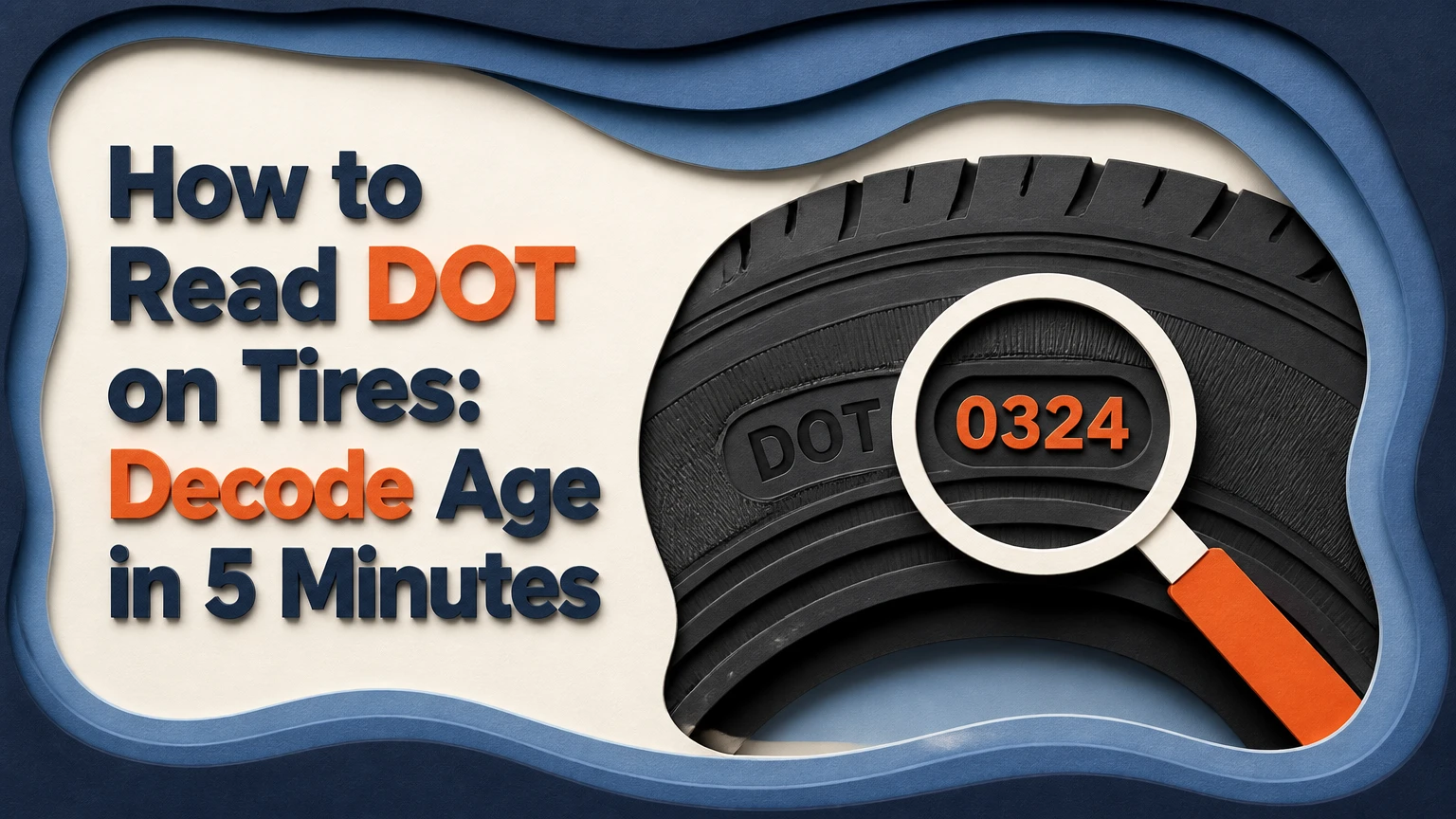
To read the DOT marking on a tire, locate the raised letters “DOT,” find the final four digits of the complete Tire Identification Number, and interpret the first two digits as the production week and the last two as the production year. For example, 2423 means the tire was made in week 24 of 2023.
Key Facts at a Glance
The last four digits of a modern DOT code identify the tire’s manufacturing week and year.
A code ending in 2423 means week 24 of 2023, not June 24, 2023.
The complete date code may appear on only one sidewall, often facing the vehicle.
DOT identification does not prove that a tire is currently safe; condition, inflation, damage, storage, and age also matter.
A three-digit date code indicates a tire manufactured before 2000 and should not be used on public roads.
Tire makers commonly recommend annual professional inspections after five or six years and replacement by ten years, but manufacturer guidance controls.
What Does the DOT Code Mean?
The DOT code is the U.S. tire identification marking required under the Department of Transportation framework. The marking identifies the tire’s production facility and manufacturing information, allowing regulators and manufacturers to trace products during recalls, investigations, and warranty claims.
The National Highway Traffic Safety Administration, or NHTSA, distinguishes tire age guidance from a single federal expiration rule. NHTSA states, “NHTSA does not have a specific tire aging recommendation,” so the vehicle or tire manufacturer’s instructions remain important. A DOT code identifies when a tire was produced, but it does not certify that an old, cracked, underinflated, or damaged tire is roadworthy.
What information does the code contain?
A complete modern Tire Identification Number can contain up to 13 characters. The characters before the date block mainly support manufacturing and regulatory traceability, while the final four digits provide the most useful information for a driver.
| Code section | Typical length | What it identifies | Consumer use |
|---|---|---|---|
| DOT prefix | 3 letters | DOT-regulated tire identification marking | Confirms the marking begins with the required identifier |
| Plant code | 2-3 characters | Manufacturing facility | Useful for recalls and traceability |
| Size code | 2 characters | Manufacturer’s internal size reference | Not a replacement for the sidewall size |
| Manufacturer code | 3-4 characters | Construction or product attributes | Mainly useful to the manufacturer |
| Date code | 4 digits | Production week and year | Determines manufacturing age |
The DOT code is not the same as the tire size, load index, speed rating, or UTQG grade. For example, P225/65R17 102H describes size, construction, load capacity, and speed category, while DOT 1A2B CDEF 2423 identifies production information.
Where Can You Find the Complete DOT Code?
The complete DOT code can appear on either tire sidewall, but the four-digit date portion is commonly molded on only one side. The outward-facing side may show “DOT” followed by plant and tracking characters, while the full code is hidden against the wheel or suspension.
Start with the sidewall facing you. Search for raised letters approximately 1-2 inches high, then follow the characters toward the final group of four digits. If the visible code ends with letters rather than four numbers, inspect the opposite side.
What tools help you read it?
Most drivers need only a flashlight, a phone camera, and a cloth. A vehicle jack is not a substitute for safe lifting equipment, so never crawl under a vehicle supported only by an emergency jack.
| Situation | Useful method | Typical time | Main limitation |
|---|---|---|---|
| Passenger-car outer sidewall | Flashlight and cloth | 2-5 minutes | Date code may face inward |
| Inward-facing sidewall | Phone camera with flash | 5-15 minutes | Suspension and brake parts can obstruct the view |
| Spare tire under a vehicle | Flashlight and camera | 10-20 minutes | Dirt, corrosion, and limited access reduce visibility |
| Trailer or caravan tire | Wheel-by-wheel inspection | 10-20 minutes | Hidden inner tires may require removal |
| Motorcycle tire | Turn handlebars or roll the motorcycle safely | 5-10 minutes | Curved sidewalls distort small characters |
Clean the sidewall with water and a soft cloth. Avoid aggressive wire brushing, solvents, or scraping, because those actions can remove molded characters and damage the rubber surface.
How Do You Read DOT on Tires?
Reading DOT on tires takes five practical steps: identify the DOT marking, find the complete code, isolate the last four digits, decode the week and year, and compare the result with the tire’s condition and manufacturer guidance. The date code is useful only when interpreted alongside physical inspection.
Step 1: Park safely and inspect every tire
Park on a level surface, engage the parking brake, and turn the steering wheel to expose the front sidewalls. Inspect all four road tires and the spare because tires on the same vehicle may have different production dates.
Look for cuts, bulges, punctures, exposed cords, uneven wear, and cracking between tread blocks. Do not drive on a tire with a sidewall bulge, exposed cord, or suspected belt separation merely because its DOT date is recent.
Success checkpoint: You can see the sidewall clearly without placing your body beneath an unsupported vehicle.
Common mistake: Checking only the tire with the easiest access and assuming the remaining tires share its date.
Step 2: Locate the letters DOT
Find the raised DOT prefix, then record every character that follows it. The full marking may be longer than the visible segment, and the date code may be separated from the other blocks by spacing or an oval-shaped molding area.
Do not confuse other sidewall markings with the DOT number. The letter E inside a circle, for example, is a European type-approval mark, while M+S indicates mud-and-snow classification and 3PMSF identifies the severe-snow symbol.
Success checkpoint: The marking begins with DOT and ends with either four digits or an older three-digit date code.
Common mistake: Treating the tire size, serial-like barcode, or E-mark as the DOT identifier.
Step 3: Read the four-digit date code
Read the final four digits in pairs. The first pair represents the production week, from 01 through 52, and the second pair represents the year.
| Date code | Production week | Production year | Approximate calendar period |
|---|---|---|---|
| 0819 | 08 | 2019 | February 2019 |
| 2423 | 24 | 2023 | June 2023 |
| 5022 | 50 | 2022 | December 2022 |
| 0325 | 03 | 2025 | January 2025 |
A code of 2423 means the tire was manufactured during the 24th production week of 2023. The code does not identify the exact day, and production weeks do not always align perfectly with calendar months.
Success checkpoint: You have written the final four digits separately from the earlier plant and tracking characters.
Common mistake: Reading 2423 as a serial number, a June 24 date, or the 24th day of 2023.
Step 4: Calculate the tire’s approximate age
Compare the production week and year with the current date. A tire made in week 24 of 2023 is approximately two years old in mid-2025, but the exact age changes by several months depending on the inspection date.
Manufacturing age begins when the tire is produced, not when it is mounted, sold, or first driven. A tire stored indoors may age more slowly than one exposed to heat and sunlight, but storage does not make a three-year-old tire chronologically new.
Success checkpoint: You have recorded the manufacturing date and the vehicle’s current inspection date.
Common mistake: Counting age from the purchase receipt instead of the DOT production week.
Step 5: Compare age with condition and manufacturer guidance
Use the DOT date as a screening value, then inspect inflation history, tread wear, cracking, repairs, vibration, and the vehicle manufacturer’s recommendations. Michelin recommends professional inspection every year after a tire reaches five years in service and replacement at ten years from manufacture, even if tread remains.
Many manufacturers publish shorter replacement guidance for particular vehicles, tire lines, climates, commercial applications, or storage conditions. A tire can require immediate replacement at four years if it has structural damage, while another may pass a visual inspection at six years but still need annual professional monitoring.
Success checkpoint: A tire professional has assessed any tire with cracking, bulges, vibration, unusual wear, or uncertain history.
Common mistake: Using a single age threshold as permission to ignore visible damage.
How Old Is Too Old for a Tire?
There is no single universal age at which every tire becomes illegal or instantly unsafe, but ten years from the manufacturing date is a widely cited maximum replacement limit from several tire manufacturers. Annual professional inspection commonly begins at five or six years, and visible damage can make a much younger tire unsafe.
The British Tyre Manufacturers’ Association and major manufacturers have published age-related guidance, but recommendations differ by brand and application. Check the tire maker’s technical documents first, then apply the more conservative instruction when a vehicle manufacturer gives a different limit.
What does the age range mean in practice?
| Tire age from manufacture | Recommended action | Why it matters |
|---|---|---|
| 0-3 years | Inspect normally and verify storage history | Age is usually a secondary concern if condition is sound |
| 4-5 years | Inspect cracking, pressure retention, and wear closely | Heat, ozone, and underinflation may accelerate aging |
| 6-9 years | Arrange annual professional inspection | Internal degradation can progress without dramatic tread loss |
| 10 years or more | Replace, regardless of remaining tread | Manufacturer maximum guidance commonly applies |
| Any age with bulge or exposed cord | Remove from service immediately | Structural damage can cause sudden failure |
A driver should not wait for ten years if the tire loses pressure repeatedly, has deep circumferential cracks, shows belt separation, or develops a sidewall bulge. Tire age is one risk factor, not a safety pass.
Why Is Deep Tread Not Enough?
Deep tread does not prove that a tire is safe because the rubber, adhesives, and reinforcing materials can deteriorate independently of tread depth. Oxygen, ozone, ultraviolet exposure, heat cycles, underinflation, and long-term loading can weaken a tire that still appears unworn.
A tread-depth gauge measures remaining groove depth, not casing integrity. NHTSA’s tire-safety guidance also tells consumers to inspect tire pressure, tread, damage, and recalls rather than relying on one measurement.
Which warning signs require replacement?
- Sidewall bulges or bubbles
- Cracks that extend into grooves or expose fabric
- Repeated air loss without a repairable puncture
- Tread separation, lifting, or a raised circumferential ridge
- Exposed steel or textile cords
- Severe uneven wear from alignment, suspension, or inflation problems
- Persistent vibration after balancing
- A tire that has been driven while severely underinflated
- An irreparable puncture in the sidewall or shoulder
A surface haze or shallow weather checking may not automatically require removal, but cracking that a technician can feel with a probe deserves professional evaluation. Photographs can document a concern, but they cannot reliably determine internal belt adhesion.
How Do Old DOT Formats Differ?
A three-digit date code identifies a tire manufactured before 2000, and the tire should be removed from road use because its construction is more than two decades old. Some pre-2000 tires include a triangle symbol after the three digits to identify the 1990s; a three-digit code without the triangle generally indicates the 1980s or an earlier decade.
| Date marking | Meaning | Road-use decision | Practical interpretation |
|---|---|---|---|
| 129 with no triangle | Week 12, year ending in 9, pre-1990 format | Do not use | At least several decades old |
| 129 with triangle | Week 12 of 1999 | Do not use | Manufactured before the modern four-digit format |
| 3122 | Week 31 of 2022 | Assess condition and guidance | Modern date format |
| 0125 | Week 01 of 2025 | Assess condition and guidance | Modern date format |
Do not reinterpret a three-digit code as a recent date. The format changed around 2000 specifically to remove decade ambiguity. Vintage tires can be retained for display or concours purposes only when they are not used on public roads.
Should You Buy a New Tire With an Older Date?
A new tire with a production date one to three years old may be acceptable when it was stored correctly, sold with a full warranty, and inspected before installation. A tire retailer should be able to disclose the DOT date, storage conditions, and warranty terms before purchase.
The phrase “new tire” describes sales status, not manufacturing age. Tires stored in a cool, dry, dark warehouse generally face less environmental stress than tires stored outdoors, beside a heat source, or mounted and left under load.
What should you ask the retailer?
| Question | Acceptable evidence | Warning sign |
|---|---|---|
| What is the DOT date? | Photo or inspection of the actual tire | Seller gives only a verbal estimate |
| How was it stored? | Indoor, dry, temperature-controlled storage | Outdoor rack or direct sun |
| Does the warranty begin at purchase? | Written manufacturer warranty terms | Warranty clock already partly consumed |
| Can I inspect all four dates? | Matching or clearly disclosed production range | Dates are hidden until after installation |
| What happens if the date is unacceptable? | Written return or exchange policy | Final sale with no date disclosure |
A three-year-old tire is not automatically defective, but it provides less calendar life before age-based replacement guidance applies. Ask for a fresher production batch when the price difference is small and the tires will be stored before installation.
What Are the Most Common Reading Mistakes?
The most consequential mistake is locating only the partial DOT marking on the outward-facing sidewall. Other errors include confusing the production date with the installation date, assuming all tires match, and treating a legal compliance marking as a present-condition inspection.
Mistake 1: Looking at only one sidewall
Fix: Inspect the opposite sidewall or use a phone camera through the wheel opening. A partial code ending in letters is not evidence that the tire has no date.
Mistake 2: Reading the wrong four digits
Fix: Start at the DOT prefix and follow the complete sequence to its final four digits. Nearby numbers may describe size, load, speed, or other product information.
Mistake 3: Assuming all four tires were made together
Fix: Record each tire separately. Replacement tires, rotation schedules, and inventory availability commonly create date differences across one vehicle.
Mistake 4: Ignoring the spare
Fix: Inspect the spare at every major service interval. A full-size spare can age in a hot trunk or beneath a vehicle for years without accumulating mileage.
Mistake 5: Cleaning the code with harsh chemicals
Fix: Use water, mild soap, and a soft cloth. Solvents and abrasive tools can fade or physically remove the molded characters.
Mistake 6: Treating a recent date as a clean bill of health
Fix: Combine the date with pressure, tread, damage, alignment, repair history, and recall checks. A new tire can be damaged during mounting or by a road impact.
How Much Does a DOT Date Inspection Cost?
A DOT date check costs nothing when performed by the vehicle owner, while a tire-shop inspection commonly ranges from free to about $25 depending on location and whether the technician performs a broader safety assessment. Replacement cost depends on tire size, vehicle class, brand, and performance category.
| Service or purchase | Typical cost range | Typical time | What it includes |
|---|---|---|---|
| Owner visual date check | $0 | 5-20 minutes | Sidewall inspection and date recording |
| Retailer date and condition check | $0-$25 | 10-30 minutes | Date, tread, pressure, and visible damage |
| Mount and balance, per tire | $20-$60 | 30-60 minutes | Removal, installation, balancing |
| Passenger tire replacement | $80-$300 per tire | 1-2 hours for four | Tire, mounting, balancing before taxes |
| SUV, truck, or specialty tire | $150-$500 or more per tire | 1-3 hours for four | Larger size, load range, or specialty construction |
Prices vary sharply by country and market. Bangladesh, for example, has different tire sizes, import costs, taxes, and retail pricing than the United States, so local quotes are more reliable than converted online estimates.
What Changes for Spares, Trailers, Motorcycles, and Used Cars?
The inspection method remains the same, but the risk pattern changes by application. Low-mileage tires often age from calendar time, while trailers, motorcycles, and spare tires may experience long storage, high loading, or unusual heat exposure.
Spare tires
Check the date, pressure, cracking, and valve condition. A compact temporary spare also has a speed restriction and inflation specification printed on its sidewall, so replacing it solely by matching the road tires can be incorrect.
Trailer tires
Trailer tires can suffer from long stationary periods, sun exposure, and load-related heat. Inspect the full sidewall and confirm the load range, maximum load, and inflation pressure before towing.
Motorcycle tires
Motorcycle tires have a smaller contact patch and may show age cracking near the rim or between tread grooves. Riders should follow the motorcycle and tire manufacturer’s replacement recommendations, especially after storage or prolonged exposure to heat.
Used cars
Check every tire before signing a purchase agreement. A vehicle with four mismatched dates, one tire from a different brand, or a spare older than the road tires may need immediate maintenance even when the tread appears deep.
What If the DOT Code Is Missing or Damaged?
A missing visible date code usually means the full Tire Identification Number is on the opposite sidewall, not that the tire lacks a manufacturing date. If both sides are unreadable, a tire professional may identify the marking from another section of the casing, but age cannot be confirmed reliably without a legible date.
Compare the other tires only as a clue, not as proof. Matching tires may come from the same production batch, but they may also have been purchased months apart or replaced individually.
Do not infer age from tread depth, brand generation, or vehicle purchase date. When the date is illegible and the tire’s history is unknown, replacement is the safer decision for a road-going vehicle, particularly if cracking or pressure loss is present.
Expert Rules for Using the DOT Date Correctly
The date code is a screening tool, not a condition certificate. A recent production week narrows one risk, but it says nothing about a nail puncture, impact damage, incorrect load rating, or prolonged underinflation.
The oldest tire often deserves the first inspection. On a used vehicle, the tire with the oldest date may be the spare or a replacement from a previous owner, and it can reveal deferred maintenance that the newest tire conceals.
Inflation history changes aging risk. Underinflation increases sidewall flex and heat generation, while overloading increases casing stress. Two tires with the same DOT date can therefore have very different service histories.
The tire manufacturer’s guidance outranks generic internet thresholds. Michelin, Bridgestone, Continental, Goodyear, Pirelli, and vehicle manufacturers may publish different inspection or replacement intervals because compounds, designs, climates, and applications differ.
Frequently Asked Questions
Does every tire have a DOT number?
Tires sold for use on public roads in the United States generally carry a DOT Tire Identification Number, although the marking may be incomplete on one sidewall. Tires made for specialty, racing, agricultural, or non-road applications can follow different marking requirements. The sidewall’s regulatory markings should be checked against the tire’s intended use.
Can I tell the tire’s exact manufacture date from the DOT code?
The DOT code identifies the production week and year, not the exact day. A code such as 2423 places production in week 24 of 2023, which is approximately June 2023. The code cannot establish the hour, day, storage history, installation date, or number of heat cycles.
Is a tire with 6/32-inch tread still safe if the DOT date is old?
A tire with 6/32-inch tread may still require replacement if age, cracking, impact damage, pressure loss, or manufacturer guidance indicates a problem. Tread depth measures usable groove material, while aging can affect the sidewall, belts, adhesives, and inner liner. A professional inspection is appropriate for older tires.
Can a tire shop install a tire made two years ago?
A retailer can usually install a two-year-old tire if the tire was stored properly, remains undamaged, and meets the vehicle’s specifications. Ask to see the DOT date and confirm warranty and return terms. The two years still count toward any manufacturer age recommendation, even if the tire was never mounted.
Does the DOT code show whether a tire is retreaded?
The DOT marking identifies a tire’s manufacturing information, but it does not by itself provide a complete retread history for every tire type. Commercial and retreaded tires can carry additional markings and documentation. Inspect the casing, retread indication, application label, and maintenance records rather than relying on the date code alone.
Should I replace all four tires when one is too old?
Replacing all four tires is not always necessary, but matching axle requirements, tread differences, drivetrain design, and manufacturer instructions matter. All-wheel-drive vehicles can be sensitive to rolling-circumference differences, while two-wheel-drive vehicles may permit more flexibility. A tire professional should evaluate the vehicle before mixing old and new tires.
The Bottom Line
To understand how to read DOT on tires, find the complete marking on both sidewalls, decode the final four digits as production week and year, and record every tire separately. Then evaluate age with tread, inflation, cracking, damage, storage, vehicle specifications, and the tire manufacturer’s guidance. A DOT date reveals manufacturing age, not current safety, so an older or damaged tire deserves professional inspection before driving.