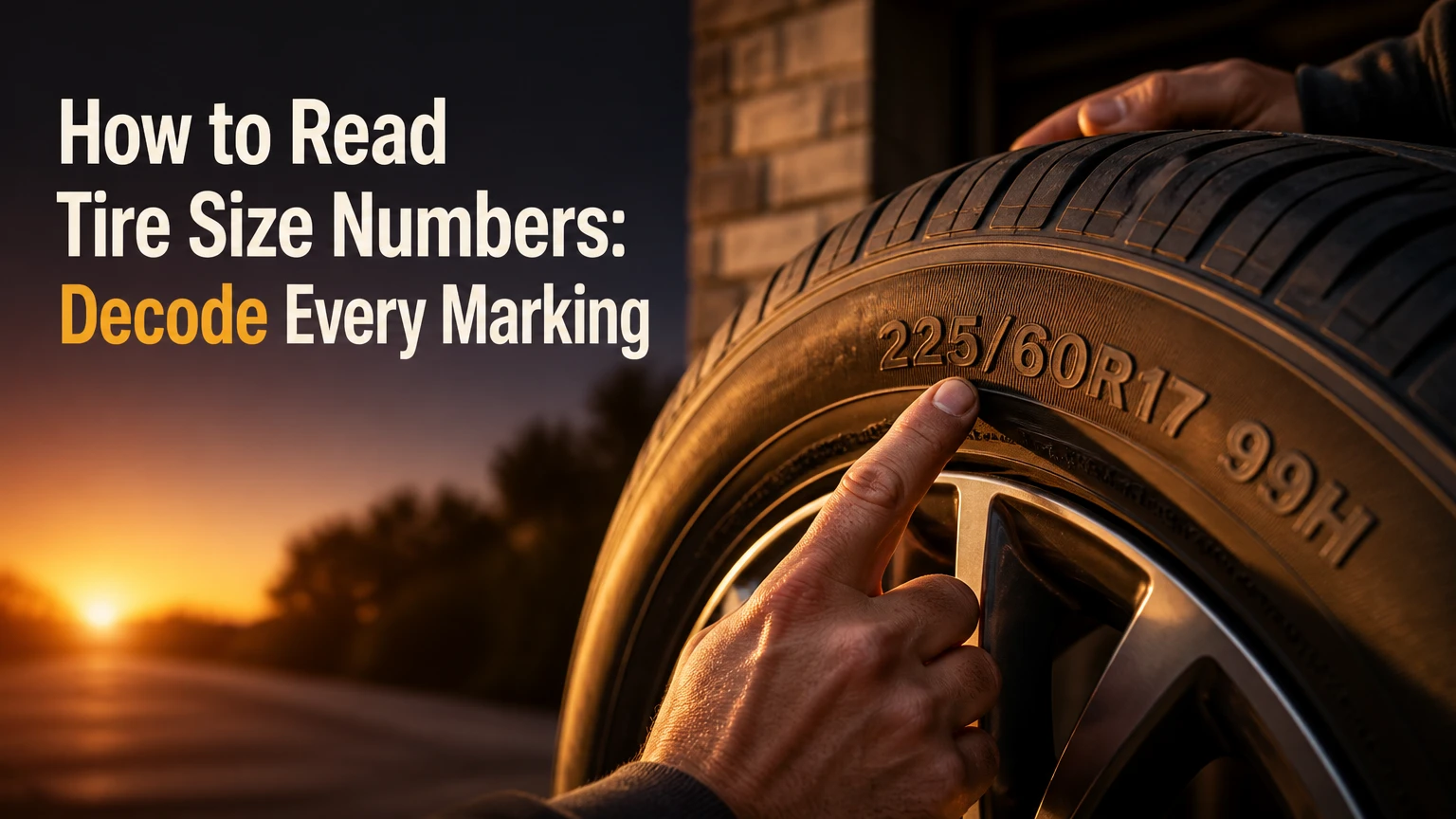
To read tire size numbers, separate the sidewall code into vehicle type, section width, aspect ratio, construction, wheel diameter, load index, and speed rating. For example, P215/65R15 95H describes a passenger tire that is 215 mm wide, has a 65% profile, uses radial construction, fits a 15-inch wheel, carries index 95, and has an H speed rating.
Key Facts at a Glance
215/65R15means 215 mm section width, a 65% aspect ratio, radial construction, and a 15-inch wheel diameter.- The 65 aspect ratio produces a sidewall about 139.75 mm high, calculated as 215 × 0.65.
- Load index 95 corresponds to 690 kg, or 1,521 lb, per tire under the applicable rating conditions.
- H speed rating means 130 mph, or 210 km/h, in standardized testing, not a recommended public-road speed.
- The driver-door tire placard and owner’s manual take priority over the size printed on an already-mounted tire.
- The final four digits of a DOT code identify manufacturing week and year, but the DOT code is not the tire-size code.
What Does P215/65R15 95H Mean?
The code P215/65R15 95H contains two related specifications: the physical tire size and its service description. The first group, P215/65R15, determines the tire’s basic geometry and wheel fitment; 95H identifies load capacity and speed category.
| Marking | Name | Meaning in the example |
|---|---|---|
| P | Type designation | Passenger-car construction category |
| 215 | Section width | 215 mm from sidewall to sidewall |
| 65 | Aspect ratio | Sidewall height equals 65% of section width |
| R | Construction | Radial internal cord arrangement |
| 15 | Wheel diameter | Fits a 15-inch wheel |
| 95 | Load index | 690 kg, or 1,521 lb, per tire |
| H | Speed rating | 130 mph, or 210 km/h, test category |
The code does not tell you every fitment requirement. A tire can have the correct nominal diameter yet fail because its approved rim width, load range, brake clearance, or wheel-well clearance is unsuitable. Tire width also describes section width under specified measurement conditions, not necessarily the visible tread width.
How do the numbers work mathematically?
A 215/65R15 tire has a calculated sidewall height of 139.75 mm and an approximate overall diameter of 660.5 mm, or 26.0 inches. The calculation is:
- Sidewall height:
215 × 0.65 = 139.75 mm - Two sidewalls:
139.75 × 2 = 279.5 mm - Wheel diameter:
15 × 25.4 = 381 mm - Overall diameter:
279.5 + 381 = 660.5 mm
The calculated diameter is useful when comparing alternate sizes, but manufacturers’ published dimensions can vary slightly because tread design, measuring rim, inflation pressure, and casing construction affect the final result.
Step 1: Find the Complete Tire Marking
Inspect both sidewalls, because the full service description may appear on only the outward-facing side. Clean mud or brake dust from the rubber and copy every character around the size, including XL, LT, C, RF, Run Flat, or a manufacturer-specific original-equipment marking.
A complete passenger-car marking may look like 225/50R17 94W XL. A light-truck flotation marking may look like LT285/70R17 121/118S, where the dual load index can specify different capacities for single and dual-wheel applications.
Record these details:
- The complete size code, including any leading letters.
- Load index or load range, such as
94,102,C, orE. - Speed rating, such as
H,V, orW. - Extra-load, reinforced, run-flat, winter, or original-equipment symbols.
- DOT identification code and four-digit manufacture date.
Success checkpoint: Your notes should reproduce the sidewall character for character, such as P225/60R17 99H.
Common mistake: Copying only 225/60R17 and losing the load, speed, or construction designation that the vehicle requires.
Step 2: Verify the Vehicle Specification
The driver-door jamb or B-pillar placard is the primary source for the vehicle’s approved tire size, cold inflation pressure, and maximum loading information. The owner’s manual may list additional front and rear sizes, temporary-spare specifications, or separate winter-wheel options.
Check the placard in this order:
- Identify the front tire size and cold pressure.
- Identify the rear tire size and cold pressure.
- Check whether front and rear sizes differ.
- Note the spare-tire size and pressure.
- Record the placard’s combined occupant-and-cargo load limit.
The National Highway Traffic Safety Administration requires a tire-information placard on applicable U.S. vehicles; the placard is more reliable than a retailer’s generic vehicle lookup because it reflects the exact trim, axle rating, and wheel package.
A vehicle can leave the factory with several approved sizes. A 2021 sedan, for example, might use 215/55R17 on one trim and 235/40R19 on another. The two sizes are not automatically interchangeable because wheel width, brake clearance, load index, and calibration may differ.
Success checkpoint: The replacement tire’s size, load capacity, and speed rating meet or exceed the placard specification.
Common mistake: Treating the tire currently on the vehicle as proof of the correct size after a previous owner installed an oversized or under-rated replacement.
Step 3: Decode Each Size Attribute
What does the first letter mean?
The first designation identifies the tire’s application category, but category names and load calculations differ by market. P indicates a passenger tire in the North American P-metric system, LT indicates a light-truck tire, and ST indicates a special-trailer tire intended for trailer axles.
| Designation | Typical application | Key limitation | Example |
|---|---|---|---|
| P | Cars, crossovers, light SUVs | Not intended for heavy commercial loading | P235/65R17 |
| No prefix | Euro-metric passenger vehicles | Load capacity may differ from P-metric equivalent | 205/55R16 |
| LT | Pickups, vans, hauling, towing | Usually heavier, stiffer, and less fuel-efficient | LT265/70R17 |
| ST | Boat, utility, and cargo trailers | Not for powered vehicle axles | ST205/75R15 |
ST tires should not be installed on a passenger vehicle, and an LT tire is not automatically an upgrade for a car. Light-truck tires may require different inflation pressures and can alter ride quality, braking behavior, and rolling resistance.
What does the width number mean?
The three-digit number is the nominal section width in millimeters, measured from the widest sidewall point to the opposite sidewall point when inflated on a specified measuring rim. A 215 tire is therefore nominally 215 mm wide, or about 8.46 inches.
Section width is not tread width. Two 215-mm tires from different manufacturers can have different tread widths, shoulder shapes, and sidewall bulges. The tire manufacturer’s technical data is necessary when clearance is tight.
A wider tire can increase dry-road contact area, but it may also follow road grooves, weigh more, reduce wet-weather resistance to hydroplaning in some conditions, and rub suspension or bodywork. Width alone does not predict grip.
What does the aspect ratio mean?
The two digits after the slash represent sidewall height as a percentage of section width. A 65 profile on a 215-mm tire has a nominal sidewall height of 139.75 mm, while a 45 profile on the same width would be 96.75 mm.
| Size | Width | Sidewall calculation | Approximate sidewall |
|---|---|---|---|
| 195/65R15 | 195 mm | 195 × 0.65 | 126.75 mm |
| 215/65R15 | 215 mm | 215 × 0.65 | 139.75 mm |
| 225/55R17 | 225 mm | 225 × 0.55 | 123.75 mm |
| 245/40R19 | 245 mm | 245 × 0.40 | 98.00 mm |
A higher aspect ratio generally provides more air volume and sidewall flex, which can improve impact comfort on damaged pavement. A lower profile generally sharpens steering response but leaves less sidewall protection against pothole damage and wheel impact.
What does R mean?
R means radial construction, in which the casing cords run substantially perpendicular to the direction of travel, with belts beneath the tread. Radial tires dominate modern passenger vehicles because their separated sidewall and tread functions support lower rolling resistance, stable high-speed behavior, and long tread life.
D means diagonal or bias construction, while B means belted bias construction. Those formats remain relevant for some vintage vehicles, agricultural equipment, specialty trailers, and off-road applications. A bias tire and radial tire with similar outside dimensions can behave very differently, so construction must match the vehicle and wheel specification.
What does the wheel diameter mean?
The number after the construction letter is the wheel’s bead-seat diameter in inches. R15 fits a 15-inch wheel, and R18 fits an 18-inch wheel; neither number describes wheel width.
A tire marked 225/50R17 requires a 17-inch wheel. A 17-inch tire cannot be safely mounted on a 17.5-inch or 18-inch wheel, even when the width appears similar. Wheel width, offset, bolt pattern, center bore, and brake clearance are separate fitment measurements.
Step 4: Check Load Index and Speed Rating
How much weight can the tire carry?
The load index is a numerical code for the maximum rated load per tire under specified conditions. Index 95 equals 690 kg, or 1,521 lb, per tire, but the correct replacement must also satisfy the vehicle placard’s axle and total-load requirements.
| Load index | Capacity per tire | Four-tire theoretical total |
|---|---|---|
| 91 | 615 kg, 1,356 lb | 2,460 kg, 5,424 lb |
| 95 | 690 kg, 1,521 lb | 2,760 kg, 6,084 lb |
| 98 | 750 kg, 1,653 lb | 3,000 kg, 6,614 lb |
| 102 | 850 kg, 1,874 lb | 3,400 kg, 7,496 lb |
| load index 110 | 1,060 kg, 2,337 lb | 4,240 kg, 9,348 lb |
The four-tire total is only a mathematical sum, not the vehicle’s legal payload. Suspension, axle ratings, wheel ratings, and the manufacturer’s gross vehicle weight rating can impose lower limits.
Never substitute a lower load index because the physical dimensions match. Extra Load or XL construction may increase capacity at a higher specified pressure, but XL does not authorize exceeding the vehicle’s gross axle weight rating.
What does the final letter mean?
The speed rating indicates the tire’s tested speed category under controlled conditions with the required load and inflation assumptions. It is not permission to drive at that speed, and it does not describe wet braking, cornering quality, or durability by itself.
| Rating | Maximum test speed | Common application |
|---|---|---|
| S | 180 km/h, 112 mph | Basic passenger tires |
| T | 190 km/h, 118 mph | Family cars and minivans |
| H | 210 km/h, 130 mph | Sedans and crossovers |
| V | 240 km/h, 149 mph | Performance-oriented cars |
| W | 270 km/h, 168 mph | High-performance vehicles |
| Y | 300 km/h, 186 mph | Very high-performance vehicles |
A ZR marking indicates a high-speed radial category, but the complete speed capability should be confirmed from the manufacturer’s service description because Z-rated tires can carry W or Y ratings. On vehicles with electronic stability control, use the manufacturer’s approved rating and avoid mixing ratings on the same axle.
Which Extra Markings Matter?
Extra sidewall symbols describe operating conditions, construction, or regulatory information rather than changing the basic tire dimensions. M+S means Mud and Snow, while the Three-Peak Mountain Snowflake, or 3PMSF, identifies a tire that has met a defined severe-snow traction test.
| Marking | Meaning | Practical consequence |
|---|---|---|
| M+S | Mud and Snow tread designation | Does not equal certified severe-winter traction |
| 3PMSF | Severe-snow performance symbol | Look for this for regular snow conditions |
| XL | Extra Load or reinforced construction | Higher load capability at specified pressure |
| SL | Standard Load | Standard passenger load construction |
| C, D, E | Light-truck load range | Confirm pressure and capacity from tire data |
| RF, RFT | Run-flat designation | Requires compatible vehicle and replacement procedure |
The DOT code is separate from the size code. Its final four digits show the manufacture week and year, so 1224 means the 12th week of 2024. Tire age should be evaluated with tread, cracking, repairs, storage, and service history; the date alone cannot establish safe remaining life.
Original-equipment markings such as MO, AO, N0, or a manufacturer-specific symbol can identify tires developed for Mercedes-Benz, Audi, Porsche, or another vehicle brand. An OE-marked tire is not automatically safer on another vehicle, and a non-OE tire is not automatically unsuitable if its approved specifications match.
Can I Change the Original Tire Size?
You can change tire size only when the replacement has adequate load capacity, compatible wheel fitment, sufficient clearance, and a closely controlled rolling diameter. The safest choices are sizes listed by the vehicle manufacturer or approved by a qualified tire and wheel specialist.
Use the door placard as the baseline. When comparing an alternative, calculate:
- Width difference in millimeters.
- Sidewall height and overall diameter.
- Revolutions per mile or kilometer.
- Wheel-width compatibility.
- Brake, strut, fender, and suspension clearance.
- TPMS compatibility and speedometer effect.
A common plus-sizing change replaces a smaller wheel with a larger wheel while preserving similar overall diameter. For example, moving from 215/60R16 to 225/50R17 changes width from 215 to 225 mm and reduces sidewall height, but the calculated diameters are approximately 664.4 mm and 656.8 mm, a difference of about 1.1%.
The vehicle’s anti-lock brakes, traction control, and speedometer are calibrated around rolling circumference. A substantial diameter change can create warning lights, inaccurate speed readings, altered shift points, or inconsistent all-wheel-drive behavior.
What Cost and Service Time Should I Expect?
Typical passenger-tire replacement costs range from $50-$100 per tire for basic compact-car sizes and $100-$200 per tire for mainstream sedan and SUV sizes, before premium brands, taxes, disposal, alignment, and specialty installation. A complete four-tire mount, balance, and installation commonly takes 45-60 minutes.
| Service item | Typical range | Variables that change the price |
|---|---|---|
| Compact passenger tire | $50-$100 each | Brand, season, size, retailer |
| Sedan or crossover tire | $100-$200 each | Load rating, warranty, tread compound |
| Light-truck tire | $150-$300 each | LT casing, load range, wheel diameter |
| Mount and balance | $15-$35 per tire | Run-flat and oversized tire labor |
| Four-wheel alignment | $80-$180 | Vehicle suspension and adjustment range |
| Tire disposal or shop fee | $2-$10 per tire | Local environmental rules |
Typical all-season passenger tires last approximately 40,000-70,000 miles when correctly inflated and rotated, but alignment, temperature, driving style, compound, road surface, and vehicle weight can move the result substantially. Inspect monthly and before long trips rather than relying only on a mileage estimate.
The U.S. Tire Manufacturers Association recommends checking tire pressure at least monthly and before long trips. Pressure should be measured cold and set to the vehicle placard value, not the maximum pressure molded into the tire sidewall.
Common Mistakes and How to Fix Them
Mistake 1: Using sidewall maximum pressure as the target
The sidewall maximum is a tire limit under stated conditions. The placard pressure is the vehicle manufacturer’s handling, load, comfort, and wear setting.
Fix: Set cold pressure to the placard value unless a manufacturer-approved loading instruction specifies otherwise.
Mistake 2: Matching dimensions but ignoring service description
A 235/65R17 tire with a lower load index may fit the wheel but fail the vehicle’s carrying requirement. The same error can occur with an insufficient speed rating.
Fix: Match or exceed the placard load index and speed rating, then confirm the tire’s actual load capacity at the intended pressure.
Mistake 3: Confusing wheel diameter with wheel width
R18 identifies an 18-inch bead-seat diameter. It does not mean the wheel is 8 inches wide, and it cannot confirm offset or brake clearance.
Fix: Obtain the wheel’s width, offset, bolt pattern, and center bore separately.
Mistake 4: Replacing only one tire on an AWD vehicle
Different tread depths and rolling circumferences can stress the center differential or electronically controlled clutch. The allowable difference varies by vehicle.
Fix: Follow the owner’s manual for tire replacement limits. Some vehicles require matching all four tires or shaving a replacement tire to a matching tread depth.
Mistake 5: Assuming M+S equals a winter tire
M+S is a tread designation and does not prove severe-snow performance. A 3PMSF symbol is the relevant severe-snow test marker.
Fix: Choose a 3PMSF tire for repeated snow use, and use dedicated winter tires when temperatures and road conditions justify them.
Mistake 6: Blaming tire size for every vibration
High-speed vibration can result from wheel imbalance, a bent wheel, radial-force variation, incorrect bead seating, or hub corrosion. A correct size does not guarantee a correctly installed assembly.
Fix: Return to the installer for balance verification, wheel inspection, bead inspection, and road-force measurement where available.
Which Tire Size Fits Different Situations?
Daily commuting
Use the placard size, standard-load construction, and the manufacturer’s approved all-season category. Prioritize tread warranty, wet braking, noise, and rolling resistance rather than choosing a wider tire solely for appearance.
Towing and heavy cargo
Use the placard-approved LT or higher-capacity option when the vehicle requires it, but do not install a higher-capacity tire to exceed the truck’s axle, hitch, or gross-weight ratings. Confirm cold pressure at the load carried.
Winter driving
A 3PMSF tire provides a better evidence-based starting point than an M+S-only tire. A smaller approved wheel with a taller sidewall can reduce wheel damage and improve snow clearance, but only use a downsized package listed or validated for the vehicle.
Modified or lifted vehicles
Flotation sizes such as 33x12.50R15LT describe approximate outside diameter, section width, construction, and wheel diameter rather than metric aspect ratio. Check steering lock, compression clearance, fender clearance, gearing, spare-tire location, and speedometer calibration before installation.
The Bottom Line
To understand how to read tire size numbers, decode the sidewall from left to right, then verify the complete service description against the driver-door placard. P215/65R15 95H identifies a passenger tire with 215-mm width, a 65% sidewall profile, radial construction, a 15-inch wheel requirement, 690-kg load capacity, and an H speed rating.
The safest replacement is not merely the same width and wheel diameter. It also matches the vehicle’s load requirement, speed category, inflation specification, construction, clearance, and drivetrain needs. Use the placard and owner’s manual first, the current tire second, and retailer fitment tools only as confirmation.
Frequently Asked Questions
Is the tire size printed on the door placard or the tire more accurate?
The door placard is the authoritative starting point for the vehicle’s factory specification because it corresponds to the exact vehicle configuration. The mounted tire may be an incorrect replacement, a winter option, or an aftermarket modification. Use the current tire to inspect wear and identify what is physically installed, not to override the placard.
Does a bigger tire make a car faster?
A larger outside-diameter tire can reduce engine rpm at a given road speed, but it may reduce acceleration because of greater mass and gearing change. A wider or heavier tire can also increase steering effort and fuel consumption. Any change should preserve approved clearance, load capacity, and rolling diameter.
Can I put a higher speed rating on my vehicle?
A higher speed rating is usually acceptable when the replacement also meets the required load index, size, wheel fitment, and pressure specification. The higher rating does not increase the vehicle’s safe operating speed, improve braking automatically, or permit exceeding posted speed limits.
What happens if the aspect ratio is wrong?
A different aspect ratio changes sidewall height and overall diameter when width and wheel diameter remain constant. The result can be altered speedometer readings, ground clearance, handling response, ride comfort, and fender clearance. Use only a manufacturer-approved alternative or a package calculated and checked by a qualified specialist.
How old can a tire be before replacement?
No single date applies to every tire because storage, climate, inflation, damage, and service history affect aging. Inspect for cracks, bulges, exposed cords, irregular wear, and repairs, then use the DOT date as part of the decision. Several manufacturers recommend replacement around six to ten years from manufacture, so follow the tire maker’s specific guidance.
Why do tire numbers use millimeters and inches together?
Passenger-tire sizing evolved as a mixed standard. Width and aspect ratio use metric measurements, while wheel bead-seat diameter remains in inches. Therefore, 215/65R15 combines 215 mm width and a 65% profile with a 15-inch wheel, rather than expressing one unified measurement system.