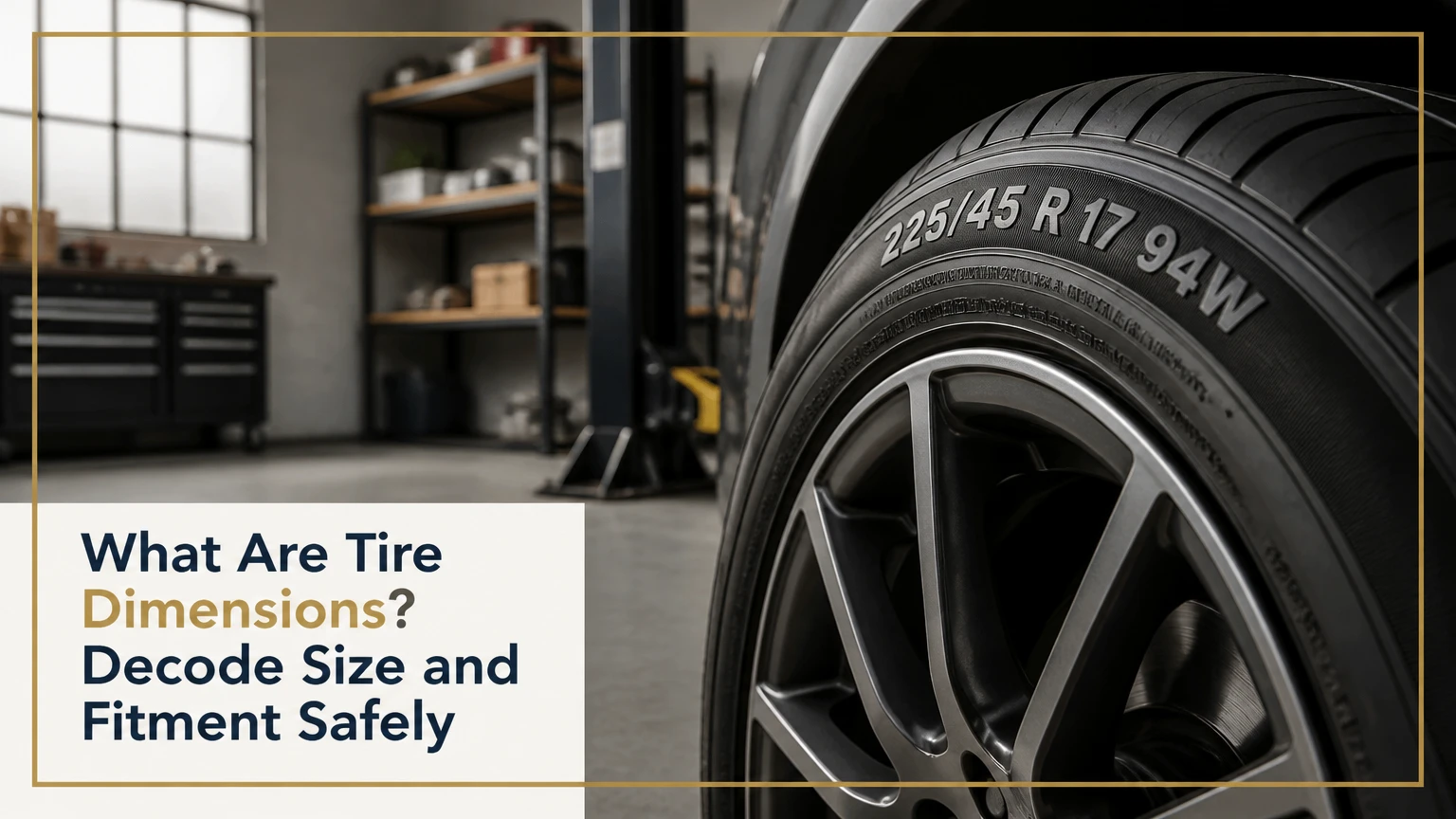
Tire dimensions are the alphanumeric measurements and ratings molded into a tire’s sidewall that define its width, sidewall height, construction, wheel diameter, load capacity, and speed capability. A code such as P215/65R15 95H identifies how the tire is built and which wheel and vehicle applications it can safely serve.
Tire Dimensions at a Glance
215/65R15means a 215-millimeter section width, a 65% aspect ratio, radial construction, and a 15-inch rim diameter.- The tire’s calculated overall diameter includes two sidewalls plus the wheel diameter.
- Load index
95permits 1,521 pounds, or 690 kilograms, per tire under the applicable testing conditions. - Speed rating
Hcorresponds to 130 mph, or 210 km/h, in standardized rating tables. - The driver-door placard and owner’s manual identify the vehicle’s approved tire sizes and pressures.
- Tire dimensions alone do not confirm fitment because wheel width, offset, brake clearance, suspension clearance, and load requirements also matter.
What Are Tire Dimensions?
Tire dimensions are the standardized sidewall measurements and performance codes used to match a tire with a wheel and vehicle. The principal dimensions are section width, aspect ratio, construction type, and rim diameter, while load index and speed rating describe operating limits rather than physical size.
The code is not a single measurement. It combines physical geometry with service classification. A tire can have the correct diameter yet remain unsuitable because its load index is too low, its sidewalls are intended for a trailer, or its width conflicts with the wheel.
Manufacturers express most passenger-car sizes in metric notation. Truck tires may use LT-metric, flotation, or numeric systems, and European tires can use a Euro-Metric code without the initial P. Tire dimensions therefore describe a sizing system, not merely the tire’s outside diameter.
How Do You Read a Metric Tire Code?
A metric tire code reads from left to right, beginning with vehicle service type and ending with load and speed limits. In P215/65R15 95H, the first four elements describe the tire’s physical arrangement, while 95H identifies capacity and speed.
| Marking | Meaning | Value in P215/65R15 95H |
|---|---|---|
P |
Service type | Passenger vehicle |
215 |
Section width | 215 mm, nominal |
/65 |
Aspect ratio | Sidewall height equals 65% of width |
R |
Internal construction | Radial |
15 |
Wheel diameter | 15 inches |
95 |
Load index | 1,521 lb, or 690 kg, per tire |
H |
Speed rating | 130 mph, or 210 km/h |
What Does the First Letter Mean?
The first letter identifies the tire’s service category, although the exact designation and load rules depend on the tire standard and market. A passenger P tire is not automatically interchangeable with an LT tire that has the same nominal width and diameter.
| Designation | Intended application | Important limitation |
|---|---|---|
P |
Cars, minivans, and many crossovers | May have lower load capability than an LT equivalent |
LT |
Light trucks, vans, and heavy-duty pickups | Often has stiffer construction and higher inflation requirements |
ST |
Trailer axles | Not designed for powered vehicle steering or drive axles |
T |
Temporary spare tires | Usually restricted to short distance and lower speed |
| No prefix | Euro-Metric passenger applications | Load capacity must be checked against the placard |
C or commercial variants |
Commercial vans in some markets | Application-specific load and pressure requirements |
An ST trailer tire is a particularly important exception. Its stiff sidewall is engineered for trailer behavior, not for the steering, braking, and drive forces of a passenger vehicle. A temporary T spare is an emergency device, not a full-time replacement.
What Does the Width Number Mean?
The width number is the tire’s nominal section width in millimeters, measured from the widest point of one sidewall to the widest point of the other sidewall on its specified measuring rim. A 215 tire is therefore nominally 215 mm wide, not necessarily exactly 215 mm on every wheel.
Actual mounted width changes with rim width, tread design, sidewall shape, and manufacturer. A tire approved for a wider rim can measure several millimeters differently than the same tire on its measuring rim.
Width affects more than appearance. A wider tire may provide a larger contact patch under suitable conditions, but it can increase steering effort, road noise, hydroplaning sensitivity in standing water, rolling resistance, and fender interference. Width should be selected with the vehicle manufacturer’s approved range and the wheel’s width.
What Does Aspect Ratio Mean?
Aspect ratio is the sidewall height expressed as a percentage of section width. A 65 aspect ratio means the nominal sidewall height is 65% of 215 mm, or 139.75 mm.
A lower aspect ratio generally creates a shorter, stiffer sidewall. Steering response can become more immediate, but pothole impact, rim damage risk, and ride harshness can increase. A higher aspect ratio provides more air volume and sidewall flex, which usually improves impact absorption and wheel protection.
| Size | Nominal sidewall height | Approximate profile use |
|---|---|---|
195/65R15 |
126.75 mm | Compact and midsize commuter cars |
215/65R15 |
139.75 mm | Family sedans and older crossovers |
225/55R17 |
123.75 mm | Sport sedans and modern crossovers |
245/40R19 |
98 mm | Performance vehicles |
265/70R17 |
185.5 mm | Pickups and off-road applications |
The aspect ratio is not the sidewall’s total visible height in every practical situation. Load, inflation, rim width, and construction alter the installed shape.
How Is Tire Diameter Calculated?
Overall tire diameter is calculated by adding two sidewall heights to the wheel diameter after converting millimeters to inches. The standard estimate is:
Overall diameter = [(width × aspect ratio × 2) ÷ 25.4] + rim diameter
For 215/65R15:
- Sidewall height:
215 × 0.65 = 139.75 mm - Two sidewalls:
139.75 × 2 = 279.5 mm - Convert sidewalls to inches:
279.5 ÷ 25.4 = 11.00 inches - Add rim diameter:
11.00 + 15 = 26.00 inches
The calculated result is nominal. Tread depth, tire load, inflation pressure, and the manufacturer’s casing design change the measured rolling radius. For replacement decisions, compare the tire manufacturer’s published overall diameter when available.
Circumference matters because vehicle systems use wheel rotation to estimate speed and distance. Replacing a 26.0-inch tire with a 27.0-inch tire increases diameter by about 3.85%, so the speedometer may read lower than actual speed and electronic systems may see a larger rotational difference.
What Is the Difference Between Tire Size and Wheel Size?
Tire size describes the rubber assembly, while wheel size describes the metal or alloy wheel. The 15 in 215/65R15 is the wheel’s bead-seat diameter, not the tire’s total outside diameter.
Wheel fitment has additional specifications that the tire code does not contain:
- Wheel width: commonly expressed as 6.5J, 7J, or 8J.
- Offset: the distance between the wheel centerline and mounting face, measured in millimeters.
- Bolt pattern: for example, 5×114.3, meaning five studs on a 114.3-mm circle.
- Center bore: the hub-opening diameter.
- Brake clearance: space required for calipers and rotors.
- Load rating: the wheel’s own structural capacity.
A 225/50R17 tire may fit a 17-inch wheel but not every 17-inch wheel. Width, offset, bolt pattern, center bore, and brake clearance determine whether the wheel can safely mount and rotate without contacting suspension or bodywork.
Which Tire Markings Affect Safety Besides Dimensions?
Load index, speed rating, maximum pressure, manufacturing date, and special-use symbols can change whether an apparently correct size is appropriate. Tire dimensions identify geometry, but the sidewall contains several separate operating constraints.
Load Index
Load index is a numerical code linked to a maximum load per tire. The value applies at the tire’s specified pressure and under the conditions defined by the relevant tire standard.
| Load index | Maximum load per tire | Approximate kilograms |
|---|---|---|
| 91 | 1,356 lb | 615 kg |
| 95 | 1,521 lb | 690 kg |
| 100 | 1,764 lb | 800 kg |
| 105 | 2,039 lb | 925 kg |
| 112 | 2,469 lb | 1,120 kg |
The replacement tire should meet or exceed the vehicle placard’s required load index unless the vehicle manufacturer specifies an alternative. Load index is not the same as payload. Four tires rated at 1,521 pounds each do not mean the vehicle can carry 6,084 pounds, because the vehicle’s gross axle and gross vehicle weight ratings remain limiting factors.
Speed Rating
Speed rating indicates the maximum speed associated with the tire’s standardized test conditions, not a recommended road speed. Heat, inflation, load, tread wear, damage, and road conditions can reduce safe operating capability.
| Rating | Rated speed | Common application |
|---|---|---|
T |
118 mph, 190 km/h | Family cars and touring tires |
H |
130 mph, 210 km/h | Sedans, crossovers, and performance touring |
V |
149 mph, 240 km/h | Performance passenger vehicles |
W |
168 mph, 270 km/h | High-performance applications |
Y |
186 mph, 300 km/h | Some performance vehicles |
(Y) |
Above 186 mph | Specialized ultra-high-performance applications |
A higher speed rating does not automatically mean better braking, longer tread life, or superior wet grip. The rating reflects heat and speed capability under test conditions.
XL, Run-Flat, OE, and 3PMSF
XL or Extra Load identifies a reinforced passenger tire that can carry more load at a higher specified pressure than a standard-load version of the same nominal size. XL does not mean the tire is suitable for every truck or trailer.
Run-flat markings indicate a tire designed to provide limited mobility after pressure loss. The allowable distance and speed vary by manufacturer, and run-flat tires generally require a functioning tire-pressure monitoring system.
OE indicates original-equipment fitment for a particular automaker or vehicle specification. OE markings can identify tuned noise, handling, or electric-vehicle requirements, but an OE mark alone does not replace the vehicle placard.
The three-peak mountain snowflake symbol, or 3PMSF, indicates a tire meeting a defined severe-snow performance test. It does not mean the tire is a dedicated winter tire, and it does not eliminate the need for suitable winter driving speed and pressure.
How Do You Find the Correct Tire Dimensions?
The driver-door placard is the primary starting point because it lists approved tire sizes and cold inflation pressures for the vehicle. Verify the placard against the owner’s manual and the tire sidewall before ordering.
- Open the driver’s door. Inspect the door jamb, door edge, glovebox area, or fuel-door region for the certification label.
- Record every listed size. Front and rear sizes may differ, particularly on performance cars with staggered wheels.
- Check the owner’s manual. Look for alternate wheel packages, spare-tire instructions, load requirements, and cold-pressure values.
- Read the current sidewall. Confirm the entire code, including service type, load index, speed rating, XL, run-flat, and OE markings.
- Verify the wheel. Confirm diameter, width, offset, bolt pattern, and brake clearance before changing wheels.
- Compare overall diameter. Keep replacement diameter close to the approved size and confirm the vehicle manufacturer’s tolerance.
- Recalibrate or inspect systems when required. New wheels may require TPMS sensor compatibility, relearning, alignment, or electronic calibration.
The placard’s pressure is the correct cold inflation starting point for the vehicle, not the maximum pressure molded into the tire sidewall. The sidewall maximum is a tire limit; the placard pressure is a vehicle-load recommendation.
Can You Use a Wider or Taller Tire?
You can change width or profile only when the tire, wheel, suspension, bodywork, brakes, and vehicle systems remain compatible. A wider tire is not automatically safer, and a taller tire is not automatically better for comfort or traction.
| Change | Potential benefit | Common cost or risk | Best controlled by |
|---|---|---|---|
| Wider section width | More dry-road grip in suitable conditions | Heavier steering, rubbing, hydroplaning risk | Approved rim width and clearance |
| Lower aspect ratio | Faster steering response and larger-wheel appearance | Harsher ride and pothole damage | Wheel diameter and sidewall height |
| Higher aspect ratio | More impact absorption and rim protection | More body movement and possible rubbing | Overall diameter and suspension clearance |
| Smaller wheel diameter | More sidewall and often lower replacement cost | Brake-caliper clearance may fail | Vehicle brake package |
| Larger wheel diameter | Space for larger brakes and sharper response | Higher wheel, tire, and damage costs | Offset, width, and brake clearance |
The common “3% rule” is a practical screening guideline, not a universal legal or engineering limit. A 3% diameter change can affect speedometer readings, ABS, traction control, transmission shift logic, and AWD clutch behavior, so the vehicle manufacturer’s specifications take priority.
What Are Tire Dimensions for Trucks and Trailers?
Truck and trailer sizing systems use additional load conventions, so nominally similar numbers cannot be compared as if they were passenger tires. LT265/70R17 identifies a light-truck tire, while ST235/80R16 identifies a special-trailer tire with a different service purpose.
A flotation size such as 31x10.50R15 typically means approximately 31 inches of nominal outside diameter, 10.50 inches of nominal section width, radial construction, and a 15-inch rim. Actual dimensions vary by manufacturer and approved measuring rim.
For towing, match the trailer tire’s load capacity to the trailer’s axle and gross rating, maintain the specified cold pressure, and use the correct ST application. For pickups, confirm whether the manufacturer requires LT construction, a particular load range, or a minimum load index when the truck carries payload or tows.
How Do Tire Dimensions Affect Driving?
Tire dimensions influence steering response, ride compliance, road noise, fuel consumption, wet behavior, and clearance. The result comes from the combined effects of sidewall stiffness, air volume, tread width, tire compound, wheel mass, alignment, and inflation pressure.
Low-profile tires usually transmit sharper impacts because their shorter sidewalls flex less. A larger wheel can also weigh more, increasing unsprung mass and reducing ride quality even when the tire’s nominal diameter remains unchanged.
Wider tires can improve dry cornering when the compound, pavement, and temperature support that outcome. In deep water, however, tread design and pressure evacuation matter more than width alone; a wider footprint may increase the tendency to ride on top of standing water.
For winter use, a narrower tire is not universally superior. A dedicated winter compound and 3PMSF certification generally matter more than selecting the narrowest available size, while the final choice must remain within the vehicle’s approved fitments.
How Much Do Different Tire Sizes Cost?
Typical US replacement prices range from approximately $50-$90 for small economy-car tires to $250-$550 or more for premium, large-diameter performance tires. Size influences cost, but brand, compound, load rating, run-flat construction, availability, and tread warranty can change the final price substantially.
| Typical tire category | Common wheel size | Price per tire | Typical replacement interval |
|---|---|---|---|
| Economy passenger | 13-15 inches | $50-$90 | 40,000-60,000 miles |
| Touring passenger | 16-17 inches | $100-$180 | 50,000-80,000 miles |
| Crossover or light truck | 17-18 inches | $140-$260 | 40,000-70,000 miles |
| Low-profile performance | 19-22 inches | $250-$550+ | 20,000-40,000 miles |
These are typical planning ranges, not guarantees. Alignment, inflation, rotation, climate, driving style, road surfaces, and tire compound can shorten or extend service life. Tire age also matters: the Department of Transportation date code identifies the production week and year, while the tire manufacturer’s guidance determines age-related inspection or replacement.
What Problems Can Incorrect Dimensions Cause?
Incorrect tire dimensions can cause physical interference, inaccurate speed readings, abnormal electronic-system behavior, uneven wear, or excessive load on the tire and wheel. The most serious errors involve insufficient load capacity, incompatible AWD circumference, or contact with suspension and body components.
| Symptom | Likely dimensional cause | Correct response |
|---|---|---|
| Tire rubs at full steering lock | Excessive width, diameter, or incorrect offset | Return to approved size and inspect clearance |
| Speedometer reads low | Replacement tire has larger overall diameter | Compare measured diameter with OEM specification |
| Harsh impacts | Lower profile or stiffer XL/run-flat construction | Use an approved higher-profile package if available |
| Center tread wears quickly | Excessive pressure or incorrect rim-width fitment | Set placard pressure and inspect wheel compatibility |
| AWD warning or driveline noise | Unequal rolling circumference | Match all four tires within manufacturer limits |
| Vehicle pulls after replacement | Different tire construction, pressure, or alignment | Equalize pressure and perform a complete inspection |
Do not solve rubbing by automatically installing spacers or trimming bodywork. Spacers alter scrub radius, bearing loading, and fender clearance, while trimming can expose wiring or weaken protective structures. A fitment specialist should measure the vehicle at full steering lock and full suspension compression.
Can Different Tire Sizes Be Used on AWD Vehicles?
Different tire sizes should not be mixed on an AWD or 4WD vehicle unless the manufacturer explicitly approves the arrangement. Even small circumference differences can force the center differential, transfer case, or electronically controlled coupling to compensate continuously.
Some vehicles use a factory staggered setup, with wider rear tires than front tires. That arrangement is engineered with approved rolling circumferences, load ratings, wheel widths, and rotation limits. Replacing one tire on such a vehicle may require matching the remaining tires closely or replacing an axle set according to the manufacturer’s instructions.
A tire with the same marked size can still have a different measured circumference because tread depth and casing design vary. For AWD vehicles, compare the manufacturer’s allowable difference and the tire maker’s measured specifications rather than relying on the sidewall code alone.
Which Tire Dimensions Suit Different Drivers?
Factory dimensions are the safest default for daily commuting because they preserve the vehicle’s validated clearance, gearing, electronic calibration, and load capacity. A specialized use case can justify another approved package, but the choice should preserve overall diameter and required ratings.
- Daily commuter: Use the placard size, standard-load or XL construction as specified, and the vehicle’s cold pressure. This normally minimizes fitment risk and preserves fuel economy.
- Winter driver: Choose an approved winter size with adequate sidewall, 3PMSF certification where severe-snow performance is needed, and a speed rating suitable for the vehicle.
- Track or performance driver: Use an approved high-performance package with sufficient heat capability, but recognize that low-profile tires and large wheels are poor choices for pothole-heavy roads.
- Off-road driver: Select the smallest approved wheel that clears the brakes, then use a taller sidewall and suitable all-terrain construction. Confirm fender clearance at compression.
- Towing owner: Match LT or ST service type to the vehicle or trailer, then verify axle load, load range, pressure, and speed rating.
An important practitioner rule is to change one variable at a time. Changing wheel diameter, width, offset, tire construction, and overall diameter together makes rubbing, handling, and electronic faults difficult to diagnose.
Frequently Asked Questions
Are tire dimensions printed on both sides of a tire?
The full size code is usually molded on at least one sidewall and may be repeated on the opposite side. The outward-facing side can display a partial code or decorative branding, so inspect both sides when the marking is difficult to locate. The driver-door placard remains the authoritative vehicle reference.
Does tire size determine the correct air pressure?
Tire size does not determine the vehicle’s correct inflation pressure. The driver-door placard or owner’s manual specifies cold pressure for the vehicle’s approved tire and load conditions, while the sidewall lists the tire’s maximum pressure limit. Never substitute the sidewall maximum for the placard pressure.
Can a 225 tire replace a 215 tire?
A 225 tire can replace a 215 tire only if the vehicle, wheel width, clearance, load rating, speed rating, and overall diameter permit it. The 10-mm nominal width increase may create rubbing or alter steering behavior, and the replacement must remain within the wheel manufacturer’s approved width range.
Do larger wheels make a car faster?
Larger wheels do not automatically make a car faster. A larger wheel paired with a shorter sidewall can sharpen steering, but added wheel weight may increase rotational and unsprung mass, reducing acceleration, braking response, and ride comfort. Tire compound and wheel weight often matter more than diameter alone.
How often should tire dimensions be checked?
Check the sidewall size whenever replacing a tire, changing wheels, buying a spare, or purchasing used wheels. Inspect pressure monthly and before long trips, but verify dimensions whenever the vehicle’s use changes, such as adding towing loads, winter wheels, or an off-road package.
The Bottom Line
Tire dimensions are the sidewall code that describes a tire’s width, profile, construction, wheel diameter, load capacity, and speed capability. To select a safe replacement, match the driver-door placard, owner’s manual, load and speed ratings, wheel specifications, and overall rolling diameter. Understanding what are tire dimensions prevents size, pressure, AWD, and clearance mistakes that a width-and-diameter comparison alone cannot reveal.