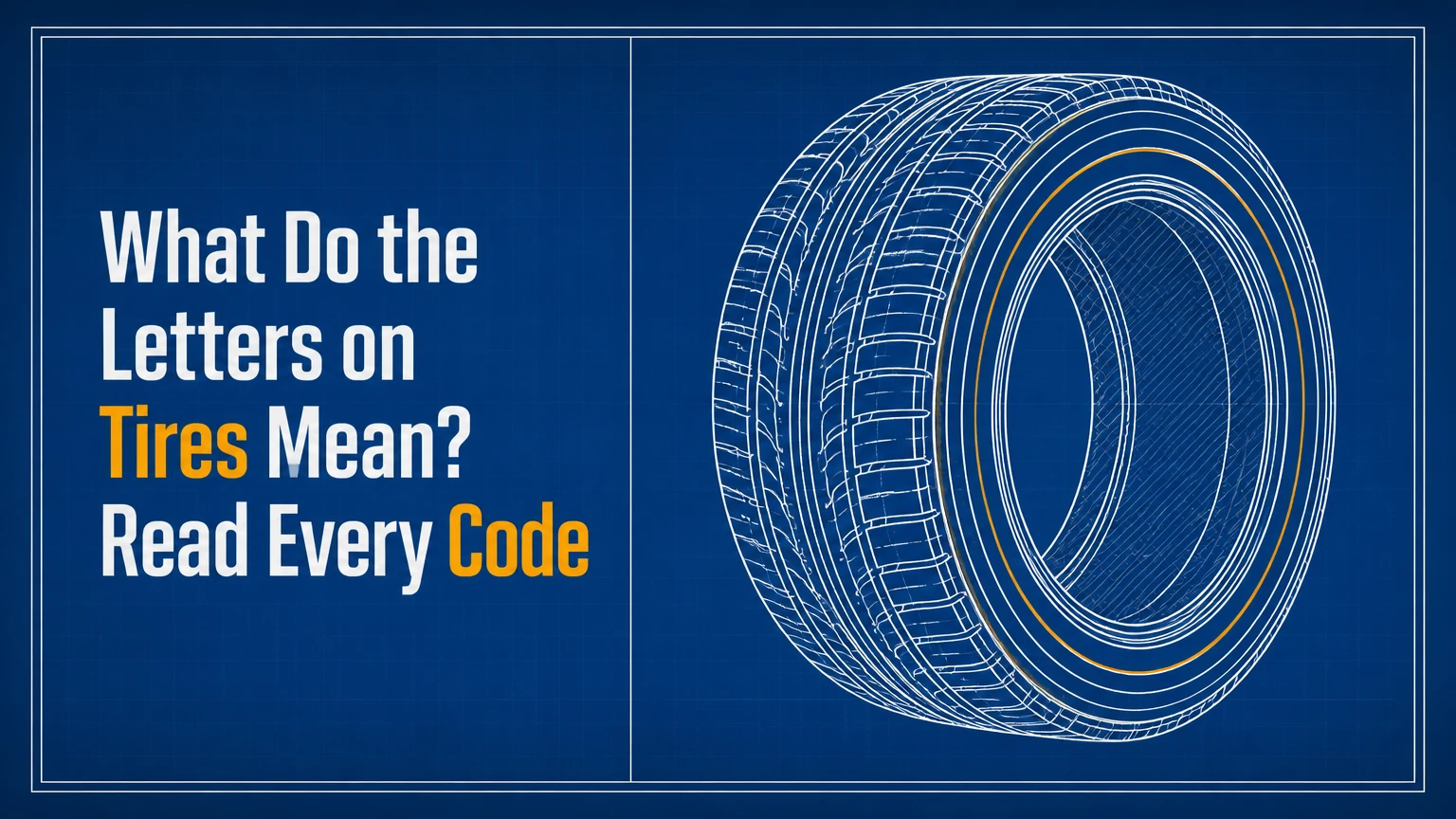
The letters on tires identify service type, internal construction, speed capability, weather certification, and special features. In a code such as P215/65R15 95H, P describes a passenger tire, R means radial construction, and H is the speed symbol; the numbers specify width, profile, rim diameter, and load index.
Tire Markings at a Glance
- P215/65R15 95H means a passenger tire that is 215 mm wide, has a 65% aspect ratio, uses radial construction, fits a 15-inch rim, carries load index 95, and has an H speed rating.
- The load index is not a weight limit for the entire vehicle. Vehicle payload, axle ratings, wheel capacity, and tire pressure still impose separate limits.
- DOT 2226 means the tire was manufactured in the 22nd week of 2026; the final four digits identify the production week and year.
- M+S indicates a mud-and-snow tread designation, while 3PMSF indicates certified severe-snow performance.
- The door-jamb placard determines normal inflation pressure, not the maximum pressure molded into the tire sidewall.
- Replacement tires should meet the vehicle manufacturer’s approved size, load, speed, and construction requirements.
How Do You Read a Tire Size Code?
A tire size code is read from left to right, with each section describing a different physical or operating attribute. For P215/65R15 95H, the complete interpretation is:
| Marking | Meaning | Value in P215/65R15 95H |
|---|---|---|
| P | Service designation | Passenger vehicle |
| 215 | Section width | 215 mm |
| 65 | Aspect ratio | Sidewall height equals 65% of width |
| R | Internal construction | Radial |
| 15 | Rim diameter | 15 inches |
| 95 | Load index | 690 kg, or 1,521 lb, per tire |
| H | Speed symbol | 210 km/h, or 130 mph |
The code does not tell you every property of a tire. It normally omits tread compound, wet-grip performance, noise level, rolling resistance, warranty mileage, and the vehicle’s correct inflation pressure. Those attributes appear elsewhere in product specifications, the vehicle placard, or the tire’s regulatory markings.
What Does the First Letter on a Tire Mean?
The first letter identifies the tire’s service category, although a missing letter can also be meaningful. P indicates a P-metric passenger tire, LT indicates a light-truck tire, ST indicates a special-trailer tire, and T identifies a temporary spare.
| Prefix | Full meaning | Typical application | Important restriction |
|---|---|---|---|
| P | Passenger | Cars, minivans, crossovers | Load rating follows P-metric rules |
| LT | Light Truck | Pickups, vans, heavy-duty SUVs | Often requires higher inflation pressure |
| ST | Special Trailer | Boat, utility, and cargo trailers | Not for steering or drive axles |
| T | Temporary | Compact spare wheel | Short-distance, reduced-speed use |
| None | Euro-metric | Passenger vehicles in many markets | Verify the exact approved specification |
P-metric and Euro-metric tires can have similar-looking dimensions but different load-capacity standards. A tire with no prefix is not automatically interchangeable with a P-metric tire, particularly when the vehicle requires a specific load rating.
A trailer tire marked ST has construction and operating assumptions suited to trailer service. Installing an ST tire on a passenger vehicle can create steering, braking, and handling problems because trailer tires are not designed for normal steering or driven-wheel duties.
What Does the Tire Width Number Mean?
The three-digit number gives the tire’s nominal section width in millimeters, measured from one sidewall’s widest point to the other. In 215/65R15, the number 215 means a nominal width of 215 mm, not necessarily the exact tread width.
Actual mounted width can vary slightly by tire model and by the width of the wheel used for measurement. A 215 tire mounted on a wider approved rim may measure wider than the same tire mounted on a narrower approved rim. The tire manufacturer’s approved rim-width range controls safe installation.
What Does the Number After the Slash Mean?
The number after the slash is the aspect ratio, which expresses sidewall height as a percentage of section width. A 65-series tire has a sidewall height equal to 65% of its nominal width.
For 215/65R15:
- Sidewall height: 215 × 0.65 = 139.75 mm
- Approximate overall diameter: 15 inches × 25.4 + 2 × 139.75 mm
- Approximate diameter: Проximately 660 mm, or 26.0 inches
The aspect ratio changes more than appearance. A lower profile, such as 40 or 45, generally reduces sidewall flex and sharpens steering response, but it also reduces air volume and leaves the wheel more exposed to pothole damage. A higher profile, such as 65 or 70, normally gives more impact absorption and ride compliance.
Changing aspect ratio without preserving overall diameter can alter speedometer accuracy, electronic stability-control behavior, gearing, and fender clearance. Tire replacement should therefore match the vehicle’s approved alternate sizes rather than relying on visual fit alone.
What Does the R on a Tire Mean?
The R means radial construction, in which the body cords run approximately perpendicular to the direction of travel and the tread is stabilized by belts. Radial construction is standard on modern passenger vehicles because it balances tread life, ride comfort, fuel economy, and high-speed stability.
Other construction symbols exist:
| Symbol | Construction | Typical use | Modern passenger-car frequency |
|---|---|---|---|
| R | Radial | Cars, SUVs, trucks, vans | Nearly universal |
| D | Diagonal or bias-ply | Vintage, agricultural, specialty equipment | Rare |
| B | Bias-belted | Historical and specialized applications | Very rare |
| F | Run-flat construction in some systems | Vehicles with mobility-after-puncture requirements | Manufacturer-specific |
The construction letter must match the wheel and vehicle application. A bias-ply tire is not a routine substitute for a radial tire, even when the dimensions appear similar.
What Does the Last Number in the Size Mean?
The number immediately after the construction letter is the wheel-rim diameter in inches. In R15, the tire is designed for a 15-inch rim.
This number describes the bead-seat diameter, not the outside diameter of the completed tire. A 15-inch tire cannot be safely mounted on a 15-inch wheel if the bead profile, rim width, or wheel design is otherwise incompatible, and a 15-inch tire cannot fit a 16-inch rim.
What Do the Load and Speed Letters Mean?
The load index and speed symbol work together to describe operating capability. The load index is a numerical code tied to a standardized capacity chart, while the speed symbol identifies the maximum test speed associated with the tire at its rated load and proper condition.
How Does a Tire Load Index Work?
A tire load index of 95 corresponds to 690 kg, or 1,521 lb, per tire under the applicable rating conditions. Four tires with index 95 have a theoretical combined tire capacity of 2,760 kg, or 6,084 lb, but that figure is not the vehicle’s legal or practical payload limit.
The vehicle manufacturer’s gross vehicle weight rating, axle ratings, wheel ratings, suspension, and tire-pressure specification may impose lower limits. Never calculate cargo capacity by multiplying the tire index alone.
| Load index | Maximum load per tire | Four-tire theoretical total |
|---|---|---|
| load index 91 | 615 kg, 1,356 lb | 2,460 kg, 5,424 lb |
| load index 94 | 670 kg, 1,477 lb | 2,680 kg, 5,908 lb |
| load index 95 | 690 kg, 1,521 lb | 2,760 kg, 6,084 lb |
| load index 98 | 750 kg, 1,653 lb | 3,000 kg, 6,614 lb |
| load index 104 | 900 kg, 1,984 lb | 3,600 kg, 7,937 lb |
| load index Load index Load index 110 | 1,060 kg, 2,337 lb | 4,240 kg, 9,369 lb |
The table uses standard load-index values. Actual vehicle fitment still depends on the manufacturer’s requirements, and some LT tires use load ranges or ply ratings in addition to, or instead of, a passenger-style load index.
What Does a Tire Speed Rating Mean?
The final letter is the tire’s speed symbol. It represents a laboratory-tested maximum speed under specified conditions, including correct load, inflation, temperature, and tire condition. It is not a recommendation to drive at that speed on public roads.
| Speed symbol | Rated speed | Common application |
|---|---|---|
| Q | 160 km/h, 99 mph | Some winter tires |
| S | 180 km/h, 112 mph | Older passenger applications |
| T | 190 km/h, 118 mph | Mainstream passenger vehicles |
| H | 210 km/h, 130 mph | Touring cars and crossovers |
| V | 240 km/h, 149 mph | Performance passenger vehicles |
| W | 270 km/h, 168 mph | High-performance vehicles |
| Y | 300 km/h, 186 mph | Very high-performance applications |
Lower speed-rated tires can change steering response, heat tolerance, and emergency handling. Replacement tires should normally meet or exceed the vehicle manufacturer’s specified speed rating, but a winter-tire exception may be allowed by local rules or the vehicle manufacturer. Check the owner’s manual before making that change.
A higher speed rating does not automatically mean a better tire. The higher-rated tire may ride more firmly, cost more, wear faster, or perform poorly in cold conditions if its compound is intended for summer use.
Which Other Letters and Symbols Matter?
Sidewall markings beyond the main size code identify the tire’s age, weather capability, load construction, original-equipment fitment, and special operating features. These symbols often determine suitability more directly than the brand name.
How Do You Read the DOT Tire Date?
The final four digits of a modern DOT date code identify the production week and year. DOT 2226 means the tire was manufactured during week 22 of 2026.
The date code may appear on only one sidewall, so inspect both sides when checking a mounted tire. Modern codes use four digits; a three-digit date code indicates a tire made before 2000 and should not be used for normal current service.
The complete DOT string also identifies the manufacturing plant and manufacturer-specific tire details. The date is the portion most consumers need, but the entire string can help a dealer trace a product or identify a recall.
Tire age is only one condition factor. Sun exposure, heat, underinflation, storage, ozone, cracking, and long periods without use can accelerate deterioration. NHTSA describes tires as “the only thing connecting your vehicle to the road,” which is why visible cracking, bulges, cord damage, or repeated air loss requires immediate professional inspection regardless of tread depth.
Is M+S the Same as a Winter Tire?
M+S does not equal a severe-winter certification. The M+S, M/S, or MS marking indicates a tread design intended to provide better mud and light-snow traction than a conventional highway tread, but it does not require the same standardized severe-snow performance test as 3PMSF.
| Marking | What it confirms | Cold-weather meaning | Best interpretation |
|---|---|---|---|
| M+S | Mud-and-snow tread designation | No severe-snow test required | Mild winter conditions |
| 3PMSF | Three-Peak Mountain Snowflake test certification | Verified severe-snow traction | Frequent snow and winter roads |
| Ice grip symbol | Regional ice-performance certification | Country-specific test | Severe icy conditions |
| No symbol | No stated winter designation | Depends on compound and design | Inspect product category |
A 3PMSF tire has a mountain outline containing a snowflake. The symbol confirms that the tire passed a defined snow-traction test, but it does not guarantee short braking distances on glare ice or eliminate the need for suitable speed and following distance.
Dedicated winter tires use compounds designed to remain flexible at low temperatures. All-season tires commonly sacrifice some cold-weather grip for longer warm-weather life, while all-weather tires often combine a 3PMSF rating with more year-round usability.
What Does XL Mean on a Tire?
XL means Extra Load, also called reinforced construction in some markets. An XL tire can carry more weight than a standard-load tire of the same nominal size when inflated to the pressure specified by its manufacturer.
XL does not mean that a vehicle can carry extra cargo beyond its door-placard or certification limits. It also does not automatically mean the tire is an LT tire. Confirm the required load index, pressure, and vehicle fitment before substituting XL for standard load.
Other common markings include:
| Marking | Meaning | Example or implication |
|---|---|---|
| XL | Extra Load | Reinforced passenger tire |
| SL | Standard Load | Normal passenger load version |
| RF, RFT, or run-flat symbol | Mobility after air loss | Exact distance and speed vary by design |
| M0, MO, *, N0, or similar | Manufacturer approval | Mercedes-Benz, BMW, Porsche, or other OE fitment |
| A/S, All Season | Product category label | Not a universal winter certification |
| Rotation arrow | Directional tread | Tire must rotate in the marked direction |
A directional tire with an arrow must be mounted correctly. An asymmetric tire has an “outside” or “inside” sidewall designation. These instructions affect water evacuation and handling, so a tire can be dimensionally correct yet incorrectly installed.
How Do Tire Types Compare?
Tire categories differ in compound, tread pattern, noise, temperature range, and expected wear. The right choice depends on climate, road surface, vehicle load, and whether the vehicle is used for towing or performance driving.
| Tire category | Typical price per tire | Typical tread life | Strongest use |
|---|---|---|---|
| Touring all-season | $80-$180 | 50,000-80,000 miles | Daily commuting |
| All-weather | $110-$220 | 40,000-65,000 miles | Year-round use with regular snow |
| Dedicated winter | $100-$220 | 3-5 winter seasons | Persistent cold and snow |
| Summer performance | $120-$300 | 20,000-40,000 miles | Warm-weather grip |
| Ultra-high-performance | $150-$350+ | 20,000-40,000 miles | Dry and wet handling |
| All-terrain | $140-$300 | 40,000-60,000 miles | Gravel, dirt, and mixed roads |
These are typical retail and service-life ranges, not guarantees. Alignment, inflation, rotation, driving style, temperature, road roughness, and vehicle weight can change wear substantially.
Touring all-season tires usually produce the lowest ownership cost for mild climates. Dedicated winter tires provide a meaningful advantage when temperatures stay low and snow or ice is common, but storing a second set adds wheel, mounting, and storage costs.
All-terrain tires can improve loose-surface traction, yet their heavier construction and aggressive tread often increase road noise, rolling resistance, and stopping distance on pavement. They are a poor trade for a vehicle that never leaves asphalt.
How Do You Choose a Safe Replacement Tire?
Use the vehicle, not the old tire alone, as the authority for replacement specifications. A previous owner may have installed an incorrect size, a mismatched load rating, or a tire unsuitable for the vehicle’s climate.
Follow this sequence:
- Read the driver-door placard. Record the front and rear tire sizes, cold inflation pressures, and any spare-tire specification.
- Check the owner’s manual. Look for approved alternate sizes, winter-tire rules, load requirements, and speed-rating exceptions.
- Match the complete specification. Compare service type, size, construction, load index, speed rating, and special requirements.
- Choose the operating category. Select touring, all-weather, winter, summer, all-terrain, or another category based on actual roads and temperatures.
- Inspect the date code. Avoid old inventory when age is excessive, and inspect stored or used tires for cracking and damage.
- Verify the wheel. Confirm rim diameter, rim width, offset, brake clearance, and tire bead compatibility.
- Install as an axle pair or complete set. Follow the manufacturer’s rules for tread-depth differences and all-wheel-drive systems.
- Set cold pressure after installation. Use the placard pressure, then recalibrate the TPMS if the vehicle requires it.
Professional tire fitment matters most when changing diameter, moving from P-metric to LT, selecting run-flats, fitting an EV, or using staggered front and rear sizes. Electric vehicles may require tires with adequate load capacity and low-noise or low-rolling-resistance specifications because battery weight increases vehicle mass.
What Mistakes Make Tire Markings Dangerous?
The most common error is treating one sidewall number as a complete fitment answer. Tire safety depends on the relationship among size, load, speed, pressure, wheel, vehicle weight, and operating conditions.
Mistake: Using Maximum Sidewall PSI
The maximum PSI molded on the tire describes the tire’s allowable limit under specified conditions. The door placard gives the vehicle’s normal cold inflation pressure, which is the correct starting point for everyday driving.
Mistake: Multiplying Load Index by Four
Four times the tire’s load capacity does not equal the vehicle’s permitted payload. The vehicle certification label, gross axle weight ratings, wheel limits, and suspension determine the usable limit.
Mistake: Mixing Different Sizes
Different rolling diameters can interfere with ABS, traction control, and all-wheel-drive systems. Even small circumference differences can create continuous speed differences between axles. Use the vehicle manufacturer’s approved combinations only.
Mistake: Mixing Speed Ratings Without Checking Placement
The safest practice is to use the same size, load index, speed rating, and model on all four positions. If replacement of only two tires is permitted, many manufacturers recommend placing the tires with greater tread depth on the rear axle, but the vehicle manual and tire professional should control the decision.
Mistake: Assuming Deep Tread Means Young Rubber
A tire can have substantial tread but still show age-related cracking or internal deterioration. Inspect date, sidewalls, bead area, tread, and repair history rather than judging condition from tread depth alone.
Mistake: Treating M+S as a Snow Guarantee
M+S is not the same test as 3PMSF. Drivers who regularly encounter snow should compare severe-snow certification, compound design, stopping performance, and local winter conditions.
What Should You Check Before Buying?
A safe replacement checklist takes about 10 minutes and prevents most ordering errors. Record the following values before comparing brands or prices:
| Checkpoint | Required value | Where to find it |
|---|---|---|
| Front tire size | Exact approved code | Door placard or manual |
| Rear tire size | Exact approved code | Door placard or manual |
| Load index | Manufacturer minimum | Placard, manual, tire catalog |
| Speed rating | Manufacturer minimum | Manual or fitment data |
| Cold pressure | Front and rear PSI | Door placard |
| Winter requirement | M+S, 3PMSF, or neither | Climate and local rules |
| Production date | Four-digit week-year code | Tire sidewall |
| Special construction | XL, run-flat, OE, directional | Sidewall and manual |
The cheapest tire is not necessarily the lowest-cost choice. A $120 touring tire rated for 70,000 miles may cost less per mile than a $180 performance tire rated for 30,000 miles, but the performance tire may deliver shorter wet braking distances and better steering response in its intended temperature range.
An experienced installer also checks alignment and suspension wear during replacement. Uneven shoulder wear, cupping, or rapid tread loss can indicate toe misalignment, worn dampers, bent components, or incorrect inflation. Replacing the tire without correcting the cause only resets the failure clock.
Frequently Asked Questions
Can I use a tire with a higher load index?
Yes, a higher load index is often acceptable when the tire’s size, construction, speed rating, wheel compatibility, and inflation requirements also meet the vehicle manufacturer’s specifications. A higher index does not increase the vehicle’s certified payload or permit operation above the door-placard limits.
Are 17-inch tires better than 15-inch tires?
A larger rim does not automatically improve safety or comfort. Larger wheels usually pair with lower-profile tires, which can sharpen steering response while reducing sidewall cushioning, increasing replacement cost, and raising pothole damage risk. Use only wheel and tire sizes approved for the vehicle.
How old can a tire be before replacement?
There is no single universal expiration date because storage and use conditions affect deterioration. NHTSA recommends inspecting tires regularly, while several tire manufacturers advise replacement around six to ten years from manufacture, even with remaining tread. Follow the tire maker’s age guidance and replace damaged tires sooner.
Should all four tires have the same brand?
Matching all four tires by brand, model, size, load index, and speed rating generally provides the most predictable handling. Some vehicles permit limited mixing, but different tread patterns and compounds can change wet grip, steering response, and electronic-control behavior. All-wheel-drive vehicles often have especially strict circumference limits.
What does the tire brand name mean?
The large name on the sidewall identifies the manufacturer or brand, while the model name identifies the product line. Those names do not specify size, load, or speed capability. Read the complete service description and sidewall code before buying, because the same model can be sold in multiple specifications.
Where can I find the correct tire size if the sidewall is worn?
The driver-door placard is usually the best source for the original approved size and pressure. The owner’s manual, manufacturer fitment database, and vehicle identification number can provide additional confirmation. Do not rely only on a worn tire, especially if the vehicle may have aftermarket wheels or a previous incorrect replacement.
The Bottom Line
What do the letters on tires mean? They identify the tire’s intended service, construction, speed capability, weather performance, and special design features. Read the entire code, then verify the vehicle placard, load requirement, speed rating, pressure, production date, wheel compatibility, and climate suitability before choosing a replacement.