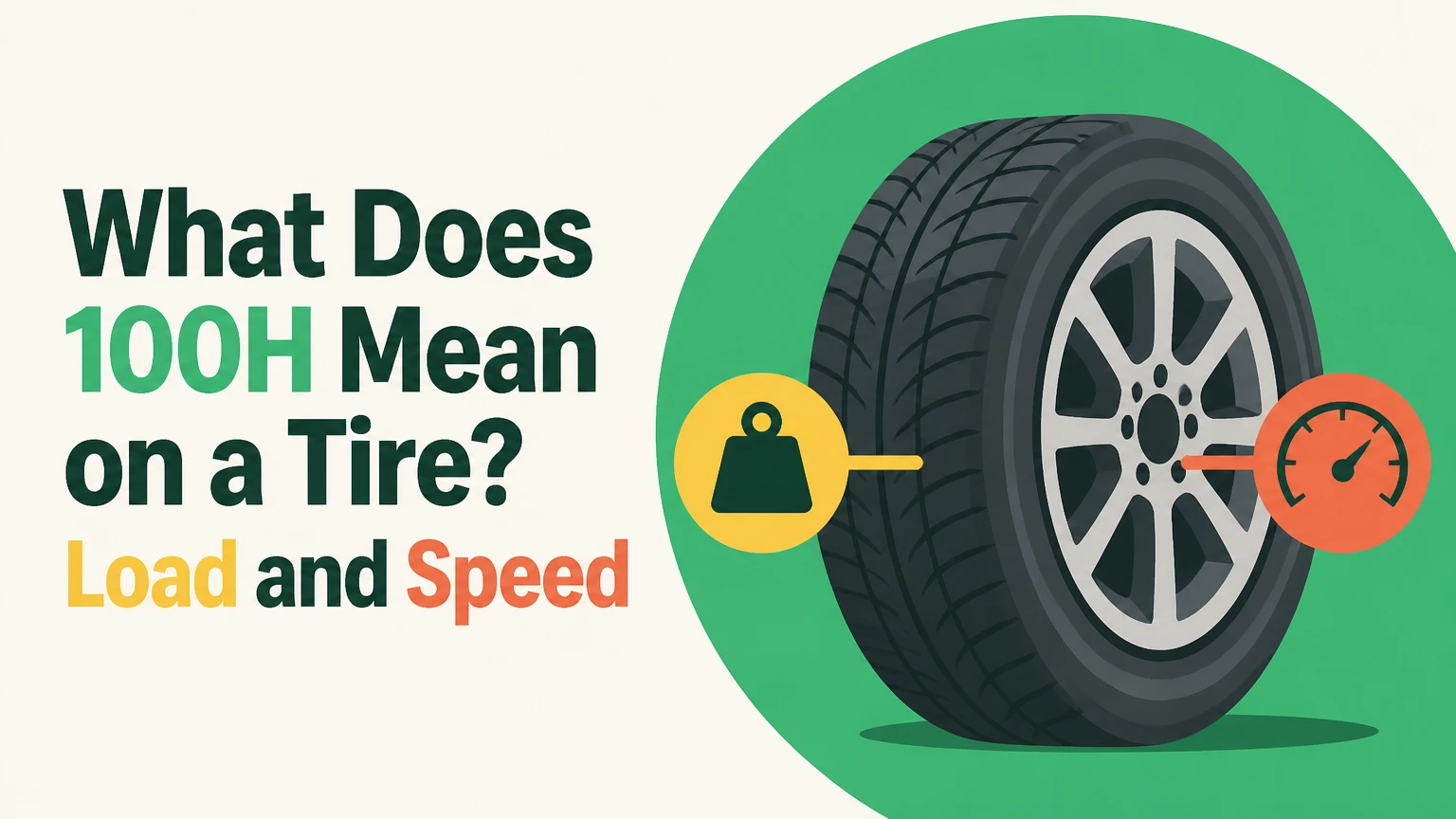
On a tire, 100H is a service description that combines a load index and a speed rating. The number 100 means the tire is rated to carry 800 kg (1,764 lb) per tire under the applicable reference conditions, while H indicates a maximum rated speed of 210 km/h (130 mph) in standardized testing.
100H at a Glance
- 100 is a load index, not a weight measurement, tire pressure, or tire size.
- A load index of 100 corresponds to 800 kg, or 1,764 lb, per tire on the standardized load index table.
- H is a speed symbol for 210 km/h, or 130 mph.
- The 800 kg load figure depends on the tire’s specified inflation pressure and testing conditions.
- The vehicle’s door-jamb placard determines the required tire load, size, pressure, and speed rating.
- Four 100-rated tires produce a mathematical tire capacity of 3,200 kg, but that does not give the vehicle a 3,200 kg legal GVWR.
What Does 100H Mean on a Tire?
The 100H marking identifies the tire’s load-and-speed service description. The first part, 100, indicates the maximum standardized load assigned to one tire; the final letter, H, indicates the tire’s certified speed category. Neither marking tells you the tire’s physical dimensions, tread pattern, age, brand, or recommended inflation pressure.
Tire manufacturers use service descriptions so a vehicle engineer, tire retailer, and driver can match a tire to the vehicle’s operating requirements. The marking normally appears after the tire size, such as 225/55R17 100H.
That complete example contains several separate attributes:
| Marking | Meaning | Example value |
|---|---|---|
| 225 | Section width | 225 mm |
| 55 | Aspect ratio | Sidewall height is 55% of width |
| R | Construction | Radial |
| 17 | Wheel diameter | 17 inches |
| 100H | Service description | 800 kg and 210 km/h |
The service description is only one part of fitment. A tire can have the correct 100H rating and still be unsuitable because its diameter, width, construction, seasonal compound, wheel size, or vehicle approval does not match.
How Does the 100 Load Index Work?
The load index 100 corresponds to 800 kg (1,764 lb) for one tire on the standardized load index chart. The number is an engineering code shared across tire standards rather than a direct kilogram or pound figure, so load index 100 does not mean 100 kg, 100 lb, or 100 psi.
The stated capacity applies under defined conditions, including the tire’s reference inflation pressure, construction, and test standard. A driver should not assume that every tire marked 100 carries exactly 800 kg at every pressure. The tire manufacturer’s load-and-inflation table controls the capacity at a particular pressure.
What Can Four 100-Rated Tires Carry?
Four 100-rated tires have a theoretical combined tire capacity of 3,200 kg (7,055 lb), calculated as 4 × 800 kg. That calculation is not the vehicle’s payload rating because the vehicle may have a lower gross vehicle weight rating, axle rating, wheel rating, suspension limit, or brake limitation.
For example, a crossover with four 100H tires might have a GVWR of 2,300 kg. The vehicle remains limited to the manufacturer’s 2,300 kg GVWR even though the tires’ simple combined index adds to 3,200 kg. The lower governing limit wins.
The load index also does not mean every tire position can carry the same share. Cargo distribution, front and rear axle limits, towing nose weight, passengers, and corner loading can shift the actual force on individual tires.
| Load index | Capacity per tire | Four-tire mathematical total | Approximate pounds per tire |
|---|---|---|---|
| 98 | 750 kg | 3,000 kg | 1,653 lb |
| 99 | 775 kg | 3,100 kg | 1,709 lb |
| 100 | 800 kg | 3,200 kg | 1,764 lb |
| 101 | 825 kg | 3,300 kg | 1,819 lb |
| 102 | 850 kg | 3,400 kg | 1,874 lb |
Does 100 Mean 100 PSI?
No. 100 is not a pressure value. Tire pressure appears separately as a recommended cold-pressure value on the vehicle placard and as a maximum permissible pressure on the tire sidewall.
The door placard might specify 35 psi for normal driving, while the tire sidewall might list a maximum of 50 psi. The driver should normally use the placard value, measured when the tire is cold, rather than inflating to the sidewall maximum. A higher pressure does not automatically increase the vehicle’s permitted payload.
What Does the H Speed Rating Mean?
The H speed symbol indicates a standardized maximum speed category of 210 km/h (130 mph). The rating describes the tire’s ability to operate at that speed under specified test conditions, including load, inflation, temperature, and test duration. It is not a recommended road speed.
A speed rating reflects a tire’s resistance to heat and deformation, but it does not guarantee safe driving at 130 mph. Road surface, weather, tread depth, tire age, pressure, alignment, wheel condition, and traffic determine real-world safety. Public roads also have speed limits that are far below the H test category in many jurisdictions.
The H symbol occupies a non-linear position in the speed-rating sequence. Ratings U and H are followed by V, but the alphabet does not map directly to speed because historical racing and performance categories created exceptions.
| Speed symbol | Maximum rated speed | Approximate mph | Typical context |
|---|---|---|---|
| S | 180 km/h | 112 mph | Basic passenger vehicles |
| T | 190 km/h | 118 mph | Family sedans and minivans |
| U | 200 km/h | 124 mph | Certain touring applications |
| H | 210 km/h | 130 mph | Passenger cars and crossovers |
| V | 240 km/h | 149 mph | Performance-oriented vehicles |
| W | 270 km/h | 168 mph | High-performance vehicles |
The U.S. National Highway Traffic Safety Administration describes speed ratings as being based on laboratory testing rather than ordinary road use. That distinction matters because a laboratory category cannot compensate for worn tread, incorrect pressure, or a damaged casing.
Does an H Rating Improve Handling?
An H-rated tire may provide sharper steering response than a T-rated tire in the same size and product family, but the letter alone does not guarantee better handling. Manufacturers can use different compounds, sidewall constructions, tread designs, and belt packages within the same speed category.
The practical difference is usually clearest during repeated cornering, emergency lane changes, or sustained high-speed operation. A higher rating can also bring a firmer ride, greater rolling resistance, higher purchase cost, or shorter tread life. The vehicle manufacturer’s original specification remains the baseline.
Why Do Load, Speed, and Pressure Affect Tire Heat?
Tire heat rises when the casing repeatedly flexes under load. Underinflation increases sidewall and tread deflection, while high speed increases the number of flex cycles per second; carrying heavy cargo combines both stresses and can raise internal temperature rapidly.
Steel belts, body plies, bead materials, cap plies, and rubber compounds manage those forces. The exact construction varies by model, so a generic claim that every H-rated tire uses a particular nylon layer is unreliable. The service description identifies the tested performance category, not a universal internal parts list.
Pressure is especially important. A tire’s load capacity at a given inflation pressure comes from the manufacturer’s load-and-inflation table. If pressure falls below the required value, the tire may carry less load and generate more heat, even though the sidewall still displays 100H.
How Do You Verify Whether 100H Fits Your Vehicle?
Verify the vehicle placard, owner’s manual, tire size, axle requirements, and replacement tire markings before ordering. The vehicle placard is usually mounted on the driver’s doorjamb, door edge, fuel-filler flap, or another manufacturer-specified location.
Use this five-step check:
- Read the placard. Record the original tire size, required load index, speed symbol, and cold inflation pressure.
- Confirm the complete size. Match width, aspect ratio, radial construction, wheel diameter, and any XL, run-flat, or OE designation.
- Compare the service description. The replacement tire should meet or exceed the required load index and speed rating unless a qualified tire professional confirms a permitted exception.
- Check axle and wheel limits. Confirm that the tire, wheel, axle, and vehicle GVWR remain compatible.
- Set cold pressure after installation. Use the placard pressure, then confirm TPMS operation and inspect for clearance.
A tire retailer may recommend 100H because it is a common replacement for the original specification, but the retailer should verify the exact vehicle application rather than rely on tire size alone.
Is 100H Suitable for an SUV, Sedan, or EV?
A 100H tire can suit a sedan, crossover, or some compact SUVs when the vehicle’s approved fitment calls for that service description. The marking alone does not identify the vehicle class because different vehicles with the same wheel diameter can have very different axle loads and handling requirements.
Electric vehicles require additional care. Battery weight can increase curb mass, while instant torque can accelerate tread wear. An EV may need a specific reinforced, low-rolling-resistance, acoustic, or manufacturer-approved tire even when its basic size appears to accept 100H.
Trailer tires are another limitation. A passenger-car 100H tire should not automatically replace a trailer tire with a different construction, load range, or service designation. Trailer use creates different lateral forces, heat patterns, and sidewall requirements.
| Situation | Is 100H automatically suitable? | Required check |
|---|---|---|
| Mid-size sedan | No | Placard size, load, and speed rating |
| Compact crossover | No | GVWR, axle loads, XL status, clearance |
| Electric vehicle | No | EV approval, load reserve, rolling resistance |
| Light trailer | No | Trailer construction, load range, and sidewall marking |
| Winter replacement | No | Winter certification, size, load, and speed symbol |
How Does 100H Compare With 100T and 100V?
100H sits between 100T and 100V in speed category while retaining the same nominal 800 kg load index. The most important difference is not carrying capacity but the tested speed category and the construction required to achieve it; actual ride, grip, noise, and wear depend on the specific tire model.
| Service description | Load per tire | Speed category | Approximate speed | Typical trade-off |
|---|---|---|---|---|
| 100S | 800 kg | S | 180 km/h | Softer response, lower speed category |
| 100T | 800 kg | T | 190 km/h | Touring comfort and moderate response |
| 100H | 800 kg | H | 210 km/h | Balanced response and speed reserve |
| 100V | 800 kg | V | 240 km/h | Firmer response and potentially higher cost |
A 100V tire is not automatically safer than a 100H tire in rain, snow, or cold weather. Tread design and compound can matter more in those conditions. Conversely, substituting 100T for a vehicle that requires 100H can reduce the vehicle’s approved performance margin and may violate local fitment rules.
Practical verdict: choose 100H when the placard calls for 100H; consider 100V only when the vehicle and tire manufacturer permit it and the handling trade-off suits your driving.
Can You Replace 100H With 100V or 98T?
A 100H tire can generally be replaced by a 100V tire only when the complete fitment remains approved. A 98T tire is not an equivalent replacement because load index 98 carries 750 kg per tire, below the 800 kg assigned to load index 100, and T also has a lower speed category than H.
Higher is not always interchangeable in every application. A replacement may need to preserve a manufacturer-specific OE marking, extra-load construction, run-flat capability, winter approval, rolling-resistance target, or front-to-rear staggered fitment.
Never mix different speed ratings across the same axle. Many manufacturers also recommend matching all four tires, especially on full-time or on-demand all-wheel-drive vehicles, where differences in rolling circumference can stress the drivetrain.
For a temporary spare, follow the spare tire label and owner’s manual. Temporary spares often have different speed and load limitations that are legal only for short, restricted use.
What Does XL Mean With 100H?
The marking 100H XL means the tire has a 100 load index, an H speed symbol, and an Extra Load construction. XL does not change the load index code itself; it identifies a reinforced tire designed to carry its specified load at a higher reference pressure than a standard-load version.
A vehicle placard may require an XL tire even when the basic size and 100H code appear correct. Passenger cars with heavy axle loads, crossovers, and some EVs commonly use reinforced construction. Match the full marking, not only the final three characters.
Other sidewall labels can include RF for run-flat terminology, M+S for mud and snow marking, 3PMSF for the Three-Peak Mountain Snowflake severe-snow symbol, and manufacturer-specific OE codes. Each label answers a different fitment question.
How Much Do 100H Tires Cost and How Long Do They Last?
A typical 100H replacement tire costs approximately $90-$280 per tire, excluding mounting, balancing, disposal fees, taxes, and alignment. Budget models often fall near $90-$130, mid-tier models near $140-$190, and premium models near $200-$280 or more, but size and market location can move those ranges substantially.
Tread life is commonly about 40,000-80,000 miles for passenger touring products when properly maintained. A mileage warranty is not a lifespan guarantee; warranty conditions usually require documented rotation, correct pressure, and even wear.
| Expense or service | Typical range | Main price driver |
|---|---|---|
| Budget 100H tire | $90-$130 | Brand, size, retailer |
| Mid-tier 100H tire | $140-$190 | Compound and warranty |
| Premium 100H tire | $200-$280+ | Testing, materials, OE fitment |
| Mount and balance | $20-$50 per tire | Wheel diameter and location |
| Four-wheel alignment | $100-$200 | Vehicle design and region |
| Typical usable tread life | 40,000-80,000 miles | Rotation, pressure, climate |
Replace a tire based on condition, not only calendar age. The U.S. Tire Manufacturers Association advises regular inspection and consultation with the tire maker about aging, while some manufacturers recommend replacement around six years of service and advise against continued use around ten years regardless of tread. The DOT date code identifies manufacture week and year, not the installation date.
What Problems Can 100H Tires Develop?
100H tires can develop vibration, edge wear, center wear, cracking, bulges, or uneven tread when pressure, balance, alignment, loading, or storage conditions are wrong. The 100H code does not diagnose a tire problem; inspection must connect the symptom with the wheel, tire, suspension, and operating conditions.
| Symptom | Likely cause | First action |
|---|---|---|
| Vibration at 100-120 km/h | Imbalance or radial-force variation | Balance and inspect wheel |
| Outer-edge wear | Underinflation or alignment error | Check cold pressure and alignment |
| Center tread wear | Overinflation | Reset to placard pressure |
| Harsh ride | Excess pressure or stiff construction | Measure pressure cold |
| Bulge or sidewall cut | Impact damage | Remove from service immediately |
| Cracks between tread blocks | Aging, ozone, or storage | Check DOT date and replace if severe |
A bulge, exposed cord, deep sidewall cut, or sudden pressure loss requires immediate removal from service. Do not repair sidewall structural damage. Vibration after installation can also result from a bent wheel, incorrect bead seating, hub corrosion, or a tire with excessive radial-force variation, so replacing tires without checking the wheel assembly can waste money.
Which Pressure Should You Use for 100H?
Use the cold inflation pressure printed on the vehicle placard, not automatically the maximum pressure molded into the tire sidewall. Measure pressure before driving or after the vehicle has been parked for at least several hours, because heat from driving temporarily raises the reading.
The placard pressure is selected for the vehicle’s original load distribution, ride, braking, steering, and tire specification. When the vehicle carries unusually heavy cargo or tows, consult the owner’s manual for any alternate pressure. Do not reduce pressure because a tire feels firm, and do not increase pressure to its maximum value to compensate for an overloaded vehicle.
Check pressure monthly and before long trips. TPMS warns about substantial pressure loss but does not replace a gauge, and many systems do not warn when all four tires are equally underinflated.
What Are the Most Common 100H Mistakes?
The most consequential mistake is treating the service description as a complete tire specification. A 100H tire can still be the wrong diameter, construction, season, vehicle approval, or wheel fitment.
Experienced tire technicians commonly watch for these errors:
- Reading 100 as a physical weight: Load index 100 means 800 kg per tire, not 100 kg or 100 psi.
- Using the sidewall maximum as the normal pressure: The placard value controls routine inflation.
- Choosing by speed letter alone: Tread compound and wet-weather testing can outweigh the difference between H and V.
- Ignoring XL or OE markings: Reinforced and manufacturer-approved versions can have different pressure and handling requirements.
- Assuming four tire capacities equal payload: GVWR and axle ratings remain binding.
- Mixing tires on an AWD vehicle: Circumference differences can create drivetrain stress even when the nominal size matches.
- Keeping damaged tires because tread remains: Structural injuries cannot be judged by tread depth alone.
One counterintuitive rule matters: a higher speed rating does not permit higher legal driving speed. Another is equally important: a tire with more theoretical capacity cannot increase the vehicle’s certified payload.
FAQ About 100H Tires
Is 100H good for highway driving?
100H is suitable for highway driving when the vehicle placard specifies it and the tires have adequate tread, correct pressure, and no damage. The H category provides a 210 km/h test rating, but highway safety still depends on speed limits, weather, tire condition, alignment, and load distribution.
Can I use 100H tires in winter?
You can use 100H tires in winter only if the tire has an appropriate winter compound and the vehicle approves that size and load. An H-rated all-season tire is not automatically a winter tire. In severe snow regions, look for the 3PMSF symbol and follow local seasonal requirements.
Does a higher load index improve fuel economy?
A higher load index does not guarantee better fuel economy. Reinforced construction can add mass and rolling resistance, while pressure, tread compound, alignment, temperature, and driving style often have larger effects. Use the vehicle-approved specification rather than selecting load index solely for fuel savings.
Should all four tires be marked 100H?
All four tires should normally match the vehicle’s required size and service description, particularly on AWD vehicles. Some vehicles use different front and rear specifications, so the placard or owner’s manual may authorize a staggered setup. Never assume four identical 100H tires are correct without checking the application.
How can I find the tire’s manufacture date?
Find the DOT code on the sidewall and read the final four digits. The first two digits identify the production week, and the last two identify the production year, so 2324 means the 23rd week of 2024. Inspect older tires for cracking and ask the manufacturer about age limits.
The Bottom Line
100H on a tire means load index 100 and H speed rating: 800 kg (1,764 lb) per tire under specified reference conditions and 210 km/h (130 mph) in standardized testing. The correct replacement depends on the complete tire size, XL or OE designation, vehicle placard, axle limits, pressure, season, and construction. If your vehicle requires 100H, match or exceed that service description without confusing tire capacity with vehicle payload.