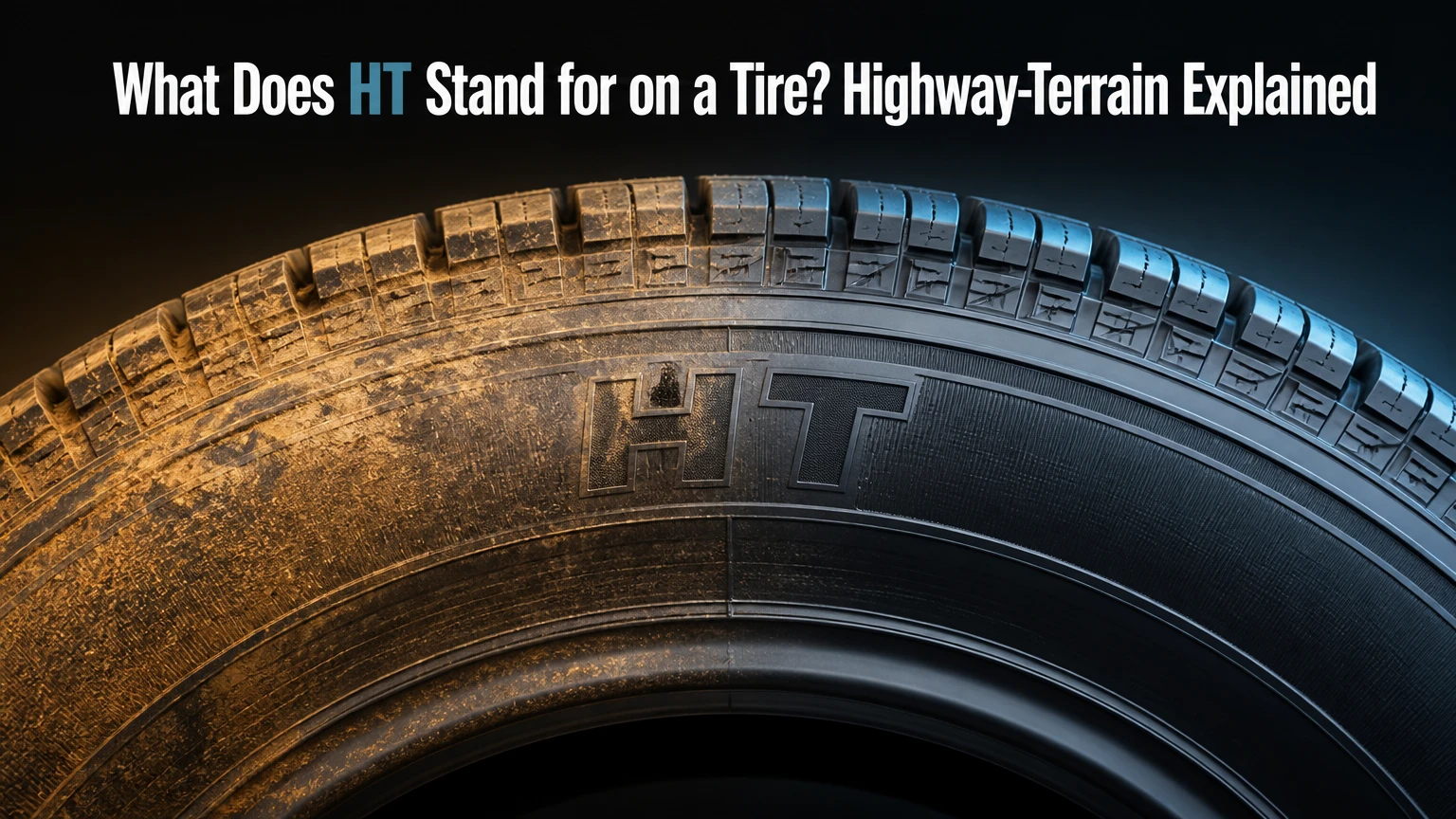
On a tire, HT or H/T usually stands for Highway-Terrain. H/T tires are designed primarily for paved roads, where they prioritize quiet operation, stable highway handling, wet-pavement grip, fuel efficiency, and long tread life over deep-mud or rock-trail traction. The designation describes the tire’s intended terrain, not its speed rating or exact load capacity.
Key Facts at a Glance
H/T means Highway-Terrain, and the abbreviation may appear as HT or H/T in product names and descriptions.
Highway-Terrain tires suit SUVs, crossovers, pickups, and vans that spend most of their mileage on asphalt or concrete.
H/T does not tell you the tire’s size, load index, speed rating, winter certification, or ply rating.
A tire marked M+S is not automatically certified for severe snow; look for the Three-Peak Mountain Snowflake symbol, or 3PMSF.
P-metric, XL, LT-metric, and commercial H/T tires can have substantially different load capacities and ride characteristics.
The vehicle placard, owner’s manual, tire size, load index, and required speed rating determine safe replacement fitment.
What Does HT Stand for on a Tire?
HT stands for Highway-Terrain on a tire, while H/T is the same abbreviation with a slash. The label generally identifies a tread category for road-oriented SUVs, pickups, crossovers, and vans. It does not mean that every H/T tire has identical construction, winter performance, towing capacity, or mileage.
Highway-Terrain tires occupy the road-focused end of the truck and SUV tire market. Their tread blocks are usually smaller and more closely connected than those on all-terrain tires, which creates a comparatively continuous contact area. Manufacturers tune the casing, rubber compound, grooves, and siping for the vehicle and service category, so a passenger-metric H/T tire can feel very different from an LT-metric H/T tire.
The abbreviation is not a universal government performance grade. A manufacturer may use H/T in a model name, catalog category, or sidewall branding, and some tires intended for highway use may not print H/T prominently on the sidewall. The complete specification matters more than the letters alone.
Is H/T the same as an H speed rating?
H/T is not the same as an H speed rating. In a size such as 265/70R17 115H, the final “H” is the speed-rating symbol, with an industry-rated maximum of 130 mph under specified test conditions; the H/T label refers to highway terrain.
A speed rating does not tell you whether a tire is quiet, mud-capable, winter-certified, or suitable for a heavy truck. Likewise, H/T does not establish a 130-mph capability. Read the whole sidewall sequence:
- 265: section width in millimeters
- 70: sidewall height as a percentage of width
- R: radial construction
- 17: wheel diameter in inches
- 115: load index
- H: speed rating
The vehicle manufacturer’s placard remains the authority for the original size, cold inflation pressure, and minimum load requirement.
How Do Highway-Terrain Tires Work?
Highway-Terrain tires work by maximizing predictable pavement contact rather than creating large voids for self-cleaning off-road traction. Circumferential grooves evacuate water, connected tread elements reduce tread squirm, and numerous sipes create additional biting edges on wet or lightly snow-covered pavement.
A typical H/T tread has four or five main grooves, depending on size and design. Continuous ribs or tightly linked blocks help maintain straight-line stability during highway cruising and towing. Closed shoulder areas can reduce the buzzing noise that large, separated all-terrain blocks produce as they strike the pavement.
Siping improves wet and cold-weather flexibility, but sipes do not turn an H/T tire into a dedicated winter tire. Deep snow requires void volume, snow-packing behavior, and compound performance that vary by model. The sidewall construction also varies: a P-metric tire usually emphasizes ride comfort, while an LT-metric tire uses stronger materials and higher inflation pressures for heavier service.
Which tire features matter most?
| Feature | Typical H/T design | Driver benefit | Limitation |
|---|---|---|---|
| Main grooves | 3-5 circumferential channels | Water evacuation at highway speed | Grooves can pack with deep mud |
| Tread blocks | Closely spaced, often 8-15 mm void spacing | Lower noise and stable contact | Less loose-terrain cleaning |
| Siping | Multiple slits in ribs and blocks | Wet and light-snow edge grip | Does not equal 3PMSF certification |
| Internal structure | Radial plies with steel belts | Shape retention and puncture resistance | Construction differs by P, XL, and LT type |
| Shoulder design | Connected or semi-closed outer blocks | Quiet cornering and even wear | Weaker loose-surface bite than open shoulders |
| Rubber compound | Road-focused all-season or all-weather compound | Rolling efficiency and pavement life | Model-specific performance in cold weather |
Tire construction is more complex than the H/T label suggests. Manufacturers mix rubber compounds, assemble textile and steel reinforcement, shape an uncured “green” tire, cure it in a mold, and inspect the finished product. Those steps explain how a tire is made, but they do not provide a shortcut for selecting one. Size, load, weather rating, and vehicle compatibility still control the decision.
What Vehicles and Roads Suit H/T Tires?
H/T tires suit vehicles that spend roughly 80%-90% of their mileage on paved roads, with occasional use on maintained gravel or firm dirt. The percentage is a practical buying guideline, not a regulatory definition, because manufacturers do not all use the same terrain split.
A crossover driver commuting on asphalt, a family using a three-row SUV for road trips, and a half-ton pickup towing a boat on highways may all benefit from H/T construction. The correct version differs by vehicle weight, axle load, trailer tongue weight, wheel size, and the driver’s tolerance for ride stiffness.
H/T tires can handle packed gravel roads, dry grass, graded dirt, and ordinary roadside access tracks when driven prudently. They are a poor match for deep mud, loose sand, sharp rocks, repeated ruts, and technical trails. Wet grass is also deceptively slippery because tread contact pressure and the surface’s low friction can overwhelm a road-oriented pattern.
What do P-metric, XL, and LT mean?
| Marking or category | Common application | Typical inflation or load context | Main trade-off |
|---|---|---|---|
| P-metric | Crossovers, SUVs, half-ton pickups | Passenger-car load standard, often 35 psi maximum operating reference | Lower mass and softer ride |
| XL or Extra Load | Heavier crossover or SUV applications | Higher load than standard P-metric at approved pressure | Firmer ride and higher replacement cost |
| LT-metric | Work pickups, vans, heavy towing | Higher load capability, commonly Load Range C, D, or E | More weight, noise, stiffness, and rolling resistance |
| Commercial H/T | Delivery vans and fleet vehicles | High-mileage service with fleet-specific load demands | Ride comfort may receive less priority |
| ST trailer tire | Trailers, not powered vehicles | Trailer-specific load and heat requirements | Not a substitute for an SUV or truck tire |
A frequent mistake is treating “10-ply” as a literal count of visible plies. Modern tires may use a Load Range E designation that traces back to older ply-rating terminology, but the tire’s actual load index and approved inflation pressure are the usable specifications. Never substitute a P-metric tire for an LT tire on a loaded truck without confirming the manufacturer’s requirements.
How Should You Read an H/T Tire Sidewall?
Read an H/T tire sidewall as a complete specification, not as a single terrain label. Confirm the size, load index, speed symbol, construction, service description, DOT date code, maximum load, and maximum pressure against the vehicle placard and owner’s manual.
| Sidewall item | Example | What it tells you | What it does not tell you |
|---|---|---|---|
| Tire size | 275/65R18 | Width, aspect ratio, radial design, wheel diameter | Exact tread life or snow grip |
| Load index | 116 | Maximum load assigned by the index table | Whether the tire is LT or P by itself |
| Speed symbol | T or H | Certified speed category under test conditions | Safe speed in every weather condition |
| Service description | 116T | Load index plus speed symbol | Trailer suitability |
| UTQG treadwear | 600 | Relative rating within the UTQG system | Guaranteed 60,000-mile life |
| DOT date code | 3624 | Manufactured in week 36 of 2024 | Installation date or storage history |
| 3PMSF symbol | Mountain and snowflake | Severe-snow performance certification | Ice performance or studded-tire behavior |
Uniform Tire Quality Grading, or UTQG, is useful for comparing tires within a manufacturer’s product range, but a treadwear grade is not a mileage warranty unless the manufacturer separately provides one. A grade of 600 does not mean a tire will last exactly 60,000 miles.
The National Highway Traffic Safety Administration, or NHTSA, describes tires as “the only thing between you and the road.” That practical reminder matters when shoppers focus on the H/T label while overlooking an underinflated tire, an overloaded axle, or a tire that is eight years old.
Are H/T Tires Good in Rain and Snow?
H/T tires are generally effective on wet pavement, but all H/T tires are not equally capable in snow. Sipes and circumferential grooves help move water away from the contact patch, while compound flexibility affects cold-weather grip; neither feature guarantees traction on packed snow or ice.
All-season H/T tires commonly carry an M+S marking, which indicates a manufacturer-defined mud-and-snow tread condition. The M+S marking is not the same as the 3PMSF severe-snow symbol used for tires that meet a defined snow-traction test.
Drivers in regions with occasional light snow may reasonably use an M+S H/T tire if the vehicle, weather, and local guidance support that choice. Drivers facing repeated snow, mountain passes, or temperatures near freezing should compare an all-weather H/T-style tire with 3PMSF certification, or use dedicated winter tires. Winter tires remain the stronger choice for sustained cold and ice.
What do H/T, A/T, and M/T tires have in common?
| Tire category | Paved-road share, typical | Loose-terrain capability | Noise and efficiency | Best-fit scenario |
|---|---|---|---|---|
| H/T | 80%-95% | Firm gravel and maintained dirt | Lowest noise, highest efficiency | Daily SUV or highway pickup |
| A/T | 50%-80% | Gravel, sand, moderate trails | Moderate noise and efficiency | Mixed road and recreational use |
| R/T | 40%-70% | Rough gravel and mild rock | More noise and weight than H/T | Aggressive appearance with road use |
| M/T | 15%-40% | Deep mud, ruts, rocks | Highest noise and rolling resistance | Frequent technical off-road driving |
The percentages are typical positioning ranges, not laboratory standards. A particular A/T tire may be quieter than another A/T tire, and a modern M/T tire may perform acceptably on pavement while still carrying significant noise, wear, and wet-braking compromises.
Which Is Better, H/T or A/T?
H/T is usually the better choice for mostly paved driving, while A/T is better when regular gravel, sand, ruts, or trail access justifies its compromises. H/T tires normally offer less tread noise, lower rolling resistance, smoother steering response, and stronger highway comfort.
An A/T tire can be sensible for a rural driver who travels several miles of rough gravel every day, hunts on unmaintained roads, or needs more edge bite in loose terrain. The decision becomes less favorable when the tire is selected only for its appearance. Larger voids and heavier carcasses can reduce fuel economy by a few percent and transmit more impact harshness, although the result depends on size, pressure, vehicle, and compound.
For a truck used 95% on pavement, H/T generally provides the more coherent design match. For a vehicle that reaches a campsite over deeply rutted roads every weekend, A/T may prevent wheelspin and sidewall damage that a highway pattern cannot manage.
Which is better for towing?
H/T tires can be excellent towing tires when their load index, inflation range, and construction match the vehicle and trailer demands. Towing safety does not come from the H/T label alone; it depends on tire capacity, axle ratings, tongue weight, inflation, speed, trailer balance, and suspension condition.
An LT-metric H/T tire may be appropriate for a heavy-duty pickup that repeatedly carries payload or controls a substantial trailer. A P-metric H/T tire can be correct for a light-duty SUV when the vehicle manufacturer specifies it. Installing a stiffer LT tire “for towing” without checking the placard can alter ride, steering response, and pressure requirements.
Before towing, calculate the loaded vehicle weight, trailer tongue weight, and axle loads. Inflate the tires to the vehicle or tire manufacturer’s cold-pressure instruction for that load. Do not use the maximum sidewall pressure automatically, because maximum pressure and recommended operating pressure are different values.
How Much Do H/T Tires Cost?
A typical set of four H/T tires costs about $500-$1,400 before taxes and optional services, depending on size, brand, construction, and load range. Passenger-metric crossover tires often cost $120-$220 each, while LT-metric Load Range E tires can cost $220-$400 or more each.
| Application | Typical tire price | Typical four-tire total | Typical installation time |
|---|---|---|---|
| Compact crossover, P-metric | $120-$180 | $480-$720 | 45-75 minutes |
| Full-size SUV, P-metric or XL | $160-$260 | $640-$1,040 | 50-80 minutes |
| Half-ton pickup, 17-20 inch | $170-$300 | $680-$1,200 | 50-90 minutes |
| Heavy-duty pickup, LT Load Range E | $240-$400+ | $960-$1,600+ | 60-100 minutes |
| Fleet van, commercial H/T | $190-$350 | $760-$1,400 | 60-100 minutes |
Typical installation pricing may add $20-$45 per tire for mounting and balancing, plus disposal, valves, TPMS service, alignment, or road-hazard coverage. Online prices can look lower before those charges. Compare the installed total and verify that the quoted tire has the correct load index and speed symbol.
How Long Do H/T Tires Last?
H/T tires commonly last 40,000-70,000 miles under normal service, but replacement can become necessary by age, damage, or uneven wear before the tread is gone. Mileage depends on alignment, inflation, rotation, vehicle weight, climate, driving style, compound, and the manufacturer’s warranty.
A driver covering 12,000-15,000 miles annually may use a tire for approximately three to six years, although calendar age is not a reliable lifespan guarantee. NHTSA advises consumers to inspect tires regularly and follow the vehicle and tire manufacturer’s guidance; many tire manufacturers recommend replacing tires around six to ten years from manufacture, regardless of remaining tread.
Check the DOT date code. The final four digits identify the production week and year, so 3624 means the 36th week of 2024. Replace a tire with sidewall cracking, bulges, exposed cords, puncture damage outside the repairable area, or tread below the legal or manufacturer-recommended limit.
How can you extend H/T tread life?
- Check cold pressure monthly and before long trips, using the door placard as the starting point.
- Rotate at the interval specified by the tire or vehicle manufacturer, commonly 5,000-8,000 miles.
- Balance the assembly when installing tires or when vibration appears.
- Obtain an alignment after pothole impacts or when the steering wheel is off-center.
- Inspect for shoulder wear, center wear, cupping, feathering, and embedded objects.
Correct pressure is especially important. Overinflation can concentrate wear toward the center, while underinflation increases shoulder wear, heat buildup, rolling resistance, and sidewall flex. Tire pressure should be checked cold because driving raises internal pressure naturally.
Why Are H/T Tires Wearing Unevenly or Vibrating?
Uneven H/T wear usually indicates incorrect inflation, misalignment, worn suspension components, poor rotation practice, or a balance problem. Highway vibration most often comes from wheel imbalance, a bent wheel, tire uniformity variation, or a tire that has shifted or suffered internal damage.
| Symptom | Likely cause | First check | Corrective action |
|---|---|---|---|
| Center tread wears quickly | Overinflation | Cold pressure versus placard | Reset pressure and inspect wear |
| Both shoulders wear | Underinflation or overload | Pressure and loaded weight | Inflate correctly and reduce overload |
| One shoulder wears | Camber or toe misalignment | Alignment readings | Repair suspension and align vehicle |
| Cupping or scalloping | Worn shocks or imbalance | Suspension and balance | Repair component, then rebalance |
| Feathered tread edges | Excessive toe setting | Hand-feel across blocks | Alignment inspection |
| Vibration at 50-70 mph | Imbalance, bent wheel, tire defect | Road-force balance and wheel runout | Balance, repair, or replace |
A new vibration deserves prompt inspection rather than a pressure adjustment alone. If vibration follows a tire position after rotation, the tire or wheel assembly becomes a stronger suspect. If the vibration changes with braking, acceleration, or steering input, inspect brakes, driveline parts, wheel bearings, and suspension as well.
What Are the Most Common H/T Buying Mistakes?
The most consequential H/T buying mistake is choosing by tread appearance or price before confirming the vehicle’s required specification. A visually aggressive tire can be less suitable for a highway-driven truck, while a cheaper P-metric tire can be inadequate for a vehicle that requires LT construction.
- Confusing terrain type with load capacity: H/T describes intended surface, not payload capability. Verify load index and service description.
- Assuming “10-ply” is a literal construction count: Compare Load Range and load tables instead of relying on informal ply language.
- Treating M+S as a winter certification: Look for 3PMSF when severe snow performance matters.
- Using the tire’s maximum PSI as the vehicle setting: Follow the placard unless a manufacturer-specific load procedure says otherwise.
- Mixing substantially different tread designs: Four matching tires usually provide more predictable handling than a mismatched front and rear pair.
- Ignoring wheel and brake clearance: A different tire size can affect rubbing, gearing, speedometer accuracy, and clearance.
- Buying based on UTQG alone: UTQG values do not replace wet-braking tests, warranty terms, load data, or independent fitment advice.
One practitioner rule is worth remembering: select the specification first, then compare tread designs and brands within that specification. Reversing that order produces many avoidable fitment errors.
Which H/T Tire Should You Choose?
Choose a P-metric H/T tire for a light-duty crossover or SUV, an XL version when the vehicle approves its higher load specification, and an LT-metric H/T tire when the placard and operating loads require it. Weather, towing frequency, wheel size, and annual mileage should determine the final model choice.
| Driver situation | Most appropriate starting category | Key specification to verify | When to reconsider |
|---|---|---|---|
| Family crossover, 90% pavement | P-metric H/T | Original size and load index | Frequent severe snow or rough roads |
| Half-ton pickup, occasional towing | P-metric, XL, or LT H/T | Placard load index and tongue-weight demand | Heavy payload or repeated trailer use |
| Heavy-duty pickup, regular towing | LT H/T | Load Range, load index, and cold pressure | Deep mud, rock trails, or sand |
| Rural gravel commuter | H/T or mild A/T | Sidewall protection and puncture warranty | Repeated ruts, sharp rock, or loose sand |
| Snow-belt commuter | 3PMSF H/T-style all-weather or winter tire | Severe-snow symbol and cold-weather rating | Frequent ice or mountain snow |
| Delivery van fleet | Commercial H/T | Fleet load, mileage warranty, casing durability | Construction sites or severe off-road routes |
A tire retailer can recommend a model, but the vehicle placard remains the fitment checkpoint. Confirm that the replacement tire is at least equal to the original load index and speed rating unless the vehicle manufacturer approves another specification.
Is a premium H/T always better?
A premium H/T tire is not automatically the best purchase if its size, load rating, weather capability, or warranty does not match the vehicle. Premium models often offer stronger wet performance, lower noise, more consistent wear, or longer warranties, but those benefits vary by model and price.
Compare the complete offer: installed cost, treadwear warranty, wet-weather test results, road-hazard terms, 3PMSF status, replacement availability, and service network. A mid-priced tire with the correct load specification can be safer and more durable for a particular truck than an expensive tire chosen for brand reputation alone.
The Bottom Line
What does HT stand for on a tire? It stands for Highway-Terrain, a road-focused tire category for SUVs, pickups, crossovers, and vans. H/T tires are usually the logical choice for quiet, efficient pavement driving and occasional firm gravel, but the label does not establish load capacity, snow performance, speed rating, or tread life.
Check the full sidewall and vehicle placard before buying. Match size, load index, speed rating, construction, inflation requirements, and weather certification to the vehicle and route. If most driving occurs on pavement, H/T is usually a better engineering match than A/T or M/T; if severe snow or demanding trails are routine, choose a tire category designed for those conditions.
Frequently Asked Questions
Does HT mean all-season on a tire?
HT does not mean all-season. HT identifies Highway-Terrain design, while all-season describes a tire’s intended temperature and weather range. Many H/T tires are all-season and carry M+S, but some road-oriented tires have different weather positioning. Confirm the manufacturer’s product description and look for 3PMSF if severe snow performance is required.
Can I put H/T tires on a 4WD truck?
You can put H/T tires on a 4WD truck when the tire size, load index, speed rating, wheel fitment, and construction meet the truck manufacturer’s requirements. Four-wheel drive improves propulsion but does not create extra braking grip. H/T tires remain limited in deep mud, loose sand, and technical rock compared with suitable A/T or M/T tires.
Are H/T tires quieter than all-terrain tires?
H/T tires are usually quieter than all-terrain tires because their connected tread blocks and smaller voids create less impact noise and tread squirm. Actual cabin noise also depends on vehicle insulation, tire width, wear pattern, inflation, road surface, and the specific A/T model. A worn or cupped H/T tire can become louder than a new A/T tire.
Can I replace only two H/T tires?
Replacing only two H/T tires can be acceptable on some two-wheel-drive vehicles, but the vehicle manufacturer’s replacement guidance controls. On many all-wheel-drive systems, substantially different tire diameters can stress the driveline, so matching all four tires is often preferred. If only two are replaced, installers commonly place the newer tires on the rear axle for wet stability.
What does HT mean on a trailer tire?
On a trailer tire, HT may be a manufacturer’s model or product designation rather than a universal definition of Highway-Terrain. Trailer tires usually use an ST service designation and have trailer-specific load, speed, heat, and inflation requirements. Do not infer trailer suitability from the letters HT alone; verify the complete sidewall marking and trailer manufacturer’s specification.
Should H/T tires be rotated?
H/T tires should be rotated according to the vehicle or tire manufacturer’s interval, commonly every 5,000-8,000 miles when no different schedule is specified. Rotation helps distribute front-axle steering and braking wear across the set. Directional, staggered-size, or asymmetric tires require the specific rotation pattern stated by the manufacturer.