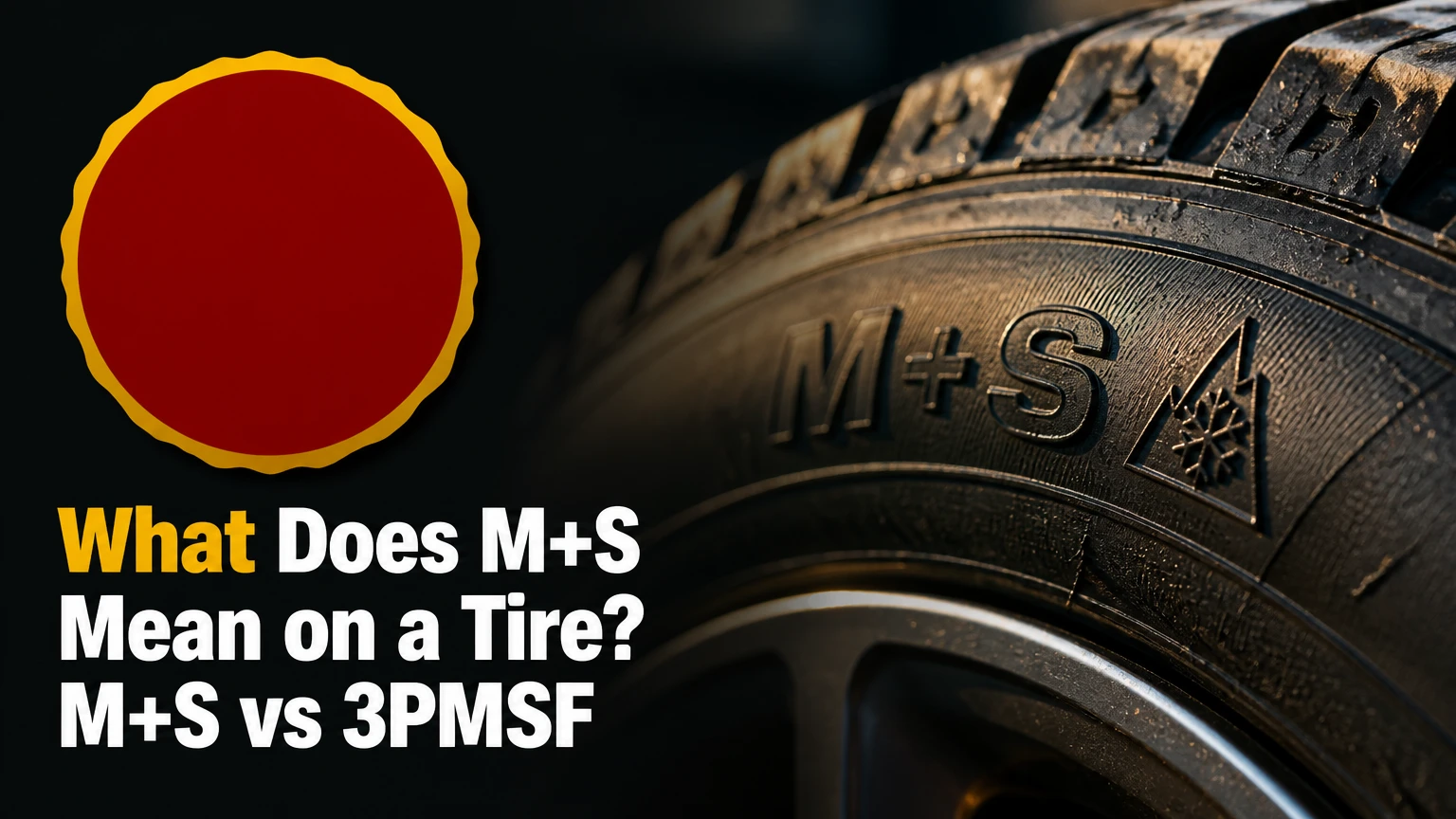
M+S on a tire means “Mud and Snow.” The marking identifies a tread pattern designed to clear mud and fresh snow more effectively than a conventional highway or summer pattern. M+S is not, by itself, proof that the tire passed an independent snow-traction test or will grip ice safely.
Key Facts at a Glance
- M+S means Mud and Snow, and M&S and M/S are common equivalent forms.
- M+S primarily describes tread geometry, including open grooves and lateral traction features.
- M+S does not require the same severe-snow performance test as the 3PMSF symbol.
- The 3PMSF symbol shows a tire passed a regulated snow-traction test for severe-snow service.
- A practical winter inspection target is at least 4/32 inch of usable tread, although laws vary.
- Four-wheel drive improves propulsion, but M+S tires still determine much of the vehicle’s braking grip.
What Does M+S Mean on a Tire?
M+S means Mud and Snow, a sidewall designation used for tires whose tread design is intended to provide better traction in mud and fresh snow than a basic highway tread. The marking may appear as M+S, M&S, or M/S, depending on the manufacturer and market.
The designation describes a design intention rather than a measured stopping distance. A tire can carry M+S and still perform poorly on polished ice, packed snow, or cold pavement if its rubber compound, siping, carcass, and tread construction are not optimized for winter conditions.
On many passenger tires, the marking appears near the tire size, load index, speed rating, and other sidewall information. It may also appear beside an all-terrain or mud-terrain designation. The letters do not indicate that the tire is a dedicated winter tire.
The U.S. Tire Manufacturers Association describes mud-and-snow tires through tread features intended to improve performance in those conditions. In practical terms, M+S tells you more about how the tread clears loose material than how the tire stops on frozen surfaces.
What does the marking look like?
The marking usually appears as one of these sidewall forms:
| Sidewall marking | Meaning | Common application | Independent snow test required |
|---|---|---|---|
| M+S | Mud and Snow | Passenger all-season tire | No |
| M&S | Mud and Snow | Older passenger and SUV tire | No |
| M/S | Mud and Snow | Light-truck and all-terrain tire | No |
| 3PMSF | Severe snow service | All-weather or winter tire | Yes, applicable regulated test |
A tire can carry both M+S and 3PMSF. In that case, M+S identifies the tread design while 3PMSF identifies compliance with a severe-snow traction requirement.
How Does the M+S Tread Pattern Work?
An M+S tread pattern uses open space and lateral grooves to move mud, slush, and loose snow away from the contact area. As the tire rotates, tread blocks compress into the road, collect soft material in the voids, and release that material when the blocks leave the ground.
The often-cited 25% void figure describes a minimum proportion of open tread area used in common regulatory definitions and industry explanations. Exact requirements can differ by jurisdiction, vehicle class, and applicable standard, so the sidewall mark should not be treated as a universal performance score.
The mechanism has four stages:
- Compression: Vehicle weight presses the tread blocks against the road.
- Collection: Mud, slush, or powder snow enters grooves between the blocks.
- Release: Tread flex and centrifugal force help eject the material.
- Recontact: Cleared tread returns to the road for the next rotation.
M+S geometry becomes less helpful when snow is hard-packed or wet and polished. Ice provides almost no material for the voids to clear, so grip depends more heavily on rubber flexibility, biting edges, siping, tread compound, temperature, and vehicle speed.
What does the 25% void ratio mean?
A 25% void ratio means roughly one-quarter of the tread face is open groove area rather than solid rubber, under the relevant measurement method. It is a geometric threshold, not a score that predicts braking distance.
Two tires can have similar open-area proportions but deliver different winter results because their compounds, block stiffness, sipe density, contact pressure, and construction differ. The 25% figure therefore explains why an M+S tire can clear loose snow, but it cannot rank one M+S tire against another.
Is M+S the Same as 3PMSF?
M+S and 3PMSF are not equivalent ratings. M+S generally reflects a manufacturer-declared tread design, while 3PMSF, the Three-Peak Mountain Snowflake symbol, identifies a tire that passed a defined snow-traction test.
In the United States and Canada, the severe-snow symbol is associated with testing based on ASTM F1805 procedures for standardized snow traction. The test compares the candidate tire with a reference tire under controlled conditions. A 3PMSF tire therefore provides stronger evidence of snow acceleration performance than M+S alone, although no symbol guarantees safe driving on every road.
| Feature | M+S only | 3PMSF all-weather | 3PMSF winter |
|---|---|---|---|
| Primary signal | Tread geometry | Snow traction plus all-season construction | Snow traction plus winter construction |
| Snow test | Manufacturer designation | Required applicable test | Required applicable test |
| Compound focus | Broad temperature range | Cold-weather flexibility | Maximum cold-weather flexibility |
| Typical use | Rain, dry roads, light snow | Year-round moderate winter | Frequent snow, ice, and freezing roads |
| Summer suitability | Usually high | Usually acceptable | Reduced by heat and wear |
| Ice performance | Limited | Better, but variable | Usually strongest option |
The mountain symbol does not automatically mean an all-weather tire is identical to a dedicated winter tire. A winter tire normally uses a more cold-focused compound and denser siping, while an all-weather tire balances winter traction with warmer-weather handling and tread life.
Why does 3PMSF matter more than M+S?
3PMSF matters because the symbol adds a measured traction requirement to the tire’s design description. M+S can indicate useful loose-snow geometry, but it does not establish a standardized result for acceleration, braking, or cornering on ice.
The distinction is important for drivers who regularly encounter compacted snow, freezing rain, mountain passes, or roads that remain below freezing. A 3PMSF tire is not invincible, but it is a more meaningful winter-performance filter than M+S alone.
Which Tires Carry an M+S Marking?
Standard all-season, all-terrain, mud-terrain, all-weather, and winter tires may carry an M+S marking. The letters identify one characteristic and do not define the entire tire category, so two M+S tires can have very different road manners and winter capability.
| Tire category | Common sidewall symbols | Typical tread depth when new | Typical best-use temperature |
|---|---|---|---|
| Highway all-season | M+S, manufacturer model name | 10/32-12/32 in | Above 45°F, with occasional cold use |
| All-terrain | M+S, sometimes 3PMSF | 12/32-16/32 in | Mixed pavement and loose surfaces |
| All-weather | M+S and 3PMSF | 10/32-13/32 in | Year-round use with regular cold weather |
| Dedicated winter | M+S and 3PMSF | 11/32-13/32 in | Frequent temperatures below 45°F |
These tread-depth ranges are typical retail specifications, not requirements for every model. Manufacturer data for the exact tire should control when specifications conflict with general categories.
Are all-season tires M+S tires?
Many all-season tires carry M+S, but “all-season” and M+S are not synonyms. All-season describes a product category intended for a broad temperature range, whereas M+S describes a tread marking.
A conventional all-season tire may work well in rain, dry weather, and occasional light snow. It may still lose flexibility and traction compared with a 3PMSF tire on cold, compacted snow. The model’s test results, compound, siping, and climate suitability matter more than the all-season label alone.
Are all-terrain tires automatically good winter tires?
All-terrain tires are not automatically good winter tires. Many have M+S tread geometry for dirt, mud, gravel, and loose snow, but only models carrying 3PMSF have passed the applicable severe-snow traction test.
Large tread blocks can help in deep loose snow while producing less consistent grip on packed snow. A three-quarter-ton truck carrying a load, for example, may need a different tire balance than a compact crossover driven mainly on wet urban pavement.
Does Cold Weather Change M+S Grip?
Cold weather can reduce the grip of a conventional M+S tire because many all-season compounds become less flexible as temperatures fall. The commonly used 45°F, or 7°C, guideline is a practical tire-selection rule, not a precise point at which every tire suddenly becomes unsafe.
Rubber does not switch from safe to dangerous at one universal temperature. Compound formulation, tire age, road temperature, sun exposure, inflation pressure, and road texture all affect grip. A quality all-season tire may remain controllable below 45°F, while a worn or aged tire can perform poorly at a higher temperature.
The 7°C guideline is most useful for repeated seasonal conditions. If daytime temperatures remain below that level and roads regularly freeze overnight, an all-weather or winter tire generally provides a larger safety margin than an M+S-only tire.
What happens below 45°F?
Below 45°F, an M+S-only tire may lose some compliance and braking grip, especially on wet, shaded, or frozen pavement. The result is usually a gradual reduction rather than an immediate failure.
A driver can notice the difference during emergency braking, lane changes, or hill starts. Cold pressure also falls as temperature drops, often by about 1 psi for each 10°F decrease, although the exact change depends on the tire and starting temperature. Check pressure against the vehicle placard, not the maximum pressure molded into the sidewall.
How Much Tread Is Needed for Snow?
At least 4/32 inch of remaining tread is a practical winter-driving inspection target, not a universal legal minimum. Below that depth, a tire has less groove volume for snow evacuation and generally less margin in slush and standing water.
Some jurisdictions permit operation until the legal wear-bar limit, commonly 2/32 inch for passenger tires in the United States. Legal minimum and winter-safe condition are different decisions. A tire can be legal while offering substantially less snow performance than when new.
| Remaining tread | Approximate condition | Snow and slush implication | Recommended action |
|---|---|---|---|
| 10/32-12/32 in | Typical new all-season range | Maximum groove capacity | Monitor pressure and wear |
| 6/32-8/32 in | Moderate wear | Reduced loose-snow reserve | Plan seasonal replacement |
| 4/32-5/32 in | Winter inspection threshold | Limited snow margin | Replace before severe winter |
| 2/32-3/32 in | Near legal limit in many U.S. states | Poor wet and snow evacuation | Replace immediately |
| Below 2/32 in | Below common U.S. legal limit | Severe hydroplaning and snow risk | Do not operate on public roads |
Measure tread in several grooves across the tire. Uneven inner-edge wear, shoulder wear, or a single low measurement can reveal alignment, inflation, suspension, or rotation problems that a center measurement misses.
When Are M+S Tires Enough?
M+S tires are usually adequate for drivers in mild climates who encounter rain, dry pavement, and occasional light, newly fallen snow on promptly cleared roads. M+S-only tires become a weak choice when driving regularly involves ice, packed snow, sustained freezing temperatures, steep grades, or emergency travel during storms.
The road surface matters more than the forecast label. A short commute on treated city streets differs from a rural route where compacted snow remains for days. An M+S tire can move through loose snow yet deliver disappointing stopping performance at the first icy intersection.
Are M+S tires enough for 4WD?
Four-wheel drive does not make M+S-only tires equivalent to winter tires. Four-wheel drive distributes engine torque to multiple wheels and can improve acceleration, but braking still depends on tire-road friction, and cornering remains limited by the same contact patches.
The National Highway Traffic Safety Administration summarizes the distinction this way: “Four-wheel drive helps you get going in snow, but it doesn’t help you stop any faster.” That principle also applies to all-wheel-drive crossovers. Drivetrain assistance cannot create additional friction on ice.
For a 4WD vehicle, choose 3PMSF tires when winter roads are frequent, then use the vehicle manufacturer’s recommended matching configuration. Many modern vehicles require all four tires to have closely matched circumference and construction.
Are M+S Tires Legal for Winter Driving?
M+S tires may satisfy winter-equipment rules in some jurisdictions, but regulations differ by country, state, province, road, vehicle weight, and weather event. Some mountain corridors require 3PMSF tires or chains during posted restrictions, while other locations accept M+S markings.
Check the transportation authority for every jurisdiction on your route. A tire that is legal in the vehicle’s home state may not meet a chain-control requirement on a pass across the border.
| Situation | M+S-only status | 3PMSF status | Practical decision |
|---|---|---|---|
| Mild U.S. city winter | Usually permitted | Permitted | Choose according to climate |
| Posted severe-snow restriction | May be insufficient | More likely accepted | Check current road signs |
| Canadian mountain route | Rules vary by province | Commonly preferred or required | Verify provincial requirements |
| Commercial or heavy vehicle use | Category-specific rules | May have additional conditions | Consult fleet and local rules |
Legal compliance is the floor, not a guarantee of traction. Drivers remain responsible for speed, following distance, visibility, tire condition, and road conditions.
Can M+S and 3PMSF Tires Be Mixed?
Mixing M+S and 3PMSF tires can reduce handling consistency and should be avoided unless the vehicle and tire manufacturer explicitly permit the arrangement. Different compounds and tread designs can produce unequal braking, cornering, and acceleration responses on snow.
Replace tires in axle pairs when possible, and install matching tires on all four wheels for most all-wheel-drive vehicles. If only two tires are replaced on a two-wheel-drive vehicle, the deeper-tread pair is generally installed on the rear axle to reduce oversteer risk, subject to the vehicle manufacturer’s instructions.
Do not mix different tire sizes, load ranges, speed ratings, or construction types merely because all four sidewalls carry M+S. Tire matching is a vehicle-engineering issue, not a symbol-matching exercise.
Why Are M+S Tires Losing Traction?
M+S tires commonly lose traction because of insufficient tread, incorrect pressure, aged rubber, compacted snow, ice, or a mismatch between tire capability and road conditions. Wheel spin at launch and frequent ABS activation indicate limited available friction, but neither symptom identifies one single fault.
Use this diagnostic sequence:
- Check cold pressure: Inflate all tires to the door-jamb specification.
- Measure tread: Check multiple points and look for measurements near 4/32 inch.
- Inspect age: Read the DOT date code; the final four digits identify production week and year.
- Look for uneven wear: Feathering, cupping, and shoulder wear require mechanical inspection.
- Assess the surface: Packed snow and ice exceed the strength of M+S geometry alone.
- Review the compound: Consider 3PMSF all-weather or winter tires for repeated cold-weather driving.
Tire age matters even when tread remains. Michelin and other manufacturers advise regular professional inspection after five years in service and replacement consideration around ten years from manufacture, with the exact recommendation depending on storage, climate, and condition.
What is M+S not good for?
M+S is not a guarantee of short braking distances on ice, stable cornering on hard-packed snow, or reliable traction below freezing. M+S also does not certify resistance to hydroplaning, fuel economy, tread life, or high-speed handling.
The marking cannot tell you whether a tire is quiet, durable, suitable for towing, or compatible with your vehicle’s load requirement. Those attributes require the model specification, test data, vehicle placard, and operating context.
Which Tire Rating Should You Choose?
Choose M+S-only tires for predominantly mild-weather driving with rare light snow, 3PMSF all-weather tires for year-round use with recurring winter conditions, and dedicated 3PMSF winter tires for frequent snow, ice, or sustained freezing roads.
| Driver and climate | Typical winter temperature | Road condition | Recommended rating |
|---|---|---|---|
| Coastal commuter | 35-55°F | Wet pavement, cleared roads | M+S all-season |
| Urban cold-weather driver | 20-40°F | Slush, occasional packed snow | 3PMSF all-weather |
| Northern suburban driver | 10-30°F | Frequent snow and freezing roads | 3PMSF winter or all-weather |
| Mountain or rural driver | 0-25°F | Grades, ice, unplowed snow | Dedicated 3PMSF winter |
| Off-road truck user | 15-50°F | Mud, gravel, loose snow | M+S or 3PMSF all-terrain, based on winter frequency |
What should a budget-conscious driver do?
A budget-conscious driver should buy the rating that matches actual winter exposure rather than selecting M+S solely because it costs less. A second set of winter wheels can reduce seasonal mounting charges, while all-weather tires can lower storage and changeover costs for moderate climates.
Typical U.S. retail pricing varies widely by vehicle size and brand. Four mainstream all-season tires may cost approximately $500-$900 before installation, four all-weather tires about $600-$1,100, and four winter tires about $550-$1,200. Installation, disposal, wheels, storage, taxes, and local availability can change the total substantially.
What should an off-road driver do?
An off-road driver should distinguish loose-surface traction from winter-road traction. M+S all-terrain tread can clear mud and deep loose snow, but 3PMSF all-terrain tires offer stronger evidence for packed-snow use.
Large voids are not a substitute for flexible winter rubber. A tire optimized for rocky trails may have stiff blocks and weak ice performance, so choose based on the percentage of driving that occurs on public winter pavement.
Expert Rules for Reading the Marking
Rule one: read the symbol beside the tread depth. A mountain with a snowflake inside it is more significant for severe snow than M+S alone. The two symbols can coexist, and their meanings should not be conflated.
Rule two: judge the whole tire, not the letters. Model-specific compound, sipe design, casing, load range, tread depth, age, and pressure can outweigh the M+S designation in real driving.
Rule three: braking exposes weaknesses first. A tire may climb a snowy driveway under power and still fail to stop effectively at an icy junction. Test acceleration claims are not braking guarantees.
Rule four: install matching tires on all-wheel-drive vehicles. Circumference differences can stress driveline components and confuse stability-control systems, even when the sidewall symbols appear compatible.
FAQ
Does M+S mean a tire is all-season?
M+S does not mean all-season. M+S identifies a mud-and-snow tread designation, while all-season describes a tire category intended for broad annual use. Many all-season tires carry M+S, but some all-weather and winter tires do as well. Review the complete model specification and look for 3PMSF when winter traction matters.
Can I drive M+S tires in snow?
You can drive M+S tires in light, loose snow when tread depth, pressure, speed, and road conditions are suitable. M+S tires are less dependable on ice, packed snow, steep grades, and repeated freezing roads. A 3PMSF all-weather or winter tire provides a stronger winter margin.
How long do M+S tires last?
M+S tire life commonly ranges from 30,000-70,000 miles, depending on compound, vehicle weight, alignment, inflation, driving style, climate, and rotation intervals. Mileage is not a replacement rule. Replace tires at the legal wear limit, around 4/32 inch for winter use, or sooner when cracking, uneven wear, or age reduces safety.
Can I use M+S tires in summer?
Most M+S all-season and all-terrain tires can be used in summer if their speed, load, pressure, and condition meet the vehicle requirements. Dedicated winter tires should be removed when sustained warm weather arrives because soft winter compounds wear faster and can reduce dry-road handling.
Does the snowflake symbol mean a tire is studded?
The 3PMSF snowflake symbol does not mean a tire is studded. The symbol identifies severe-snow traction certification, while studs are separate metal traction devices installed only on approved tire models and during legally permitted periods. Studded tires may also carry M+S and 3PMSF markings.
Should I replace all four M+S tires at once?
Replacing all four M+S tires at once usually provides the most consistent handling, especially on all-wheel-drive vehicles. If replacement of two tires is necessary, follow the vehicle manufacturer’s instructions; many tire professionals place the deeper-tread pair on the rear axle to improve wet and snow stability.
The Bottom Line
M+S on a tire means Mud and Snow, but the marking primarily describes tread geometry and loose-material clearing ability. It does not certify ice grip, cold-weather braking, or severe-snow performance.
For occasional light snow on cleared roads, a sound M+S all-season tire may be sufficient. For regular winter conditions, choose a tire with the 3PMSF symbol, and select a dedicated winter tire when snow, ice, steep grades, and freezing temperatures dominate your driving. M+S tells you what the tread was designed to handle. The complete tire specification tells you whether it is appropriate for your roads.