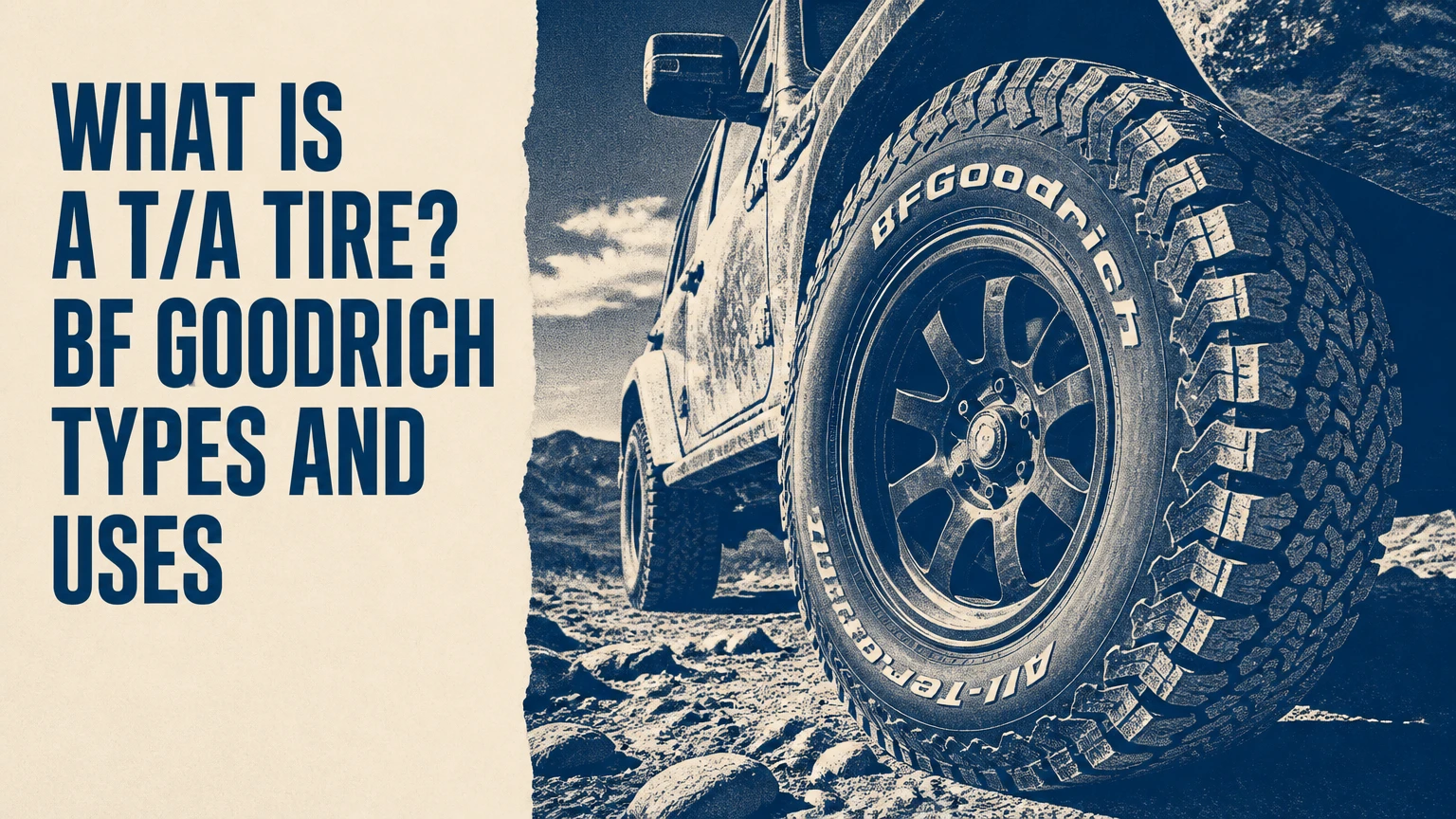
A T/A tire is primarily a BFGoodrich product designation, traditionally understood as “Traction Advantage.” The name identifies a family of tires for classic cars, passenger vehicles, light trucks, SUVs, and work trucks; it is not a universal tire-construction code used by every manufacturer. BFGoodrich T/A models differ substantially in tread, casing, load rating, noise, winter performance, and intended terrain.
Key Facts at a Glance
- T/A means “Traction Advantage” in BFGoodrich product naming and has historical links to the SCCA Trans-Am racing era.
- Radial T/A is the classic raised-white-letter tire associated with American muscle cars and period-style restorations.
- All-Terrain T/A KO2 and KO3 are truck and SUV tires designed for mixed pavement, gravel, dirt, and moderate trail use.
- Mud-Terrain T/A KM3 prioritizes deep mud and technical off-road traction over quiet highway operation.
- HD-Terrain T/A KT targets heavy-duty pickups and demanding commercial or work-truck service.
- A T/A label alone does not confirm fitment: vehicle placard pressure, tire size, load index, speed rating, and axle compatibility still determine safety.
What Does T/A Mean on a Tire?
T/A means “Traction Advantage” in BFGoodrich’s naming system, although the letters do not provide a complete technical description of the tire. BFGoodrich developed the designation as a proprietary product identity, and the name is commonly associated with the company’s performance and all-terrain tire history.
The designation is also linked historically with the Sports Car Club of America’s Trans-Am racing series. That history explains why the name appears on tires associated with American performance cars, but modern T/A products extend far beyond racing or muscle cars.
T/A is therefore different from markings such as P, LT, XL, M+S, and 3PMSF. Those markings communicate vehicle category, construction or load configuration, or winter-use certification. T/A communicates the product family or model name. The complete sidewall is required to identify the tire’s actual specifications.
For example, LT265/70R17 121/118S identifies an LT tire with a 265-millimeter section width, 70-series aspect ratio, radial construction, 17-inch wheel diameter, dual load indexes of 121 and 118, and an S speed rating. “T/A KO2” identifies the BFGoodrich model family, not those performance limits.
What Are T/A Tires Designed to Do?
BFGoodrich T/A tires are designed around different traction priorities rather than one common performance formula. Radial T/A models emphasize classic styling and dry-road driving, All-Terrain models balance pavement with loose surfaces, Mud-Terrain models maximize open-tread off-road grip, and HD-Terrain models tolerate heavier work-truck demands.
How Does a T/A Tire Produce Traction?
A T/A tire generates traction through the interaction of tread compound, tread geometry, sipes, casing stiffness, contact pressure, and the surface beneath the vehicle. Road-oriented tires use a more continuous tread footprint for predictable steering and lower noise, while off-road tires use voids, reinforced shoulders, and flexible edges to clear mud or conform to uneven ground.
BFGoodrich technologies vary by model. KO2 and KO3 all-terrain tires use features intended to resist gravel damage and improve tread-block stability, while KM3 mud-terrain tires use large, open blocks for loose terrain. A feature shown in marketing for one model should not automatically be assumed to exist in every tire carrying the T/A name.
Tread-block phasing can reduce repetitive noise by preventing identical blocks from striking the pavement at one frequency. Sipes create additional edges for wet or snowy surfaces, but aggressive siping can reduce block stability if the tread is not properly supported. Sidewall reinforcement can improve puncture resistance and lateral control, but it also adds weight and may transmit more impact harshness.
What Are the Main T/A Tire Families?
The main T/A families are Radial T/A for classic passenger vehicles, All-Terrain T/A for mixed road and trail driving, Mud-Terrain T/A for severe off-road terrain, and HD-Terrain T/A for heavy-duty truck work. Their names overlap, but their use cases are not interchangeable.
| BFGoodrich family | Primary vehicle | Typical surface | Main advantage | Main compromise |
|---|---|---|---|---|
| Radial T/A | Classic cars, coupes, muscle cars | Dry pavement, wet pavement | Raised white letters and period appearance | Less suitable for severe snow or trails |
| All-Terrain T/A KO2 | Pickups, Jeeps, SUVs | Asphalt, gravel, dirt, snow | Balanced road and off-road capability | More noise and weight than touring tires |
| All-Terrain T/A KO3 | Pickups, SUVs, overland vehicles | Highway, gravel, rocky trails | Updated all-terrain durability and road behavior | Higher purchase price than basic highway tires |
| Mud-Terrain T/A KM3 | Modified 4x4s, trail vehicles | Mud, rocks, deep ruts | Open tread and strong off-road bite | Noise, vibration, and pavement wear |
| HD-Terrain T/A KT | Heavy-duty pickups, work trucks | Pavement, job sites, gravel | Work-oriented durability and load capability | Firm ride and limited passenger-car suitability |
What Is a BFGoodrich Radial T/A?
The BFGoodrich Radial T/A is a classic-style radial tire intended mainly for vintage American cars, muscle cars, hot rods, and restorations. Its most recognizable feature is the raised white letter sidewall, although many sizes can be mounted with the black side facing outward.
Radial T/A fitments commonly appear in 14-inch and 15-inch wheel applications, with some larger sizes available depending on market and production. The tire preserves a traditional appearance while using modern radial construction and an all-season-oriented tread compound.
The Radial T/A is not the ideal choice for every classic car. Owners should verify the tire’s load index, speed rating, actual section width, wheel width, clearance, and wet-weather expectations. A period-looking tire may have a lower speed rating than a modern performance tire, and a classic suspension may need more attention than the tire itself.
What Are the KO2 and KO3 All-Terrain Tires?
BFGoodrich All-Terrain T/A KO2 and KO3 tires are light-truck and SUV tires for drivers who divide mileage between pavement and unpaved surfaces. They generally provide stronger sidewalls and more damage resistance than highway-terrain tires, while remaining more road-friendly than a mud-terrain design.
The 3PMSF symbol, when present on the specific size, indicates that the tire passed an industry severe-snow traction test. It does not make the tire a dedicated winter tire. The rubber compound and tread behavior of a three-peak mountain snowflake all-terrain tire still differ from those of a cold-weather winter tire.
KO3 is the newer generation in the product line. Exact sizes, load ranges, speed ratings, tread warranties, and construction details vary by market and SKU, so buyers should verify the product page and sidewall rather than generalizing from the model name.
What Is the KM3 Mud-Terrain T/A?
The BFGoodrich Mud-Terrain T/A KM3 is an off-road tire designed for deep mud, rocks, sand, ruts, and technical trail driving. Its large tread blocks and substantial shoulder geometry can maintain forward movement when a less open tread packs with mud.
KM3 is a poor match for a vehicle that spends nearly all its time on smooth pavement and must remain quiet. Mud-terrain tread can produce a pronounced hum, wear faster under frequent highway cornering, and feel less precise than an all-terrain or highway-terrain tire.
What Is the HD-Terrain T/A KT?
The HD-Terrain T/A KT is intended for heavy-duty pickups and work-oriented applications where high torque, towing, gravel, and job-site surfaces place more stress on the tread and shoulder. The correct choice still depends on the truck’s required load range and the manufacturer’s fitment approval.
A heavy-duty name does not authorize overloading. The truck’s certification label, axle ratings, wheel ratings, tire load index, and inflation requirements remain controlling limits.
How Do the Main T/A Families Compare?
The best T/A family depends on the surface carrying most of the vehicle’s mileage. Radial T/A suits appearance-focused classic-car use, KO2 or KO3 suits mixed road and trail travel, KM3 suits severe trails, and KT suits work-truck duty.
| Decision factor | Radial T/A | All-Terrain KO2 or KO3 | Mud-Terrain KM3 | HD-Terrain KT |
|---|---|---|---|---|
| Best vehicle | 1960s-1980s style car | Jeep, SUV, half-ton pickup | Modified 4×4 | Heavy-duty pickup |
| Highway noise | Low to moderate | Moderate | High | Moderate to high |
| Severe-snow marking | Usually not the primary feature | Available on specified sizes | Size-dependent, verify sidewall | Size-dependent, verify sidewall |
| Off-road emphasis | 0-10% unpaved use | 20-50% unpaved use | 50% or more technical use | Job sites and gravel |
| Typical size range | 14-15 inches commonly | 15-22 inches, size-dependent | 15-20 inches, size-dependent | 17-20 inches, size-dependent |
| Typical price per tire | $150-$250 or more | $220-$400 or more | $250-$450 or more | $250-$450 or more |
| Main drawback | Limited severe-weather flexibility | Weight and rolling resistance | Noise and pavement wear | Firmness and cost |
The percentages in the table are practical selection guidelines, not manufacturer requirements. A driver who occasionally reaches a trailhead does not automatically need a mud-terrain tire.
Which T/A Tire Fits a Classic or Muscle Car?
The Radial T/A is usually the appropriate T/A choice for a classic or muscle car when raised white letters, period appearance, and ordinary road use are priorities. A modern ultra-high-performance tire may deliver sharper wet braking or cornering, but it can look and feel wrong on a restored vehicle.
Before ordering, compare the original tire size with the available Radial T/A size and measure wheel clearance. A wider tire can contact a front sway bar, control arm, inner fender, or rear quarter panel during steering or suspension compression.
The raised white lettering can face outward for the traditional presentation or inward for a more understated appearance. Wash white letters with water and a non-petroleum cleaner. Tire browning often results from antiozonant chemicals migrating through the rubber, not from ordinary road dirt alone.
Are T/A Tires Suitable for Snow?
Some All-Terrain T/A sizes carry the 3PMSF severe-snow symbol, but a T/A tire is not automatically a winter tire. KO2 and KO3 can be reasonable choices for drivers who encounter occasional snow and also need gravel or trail durability, while dedicated winter tires remain preferable for repeated ice, packed snow, and low temperatures.
The M+S marking is less demanding than 3PMSF and should not be treated as equivalent certification. Drivers in regions with frequent winter storms should compare stopping distance, temperature range, local tire laws, and the vehicle’s drivetrain before choosing an all-terrain tire.
A four-wheel-drive system improves propulsion but does not eliminate the need for appropriate tires. Steering and braking still depend on the tire’s available friction.
How Much Do T/A Tires Cost?
T/A tires typically cost about $150-$250 or more per tire for Radial T/A sizes and $220-$450 or more per tire for truck-oriented KO2, KO3, KM3, and KT sizes. Installed totals increase after mounting, balancing, valve stems, disposal fees, taxes, and optional road-hazard coverage.
| Purchase scenario | Tire-only range | Typical installation additions | Approximate four-tire total before tax |
|---|---|---|---|
| Radial T/A, 14-15 inch | $150-$250 each | $20-$45 each | $680-$1,180 |
| KO2 or KO3, 16-18 inch | $220-$350 each | $25-$50 each | $980-$1,600 |
| KM3, 17-20 inch | $250-$450 each | $25-$55 each | $1,100-$2,020 |
| KT, heavy-duty sizes | $250-$450 each | $30-$60 each | $1,120-$2,040 |
These are typical retail planning ranges, not fixed prices. Size, load range, retailer, region, promotions, and availability can move the final invoice substantially.
How Long Do T/A Tires Last?
T/A tread life commonly falls between 40,000 and 60,000 miles, but the range is a planning estimate rather than a promise. Radial T/A use on a performance-oriented car may approach 40,000 miles, while an all-terrain tire used gently on pavement may approach 50,000-60,000 miles.
Mud, rocks, low inflation, aggressive acceleration, heavy towing, poor alignment, and frequent hard cornering shorten service life. Front-wheel-drive vehicles can also wear front tires much faster when rotations are ignored.
Age matters even when tread remains. The U.S. Tire Manufacturers Association advises regular inspection of older tires, and the National Highway Traffic Safety Administration recommends replacing tires that show aging damage or have reached the vehicle or tire maker’s stated age guidance. Read the DOT date code: the final four digits identify the week and year of manufacture, such as 2324 for week 23 of 2024.
A six-year limited warranty is a warranty term, not a guaranteed six-year operating life. Warranty coverage depends on mileage, defects, maintenance records, and the manufacturer’s written conditions.
What Should You Check Before Buying a T/A Tire?
Check the vehicle placard, the existing tire sidewall, wheel dimensions, and the intended driving surface before purchase. The vehicle placard, usually found on the driver-door jamb, specifies the manufacturer’s recommended cold inflation pressure and original tire size.
Use this checklist:
- Match the size: Confirm width, aspect ratio, wheel diameter, and approved replacement dimensions.
- Match the load index: Do not install a tire with less load capacity than the vehicle requires.
- Check the speed rating: A classic Radial T/A may have a lower rating than a modern performance tire.
- Confirm P or LT construction: LT tires can be heavier and may require different pressure practices.
- Verify 3PMSF status: Check the exact size if severe-snow capability matters.
- Check wheel width and clearance: Account for steering lock, suspension compression, and chain clearance.
- Confirm axle matching: Use the same model, size, and similar tread depth across an axle.
- Inspect the date code: Avoid old inventory when storage history is uncertain.
The sidewall’s maximum pressure is not automatically the correct operating pressure. Inflate to the vehicle placard specification unless a qualified tire professional or vehicle manufacturer provides a documented alternative.
What Problems Can T/A Tires Develop?
Common T/A tire problems include uneven wear, vibration, sidewall damage, wet-weather underperformance, excessive noise, and premature aging. Most problems result from vehicle condition, inflation, alignment, load, or application mismatch rather than a single defective tread pattern.
| Symptom | Likely cause | First diagnostic action | Corrective response |
|---|---|---|---|
| Center tread wears first | Overinflation or light load | Measure cold pressure against placard | Correct pressure and inspect wear |
| Both shoulders wear first | Underinflation or overload | Check pressure and axle load | Inflate correctly and reduce overload |
| Cupping or scalloping | Worn shocks, imbalance, misalignment | Inspect suspension and balance | Repair suspension, align, and rotate |
| Steering-wheel vibration | Wheel imbalance, bent wheel, tire runout | Road-force balance and inspect wheel | Balance, repair, or replace component |
| White letters turn brown | Antioxidant migration or harsh cleaner | Wash with water and mild cleaner | Avoid petroleum-based dressings |
| Rapid off-road shoulder damage | Low clearance, sharp rocks, incorrect pressure | Inspect cuts and sidewall bruises | Adjust route, pressure, or tire choice |
A vibration that appears suddenly after a trail drive may indicate a packed mud-covered wheel, bent rim, internal tire damage, or a separated belt. Do not continue at highway speed until the cause is identified.
Rotate tires according to the vehicle manufacturer’s schedule. A typical interval is 5,000-7,500 miles, but directional tires, staggered fitments, and performance vehicles may require a different pattern or may not permit front-to-rear rotation.
Can You Mix Different T/A Models?
Mixing different T/A models on the same axle is generally poor practice, and mixing substantially different tires across an AWD vehicle can create drivetrain and stability-control problems. KO2, KO3, KM3, Radial T/A, and KT tires have different diameters, tread stiffness, void ratios, and handling responses even when their nominal sizes match.
Replace tires in axle pairs when possible. If only two tires are replaced, the deeper-tread pair is commonly installed on the rear axle, subject to the vehicle manufacturer’s instructions, because rear traction helps resist oversteer on wet roads.
AWD vehicles require special care. Some manufacturers specify maximum circumference differences, often expressed as a small percentage or tread-depth limit. Follow the owner’s manual, not a generic tire-shop rule.
What Are the Alternatives to a T/A Tire?
The main alternatives are touring all-season tires for quiet pavement use, highway-terrain tires for pickups that rarely leave asphalt, dedicated winter tires for repeated cold-weather driving, and modern performance tires for sharper handling.
| Alternative | Better than Radial T/A for | Better than KO2 or KM3 for | Main sacrifice |
|---|---|---|---|
| Touring all-season | Quiet commuting and wet braking | Fuel efficiency and comfort | Minimal trail durability |
| Highway-terrain truck tire | Towing on paved roads | Lower noise and rolling resistance | Reduced loose-surface grip |
| Dedicated winter tire | Ice, packed snow, temperatures below 45°F | Cold-weather braking | Seasonal changeover and storage |
| Max-performance summer tire | Dry cornering and steering response | Road handling on modified cars | Poor cold and snow performance |
| Commercial all-position tire | Fleet mileage and highway duty | Heavy work schedules | Less classic styling or trail grip |
A T/A tire is a sensible choice when its specific strengths match the vehicle’s use. It is a poor choice when buyers select the name for appearance while ignoring winter climate, towing load, annual mileage, or highway comfort.
How Should T/A Tires Be Maintained?
Maintain T/A tires with monthly cold-pressure checks, regular rotation, prompt damage inspection, and periodic alignment evaluation. Check pressure before driving because heat from motion increases pressure and can conceal an underinflation problem.
Use a separate gauge rather than relying only on the vehicle’s TPMS. TPMS warns about pressure loss but may not warn when all four tires are uniformly underinflated.
For off-road driving, air-down pressure should follow the tire manufacturer’s guidance and the vehicle’s bead and wheel limitations. Reinflate before returning to pavement. Driving a heavily deflated tire at highway speed can cause heat buildup, bead damage, and casing failure.
Clean raised white letters with water, mild soap, and a soft or nylon brush. Avoid petroleum solvents, aggressive tire shine, and stiff metal brushes that can discolor or abrade the lettering.
Three Practitioner Rules That Prevent Expensive Mistakes
- Treat the placard as the starting pressure: The sidewall maximum is a structural limit, not a recommendation for that vehicle.
- Measure tread depth across the tire: A single center measurement can hide shoulder wear caused by underinflation or alignment faults.
- Match the tire to the percentage of pavement use: A KM3 chosen for occasional mud can waste fuel and comfort during thousands of highway miles.
Frequently Asked Questions
Does T/A Mean All-Terrain?
No. T/A is a BFGoodrich product designation, not a synonym for all-terrain. Radial T/A is a classic passenger-car tire, while KO2 and KO3 are all-terrain models. KM3 is mud-terrain, and KT is designed for heavy-duty truck use.
Are T/A Tires Good for Daily Driving?
All-Terrain T/A tires can work well for daily driving when the vehicle regularly encounters gravel, dirt, snow, or trails. Radial T/A suits ordinary classic-car road use. Drivers who spend nearly every mile on asphalt may get quieter operation, lower rolling resistance, and better wet-road manners from a touring or highway-terrain tire.
Are KO2 and KO3 the Same Tire?
KO2 and KO3 are different generations of BFGoodrich All-Terrain T/A tires. KO3 updates the product design, but availability, dimensions, load ranges, speed ratings, and severe-snow markings vary by size and market. Compare the exact SKU rather than assuming every KO3 specification is identical to KO2.
Can T/A Tires Be Used on a 4×4?
Yes, several T/A models are designed for 4×4 vehicles, including KO2, KO3, KM3, and some KT applications. Fitment requires the correct size, load index, wheel width, clearance, and inflation pressure. A Radial T/A passenger-car tire is not automatically suitable for a truck or off-road vehicle.
Why Are My T/A Tires Wearing Unevenly?
Uneven T/A tire wear usually results from incorrect pressure, misalignment, worn suspension components, imbalance, infrequent rotation, or excessive load. Cupping often points toward suspension or balance problems, while center wear commonly indicates overinflation. Have the vehicle inspected before replacing tires.
Should You Buy a T/A Tire?
Buy a T/A tire when the BFGoodrich model matches the vehicle and driving environment: Radial T/A for classic appearance, KO2 or KO3 for mixed road and trail use, KM3 for severe off-road terrain, and KT for demanding truck work. What is a T/A tire in practical terms? It is a branded family, not a single universal specification, so the exact model and sidewall ratings determine whether it is the right choice.