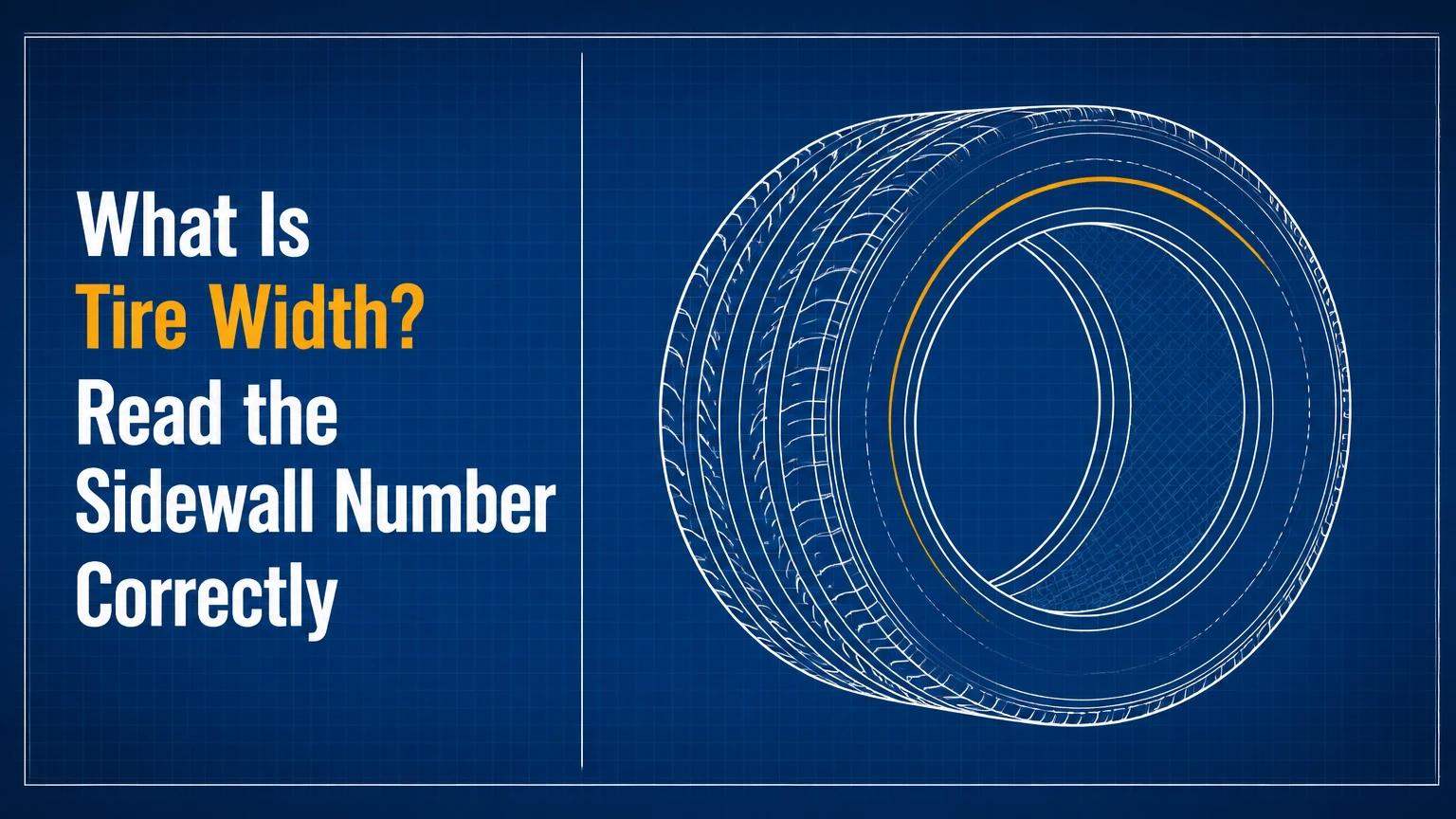
Tire width is the nominal distance across a properly inflated tire’s sidewalls, measured in millimeters on its approved measuring rim. The first three-digit number in a size such as 225/45R18 represents that section width, so 225 means approximately 225 millimeters, not the tread’s exact road-contact width.
Key Facts at a Glance
- Tire width is usually identified by the first three-digit number in a metric tire size.
- In 225/45R18, the 225 represents nominal section width in millimeters.
- Actual overall width varies by tire model, measuring rim, sidewall protectors, and approved rim width.
- Wider tires can improve dry-road cornering response but may increase weight, drag, noise, and tramlining.
- Tire width must match the wheel’s approved rim-width range, load requirement, clearance, and vehicle systems.
- The vehicle placard, usually found on the driver’s doorjamb, takes priority over the tire sidewall for inflation pressure.
What Is Tire Width?
Tire width is the nominal section width from one sidewall to the other, measured in millimeters after inflation on a specified rim. Tire manufacturers publish the measurement under industry testing conditions, so a tire marked 225 may measure somewhat wider or narrower when installed on a different rim.
The sidewall number identifies section width, not tread width. A 225-millimeter tire can have a tread that measures roughly 175-195 millimeters, depending on its tread design, shoulder shape, and construction. Decorative lettering, rim guards, and raised protective ribs can also make the overall tire wider than its stated section width.
Tire width affects the tire’s casing shape and the shape of its contact patch. Width also interacts with wheel width, offset, inflation pressure, aspect ratio, compound, tread pattern, load index, and suspension geometry. Width alone cannot predict braking distance or cornering grip.
Which Width Does the Sidewall Number Describe?
The three-digit sidewall number describes nominal section width. It excludes some raised sidewall features and does not tell you the exact width of the tread touching the pavement.
| Dimension | Meaning | Example value for a 225 tire |
|---|---|---|
| Section width | Nominal sidewall-to-sidewall measurement | 225 mm |
| Overall width | Maximum outside width including protectors | About 228-240 mm, model-dependent |
| Tread width | Width of the patterned tread area | About 175-195 mm, model-dependent |
| Sidewall height | Section width multiplied by aspect ratio | 101.25 mm at 45 aspect ratio |
The exact figures in the table are typical examples, not universal specifications. A tire manufacturer’s data sheet is the correct source for a particular model.
How Do You Read the Width on a Tire?
Read the first three-digit number in the metric size sequence. In 225/45R18 95V, 225 is the section width, 45 is the aspect ratio, R identifies radial construction, 18 is the wheel diameter, 95 is the load index, and V is the speed rating.
The complete code contains more than width. Replacing a tire requires matching the vehicle’s required load capacity and speed rating, not merely copying the first number.
| Marking | Meaning | Example |
|---|---|---|
| P | Passenger-car tire classification | P225/45R18 |
| 225 | Nominal section width | 225 mm |
| 45 | Aspect ratio | Sidewall height is 45% of 225 |
| R | Radial construction | Radial tire |
| 18 | Wheel diameter | 18 inches |
| 95 | Load index | 690 kg, or 1,521 lb, per tire |
| V | Speed rating | 240 km/h, or 149 mph, under rating conditions |
For factory replacement sizing, check the driver’s door placard first. The sidewall tells you what is currently mounted, while the placard and owner’s manual identify the vehicle manufacturer’s approved size and cold inflation pressure.
How Do You Calculate Sidewall Height?
Multiply section width by aspect ratio as a decimal. A 225/45 tire has a sidewall height of 101.25 millimeters because 225 × 0.45 equals 101.25.
The calculation matters when changing width or aspect ratio. Overall diameter is approximately:
Overall diameter = wheel diameter + 2 × sidewall height
For a 225/45R18 tire:
- Sidewall height: 225 × 0.45 = 101.25 mm
- Wheel diameter: 18 inches × 25.4 = 457.2 mm
- Approximate overall diameter: 457.2 + 202.5 = 659.7 mm
A width change without an aspect-ratio adjustment can alter diameter enough to affect speedometer readings, ground clearance, gearing, ABS calibration, and traction-control intervention.
How Does Tire Width Change Driving Behavior?
Tire width changes the tire’s casing shape, shoulder leverage, aerodynamic exposure, and road contact geometry. A wider tire usually creates a shorter, broader contact patch at the same load and pressure, while a narrower tire tends toward a longer, narrower patch.
The total contact area is governed mainly by vertical load and inflation pressure, not width alone. A useful approximation is:
Contact area ≈ tire load ÷ inflation pressure
At 1,000 pounds of load and 35 psi, the theoretical contact area is about 28.6 square inches before accounting for casing stiffness, tread curvature, and pressure distribution. A wider tire changes the shape and pressure distribution of that area rather than guaranteeing a larger total area.
Dry-Road Grip and Cornering
Wider tires can increase lateral stability when the compound, tread design, wheel width, and suspension are also appropriate. A broader tread may reduce tread-block distortion during hard cornering, but a premium narrow tire can outperform a poor-quality wide tire because rubber compound and construction often dominate.
A wider tire can also increase steering effort and road sensitivity. Front tires with wide tread blocks tend to follow grooves and pavement seams, a behavior commonly called tramlining. Electric power steering may mask the extra effort at low speed while transmitting more road texture at highway speed.
Braking and Acceleration
Width can help a vehicle use available dry-road grip, especially during repeated high-load braking or acceleration. It does not guarantee shorter stops because ABS, tire compound, road temperature, wetness, vehicle weight, and tread condition remain decisive.
On wet roads, a wider tire may need to displace more water laterally. Tread void ratio, groove design, speed, pressure, and water depth determine hydroplaning behavior, so the simple rule that every wide tire hydroplanes sooner is incomplete.
Fuel Economy, Noise, and Comfort
Wider tires commonly increase rolling resistance and aerodynamic drag, particularly when they also add mass or use a softer performance compound. The actual fuel penalty varies by tire construction, pressure, vehicle aerodynamics, wheel design, temperature, and driving speed; a universal miles-per-gallon penalty per 10 millimeters is not reliable.
| Width change | Typical vehicle effect | Main reason | Practical consequence |
|---|---|---|---|
| 195 to 205 mm | Small increase in steering stability | Broader tread and casing | Usually modest efficiency change |
| 205 to 225 mm | More lateral support | Wider contact shape and often larger wheel | Check clearance and rim width |
| 225 to 245 mm | Stronger dry-road response | Greater tread and shoulder capacity | More weight, noise, and tramlining risk |
| 245 to 275 mm | High-load performance capability | Larger casing and reinforced construction | Higher cost and fitment complexity |
Comfort depends heavily on sidewall height. Moving from 225/55R17 to 245/40R18 changes both width and sidewall height, so the harsher ride may result more from the shorter sidewall than from the extra 20 millimeters.
Which Tire Width Is Best for Different Vehicles?
The best width is the vehicle manufacturer’s approved size that satisfies load, clearance, handling, and operating conditions. Common ranges provide context, but they do not replace the placard because two vehicles with similar weights may use different widths and wheel offsets.
| Vehicle use | Common nominal widths | Typical priority | Fitment caution |
|---|---|---|---|
| Subcompact hatchback | 155-195 mm | Efficiency and snow mobility | Avoid exceeding factory rim width |
| Family sedan | 195-235 mm | Comfort, wet grip, and wear | Preserve diameter within approved limits |
| Sports coupe | 225-305 mm | Lateral grip and steering response | Check front and rear clearance separately |
| Crossover or SUV | 225-285 mm | Load, stability, and ground use | Match load index and inflation requirement |
| Pickup truck | 245-325 mm | Payload, towing, and terrain | Confirm axle load and wheel certification |
Vehicle category does not determine tire width by itself. A compact crossover with a heavy battery pack may require a higher load index than a lighter gasoline sedan, even when both use a 235-millimeter section width.
Are Front and Rear Tire Widths Always the Same?
No. A staggered setup uses different widths front and rear, such as 225/40R19 at the front and 255/35R19 at the rear. Performance vehicles may use staggered sizing to balance steering response with rear-drive traction, but AWD vehicles often require tightly matched rolling circumferences.
Never rotate a staggered setup front to rear unless the tire and wheel dimensions permit it. Mixing rolling diameters on an AWD system can create driveline stress or fault conditions, and the vehicle manufacturer’s service guidance controls.
How Does Wheel Width Affect Tire Fitment?
Wheel width determines how the tire’s beads are positioned and how the sidewalls support the tread. Every tire model has an approved rim-width range, and the correct range appears in the manufacturer’s technical specification rather than in a generic width chart.
For example, a 225/45R18 tire might be approved for a 7.0-8.5-inch wheel, but the exact range differs by model. A 7-inch wheel produces a different sidewall shape from an 8.5-inch wheel even though the tire marking remains unchanged.
| Tire size example | Typical approved rim range | Common fitment risk outside range |
|---|---|---|
| 205/55R16 | 5.5-7.5 in | Soft response on an excessively narrow rim |
| 225/45R18 | 7.0-8.5 in | Pinched or stretched sidewall |
| 245/40R19 | 8.0-9.5 in | Inner clearance and fender contact |
| 275/35R20 | 9.0-11.0 in | High cost and reduced pothole protection |
A narrow wheel can pinch a wide tire, round its tread profile, and reduce shoulder support. An excessively wide wheel can stretch the sidewall, expose the rim to impact damage, and make the tire less forgiving over potholes.
Can You Install a Wider Tire Safely?
You can install a wider tire safely only when the complete combination meets the vehicle, tire, and wheel manufacturer’s limits. The check must include rim width, load index, speed rating, outer diameter, offset, suspension clearance, fender clearance, steering lock, and local regulations.
A practical clearance check requires measuring both sides of the wheel. Increasing section width by 20 millimeters adds approximately 10 millimeters per side only when the wheel centerline remains unchanged; a different offset can move much more of the added width inward or outward.
Before buying, verify:
- The tire fits the wheel’s approved rim-width range.
- Load index equals or exceeds the vehicle requirement.
- Speed rating meets the original specification.
- Overall diameter stays within the vehicle’s accepted tolerance.
- The tire clears struts, brake components, fenders, and liners at full steering lock.
- The replacement wheel retains suitable offset and load capacity.
- TPMS sensors and valve stems are compatible.
- AWD, ABS, and traction-control requirements are preserved.
A tire shop should test-fit or measure the proposed combination rather than relying on appearance. Visual clearance at rest does not prove clearance during suspension compression or steering movement.
Are Narrow Tires Better for Winter?
Narrow tires can be advantageous in deep snow because they apply more load per unit of tread width and may cut through loose snow rather than float across it. Narrow sizing is not automatically safer on every winter surface, because the winter compound, tread pattern, temperature, and road clearing determine much of the result.
For packed snow and ice, a dedicated winter tire usually matters more than a modest width change. A 205-millimeter winter tire with a severe-snow-service rating can outperform a 195-millimeter all-season tire that becomes hard below freezing.
| Condition | Width tendency | More influential factor | Recommended check |
|---|---|---|---|
| Deep loose snow | Narrower can help | Tread void and vehicle clearance | Use approved winter size |
| Packed snow | Width effect is modest | Winter compound and sipes | Look for 3PMSF marking |
| Wet highway | Depends on tread design | Grooves, pressure, speed | Replace worn tires promptly |
| Dry summer roads | Wider may help | Compound and temperature | Match wheel and suspension |
| Ice | Width is secondary | Studs, compound, and braking | Drive below tire limits |
The vehicle placard may list a narrower winter size with a smaller wheel. Follow that approved configuration rather than improvising a width reduction.
What Problems Follow an Incorrect Width?
Incorrect tire width can produce rubbing, poor steering response, irregular wear, vibration, speedometer error, or reduced load capacity. The symptom usually identifies the system that needs inspection, but tire width is often only one part of the fault.
| Symptom | Likely cause | Inspection | Corrective action |
|---|---|---|---|
| Rubbing during turns | Excess width or incorrect offset | Check liner and strut marks | Restore clearance or approved fitment |
| Center tread wear | Overinflation or unsuitable profile | Measure cold pressure and tread depth | Set placard pressure, replace if damaged |
| Both shoulder edges worn | Underinflation or overload | Check pressure history and axle load | Correct pressure and load |
| Steering pulls into grooves | Wide tread, wear, or alignment | Inspect toe, camber, and tread | Align or choose approved size |
| Vibration after installation | Balance, bent wheel, or tire uniformity | Road-force balance and wheel runout | Rebalance or replace defective part |
| ABS or TPMS warning | Diameter, sensor, or pressure mismatch | Scan faults and verify pressures | Restore matching size and sensor setup |
Narrow or wide tires do not independently cause a specific wear pattern in every case. Inflation pressure, alignment, rotation, suspension condition, and loading must be evaluated together.
Why Does a Wider Tire Sometimes Wear Faster?
A wider tire can wear quickly when its wheel width, alignment, pressure, or vehicle loading produces uneven tread stress. A pinched tire may crown in the center, while an aggressive negative-camber setting can wear the inner shoulder regardless of section width.
Tire pressure must come from the vehicle placard, not the maximum pressure molded into the sidewall. The U.S. National Highway Traffic Safety Administration states, “The correct tire pressure is the pressure recommended by the vehicle manufacturer.” Check pressure cold, because driving heat raises the reading.
What Does a Width Change Cost?
A typical passenger-car tire-width change costs about $400-$1,000 for four tires, while high-performance or truck applications can exceed $1,600 before new wheels. Mounting and balancing four tires commonly takes 45-60 minutes, but alignment, TPMS service, and wheel replacement add time and cost.
| Item | Typical passenger-car range | Typical performance or truck range |
|---|---|---|
| Tire price per tire | $80-$180 | $180-$450+ |
| Mount and balance, four tires | $80-$160 | $100-$220 |
| Four-wheel alignment | $100-$220 | $120-$280 |
| TPMS service, four wheels | $0-$120 | $40-$160 |
| Installation time | 45-60 minutes | 60-120 minutes |
Prices vary by brand, region, tire size, seasonal demand, and shop equipment. A width change that requires new wheels can add $500-$2,000 or more, especially when forged or load-rated wheels are involved.
The tire itself may vary several millimeters from its nominal width. Tire manufacturers measure models on specified reference rims, so two 225 tires from different product lines can have different measured widths and sidewall shapes.
Which Width Fits Your Driving Situation?
Factory width is the best choice for ordinary commuting because the vehicle’s steering, braking, suspension, ABS calibration, and fuel-economy targets were developed around approved sizes. A different width can work, but the complete tire and wheel package must be validated first.
Choose according to the operating situation:
- Daily commuting: Use the placard size, load index, and pressure. Prioritize wet braking, tread life, and rolling resistance over visual width.
- Performance driving: Consider a wider approved tire only with a suitable wheel, adequate clearance, and a tire compound designed for the temperature range.
- Winter driving: Use the manufacturer’s approved winter size, often with a narrower wheel and a 3PMSF-rated tire.
- Towing or hauling: Preserve or exceed the required load index and cold pressure. Width cannot compensate for an overloaded axle.
- Electric vehicles: Check the tire’s load capacity and low-rolling-resistance specification because battery weight increases tire loading and range sensitivity.
- Off-road use: Select a construction and sidewall rating for the terrain. More width can reduce ground pressure in sand but may increase bead and fender risks.
One practitioner rule is especially useful: never choose width first. Choose the vehicle-approved diameter, load capacity, wheel range, and clearance first, then compare widths that satisfy those constraints.
Common Tire-Width Mistakes to Avoid
The most common mistake is treating the first three-digit number as an exact measurement of every part of the tire. Section width, overall width, and tread width differ, and the manufacturer’s technical sheet is needed for precise clearance work.
Avoid these errors:
- Using the maximum sidewall pressure: The molded maximum is not the vehicle’s operating target.
- Ignoring wheel offset: Offset can move a wider tire into the suspension or beyond the fender.
- Matching diameter by guesswork: Calculate the new rolling circumference or use a verified tire-size calculator.
- Changing only one axle: Different front and rear diameters can affect ABS and AWD operation.
- Retaining an inadequate load index: Width does not prove load capacity.
- Skipping full-lock inspection: Check both steering directions and suspension compression.
- Assuming wider means better braking: Compound, temperature, tread depth, and wet conditions can reverse the result.
Tire width is also a poor solution for a vehicle that needs more towing capacity, higher payload, or better winter traction. Those goals require the correct load-rated construction, dedicated winter compound, or approved vehicle equipment.
The Bottom Line
Tire width is the nominal sidewall-to-sidewall section measurement in millimeters, represented by the first three-digit number in a metric tire code. A 225/45R18 tire is approximately 225 millimeters wide, but its tread and maximum outside width will differ according to the model and wheel.
Width influences contact-patch shape, steering response, dry grip, comfort, noise, efficiency, snow behavior, and clearance. The safest replacement is the size listed on the vehicle placard, with equal or greater load and speed ratings, correct pressure, and a wheel that meets the tire manufacturer’s specifications. For any change, verify diameter, offset, suspension clearance, TPMS compatibility, and AWD or stability-control requirements before purchase.
Frequently Asked Questions
Is tire width measured in inches or millimeters?
Metric passenger-tire width is stated in millimeters, so 225 means approximately 225 mm. Wheel diameter is stated in inches, which explains the mixed units in 225/45R18. A 225-millimeter section width is about 8.86 inches, but the tire’s actual outside width may differ because of sidewall features and rim width.
Does tire width affect speedometer accuracy?
Tire width affects speedometer accuracy only when the width change also alters overall diameter or rolling circumference. Changing from 225/50R17 to 235/50R17 increases sidewall height and diameter, while changing to a lower aspect ratio can preserve diameter. Compare calculated dimensions with the vehicle manufacturer’s permitted range.
Can different tire widths use the same wheel?
Different widths can share a wheel only when each tire model is approved for that wheel’s rim width and the complete assembly clears the vehicle. For example, a wheel suitable for a 225 tire may also accept a 235 tire, but the tire manufacturer’s approved range and the vehicle’s clearance determine whether the combination is legal and safe.
Does tire width affect tire pressure?
Tire width influences casing design and load capacity, but width alone does not determine inflation pressure. Use the cold pressure printed on the vehicle placard for the installed approved size. If a nonstandard size or load range is used, obtain pressure guidance from the tire manufacturer or a qualified tire professional.
Are wider tires louder?
Wider tires can produce more road noise because they have a larger tread footprint, greater tread-block area, or a more aggressive performance pattern. Noise also depends on compound, rotation design, pavement, inflation pressure, and wear. A narrower tire with an aggressive tread can be louder than a wide touring tire.
Should all four tires have the same width?
Most passenger vehicles use the same width at all four corners, but some performance cars use an approved staggered setup. AWD vehicles generally require closely matched rolling circumferences. Follow the placard and owner’s manual, and do not mix widths or diameters unless the vehicle manufacturer explicitly approves that configuration.