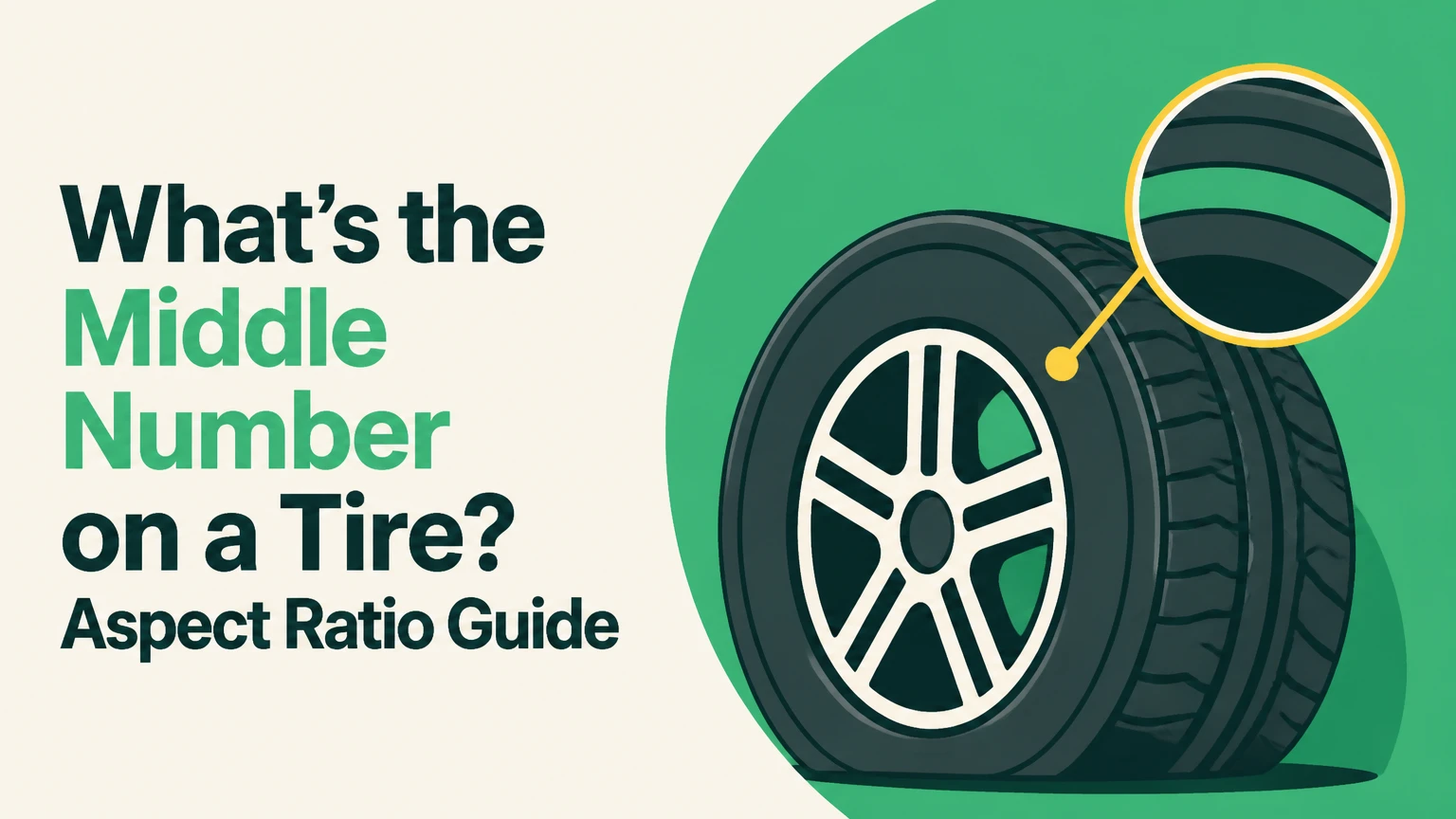
The middle number on a tire is the aspect ratio, which expresses the tire’s sidewall height as a percentage of its section width. In a size such as 205/55R16, the number 55 means the nominal sidewall height is 55% of 205 millimeters, or 112.75 millimeters.
Key Facts at a Glance
The middle number in 205/55R16 is the tire’s 55 aspect ratio.
Aspect ratio is a percentage, not a measurement in millimeters or inches.
A 55 ratio on a 295-millimeter tire has a taller sidewall than a 55 ratio on a 185-millimeter tire.
Nominal sidewall height equals section width multiplied by aspect ratio divided by 100.
Changing aspect ratio can alter total tire diameter, speedometer accuracy, gearing, clearance, and ride comfort.
The replacement tire must also match the vehicle’s approved width, wheel diameter, load index, speed rating, and clearance.
What’s the Middle Number on a Tire?
The middle number on a tire identifies the aspect ratio, also called the tire profile. The value compares one sidewall’s nominal height with the tire’s section width, so a 55 ratio means the sidewall height is approximately 55% of the stated width.
A tire marked 205/55R16 therefore has a 205-millimeter section width, a nominal sidewall height of 112.75 millimeters, radial construction, and a 16-inch wheel diameter. The ratio does not tell you the sidewall height by itself because the first number supplies the width used in the calculation.
Michelin defines aspect ratio as “the ratio of the tire’s section height to its section width.” That definition explains why the number has no independent unit. Aspect ratio describes a relationship between two dimensions.
The term “sidewall height” normally refers to the distance from the wheel rim area to the tread surface. The calculated result is nominal because tire manufacturers measure tire dimensions under specified conditions, and the installed height changes slightly with wheel width, inflation pressure, load, and construction.
How Is Aspect Ratio Calculated?
Aspect ratio is calculated by multiplying the tire’s section width by the ratio expressed as a decimal. A 205/55 tire uses 205 × 0.55, producing a nominal sidewall height of 112.75 millimeters.
Formula:
Nominal sidewall height = section width × aspect ratio ÷ 100
For a 245/40R18 tire:
245 × 40 ÷ 100 = 98 millimeters
The result applies to one sidewall. The tire has two sidewalls, so the pair contributes approximately 196 millimeters to the tire’s section diameter before adding the wheel diameter. The actual tire’s published overall diameter can differ because tread depth, molding, measuring rim width, and load affect the result.
Sidewall Calculations for Common Tire Sizes
| Tire size | Section width | Aspect ratio | Nominal sidewall height |
|---|---|---|---|
| 185/55R15 | 185 mm | 55 | 101.75 mm |
| 205/55R16 | 205 mm | 55 | 112.75 mm |
| 225/60R17 | 225 mm | 60 | 135.00 mm |
| 245/40R18 | 245 mm | 40 | 98.00 mm |
| 265/70R17 | 265 mm | 70 | 185.50 mm |
The table illustrates a common mistake: equal aspect ratios do not produce equal sidewall heights. A 295/55 tire has a nominal sidewall of 162.25 millimeters, while a 185/55 tire has a nominal sidewall of 101.75 millimeters.
How Do You Read the Complete Tire Code?
The first number gives section width, the middle number gives aspect ratio, the letter identifies construction, and the number after the letter gives the wheel diameter. Additional letters and numbers identify service type, load capacity, and speed capability.
| Marking | Meaning | Example value | Unit or significance |
|---|---|---|---|
| 205 | Section width | 205 | Millimeters |
| 55 | Aspect ratio | 55 | Percentage |
| R | Construction | Radial | Internal tire construction |
| 16 | Rim diameter | 16 | Inches |
| 91 | Load index | 91 | 615 kilograms maximum load per tire |
| V | Speed symbol | V | 240 km/h maximum rated speed under specified conditions |
A complete marking may appear as P205/55R16 91V. The P indicates a passenger tire under the relevant industry classification. LT identifies a light-truck tire, while XL generally indicates extra-load construction, which permits a higher load capacity at a specified pressure than the standard version of the same basic size.
The sidewall may also show M+S or a three-peak mountain snowflake symbol. Those markings concern winter or severe-snow capability, not aspect ratio. DOT identification codes, manufacturing information, and maximum inflation markings provide additional safety and traceability information.
The vehicle placard, usually located on the driver’s door jamb, is the correct starting point for approved tire size and cold inflation pressure. The maximum pressure molded into the tire is not automatically the vehicle’s recommended operating pressure.
How Does Aspect Ratio Change Driving?
A lower aspect ratio usually gives the tire a shorter, stiffer sidewall, while a higher ratio generally provides more vertical air volume and sidewall flex. The result affects steering response, impact absorption, wheel protection, noise, and appearance, but aspect ratio is only one part of the tire’s behavior.
Lower-Profile Tires
A 35, 40, 45, or 50 aspect ratio often appears on performance sedans, sports cars, and vehicles with larger wheels. The shorter sidewall can reduce lateral deflection during cornering, which may make steering inputs feel more immediate.
The trade-off is reduced vertical cushioning. A sharp pothole impact transfers more force to the wheel, tire bead, and suspension, particularly when the tire is underinflated or the wheel uses a large diameter with little sidewall. A low-profile tire is not automatically better for braking, because compound, tread pattern, road temperature, ABS calibration, and tire width also affect stopping distance.
Higher-Profile Tires
A 60, 65, 70, or 75 aspect ratio usually creates a taller sidewall for the same section width. More sidewall volume can improve impact absorption and protect the wheel from pothole damage, although it can also allow more body movement and steering delay.
High-profile tires are common on crossovers, pickup trucks, vans, and off-road vehicles. The higher ratio alone does not guarantee better traction in mud, snow, or sand. Tread design, casing construction, tire pressure, vehicle weight, and the driving surface determine whether the tire performs well in that environment.
Profile Trade-Offs by Driving Effect
| Driving factor | Lower profile, 35-50 | Mid profile, 55-65 | Higher profile, 70-85 |
|---|---|---|---|
| Steering response | Fastest typical response | Balanced response | Slower initial response |
| Impact cushioning | Lowest | Moderate | Highest typical cushioning |
| Wheel protection | Reduced on sharp impacts | Moderate | Better on compatible wheels |
| Cornering flex | Lower | Moderate | Higher |
| Common vehicle type | Sports sedan | Sedan, crossover | Pickup, SUV, van |
| Pothole tolerance | Lower | Moderate | Higher, if pressure is correct |
Industry sources do not use one universal boundary for “low profile,” “standard profile,” and “high profile.” Many consumer guides call ratios around 55 and below low profile, ratios around 60-70 conventional, and ratios of 75 or more high profile, but vehicle class and tire design make those labels approximate.
Which Profile Fits Each Driving Situation?
The factory-approved size is the best default for daily driving because vehicle systems are calibrated around its rolling diameter, load capacity, and handling characteristics. A different profile can work only when the replacement maintains adequate load capacity, wheel compatibility, clearance, and a closely matched overall diameter.
| Driving situation | Common ratio range | Useful characteristic | Main limitation |
|---|---|---|---|
| Urban commuting | 55-65 | Balanced response and comfort | Less wheel protection than 70-series tires |
| Pothole-heavy roads | 60-75 | More vertical cushioning | More sidewall movement |
| Highway performance | 35-50 | Immediate steering response | Harsher impacts and wheel risk |
| Gravel and trail use | 65-80 | Greater obstacle clearance and flex | Slower steering response |
| Winter driving | 55-70 | More air volume and compliance | Ratio does not replace winter tread |
| Towing or heavy loads | Factory-specified LT ratio | Load-rated casing and capacity | Incorrect size can overload components |
A commuter who drives damaged urban roads generally benefits from staying near the original ratio rather than selecting the shortest sidewall for appearance. A performance driver on smooth roads may value a 40 or 45 ratio, but the vehicle’s approved wheel and tire package remains the controlling constraint.
For snow, tire width, tread compound, siping, and the three-peak mountain snowflake marking matter more than the middle number. For towing, load index and tire construction matter more than choosing a taller sidewall.
Can You Change the Aspect Ratio?
You can change the aspect ratio only as part of a verified tire-and-wheel fitment, and the replacement should normally preserve the vehicle’s overall tire diameter within the manufacturer’s accepted range. Changing the ratio while keeping the same wheel diameter changes the tire’s outer diameter and may create calibration or clearance problems.
Consider a vehicle originally equipped with 225/65R17 tires. Replacing them with 225/50R17 lowers each nominal sidewall from 146.25 to 112.5 millimeters. With the same 17-inch wheel, the approximate overall diameter falls from 724.3 to 656.8 millimeters, a difference of about 9.3%.
That change can cause:
- A speedometer to read higher than the vehicle’s actual speed.
- The engine and transmission to operate at different road-speed ratios.
- Traction-control, anti-lock braking, or stability-control calibration issues.
- Reduced ground clearance and more exposed wheel damage.
- Incorrect tire load capacity if the replacement specification is unsuitable.
A common plus-sizing approach increases wheel diameter while reducing aspect ratio so the outside diameter remains similar. For example, a manufacturer-approved move from 215/60R16 to 225/50R17 changes width, wheel diameter, and ratio together. The published overall diameter, approved rim width, load index, speed rating, and clearance must be checked rather than inferred from the numbers alone.
What Happens When Tire Diameter Changes?
Tire diameter changes alter the distance traveled per wheel revolution. A smaller replacement tire rotates more times over the same road distance, so a speedometer calibrated for the original tire generally indicates a speed higher than the vehicle’s actual speed.
Approximate speedometer relationship:
Actual speed = indicated speed × new tire diameter ÷ original tire diameter
If the original diameter is 700 millimeters and the replacement diameter is 665 millimeters, an indicated 100 km/h corresponds to approximately:
100 × 665 ÷ 700 = 95 km/h
The exact result depends on the vehicle’s calibration and tire operating dimensions. Tire manufacturers publish nominal dimensions, while real rolling circumference changes with pressure, load, tread wear, and speed.
The U.S. National Highway Traffic Safety Administration advises drivers to use the tire size specified by the vehicle manufacturer and to follow the vehicle placard for inflation information. That guidance matters because tire size is part of a vehicle’s integrated braking, suspension, and electronic-control design.
Does Aspect Ratio Determine Price or Tire Life?
Aspect ratio does not determine tire price or expected mileage by itself. Price and service life depend more heavily on tire brand, compound, speed rating, load rating, warranty, construction, alignment, inflation, climate, road surface, and driving style.
A 40-series tire can cost less than a 70-series tire in one brand and more in another. High-performance compounds often wear faster than touring compounds regardless of profile, while a premium touring tire may outlast a cheaper tire with the same aspect ratio.
| Tire category | Typical purchase pattern | Typical mileage range | Main mileage variables |
|---|---|---|---|
| Performance summer | Higher price per tire | 20,000-40,000 miles | Soft compound, aggressive driving |
| Touring all-season | Moderate price | 45,000-80,000 miles | Rotation, alignment, tread compound |
| Highway all-season | Moderate to high price | 50,000-80,000 miles | Load, towing, road surface |
| All-terrain light truck | Moderate to high price | 35,000-60,000 miles | Gravel, inflation, casing design |
| Winter tire | Seasonal purchase | 20,000-40,000 miles | Storage, warm-weather use, compound |
These are typical practitioner ranges, not guarantees. Tire warranties may advertise a mileage figure, but warranty conditions often require regular rotation, documented maintenance, correct inflation, and replacement before a specified tread depth.
Why Do Replacement Tires Rub?
Replacement tires rub when their overall width, diameter, section shape, wheel offset, or suspension position exceeds the vehicle’s available clearance. A higher aspect ratio can increase diameter, but a wider tire or different wheel offset can also move the tire into the strut, fender liner, sway bar, or bodywork.
Inspect clearance at full steering lock and through suspension travel. A tire that clears while parked may contact the inner fender during a turn, over a bump, or when the vehicle carries passengers and cargo.
Before buying a nonstandard size, verify:
- The tire’s approved rim-width range.
- The wheel’s diameter, width, and offset.
- Load index and speed rating against the placard.
- Clearance from struts, brake components, and fender liners.
- Overall diameter compared with the original size.
- Whether all-wheel-drive systems require closely matched circumferences.
- Whether the vehicle manufacturer lists the size as an approved option.
A tire shop can measure static clearance, but a fitment check should also account for steering lock and compression. Plastic liner contact may produce noise first, while metal or suspension contact can damage the tire.
What Common Mistakes Should You Avoid?
The most serious aspect-ratio mistakes involve confusing percentage with millimeters, ignoring the first width number, and changing tire diameter without checking vehicle calibration. Correcting those errors requires reading the complete size code, not focusing on the middle number alone.
Mistake 1: Treating 55 as 55 millimeters
The number 55 means 55% of section width. A 205/55 tire has a nominal sidewall of 112.75 millimeters, not 55 millimeters.
Mistake 2: Comparing ratios without comparing widths
A 235/55 tire has a nominal sidewall of 129.25 millimeters, while a 195/60 tire has 117 millimeters. The 60 ratio is higher, but its sidewall is shorter because the tire is narrower.
Mistake 3: Using maximum tire pressure as the vehicle setting
The pressure molded on the sidewall identifies a tire limit under stated conditions. The driver-door placard gives the vehicle manufacturer’s recommended cold pressure for the specified tire size and load.
Mistake 4: Choosing a tire by appearance
A lower sidewall may look sportier but can reduce impact protection and ride comfort. Appearance does not establish load capacity, braking performance, wet grip, or compatibility.
Mistake 5: Mixing sizes on all-wheel drive
Many all-wheel-drive systems require tires with closely matched rolling circumferences. Replacing one tire with a materially different diameter can increase driveline stress, even when the tire fits physically.
What Should You Check Before Buying Tires?
Use the vehicle placard and owner’s manual before comparing tire prices. Confirm the size, load index, speed rating, construction, seasonal designation, and recommended pressure, then compare the replacement tire’s published specifications.
A practical replacement checklist is:
- Photograph the current sidewall marking.
- Read the driver-door tire label.
- Confirm whether the vehicle uses staggered front and rear sizes.
- Match or exceed the original load index and speed symbol unless the manufacturer specifies otherwise.
- Compare published overall diameter and approved rim width.
- Check whether the vehicle requires run-flat, self-sealing, or extra-load tires.
- Replace tires in axle pairs when appropriate, and follow the vehicle manufacturer’s position for placing newer tires.
- Set cold pressure after installation and inspect for leaks, vibration, or rubbing.
Tread depth, age, visible cracking, puncture history, and uneven wear can matter more than a small aspect-ratio difference. Alignment problems commonly create shoulder wear that a new tire cannot solve.
FAQ
Is a 55 aspect ratio considered low profile?
A 55 aspect ratio is often classified as low profile by consumer tire guides, but the label is not universal. A 55-series tire on a narrow compact-car wheel has a different visual and structural effect from a 55-series tire on a wide performance wheel. The actual sidewall height depends on section width.
Does a higher aspect ratio improve fuel economy?
A higher aspect ratio does not automatically improve fuel economy. Rolling resistance depends on tire compound, construction, inflation pressure, tread pattern, mass, width, and aerodynamic factors. A taller replacement can change diameter and gearing, but it may also add weight or use a less efficient casing.
Can I install a different aspect ratio on the same rim?
A different ratio can fit the same rim diameter, but physical fit does not prove safe compatibility. The new tire must fit the rim width, maintain sufficient load capacity, preserve acceptable overall diameter, clear the vehicle, and remain compatible with ABS, stability control, and all-wheel-drive requirements.
What does the letter R mean in a tire size?
The letter R means radial construction, the dominant construction type for modern passenger vehicles. The R is not a rating and does not mean “rim.” In 205/55R16, the 16 after R identifies the wheel diameter in inches.
Is the middle number related to tire pressure?
The aspect ratio does not directly specify tire pressure. Recommended cold inflation pressure comes from the vehicle manufacturer’s placard or manual, while the tire sidewall lists maximum pressure information. Load index, tire construction, and vehicle loading determine how pressure requirements are applied.
The Bottom Line
The middle number on a tire is the aspect ratio, a percentage that converts section width into nominal sidewall height. In 205/55R16, 55 means approximately 112.75 millimeters of sidewall height, not 55 millimeters.
Aspect ratio influences ride comfort, steering response, wheel protection, clearance, and tire diameter, but it does not work alone. Before changing the number, check the vehicle placard, load index, speed rating, wheel width, overall diameter, and electronic-system compatibility. The safest answer to “what’s the middle number on a tire” is therefore both simple and practical: it is the sidewall-height percentage, and it must be interpreted with the rest of the tire code.