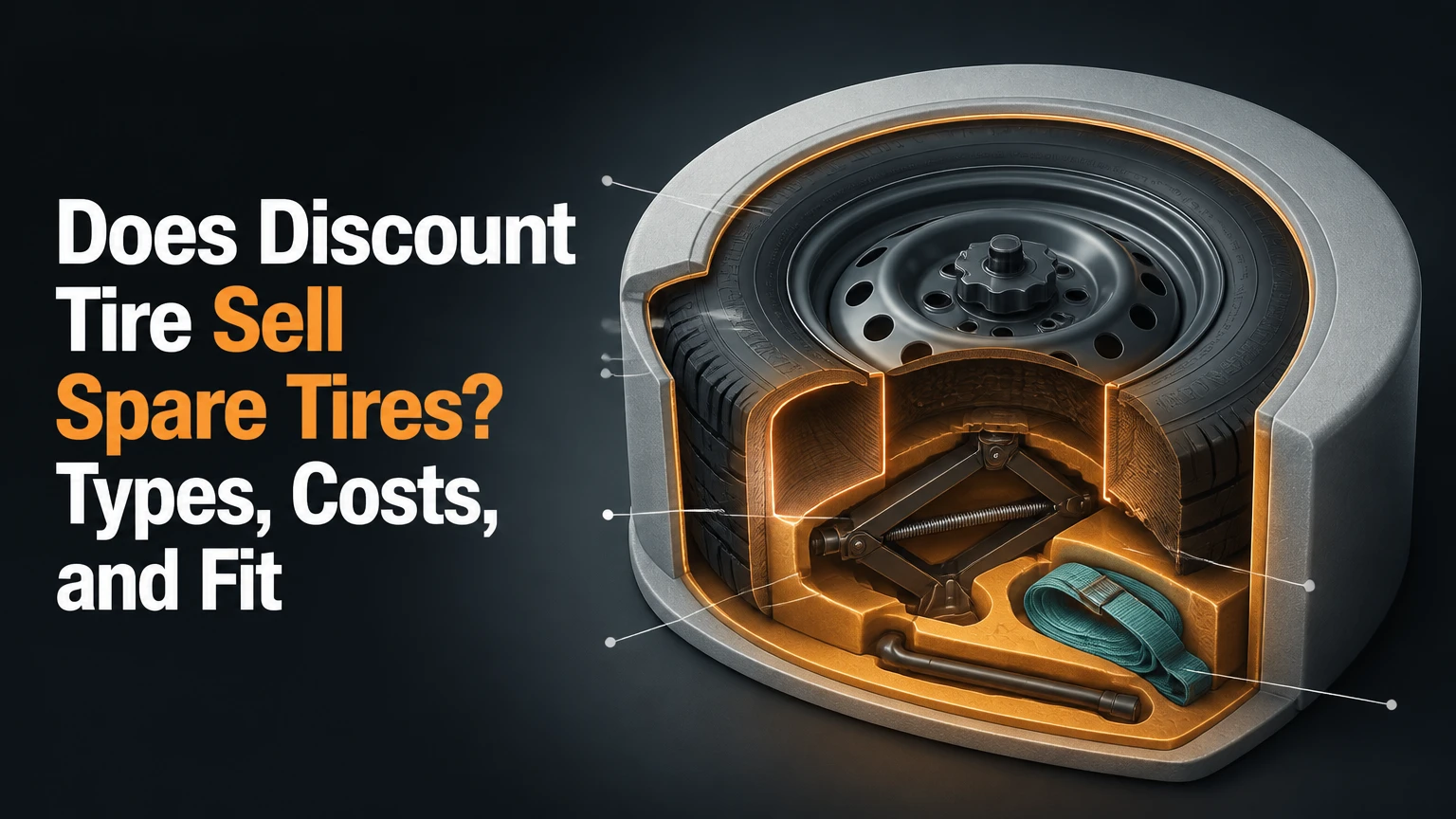
Yes, Discount Tire sells spare tires, including compact temporary spares and full-size spare tire assemblies for compatible vehicles. The important qualification is that availability depends on the vehicle, store inventory, and whether you need a tire alone, a mounted wheel-and-tire assembly, or a complete kit with a jack and lug wrench.
Key Facts at a Glance
Discount Tire’s spare-tire offerings can include compact donut spares and full-size assemblies.
A spare tire purchase does not automatically include a jack, lug wrench, wheel chocks, or locking-lug key.
A compact spare commonly carries a 50 mph maximum, but the vehicle or spare sidewall is the controlling authority.
Typical complete wheel-and-tire spare costs range from about $150-$400 or more, depending on vehicle fit and components.
Bolt pattern alone does not prove compatibility; center bore, offset, load rating, brake clearance, and lug-seat design also matter.
AWD, staggered-wheel, performance-brake, and towing applications require vehicle-specific advice before purchase.
Does Discount Tire Sell Spare Tires?
Discount Tire sells spare tire solutions through its online catalog and stores, but the exact product depends on the vehicle selected. A searcher may find a compact spare, a full-size tire, a steel wheel, or a mounted wheel-and-tire assembly rather than one universal product that fits every car.
Discount Tire’s official spare-tire buyer resources describe temporary and full-size options, while its wheel catalog supports vehicle-specific wheel matching. Local availability can differ because many replacement spares are ordered rather than displayed in store. Calling a Discount Tire location with the year, make, model, trim, drivetrain, and brake package is often faster than relying on a generic size search.
The phrase “spare tire” creates an avoidable ambiguity. Some sellers use it for rubber only, while drivers usually mean a ready-to-install wheel and tire. Ask for a wheel-and-tire assembly for emergency use if you want a mounted spare.
What does Discount Tire usually sell?
Discount Tire may sell the tire, compatible wheel, and mounting service required to create a usable spare assembly. The store may not supply every vehicle-specific tool needed to remove your damaged wheel.
| Product or service | What it includes | Typical planning range | Confirm before ordering |
|---|---|---|---|
| Compact spare tire | Temporary rubber tire | $150-$290 | Tire size, speed rating, pressure |
| Steel spare wheel | Basic steel rim | $60-$100 | Bolt pattern, bore, offset, lug seat |
| Mounted spare assembly | Tire mounted to wheel | $200-$400+ | Brake clearance, balance, TPMS |
| Mounting and balancing | Shop labor for assembly | About $20 per tire | Store policy and warranty terms |
| Vehicle jack kit | Jack, handle, wrench, storage parts | $50-$150 aftermarket or dealer typical | Lift point and vehicle-specific fit |
These are typical planning figures, not a guaranteed Discount Tire price list. Tire brand, vehicle class, wheel finish, local market, taxes, shipping, and availability can move the final amount substantially.
Which Types of Spare Tires Can You Buy?
The two main choices are a compact temporary spare and a full-size spare. A compact spare saves weight and storage space, while a full-size spare preserves more of the vehicle’s normal handling and operating capability.
Compact donut spares
A compact spare is narrower and often smaller in diameter than the vehicle’s regular tire. Its purpose is to move the vehicle to a repair facility, not to replace a normal tire for daily driving.
A compact spare commonly has a 50 mph maximum speed and a practical travel limit of roughly 50-70 miles, but those figures are only general benchmarks. The molded sidewall and the vehicle owner’s manual override general guidance. Many temporary spares require approximately 60 psi, so use the specified cold pressure rather than the door-jamb pressure for the normal tires.
Compact spares create different handling characteristics. The narrow tread reduces cornering grip, braking consistency, and wet-road traction, while the smaller diameter can affect ABS, traction control, and all-wheel-drive systems. Avoid hard cornering, sudden lane changes, heavy towing, and extended freeway travel.
Full-size spare assemblies
A full-size spare uses a tire and wheel close to the dimensions of the vehicle’s regular equipment. A matching assembly can be an identical alloy wheel, while a practical version often uses a black steel wheel with the correct tire size and load rating.
A full-size spare is the stronger choice for long-distance travel, trucks, SUVs, towing, and remote areas because it avoids the short-distance limitation of a donut. The trade-off is weight, cargo volume, purchase cost, and the need to maintain a fifth tire.
A “full-size” label does not guarantee a perfect match. A different tread depth, tire diameter, wheel offset, or load rating can still create handling or drivetrain concerns. For an AWD vehicle, the manufacturer’s allowable circumference difference is more important than the marketing label.
| Spare type | Typical size relationship | Common limit | Best fit |
|---|---|---|---|
| Compact donut | Smaller diameter and narrower tread | 50 mph, about 50-70 miles typical | Sedans and limited trunk wells |
| Full-size steel spare | Same approved tire size, steel wheel | Vehicle and tire rating | SUVs, trucks, road trips |
| Matching alloy spare | Same tire and wheel specification | Normal tire rating if approved | Performance or appearance-sensitive vehicles |
| Collapsible spare | Inflates after storage | Model-specific speed and distance | Vehicles designed for that system |
How Much Does a Discount Tire Spare Cost?
A spare tire setup typically costs about $150-$400 before tax, with a complete vehicle-specific package potentially exceeding $400. The price depends on whether the purchase includes only rubber, a steel wheel, mounting, balancing, a tire-pressure sensor, and the vehicle’s required tools.
A compact spare tire by itself may cost less than a full-size mounted assembly, but tire-only pricing can be misleading because an unmounted tire cannot be installed during an emergency. A practical budget should include the wheel and the labor needed to assemble it.
| Configuration | Typical price | Main cost driver | Emergency usefulness |
|---|---|---|---|
| Compact tire only | $150-$290 | Temporary-spare construction | None until mounted |
| Compact tire plus steel wheel | $210-$390 | Wheel fit and tire brand | Ready after mounting |
| Full-size tire plus steel wheel | $200-$400+ | Tire size and load rating | Ready after mounting |
| Complete package with TPMS | $250-$500+ | Sensor and programming | Dashboard monitoring possible |
| Jack and wrench kit | $50-$150 | OEM versus aftermarket parts | Required for roadside change |
Discount Tire may mount and balance a wheel-and-tire assembly, but service coverage and warranty treatment can vary by product and location. Ask for the out-the-door price, expected arrival date, mounting fee, balancing fee, TPMS cost, and any disposal or shipping charge.
Does Discount Tire Sell the Jack and Lug Wrench Too?
A Discount Tire spare assembly does not necessarily include the jack, lug wrench, wheel chocks, or locking-lug key. Drivers whose cars were factory-equipped without a spare should assume the tools require a separate purchase until the store confirms otherwise.
Vehicle manufacturers package emergency tools around specific lift points and wheel hardware. An aftermarket scissor jack that reaches the vehicle may still be unsafe if its saddle does not engage the approved lift point. A wrench can also fail to fit a factory locking lug or a different lug-nut seat used with the spare wheel.
Before purchase, identify four items:
- The jack’s lifting capacity and saddle shape.
- The wrench size required by the spare and vehicle lug nuts.
- The adapter for any locking lug nuts.
- The storage location and retention method for the assembly.
A dealer is often the simplest source for an original-equipment jack kit. An aftermarket kit can work when its capacity, lift range, contact point, and wrench size match the vehicle. Never rely on a bottle jack or roadside object as a substitute for a stable, rated jack and wheel chocks.
How Do You Order the Correct Spare?
Order a spare by vehicle application, then verify the physical and electronic fit before leaving the store. The vehicle’s year, model, trim, drivetrain, wheel size, brake package, and lug hardware determine whether a proposed assembly is safe.
Step 1: Inspect the existing storage space
Lift the trunk or cargo floor and photograph the spare well, retaining bolt, foam insert, and jack compartment. Measure the available diameter and depth if you are considering a full-size assembly.
A vehicle without a well can still carry a spare, but the assembly may occupy cargo space or require a dedicated carrier. Do not assume a tire will fit beneath the floor because the tire diameter appears close; width, sidewall bulge, and wheel face can prevent the cover from closing.
Step 2: Ask for a mounted wheel-and-tire assembly
Tell the associate whether you need a temporary donut or a full-size spare. Provide the tire size printed on the sidewall, such as P225/65R17, and request confirmation of the approved spare specification in the owner’s manual.
A regular replacement tire is not automatically a spare. Its tread width, wheel construction, and storage dimensions may be unsuitable for emergency use.
Step 3: Verify wheel geometry
Check more than the bolt pattern. A wheel listed as 5×114.3, for example, still requires the correct center bore, offset, diameter, width, load rating, and brake clearance.
| Fit specification | What it controls | Failure if wrong |
|---|---|---|
| Bolt pattern | Stud or lug-hole alignment | Wheel cannot mount correctly |
| Center bore | Hub centering | Vibration or inability to seat |
| Offset | Wheel position relative to hub | Caliper, suspension, or fender contact |
| Load rating | Supported vehicle weight | Wheel overload or structural damage |
| Lug-seat type | Contact between nut and wheel | Loose or damaged hardware |
| Brake clearance | Space around caliper | Wheel will not rotate or mount |
Step 4: Confirm TPMS requirements
A spare may have no tire-pressure monitoring sensor, or it may need a compatible sensor installed and relearned. The vehicle can display a TPMS warning when the spare is mounted even if the tire is correctly inflated.
Ask whether the sensor is included, whether it is programmed, and whether the vehicle recognizes it automatically. The owner’s manual explains how the system behaves when a temporary spare is installed.
Step 5: Request a test fit
Have the store test-fit the spare on the axle where it will be used, if service conditions permit. Confirm that the wheel seats flush, the lug nuts engage correctly, the brake caliper clears the inner barrel, and the wheel rotates without contact.
The test fit is the most valuable step for performance cars, trucks with aftermarket brakes, and vehicles using wheel spacers. A catalog match can still fail at the caliper.
What Is the Difference Between a Donut and Full-Size Spare?
A donut is cheaper and easier to store, while a full-size spare offers better handling consistency and greater trip flexibility. The correct choice depends on storage space, annual driving conditions, drivetrain requirements, and whether a roadside repair is likely to occur far from a tire shop.
| Decision factor | Compact donut | Full-size steel spare | Matching alloy spare |
|---|---|---|---|
| Typical purchase cost | $150-$390 mounted | $200-$400+ mounted | $300-$600+ typical |
| Storage demand | Low, narrow footprint | High, normal tire diameter | High, normal tire diameter |
| Speed guidance | 50 mph typical | Vehicle or tire rating | Vehicle or tire rating |
| Distance guidance | 50-70 miles typical | No temporary-spare limit | No temporary-spare limit |
| Handling change | Pronounced | Smaller change | Closest to normal |
| Towing suitability | Usually poor | Better if manufacturer-approved | Better if manufacturer-approved |
| AWD compatibility | Highly vehicle-specific | Usually easier to match | Usually easiest to match |
A full-size spare is not automatically better for every driver. A heavy assembly can be difficult to lift, reduce cargo capacity, and remain neglected if stored under the vehicle. A maintained compact spare is safer than an oversized full-size tire that cannot be secured or inflated correctly.
Can You Drive an AWD Vehicle on a Donut Spare?
An AWD vehicle may be damaged by an incorrectly sized temporary spare, so the owner’s manual must determine whether a donut is permitted. Different tire circumferences force the drivetrain to rotate at different speeds, which can stress the center differential, coupling, transfer case, or clutch pack.
Some manufacturers permit a temporary spare on AWD vehicles for a stated distance and axle position. Others require a matching tire diameter or recommend disabling the AWD system. The vehicle’s warning messages do not replace the manufacturer’s instructions.
Use a full-size spare with closely matched rolling circumference when the manual requires it. If a front-wheel-drive vehicle has large front brakes, the compact spare may fit only on the rear axle. In that situation, move a compatible rear wheel to the front and install the donut at the rear, but follow the vehicle-specific procedure.
Performance cars create another problem. Staggered front and rear tire sizes, oversized calipers, directional tread, and low-profile sidewalls can make a universal spare unsafe or unusable.
How Long Can You Drive on a Spare?
Drive only far enough to reach a safe repair destination, and follow the lowest speed and distance limit printed on the spare or specified by the vehicle manufacturer. For many compact spares, 50 mph and approximately 50-70 miles are common planning limits, not universal permissions.
Reduce speed further in rain, snow, strong crosswinds, or heavy traffic. Increase following distance because braking and cornering behavior can change immediately after installation. Avoid cruise control if the owner’s manual warns against it with a temporary spare.
The spare is a bridge to repair, not a second set of tires. Replace or repair the damaged regular tire as soon as practical, then return the spare to its storage position at the specified pressure.
What happens if the spare is underinflated?
An underinflated spare can overheat, deform, and fail under load. Temporary spares often require much higher pressure than normal tires, so checking pressure against the driver-door placard can produce the wrong result.
Use a reliable gauge when the tire is cold. Discount Tire’s spare-tire maintenance guidance and the tire sidewall provide useful checks, but the vehicle manual remains authoritative for the installed assembly.
Do Spare Tires Expire?
Spare tires age even when they have never touched pavement. Heat, ozone, moisture, and long-term compression can degrade rubber, so a new-looking spare may still require replacement because of its manufacturing date or visible deterioration.
Find the DOT code on the sidewall. The final four digits identify the manufacturing week and year: 1218 means the tire was made in the 12th week of 2018. Tire manufacturers and vehicle makers differ in replacement guidance, but a spare around six to ten years old deserves professional inspection and may warrant replacement regardless of tread.
Inspect for cracks, bulges, flat spots, valve damage, and corrosion around the bead. Check the spare’s pressure during regular tire service, oil changes, or at least every few months. A flat spare defeats the entire emergency plan.
What Alternatives Exist if Your Car Has No Spare?
A tire inflator and sealant can address a small tread puncture, but neither option repairs a sidewall cut, bent wheel, separated tread, or tire that has left the rim. Run-flat tires can provide limited mobility after air loss, while roadside assistance can provide labor but may involve waiting and coverage limits.
| Alternative | Typical capability | Common limitation | Best scenario |
|---|---|---|---|
| Sealant and inflator | Small tread puncture | No sidewall or large-hole repair | Short trip to tire shop |
| Run-flat tire | About 50 miles at up to 50 mph typical | Cost, ride, replacement limits | Factory-designed application |
| Roadside assistance | Tire change or tow | Wait time and coverage area | Urban or covered driving |
| Tire plug kit | Temporary tread repair | Requires tools and safe access | Experienced driver, simple puncture |
| Purchased spare assembly | Full tire replacement | Storage, weight, maintenance | Remote travel and long trips |
Sealant can also complicate later tire repairs and may require cleaning the tire-pressure sensor. Check the sealant expiration date, because many cartridges have a limited service life.
What Common Spare-Tire Mistakes Should You Avoid?
The most common failures involve fit, pressure, and missing tools rather than the tire brand. A spare becomes useful only when the wheel fits the brakes, the tire holds its required pressure, and the driver can safely remove the damaged wheel.
- Buying by bolt pattern alone: Confirm center bore, offset, load rating, lug seat, and caliper clearance.
- Assuming the car’s wrench fits: Test the socket on the actual lug nuts, including locking hardware.
- Storing a full-size tire without securing it: A loose assembly can become a dangerous projectile during sudden braking.
- Ignoring pressure: Compact spares often require about 60 psi, substantially above ordinary passenger-tire pressure.
- Using a donut on the wrong axle: Large front brakes or directional tires can require a specific installation sequence.
- Treating a temporary spare as a normal tire: Speed, distance, traction, and drivetrain restrictions remain active until repair.
- Skipping a test fit: A wheel can clear the hub but contact the brake caliper when rotated.
A practitioner rule is simple: test-fit the assembly before an emergency, not beside a dark roadside. Mark the correct lug wrench and place the jack handle, chocks, gloves, and pressure gauge together.
Which Spare Should Different Drivers Choose?
Most city commuters should choose a compact spare when the vehicle manufacturer approves one and the trunk well accepts it. Road-trip drivers, truck owners, towing users, and people who travel through remote areas generally gain more value from a maintained full-size assembly.
| Driver situation | Preferred option | Reason | Check first |
|---|---|---|---|
| City sedan commuter | Compact donut | Low weight and small storage footprint | 50 mph limit and well size |
| Family SUV road trip | Full-size steel spare | Greater range and cargo flexibility after a flat | Load rating and carrier |
| AWD crossover | Manufacturer-approved full-size or exact-diameter spare | Reduces drivetrain mismatch risk | Circumference tolerance |
| Performance coupe | Vehicle-specific compact or matching assembly | Brake and staggered-wheel constraints | Front caliper clearance |
| Pickup used for towing | Full-size, load-rated spare | Better load and distance capability | Tire load range and hoist |
| EV with no spare well | Approved compact assembly or roadside plan | Cargo and weight constraints | Manufacturer instructions |
The best option is the one that matches the manufacturer’s dimensions and your actual driving environment. A spare designed for an emergency cannot compensate for an incompatible wheel.
Frequently Asked Questions
Can Discount Tire install a spare tire on my car?
Discount Tire can typically mount and balance a tire on a compatible wheel, subject to product availability and store service policies. Installation on the vehicle may involve a separate service request, and a temporary spare should be test-fitted for brake clearance before an emergency. Confirm labor, balancing, TPMS, and warranty details with the local store.
Can I buy a used spare wheel and tire?
A used spare can work when its dimensions, load rating, age, tread condition, and wheel integrity match the vehicle requirements. Avoid unknown-age tires, cracked sidewalls, bent wheels, corroded bead seats, and assemblies with an uncertain accident history. Verify the DOT date code and have a tire professional inspect the assembly before relying on it.
Does a spare tire need a TPMS sensor?
A spare tire does not always require a TPMS sensor, but the vehicle may display a warning when one is absent. Some vehicles relearn a new sensor automatically, while others require a scan tool or a drive cycle. Ask whether the spare assembly includes a compatible sensor and whether programming is included.
Can I use a different tire brand as a spare?
A different brand can be acceptable for a temporary spare when the size, load index, speed rating, construction, and approved circumference match the vehicle requirements. Brand matching matters less than specification matching. AWD vehicles and vehicles with strict tire-uniformity rules may require a closer match or a manufacturer-approved assembly.
Should I keep a donut spare at full pressure?
Keep a compact spare at the pressure printed on its sidewall or specified by the vehicle manufacturer, checked when cold. The required pressure is often near 60 psi and may be much higher than the vehicle’s regular tire pressure. Check it periodically because stored tires lose air over time.
The Bottom Line
Discount Tire does sell spare tires and can often provide a compatible compact or full-size wheel-and-tire assembly. The buyer must confirm whether the product includes the wheel, mounting, balancing, TPMS sensor, jack, lug wrench, and storage hardware, because those components are not automatically bundled.
For a commuter, a properly fitted donut is usually the lowest-weight solution. For AWD vehicles, towing, road trips, remote travel, or performance brakes, a vehicle-approved full-size or exact-diameter spare is usually the safer decision. Before ordering, ask Discount Tire to verify the complete fit and test-fit the assembly when possible. That is the practical answer to “does discount tire sell spare tires”: yes, but the correct purchase is a vehicle-specific emergency system, not merely a loose tire.