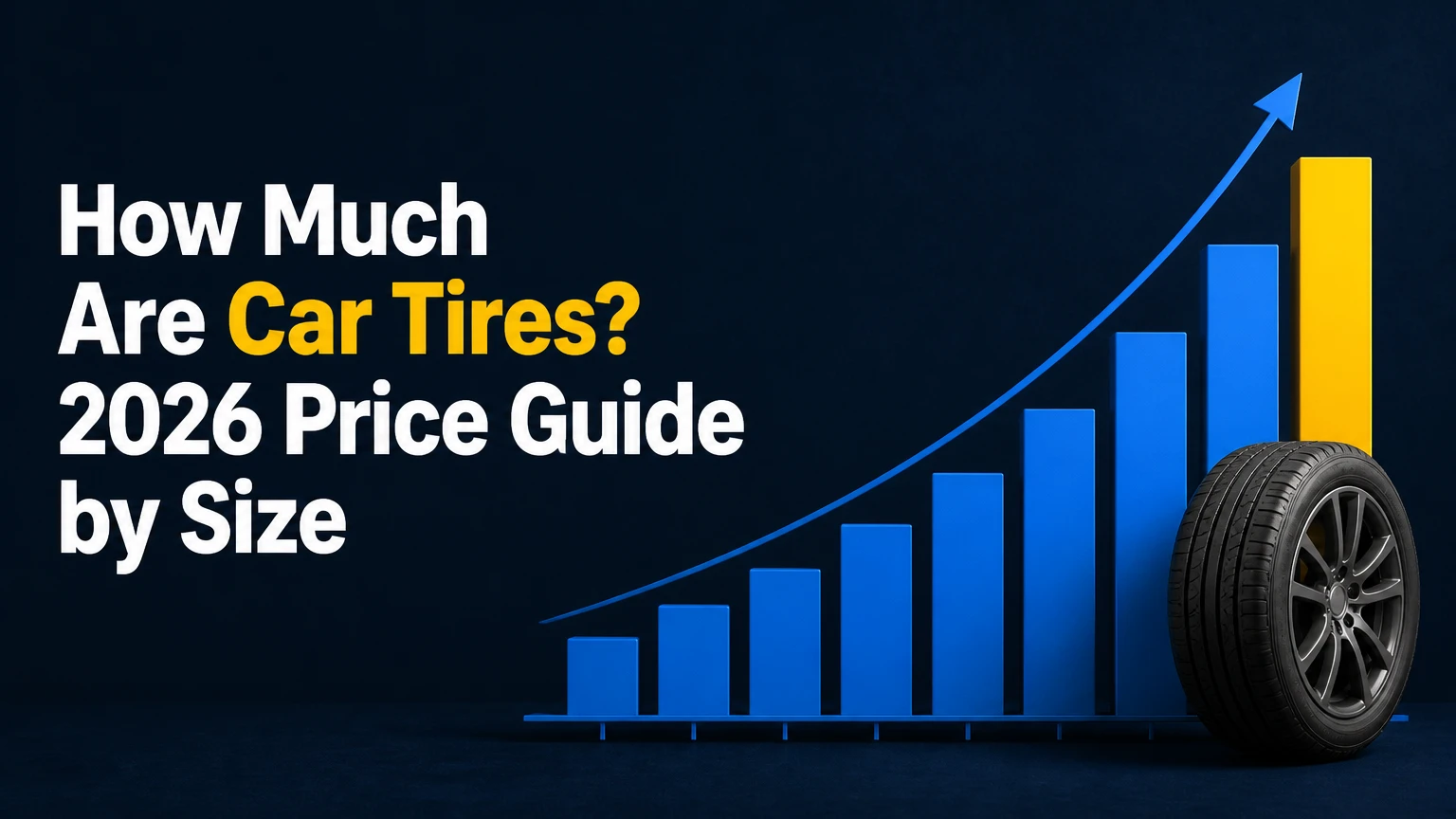
Car tires typically cost $50-$300 or more per tire globally, while common Dhaka prices in 2026 range from approximately ৳9,000-৳14,000 for compact-car tires, ৳16,000-৳20,500 for sedan tires, and ৳33,000-৳36,500 for SUV tires. A complete four-tire purchase therefore costs about ৳36,000-৳146,000 before fitting, balancing, and alignment, depending mainly on size, brand, construction, and availability.
Key Facts at a Glance
- A compact-car tire such as 175/65 R15 commonly costs ৳9,000-৳14,000 in Dhaka.
- A sedan tire such as 205/55 R16 commonly costs ৳16,000-৳20,500.
- An SUV tire such as 265/60 R18 commonly costs ৳33,000-৳36,500.
- Mounting and wheel balancing usually add ৳500-৳1,000 per tire, while alignment commonly costs ৳1,500-৳3,000 per vehicle.
- The tire’s four-digit DOT code identifies its production week and year, not its expiry date.
- The cheapest safe choice is usually a fresh tire from an established second-tier brand, not an unknown tire with unclear certification or storage history.
How Much Are Car Tires by Size and Vehicle?
Car tire prices are usually driven more by tire size and supply than by the vehicle badge alone. Larger diameters, wider tread, higher load ratings, reinforced sidewalls, run-flat construction, and uncommon sizes increase the price because they require more material and sell in lower volumes.
The following are typical Dhaka retail ranges, not fixed quotations. Imported inventory, exchange rates, manufacturing country, warranty coverage, and tire age can move a price outside these bands.
| Vehicle category | Example size | Typical price per tire | Four-tire cost |
|---|---|---|---|
| Small hatchback | 165/65 R14 | ৳7,500-৳11,000 | ৳30,000-৳44,000 |
| Compact car | 175/65 R15 | ৳9,000-৳14,000 | ৳36,000-৳56,000 |
| Small crossover | 215/60 R16 | ৳15,000-৳21,000 | ৳60,000-৳84,000 |
| Sedan | 205/55 R16 | ৳16,000-৳20,500 | ৳64,000-৳82,000 |
| Large sedan | 225/55 R17 | ৳22,000-৳30,000 | ৳88,000-৳120,000 |
| SUV or crossover | 265/60 R18 | ৳33,000-৳36,500 | ৳132,000-৳146,000 |
A four-tire total is not always four times the advertised unit price. Dealers may include valve replacement, disposal, fitting, or balancing in a package, while alignment may remain separate. Ask whether the quotation includes VAT, installation, balancing, new valves, and any road-hazard warranty.
What determines the price of a tire?
Brand tier, compound, tread pattern, speed rating, load index, production date, and import availability determine the final price. A 16-inch touring tire may cost less than a 15-inch performance tire if the smaller tire uses a specialist compound or has limited local stock.
Premium tires from Michelin, Bridgestone, Continental, Goodyear, and Yokohama commonly cost more because their designs may deliver lower rolling resistance, quieter operation, stronger wet braking, or more consistent manufacturing. Those benefits are not guaranteed for every model, so compare the exact tire line rather than the brand name alone.
What Does a Complete Tire Replacement Cost?
A complete replacement in Dhaka typically costs ৳38,000-৳150,000, including four tires, mounting, balancing, and a normal alignment. The lower end suits compact-car tires, while the upper end reflects large SUV sizes or premium imported models.
| Expense | Typical charge | Charging basis | When it applies |
|---|---|---|---|
| Tire purchase | ৳9,000-৳36,500 each | Per tire | Always |
| Mounting | ৳250-৳600 each | Per tire | When tires are removed from wheels |
| Wheel balancing | ৳250-৳500 each | Per wheel | After tire installation or vibration |
| Wheel alignment | ৳1,500-৳3,000 | Per vehicle | After uneven wear, impact, or suspension work |
| New rubber valves | ৳100-৳300 each | Per valve | Recommended with new tires |
| TPMS service | ৳500-৳2,000 each | Per sensor | If sensors need replacement or relearning |
Mounting places the tire on the wheel; balancing corrects weight differences between the tire and wheel. Alignment adjusts steering geometry and cannot correct a tire that is simply out of balance.
A practical budget for a sedan using four 205/55 R16 tires is ৳67,500-৳88,500: ৳64,000-৳82,000 for tires, roughly ৳2,000-৳4,000 for mounting and balancing, and about ৳1,500-৳3,000 for alignment.
What Are You Paying for in a Car Tire?
A car tire combines a tread compound, sidewall, bead, belts, and internal plies into a pressurized structure. The tread creates road grip and channels water, the sidewall controls comfort and lateral response, the steel bead seals against the rim, and the internal casing carries the vehicle’s load.
The U.S. National Highway Traffic Safety Administration describes tires as “the only part of your vehicle that makes contact with the road.” That contact patch is small, so compound quality, inflation pressure, temperature, and tread condition directly influence braking and steering.
Price differences often reflect engineering hidden beneath the tread. A premium touring tire may use a silica-rich compound for wet grip and lower rolling resistance, while an all-terrain tire may use thicker sidewalls and larger tread blocks to resist cuts. A reinforced XL tire carries more load but can ride more firmly when fitted to a vehicle that does not require it.
How Do You Read Tire Size Numbers?
A code such as 205/55 R16 91V identifies the tire’s width, sidewall proportion, construction, wheel diameter, load index, and speed rating. The replacement must meet the vehicle manufacturer’s approved size and load requirements, even when another tire physically fits the wheel.
| Marking | Meaning | Example value | Practical effect |
|---|---|---|---|
| 205 | Section width | 205 mm | Wider tread may improve grip but increase cost and steering effort |
| 55 | Aspect ratio | Sidewall is 55% of width | Lower profile usually sharpens handling and reduces ride comfort |
| R | Construction | Radial | Standard construction for modern passenger vehicles |
| 16 | Rim diameter | 16 inches | Fits only a 16-inch wheel |
| 91 | Load index | 615 kg per tire | Four tires theoretically support 2,460 kg at rated conditions |
| V | Speed rating | Up to 240 km/h | Must meet or exceed the vehicle requirement |
The load index is a coded value, not a direct weight printed in kilograms. A 91-rated tire supports approximately 615 kilograms under its specified conditions, while the vehicle’s placard remains the authority for minimum load and pressure.
Check the driver-door placard first. The owner’s manual may list alternate sizes, but changing diameter or overall tire height can affect speedometer accuracy, braking systems, fender clearance, and electronic stability control.
Which Tire Tier Offers the Best Value?
Mid-range tires usually offer the best balance for ordinary commuting because they cost less than premium models while providing more consistent quality and warranty support than anonymous budget products. Premium tires can justify their price when wet braking, cabin noise, long highway mileage, or a specialized vehicle requirement matters more than the initial purchase.
| Tier | Typical global price | Typical Dhaka position | Suitable buyer | Main compromise |
|---|---|---|---|---|
| Budget | $50-$150 | ৳7,500-৳14,000 | Low-mileage city driver | Shorter life and less consistent wet performance |
| Mid-range | $150-$300 | ৳14,000-৳25,000 | Daily commuter and family sedan owner | Higher initial price |
| Premium | $300+ | ৳25,000-৳45,000+ | Long-distance, luxury, or performance driver | Cost per set |
| Specialist | $200-$500+ | ৳30,000-৳60,000+ | Run-flat, EV, A/T, or high-load applications | Noise, availability, or replacement expense |
Brand examples are only starting points. Kumho, Hankook, MRF, Laufenn, and similar established brands may occupy different positions by model, while Michelin and Bridgestone offer both touring and performance lines with different costs.
A useful practitioner rule is to compare cost per expected kilometre, not only purchase price. A ৳12,000 tire that lasts 35,000 kilometres costs about ৳0.34 per kilometre; a ৳18,000 tire lasting 55,000 kilometres costs about ৳0.33 per kilometre before accounting for differences in wet grip or service life.
Which Tire Type Suits Your Driving?
For Dhaka’s hot climate, heavy rain, congestion, and generally limited snow exposure, a quality touring or all-season passenger tire is usually the most suitable choice. Summer performance tires can work in hot weather, while winter tires are unnecessary for normal Dhaka driving and all-terrain tires make sense only when road surfaces justify their noise and fuel penalties.
| Tire type | Typical cost in BDT | Best application | Important limitation |
|---|---|---|---|
| Touring or all-season | ৳9,000-৳18,000 | City commuting and mixed weather | Not designed for deep snow or track use |
| Summer performance | ৳20,000-৳40,000+ | Fast road driving and precise handling | Faster wear and poor cold-weather flexibility |
| All-terrain | ৳30,000-৳45,000 | SUVs using gravel, mud, or broken roads | More noise and rolling resistance |
| Winter or snow | ৳15,000-৳25,000 | Regular ice and snow below about 7°C | Rapid wear in hot conditions |
All-season terminology varies by market. A tire labeled all-season is not automatically suitable for severe winter conditions, and a summer tire is not necessarily unsafe in hot rain. Examine wet-grip testing, tread warranty, and the actual climate before choosing by label.
Do not choose an all-terrain pattern for a city SUV simply because the tread looks stronger. Large tread blocks can reduce highway comfort, increase stopping distances on some wet surfaces, and lower fuel economy.
How Should You Buy the Correct Tires?
Buy tires by verified vehicle fitment, intended use, production date, and seller reliability, in that order. The most expensive error is buying a tire that fits the rim but fails the manufacturer’s load, speed, clearance, or electronic-system requirements.
- Read the door placard. Record the approved size, load index, speed rating, and cold inflation pressure.
- Inspect the current sidewall. Confirm the marking, but do not copy a nonstandard replacement that a previous owner installed.
- Choose the use case. Separate urban commuting, highway travel, rough-road use, wet-weather priority, and performance driving.
- Compare exact models. Check compound type, tread warranty, wet traction information, noise claims, and warranty terms.
- Inspect the DOT date. A code such as 2625 means the 26th production week of 2025.
- Confirm inventory condition. Inspect sidewalls for cracks, bead damage, distortion, and improper storage.
- Request a complete quotation. Include four tires, valves, mounting, balancing, alignment, taxes, and disposal.
- Check the finished installation. Verify pressure, rotation direction, torque, valve leakage, and TPMS operation.
A tire made two years earlier is not automatically defective. Rubber aging depends on storage, sunlight, heat, ozone, and handling, but buyers should negotiate when inventory is older and avoid tires with visible cracking or uncertain storage history.
When Should You Replace All Four Tires?
Replace all four tires when tread wear is broadly even and the tires have reached the wear indicators, developed age-related cracking, suffered structural damage, or become mismatched in performance. Replacing only two can be acceptable when the remaining pair is substantially newer, undamaged, and within the vehicle maker’s tolerance.
Passenger-car tread wear indicators become level with the tread at approximately 1.6 millimetres, the common legal minimum in many jurisdictions. Wet braking can deteriorate before that point, especially in heavy rain, so drivers should not treat the legal limit as a performance target.
When replacing two tires on a two-wheel-drive car, many tire professionals recommend placing the newer pair on the rear axle. Better rear traction helps reduce oversteer and loss of control on wet roads. AWD vehicles require closer matching of circumference and tread depth because differences can stress the drivetrain.
Replace the spare if it is cracked, severely aged, or has spent years exposed to heat. A full-size spare with excellent tread can still be unsafe if its casing has deteriorated.
Are Used or Retreaded Tires Safe Alternatives?
Used tires can reduce the upfront price, but their hidden history makes them the riskiest economy option for passenger cars. Retreaded tires are more established in commercial fleets, yet suitability depends on casing inspection, certification, application, and the retreader’s quality controls.
Reject a used tire if you cannot verify its age, repair history, internal damage, previous inflation abuse, or storage conditions. Do not rely on tread depth alone because pothole impacts can damage belts without leaving an obvious external mark.
A used tire should never have exposed cords, sidewall bulges, bead damage, deep cuts, irregular repairs, or severe shoulder wear. A puncture repair in the central tread may be professionally acceptable in some cases, but shoulder and sidewall repairs are unsafe for normal road use.
A low-cost new tire from a traceable manufacturer generally provides a better risk balance than an old premium tire with unknown history. The apparent saving disappears after one failure, premature replacement, or uneven wear damages another component.
What Problems Appear After Tire Installation?
Vibration after installation usually indicates wheel imbalance, a bent rim, a tire that is not seated correctly, or a defective tire. A vehicle pulling left or right more often indicates alignment, unequal pressure, tire conicity, or a brake or suspension problem.
| Symptom | Likely cause | First inspection | Typical remedy |
|---|---|---|---|
| Vibration at 80-110 km/h | Imbalance or bent wheel | Dynamic balance and rim runout | Rebalance or repair wheel |
| Steering pulls | Unequal pressure or alignment | Cold pressures and alignment angles | Correct pressure or align |
| Center tread wear | Overinflation | Door-placard pressure | Reduce to specified cold pressure |
| Both shoulders worn | Underinflation | Pressure loss and valve leak | Inflate, repair leak, inspect casing |
| One shoulder worn | Camber or toe error | Alignment and suspension joints | Align or replace worn component |
| Repeating thump | Tire flat spot or belt damage | Visual and radial runout check | Replace damaged tire |
Do not ask a tire shop to solve every vibration with extra wheel weights. Excessive weights can indicate a bent rim, an out-of-round tire, or incorrect mounting, and the underlying cause should be identified before the car leaves the workshop.
How Do You Protect Your Tire Investment?
Check tire pressure monthly and before long trips, using a reliable gauge when the tires are cold. The correct value is printed on the vehicle placard, not the maximum pressure molded into the tire sidewall.
Rotate tires at approximately 8,000-10,000 kilometres, unless the owner’s manual specifies a different interval or the tires are directional, staggered, or non-rotatable. Rotation cannot correct worn suspension parts, poor alignment, or a tire with internal damage.
Inspect for nails, bulges, cracks, shoulder wear, and tread-depth differences. Keep TPMS warning lights resolved promptly because a sensor warning may indicate a slow puncture rather than a sensor fault.
Three practitioner rules prevent many avoidable failures:
- Never reduce pressure to improve ride comfort without measuring the effects on shoulder wear and heat.
- Never mix radically different tread patterns on the same axle, even when the size matches.
- Recheck wheel-nut torque after the workshop’s specified interval if the vehicle manufacturer requires it.
What Is the Cheapest Safe Tire Strategy?
The cheapest safe strategy is to buy the correct size from a reputable, traceable brand, select a fresh mid-range or established budget model, and pay for proper mounting and balancing. Avoiding alignment, valves, or pressure checks can create larger costs through rapid wear and handling problems.
For a compact hatchback, budget approximately ৳36,000-৳56,000 for four tires, plus service charges. For a sedan, reserve ৳67,500-৳88,500 for four 205/55 R16 tires and standard installation. For an SUV, a complete replacement can exceed ৳135,000 before optional TPMS or suspension work.
Do not pay for a performance tire when the vehicle spends nearly every trip in traffic. Conversely, do not fit the least expensive tire to a heavy SUV that regularly carries passengers over broken roads, because load, heat, and sidewall damage become more significant.
Frequently Asked Questions
How long do car tires usually last?
Car tires commonly last about 40,000-80,000 kilometres, but climate, inflation, alignment, driving style, compound, and storage can shorten or extend that range. A tire used in high heat, heavy traffic, or frequent pothole impacts may require replacement well before its tread warranty ends.
Can I replace only one car tire?
Replacing one tire is appropriate only when the other tires are nearly new, the same model remains available, and the tread-depth difference satisfies the vehicle and tire manufacturer’s limits. On AWD vehicles, even small circumference differences can create drivetrain stress, so consult the manufacturer before replacing a single tire.
Does a wider tire improve braking?
A wider tire can increase dry-road grip when the compound, road surface, temperature, and wheel fitment are suitable, but width alone does not guarantee shorter braking distances. Wet performance depends heavily on tread design, pressure, compound, load, and the vehicle’s anti-lock braking system.
Is a higher speed rating worth paying for?
A higher speed rating is worth paying for only when the vehicle requires it or the selected tire offers a meaningful handling or heat-resistance benefit. A higher rating may produce a firmer ride and higher cost, and it does not make public-road driving at that speed safe or legal.
How much should tire pressure change in hot weather?
Tire pressure rises as the air inside warms, so measure pressure before driving rather than releasing air from a hot tire. Use the vehicle placard’s cold-pressure specification, because the recommended value already accounts for normal temperature changes during operation.
The Bottom Line
“How much are car tires?” has no single answer because size, brand tier, construction, market, and service charges change the total. In Dhaka, plan on ৳9,000-৳36,500 per tire, or approximately ৳36,000-৳146,000 for four tires, then add fitting, balancing, and alignment. Verify the sidewall size, load index, speed rating, DOT date, and pressure requirement before paying. A correctly fitted, fresh mid-range tire is often the strongest value for ordinary driving, while premium or all-terrain construction earns its cost only when the driving conditions demand it.