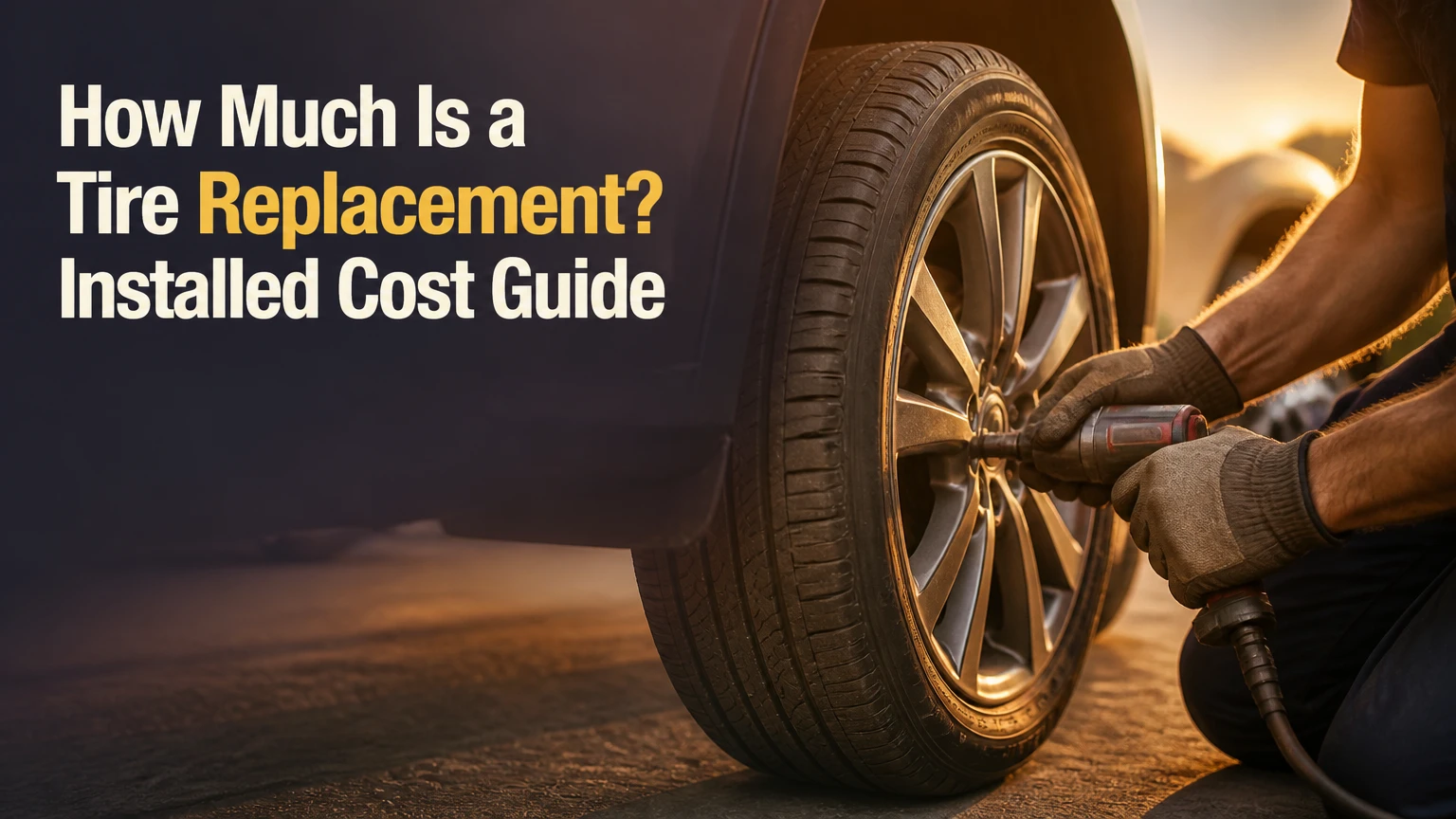
A single tire replacement typically costs $150-$350 installed for a standard passenger car, while four tires usually cost $500-$1,200 installed. Large SUVs, pickup trucks, performance cars, run-flats, and specialty tires can raise a four-tire bill to $900-$1,500 or more, depending on tire size, brand, labor, taxes, and optional services.
Key Facts at a Glance
- A standard passenger-car tire commonly costs $80-$350 before installation, depending on its tier, size, and design.
- Mounting and balancing typically add $20-$45 per tire, while disposal commonly adds $5-$25 per tire.
- A TPMS rebuild or replacement commonly costs $10-$40 per wheel, although a complete sensor can cost more.
- Four-wheel alignment typically costs $100-$150 and is needed when measurements or wear patterns show a geometry problem.
- Tires should be replaced at 2/32 inch of remaining tread, or sooner when damage, uneven wear, or age creates a safety concern.
- AWD vehicles may require four matching tires because diameter differences can stress the drivetrain.
What Does a Tire Replacement Cost?
A tire replacement costs about $150-$350 for one standard tire installed and $500-$1,200 for a complete set of four. The price includes the tire and usually mounting and balancing, but taxes, disposal, TPMS parts, alignment, roadside service, and road-hazard coverage may appear separately on the invoice.
A small commuter sedan with 16-inch all-season tires may fall near the lower end. A luxury SUV with 20-inch tires, a sports car with staggered fitment, or a truck with load-range E all-terrain tires can exceed the upper range because each tire contains more material and carries a higher load.
The quoted price also depends on whether the shop advertises a package price. A tire listed at $145 may become $190 after installation, disposal, valve service, and taxes. Ask whether the quote is out the door, meaning the final amount before payment.
Typical Installed Price by Vehicle
| Vehicle and fitment | Tire price each | Installation fees each | Typical set of four |
|---|---|---|---|
| Compact sedan, 15-16 inch | $80-$160 | $25-$55 | $420-$860 |
| Midsize sedan, 17-18 inch | $120-$250 | $30-$65 | $620-$1,260 |
| Crossover or small SUV | $130-$280 | $30-$70 | $680-$1,400 |
| Pickup or large SUV, 18-22 inch | $180-$400 | $35-$85 | $900-$1,950 |
| Performance car, summer tires | $220-$500+ | $35-$90 | $1,100-$2,350+ |
| Run-flat or specialty EV tire | $200-$500+ | $40-$100 | $1,200-$2,400+ |
These are typical United States retail ranges, not a guaranteed quote. Local wages, sales tax, seasonal demand, tire availability, and vehicle-specific fitment can move the final total substantially.
What Determines the Final Price?
The main price drivers are tire size, construction, load rating, speed rating, vehicle type, brand tier, and the services included in the installation package. A 225/65R17 tire for a crossover is usually less expensive than a 275/35R20 ultra-high-performance tire because the latter uses a wider casing, specialized compound, and lower-profile sidewall.
Cost Breakdown Per Tire
| Charge | Typical amount | When it applies | What to verify |
|---|---|---|---|
| Replacement tire | $80-$500+ | Every replacement | Exact size, load index, speed rating |
| Mounting | $15-$35 | Tire removed from wheel | Included in package or separate |
| Computer balancing | $10-$30 | Every mounted tire | Road-force balancing for persistent vibration |
| Rubber valve stem | $3-$10 | Standard valve service | Included with installation |
| TPMS rebuild kit | $10-$40 | Sensor seal or valve replacement | Kit versus complete sensor |
| Tire disposal | $5-$25 | Old casing left at shop | Local environmental fee |
| Alignment | $100-$150 | Only when geometry requires correction | Printout before and after service |
| Road-hazard coverage | $15-$40 per tire | Optional protection plan | Repair, replacement, prorating terms |
The most commonly overlooked charges are disposal, TPMS service, and alignment. A four-tire package with $30 of installation per wheel, $15 disposal per wheel, and $20 TPMS service per wheel adds $260 before taxes to the tire prices alone.
An alignment should not be added automatically to every tire purchase. A technician should inspect steering and suspension parts and measure wheel angles first. New tires cannot correct a bent control arm, worn tie rod, damaged wheel, or failed bushing.
How Much Is a Tire Replacement for Four Wheels?
A complete four-tire replacement commonly costs $500-$1,200 installed for a car or small crossover. Mid-range tires usually produce the best balance between purchase price, wet traction, warranty length, and tread life, while premium truck, performance, and run-flat sets can cost $1,500 or more.
Replacing four tires together gives all four corners similar tread depth and handling characteristics. That consistency matters most during emergency braking, heavy rain, and cornering when a vehicle transfers weight between axles.
One, Two, or Four Tires?
| Replacement quantity | Typical installed cost | Usually appropriate when | Main concern |
|---|---|---|---|
| One tire | $150-$350 | One casing has damage and tread matches | Tread-depth mismatch |
| Two tires | $300-$700 | One axle needs replacement and vehicle allows it | New tires generally go on rear axle |
| Four tires | $500-$1,200 | Tread is worn broadly or AWD requires matching | Highest upfront cost |
| Four performance tires | $1,100-$2,350+ | Staggered or high-speed fitment | Limited tread life |
On a two-wheel-drive vehicle, two new tires are generally installed on the rear axle, even when the front tires appear more worn. Deeper rear tread helps reduce oversteer and loss of rear traction on wet roads. The tire manufacturer and vehicle manual should control the final recommendation.
AWD vehicles require extra caution. Some manufacturers specify a maximum allowable difference in circumference or tread depth, and the permitted difference varies by drivetrain. A shop may recommend four tires, shaving a replacement tire to match, or replacing tires in axle pairs only when the manufacturer permits it.
Which Tire Type Fits Your Driving?
All-season tires fit moderate climates and mixed daily driving, winter tires fit repeated freezing and snow conditions, summer tires fit warm-weather handling, and all-terrain tires fit drivers who regularly leave paved roads. No tire category performs best in every temperature, surface, and load condition.
| Tire type | Typical price each | Best operating conditions | Limitation |
|---|---|---|---|
| Standard all-season | $80-$220 | Rain, dry roads, mild winter | Reduced ice and deep-snow grip |
| Grand-touring all-season | $130-$300 | Highway commuting and quiet rides | Less responsive than performance tires |
| Winter or snow | $120-$350 | Below-freezing roads, snow, ice | Faster warm-weather wear |
| Summer performance | $180-$500+ | Warm dry and wet pavement | Poor choice for freezing conditions |
| All-terrain | $160-$400 | Gravel, dirt, mud, mixed pavement | More noise and rolling resistance |
| Run-flat | $200-$500+ | Vehicles designed for run-flat systems | Harsh ride and higher replacement cost |
A winter tire uses a compound designed to remain flexible in low temperatures and a tread pattern with dense sipes. A summer tire uses a warmer-weather compound and tread blocks intended to improve dry-road response. An all-season tire is a compromise, not a substitute for a severe-snow tire in regions with prolonged ice and snow.
Electric vehicles can cost more to equip because their weight and instant torque may require a higher load rating, low-rolling-resistance construction, acoustic foam, or EV-specific fitment. The tire sidewall and owner’s manual determine compatibility, not the vehicle’s battery size alone.
What Happens During Tire Installation?
Professional tire installation usually takes 45-90 minutes for four tires, including mounting, balancing, and vehicle installation. The technician removes each wheel, deflates and demounts the old casing, inspects the wheel, services the valve or TPMS seal, mounts the new tire, balances the assembly, and torques the lug nuts.
The Professional Replacement Sequence
- Confirm fitment. The technician verifies size, load index, speed rating, rotation direction, and outside markings against the vehicle placard.
- Remove the wheel. The vehicle is lifted safely, lug nuts are removed, and each wheel is identified by position when rotation history matters.
- Inspect the assembly. The casing, rim, bead seat, valve, TPMS sensor, brake components, and wheel studs are checked for damage.
- Break the bead and demount. Air is released, the bead is separated from the rim, and tire-changing equipment removes the casing without bending the wheel.
- Mount and inflate. The new tire is lubricated, fitted over the rim, and inflated to seat both beads. The tire is then set to the vehicle’s recommended cold pressure.
- Balance the wheel. A computerized balancer identifies mass imbalance and guides placement of adhesive or clip-on weights.
- Install and torque. The wheel is fitted to the hub and lug nuts are tightened to the manufacturer’s torque specification.
- Check pressure and TPMS. The technician confirms cold pressure, sensor communication, valve leakage, and directional or asymmetric tread orientation.
You should receive the old tires back or confirm their disposal, the recommended cold pressures, the torque specification or service record, and any alignment or suspension findings. A vibration after installation can indicate imbalance, a bent wheel, tire uniformity variation, incorrect mounting, or a driveline issue.
Do New Tires Need an Alignment?
New tires need an alignment when the vehicle has incorrect wheel angles, uneven wear, steering pull, a recent impact, or suspension work. Tire replacement alone does not create an alignment problem, so a shop should measure the vehicle rather than sell alignment service automatically.
The strongest warning signs are a steering wheel that is off-center on a straight road, feathered tread edges, rapid wear on one shoulder, or a vehicle that drifts on a level surface. Tire pressure differences and road crown can imitate a pull, so those checks come first.
Wheel alignment corrects suspension geometry. Wheel balancing corrects rotating mass distribution. Balancing addresses vibration that changes with speed, while alignment addresses directional control and irregular wear. One service cannot substitute for the other.
Budget, Mid-Range, or Premium Tires?
Budget tires minimize the initial bill, mid-range tires often offer the most balanced ownership cost, and premium tires can justify their price when wet braking, noise, long highway mileage, or severe weather matters. The cheapest tire is a poor value if it wears early or has inadequate grip for the driver’s conditions.
| Tier | Typical price each | Typical warranty range | Best fit | Trade-off |
|---|---|---|---|---|
| Budget | $80-$140 | 40,000-60,000 miles | Older car or low annual mileage | More noise and shorter service life |
| Mid-range | $140-$250 | 50,000-75,000 miles | Daily commuting and highway travel | Higher purchase cost |
| Premium | $220-$500+ | 60,000-90,000 miles | Wet roads, comfort, long ownership | Large upfront expense |
| Specialty | $200-$500+ | 20,000-60,000 miles | Run-flats, EVs, performance, off-road | Narrower use case |
Mileage warranties are conditional. Tire rotation intervals, alignment, inflation, and proof of maintenance can affect a warranty claim. A 70,000-mile warranty does not guarantee that a tire will last 70,000 miles on a heavily loaded vehicle, an aggressive driver, or a poorly aligned suspension.
A counterintuitive buying rule is to compare cost per expected 10,000 miles, not price per casing. A $160 tire expected to last 50,000 miles costs about $32 per 10,000 miles before service fees. A $110 tire lasting 30,000 miles costs about $37 per 10,000 miles, even though its checkout price is lower.
When Should Tires Be Replaced?
Tires should be replaced at 2/32 inch of tread, when structural damage appears, when tread wear becomes uneven, or when age and environmental exposure degrade the rubber. The legal minimum is not a performance target because wet braking and hydroplaning resistance decline before the final wear bars are flush.
The U.S. National Highway Traffic Safety Administration advises inspecting tires regularly and replacing tires with worn tread or damage. NHTSA describes tires as “the only thing that connects your vehicle to the road,” a concise explanation of why sidewall condition, inflation, and tread matter together.
Age requires judgment rather than one universal number. Bridgestone recommends removing tires from service at 10 years from manufacture, including unused spare tires, while several manufacturers recommend professional inspection beginning at five or six years. Read the four-digit DOT date code, such as 3523, which indicates production in the 35th week of 2023.
Replace Immediately for These Conditions
- Sidewall bulge, bubble, deep cut, exposed cord, or separation.
- A puncture in the shoulder or sidewall.
- A puncture larger than approximately 1/4 inch.
- Repeated pressure loss after a repair.
- Tread below 2/32 inch or wear bars at the tread surface.
- Cracking from ozone, sunlight, storage, or age.
- Tread-depth mismatch beyond the vehicle manufacturer’s AWD limit.
A tire with a bubble cannot be safely patched because the internal cord structure has failed. External appearance is not a reliable test of casing integrity.
When Is a Repair Safer Than Replacement?
A repair is usually appropriate for a small puncture in the central tread area when the casing has not been driven severely underinflated and the tire meets the repair policy of the manufacturer and shop. A proper repair requires removing the tire, inspecting the inside, and using an approved patch-plug combination.
A rope plug inserted from outside may temporarily stop air loss, but it does not replace an internal inspection. Repairs in the sidewall, shoulder, bead, or a damaged casing should not be treated as equivalent to a center-tread repair.
Do not keep driving on a visibly flat tire to reach a shop. Driving without adequate pressure can destroy the inner liner and turn a repairable puncture into a replacement.
How Do You Avoid a Bad Tire Purchase?
Avoid a bad tire purchase by matching the full specification, checking the production date, confirming the installed total, and comparing warranty conditions. The largest shopping mistake is choosing a tire by diameter alone while ignoring load index, speed rating, vehicle fitment, or seasonal performance.
Use this checklist before paying:
- Read the door-jamb placard for the approved size and cold inflation pressure.
- Match the load index and speed rating unless the vehicle manufacturer permits another specification.
- Check whether the tire is directional, asymmetric, run-flat, or marked for a specific original-equipment application.
- Inspect the DOT date code and request newer stock when practical.
- Ask for the out-the-door price, including mounting, balancing, valves, TPMS, disposal, taxes, and alignment.
- Confirm whether the price includes rotation, puncture repair, mileage warranty, or road-hazard coverage.
- Check the spare tire’s condition because a full-size spare may need matching tread depth.
- Keep the invoice and maintenance records for warranty and future rotation claims.
Do not select a lower speed rating or load index merely to reduce cost. A tire that physically fits the wheel may still be unsuitable for the vehicle’s weight, speed capability, or braking system.
How Much Does Mobile or Specialty Replacement Cost?
Mobile tire replacement commonly adds $50-$150 to the tire and installation bill, while run-flat, oversized truck, EV, and specialty fitments can add $20-$100 or more per tire. Convenience, equipment requirements, after-hours labor, and limited inventory explain the premium.
Mobile service is useful for a disabled vehicle, fleet, or customer who cannot safely drive to a shop. It may be less suitable for a bent wheel, persistent vibration, alignment problem, or complicated TPMS fault because a full-service workshop has more diagnostic equipment.
Run-flat tires require compatible wheels, pressure-monitoring systems, and a vehicle designed for their handling characteristics. Replacing run-flats with ordinary tires can affect the spare-tire strategy, ride behavior, and manufacturer approval.
Common Replacement Mistakes and Fixes
Replacing Only the Visibly Damaged Tire
A single replacement is acceptable only when tread depth, model, size, construction, and wear remain compatible. Measure the other tires instead of relying on visual inspection, particularly on AWD vehicles.
Skipping a Post-Installation Torque Check
Lug nuts can settle after wheel installation. Follow the shop’s recheck interval, often 25-100 miles depending on the wheel and service policy, and stop driving if a wheel develops looseness, clicking, or severe vibration.
Treating Tire Pressure as a Tire Defect
Pressure should be measured cold with a reliable gauge and compared with the door-placard value. The maximum pressure molded into the sidewall is not the normal vehicle setting.
Assuming New Tires Fix Suspension Wear
New rubber cannot correct worn tie rods, bent wheels, failed struts, or a damaged control arm. A new tire that develops shoulder wear quickly needs an inspection, not another replacement.
Installing Tires in the Wrong Direction
Directional tires must rotate according to the sidewall arrow. Asymmetric tires require the “outside” marking to face outward, because reversing either design changes the intended water evacuation and handling behavior.
FAQ
Can I Replace Tires at Different Brands?
You can use different brands on some two-wheel-drive vehicles, but matching tires on the same axle is the safer baseline. The tires should share size, construction, load index, speed rating, and comparable tread depth. AWD systems may impose tighter matching requirements, so consult the owner’s manual before mixing models.
How Long Does a Tire Replacement Take?
A four-tire installation commonly takes 45-90 minutes when the shop has the tires in stock and no alignment or TPMS fault requires diagnosis. Oversized wheels, run-flats, seized lug nuts, corrosion, wheel damage, or seasonal demand can extend the appointment to two hours or more.
Should New Tires Go on the Front or Rear?
When only two tires are replaced, new tires generally go on the rear axle of a conventional front-wheel-drive or rear-wheel-drive vehicle. Deeper rear tread improves wet-road stability and reduces the risk of a rear slide. Follow the vehicle manufacturer’s instructions for unusual drivetrains or staggered fitments.
Are Used Tires Worth Buying?
Used tires can reduce the purchase price, but their value depends on tread depth, age, repairs, storage, and hidden casing damage. Reject any used tire with a sidewall injury, uneven wear, visible cracking, unknown history, or a DOT date that leaves little useful service life.
Does Tire Insurance Pay for Replacement?
Road-hazard coverage may repair or replace a tire damaged by a covered puncture, usually subject to exclusions, tread-depth limits, prorating, and installation fees. Manufacturer warranties generally address workmanship or treadwear conditions, not every road impact. Read the written policy before treating coverage as a guarantee.
The Bottom Line
How much is a tire replacement? Budget $150-$350 for one standard passenger-car tire installed or $500-$1,200 for four, then verify TPMS, disposal, taxes, alignment, vehicle fitment, and AWD requirements. Choose the tire by load and seasonal performance first, compare the complete installed price second, and replace damaged or aged casings before the tread reaches its legal limit.