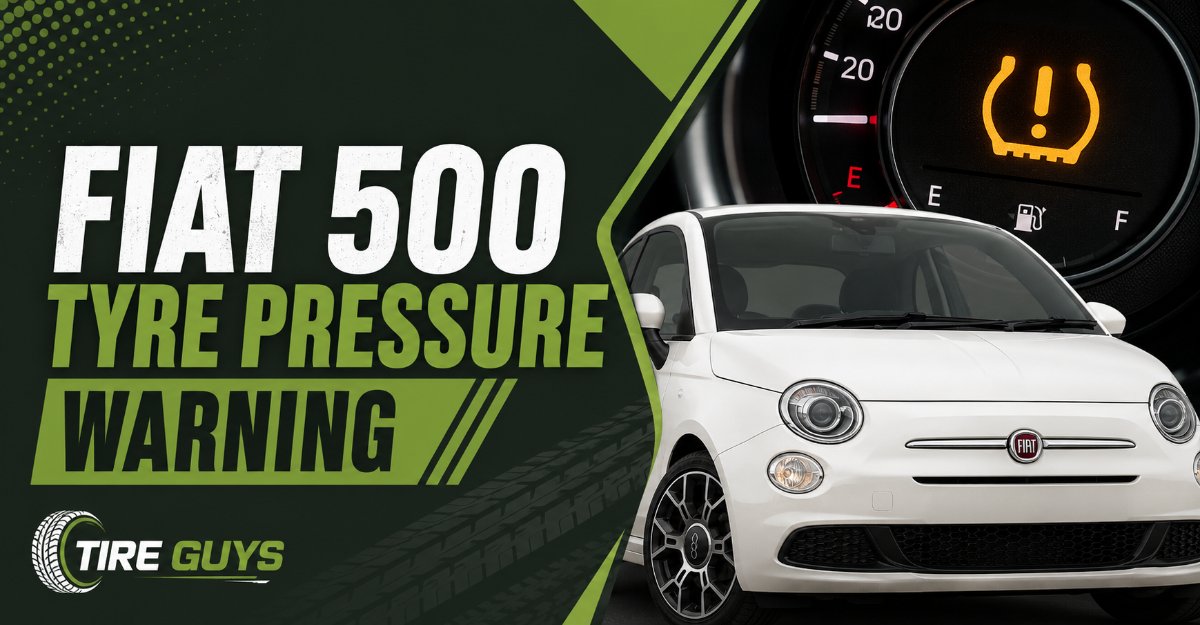
The fiat 500 tyre pressure warning light illuminates automatically when the vehicle detects that one or more tyres have dropped 20 to 25 percent below the manufacturer’s recommended pressure specification. To clear this dashboard alert, you must inflate all four tyres to their proper cold pressure settings and execute a manual system reset using your steering wheel or dashboard menu controls.
Key Facts / At a Glance:
- Trigger Threshold: The system activates when tyre pressure drops below roughly 24 to 25 PSI.
- Standard Pressure: Front tyres typically require 32 PSI (2.2 bar), while rear tyres need 33 to 35 PSI (2.3 bar).
- System Types: Fiat uses Indirect systems (wheel speed sensors) in most European models and Direct systems (internal wheel sensors) in North American models.
- Reset Requirement: Adding air does not automatically turn off the light on most models; a manual dashboard reset is strictly required.
- Hardware Lifespan: Direct TPMS sensor batteries last 8 to 10 years before requiring full replacement.
What do you need before starting the reset?
Before attempting to clear the dashboard light, you must ensure the physical tyres are correctly inflated. Resetting the system with under-inflated tyres will calibrate the computer to the wrong pressure, rendering the safety system useless.
- Time Required: 10 to 15 minutes.
- Difficulty: Beginner.
- Cost: £0 to £2 (for fuel station air pump access).
- Tools Required: A reliable digital tyre pressure gauge and access to an air compressor.
- Prerequisite: Tyres must be “cold”. The vehicle must have been parked for at least 3 hours, or driven for less than 1 mile at low speeds prior to inflation.
Why is the Fiat 500 tyre pressure warning light on?
The Fiat 500 tyre pressure warning light activates to alert the driver of a dangerous loss of tyre traction and load-carrying capacity. The system measures pressure directly or indirectly, and legal safety standards require the light to trigger when inflation drops 20 to 25 percent below the door placard recommendation.
This drop in pressure can result from a physical puncture, a faulty valve stem, or natural environmental factors. Air expands when heated and contracts when cooled. A sudden overnight temperature drop of 10 degrees Celsius will cause tyre pressure to drop by roughly 1.5 to 2 PSI. This phenomenon, known as the “winter false alarm,” is the most common cause of warning lights during colder months. If the light appears on a freezing morning, the air has physically compressed inside the tyre and must be topped up.
How do I find the correct tyre pressure?
You can find the exact tyre pressure specifications for your specific Fiat 500 on the driver’s side door jamb placard or inside the vehicle owner’s manual. The correct pressure is determined by the vehicle’s weight distribution, suspension tuning, and specific wheel size.
Standard Fiat 500 models typically require 32 PSI (2.2 bar) in the front tyres and 33 to 35 PSI (2.3 bar) in the rear tyres under normal passenger loads. If the vehicle is fully loaded with four adults and luggage, the manual often recommends increasing the rear pressure to 36 PSI to handle the extra weight. Abarth performance variants or models fitted with larger 17-inch alloy wheels may have completely different baseline requirements, making the door placard the only definitive source of truth. The space-saver spare tyre requires a significantly higher pressure, usually sitting at 41 PSI (2.8 bar).
Which TPMS system does my Fiat 500 have?
Fiat has utilized two completely different types of Tyre Pressure Monitoring Systems (TPMS) depending on the production year and the target geographic market. Identifying your system is critical because they fail differently and require different maintenance approaches.
The Indirect system uses existing software, while the Direct system relies on physical hardware inside the wheels.
| Feature | Indirect TPMS (iTPMS) | Direct TPMS |
|---|---|---|
| How it works | Uses ABS sensors to measure wheel rotational speed. Deflated tyres spin faster. | Uses battery-powered pressure sensors mounted behind the tyre valve stems. |
| Availability | Standard on most European and UK Fiat 500 and 500e models from 2014 onwards. | Standard on North American models (2012 to 2019) and specific trims like the 500X. |
| Dashboard Data | Only displays a general flat tyre warning icon. | Displays individual, real-time PSI numbers for each specific wheel. |
| Primary Advantage | Zero maintenance costs. No internal batteries to replace during the car’s lifespan. | Highly accurate. Detects if all four tyres lose pressure simultaneously. |
| Primary Drawback | Requires a manual dashboard reset every single time air is added. | High replacement costs when the non-replaceable internal batteries die. |
The Indirect system has a notable limitation. Because it measures rotational speed differences between wheels, it struggles to detect a scenario where all four tyres lose air at the exact same rate over several months. Direct systems avoid this flaw by measuring physical air pressure independently at each corner.
How do I reset the Fiat 500 tyre pressure warning?
Once all four tyres are inflated to the correct cold pressure, you must force the vehicle computer to accept these new values as the baseline.
Resetting Analogue Dashboards (2010 to 2019 Models)
Most standard Fiat 500 models with physical speedometer needles use a button array located on the right side of the dashboard cluster to manage settings.
- Turn the ignition on: Insert the key and turn it to the ON or RUN position. Do not start the engine.
- Access the menu: Press the “Menu” button located near the right side of the instrument binnacle.
- Navigate to the reset option: Use the up (+) or down (-) buttons to scroll through the options until the digital screen displays “Reset Tyres” or “Tyre Pressure”.
- Initiate the reset: Press the “Menu” button once to select this option.
- Confirm the action: Scroll to highlight “Yes”, then press the “Menu” button again to confirm.
- Verify completion: The dashboard screen will display “Reset Saved”. You can now start the engine and drive normally.
Common mistake at this step: Drivers often scroll to “Yes” but forget to press the Menu button a final time to lock in the command. If you do not see the “Reset Saved” confirmation, the system will continue to display the warning light.
Resetting Digital Dashboards (500e and Newer Trims)
Newer Fiat 500 models, particularly the electric 500e and those with full digital driver displays, move the reset procedure to the steering wheel controls.
- Activate the electronics: Switch the ignition on without pressing the brake pedal. This ensures the electronics power up without engaging the drive motor or engine.
- Open vehicle settings: Use the directional arrows on the steering wheel to toggle horizontally to the “Vehicle Info” or “Settings” menu tab.
- Locate tyre pressure: Scroll vertically down through the list to find the “Tyre Pressure Reset” screen.
- Hold to confirm: Press and hold the “OK” button in the center of the directional pad. Hold it until the progress bar on the screen fills completely and clears.
- Calibrate the system: Drive the vehicle at a speed above 15 mph (25 km/h) for 10 to 15 minutes. The system needs this continuous driving data to finalize the baseline calibration.
Common mistake at this step: Failing to complete the 15-minute calibration drive. If you reset the system and immediately park the car, the computer cannot learn the new wheel rotational speeds, and the light may return on your next trip.
What causes a flashing TPMS light?
A flashing tyre pressure light indicates a hardware or software malfunction within the TPMS system itself, rather than a simple low-air situation. If the warning light flashes for roughly 60 seconds upon vehicle startup before turning solid, the computer has lost communication with one or more sensors.
For Direct TPMS systems, this almost always means a sensor battery has died. The lithium batteries sealed inside Direct TPMS sensors have a finite lifespan of 8 to 10 years. Because the batteries cannot be replaced independently, the entire sensor unit must be swapped out. For Indirect systems, a flashing light typically points to a damaged ABS wheel speed sensor or a severed wiring harness near the wheel hub, often caused by road debris or heavy pothole impacts.
How much does TPMS repair cost?
Repairing a faulty tyre pressure system varies significantly based on your vehicle’s system type and whether you visit a dealership or an independent garage.
If your vehicle requires basic air adjustment and a manual reset, the cost is practically zero. However, replacing hardware requires professional tools. Direct TPMS sensor replacement typically costs between £40 and £90 ($50 to $110) per wheel at an independent tyre shop. This price includes the physical sensor, the labor to dismount the tyre, the electronic programming to pair the new sensor with the Fiat ECU, and standard wheel balancing. If the dashboard displays a “TPMS Unavailable” error message, a mechanic will charge a diagnostic fee of £30 to £60 ($40 to $80) to connect an OBD2 scanner and pinpoint exactly which wheel sensor has failed.
What are common mistakes when fixing tyre pressure?
Drivers frequently make errors that cause the warning light to return shortly after attempting a fix. Understanding these failure modes prevents unnecessary trips to the mechanic.
The most frequent error is checking and adjusting pressure on warm tyres. Driving heats up the air inside the tyre casing, temporarily raising the internal pressure by 3 to 5 PSI. If a driver bleeds air out of a warm tyre to match the door placard, that tyre will become severely under-inflated once the rubber cools overnight, immediately triggering the warning light the next morning.
Another severe mistake involves emergency puncture repair kits. Aerosol products like Fix-a-Flat inject a thick, liquid sealant into the tyre casing to plug holes. While effective in emergencies, this liquid permanently coats and ruins the delicate electronic sensors used in Direct TPMS setups. If you use liquid sealant on a Direct TPMS equipped Fiat, you will inevitably have to replace the internal sensor.
Frequently Asked Questions
Can I drive with the tyre pressure warning light on?
You should not drive at highway speeds or for long distances with the light illuminated. While you can safely drive at low speeds to the nearest fuel station, driving on severely under-inflated tyres compromises braking distances, drastically increases blowout risk, and causes rapid, uneven tread wear.
Why won’t the tyre pressure light turn off after adding air?
If you drive a European Fiat with an Indirect system, adding air does nothing to the vehicle computer. The light remains on because the system requires a manual reset via the dashboard menu to learn the new wheel circumferences. If the light remains on after a reset, you may have a slow puncture.
Does the Fiat 500 spare tyre have a pressure sensor?
The standard space-saver spare tyre provided with the Fiat 500 does not contain a pressure sensor. If you mount the spare wheel, the vehicle will detect a missing signal or a drastic difference in wheel speed, and the TPMS warning light will remain illuminated on the dashboard until the primary wheel is repaired and reinstalled.
How do I know if my sensor battery is dead?
A dead sensor battery causes the dashboard light to flash continuously for roughly one minute immediately after turning the key, before settling into a solid yellow icon. This specific 60-second flashing sequence is the universal automotive diagnostic code for a system fault, confirming the issue is electronic rather than pneumatic.
The Bottom Line
Resolving a fiat 500 tyre pressure warning is a routine maintenance task that requires correct inflation levels and a proper digital recalibration. Always rely on the tyre pressure figures printed on your specific door placard, ensure the tyres are cold before adjusting, and build a habit of navigating your dashboard menu to reset the system every time you visit an air pump. If the light flashes upon startup on an older model, budget for new sensors during your next scheduled tyre change.