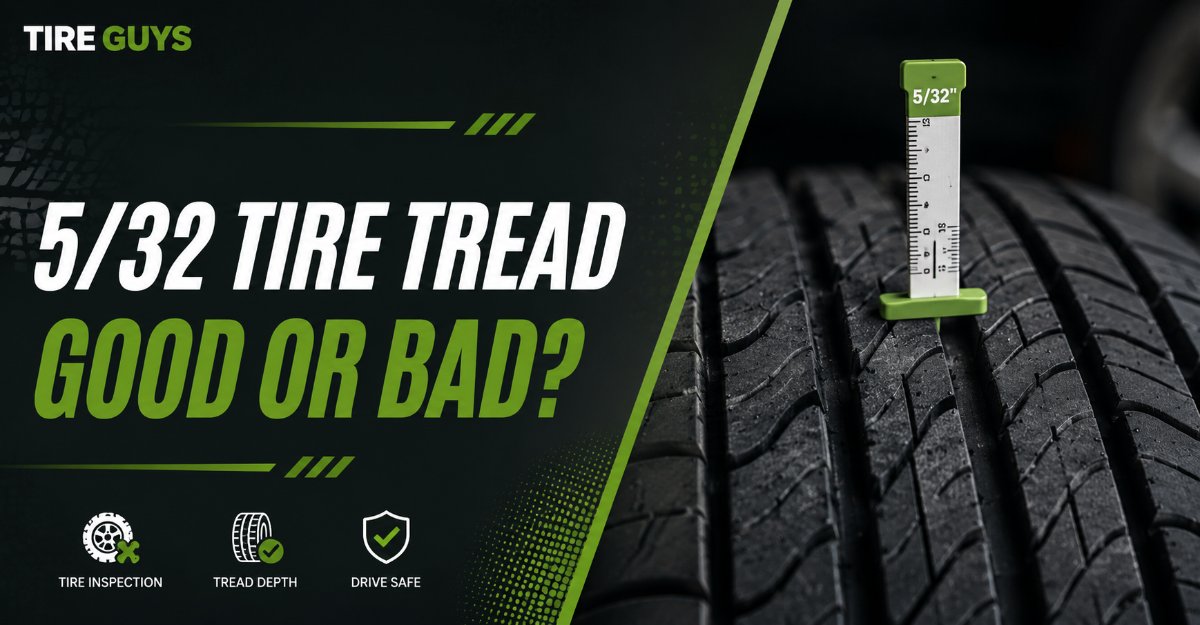
A 5/32 tire tread is considered marginal or fair, offering adequate safety for normal dry roads but posing a noticeable reduction in wet traction. At this depth, your tires are approximately 65 percent worn and will require replacement within the next 5,000 to 12,000 miles. You do not need to replace them today, but you must monitor them closely and plan to buy new tires before the start of heavy rain or winter weather.
Key Facts at a Glance
- Safety Status: Fair to Marginal.
- Remaining Lifespan: 5,000 to 12,000 miles under normal driving conditions.
- Wet Weather Performance: Hydroplaning risk increases significantly at highway speeds.
- Winter Weather Performance: Not recommended for driving in freezing slush or fresh snow.
- Legal Limit Context: Still legal in all 50 states, sitting safely above the 2/32 inch minimum threshold.
What Does 5/32 Tire Tread Actually Mean?
Tire tread depth measures the vertical distance from the outermost surface of the rubber down to the deepest internal grooves. In the United States, this depth is universally measured in 32nds of an inch. A standard passenger tire typically starts with 10/32 or 11/32 of an inch of tread. Reaching 5/32 means the tire has lost more than half of its original usable rubber.
Deep grooves exist primarily to channel water, slush, and snow away from the tire’s contact patch. This mechanism prevents hydroplaning by allowing the rubber to maintain mechanical grip on the asphalt. At 5/32 of an inch, the tire retains enough void capacity to handle light rain and dry pavement. However, the physical volume of water the tire can evacuate per second is vastly reduced compared to a brand new tire.
How 5/32 Compares on the Safety Spectrum
To understand exactly where your tires stand, compare them against the universal industry safety baseline.
| Tread Depth | Safety Status | Practical Action Required |
| 10/32″ to 12/32″ | Excellent | None. This is brand new condition. |
| 7/32″ to 9/32″ | Good | None. Safe for all standard driving conditions. |
| 5/32″ to 6/32″ | Marginal / Fair | Monitor monthly. Safe for dry roads, use caution in heavy rain. |
| 3/32″ to 4/32″ | Low / Caution | Replace soon. Wet traction is severely compromised. |
| 2/32″ or less | Dangerous / Illegal | Replace immediately. High risk of blowout and hydroplaning. |
Is 5/32 Tire Tread Safe to Drive On?
Driving on 5/32 tire tread is safe under the right environmental conditions, but safety is heavily dependent on the current weather and your driving speed. The physical capabilities of the rubber change as the depth decreases.
Performance in Dry Conditions
On dry, warm pavement, a tire at 5/32 actually provides excellent mechanical grip. Racing slicks have zero tread, maximizing the contact patch with the road. While street tires at 5/32 are not racing slicks, they do put a large amount of rubber in direct contact with the asphalt. Braking and cornering on dry roads remain completely safe and predictable.
Performance in Heavy Rain
Wet weather is where 5/32 tread begins to show its limitations. Water cannot compress. When you hit a puddle at 60 mph, the tire must channel gallons of water out of the way in fractions of a second. At 5/32, the channels are shallow. If the volume of standing water exceeds the evacuation capacity of the grooves, the water lifts the tire off the road. This is called hydroplaning. Your stopping distance in heavy downpours will increase by up to 30 percent compared to a new tire.
Performance in Winter Weather
Driving on 5/32 tread in snow or freezing slush is highly discouraged. Winter tires rely on tiny slits called sipes to bite into packed snow. By the time a tire wears down to 5/32, the most effective sipes have been completely worn away. The rubber compound has also likely undergone multiple heat cycles, hardening it and reducing its flexibility in freezing temperatures.
How Long Will 5/32 Tires Last?
A typical passenger car tire at 5/32 will last another 5,000 to 12,000 miles. Translating that to time, most average American drivers will get another 4 to 10 months of use before the tires become hazardous.
The exact mileage depends on the wear rate of your specific tire compound. A standard touring tire typically loses 1/32 of an inch every 4,000 miles. Because tires must be replaced by law at 2/32, you have exactly 3/32 of an inch of usable, legal rubber remaining. Multiplying three by 4,000 yields an estimated 12,000 miles of maximum remaining life. High performance and soft compound summer tires wear much faster and may only yield another 5,000 miles.
Variables that accelerate tread wear at this stage include poor wheel alignment, aggressive cornering, towing heavy loads, and chronic underinflation.
How to Accurately Measure 5/32 Tread Depth
Visual inspections are insufficient for determining exact tread depth. You must take physical measurements across multiple points of the tire to ensure the rubber is wearing evenly.
Step-by-Step Measurement Process
Follow these instructions to get a precise reading:
- Park on flat ground: Engage the parking brake. Turn your steering wheel completely to the left or right to expose the front tire tread clearly.
- Use a dedicated gauge: Insert a digital or mechanical tread depth gauge into the central longitudinal grooves of the tire. Push the pin down until it touches the base of the groove.
- Measure multiple spots: Take three distinct readings across the width of the tire. Measure the outer edge, the dead center, and the inner edge.
- Identify the lowest number: The lowest measured number is your actual tire depth. If your outer edge reads 5/32 but the inner edge reads 2/32, the tire is dangerous and must be replaced.
- Check the Treadwear Indicator Bars: Look for small, raised blocks of rubber molded into the bottom of the main grooves. These bars sit exactly at 2/32 of an inch. If your remaining tread is approaching these bars, your 5/32 window is closing fast.
Why the Penny Test Fails at 5/32
Many drivers rely on the traditional “Penny Test” by inserting a Lincoln penny upside down into the tread. If you can see the top of Lincoln’s head, the tire is considered bald. This is a dangerous metric because the top of Lincoln’s head measures exactly 2/32 of an inch. If you wait until the penny test fails, you have already been driving on dangerously compromised tires for thousands of miles. Instead, use a Washington quarter. The distance from the rim of the coin to Washington’s head is exactly 4/32 of an inch. If the top of his head is flush with the tread, you are nearing the end of your tire’s safe life.
What Are the Options for Tires at 5/32 Depth?
When your tires reach 5/32, you face three primary strategic paths. Your decision should be based on your budget, your local climate, and your vehicle’s drivetrain type.
Option 1: Drive and Monitor
You keep the current tires on the vehicle and commit to checking the tread depth and air pressure on the first day of every month.
- Pros: Maximizes the financial value of the tires you already own. Avoids immediate upfront expenses.
- Cons: Reduced safety margin in severe weather. Requires active maintenance and vigilance.
Option 2: Immediate Replacement
You discard the partially worn tires and install a brand new set of four.
- Pros: Restores maximum braking performance and hydroplaning resistance. Provides total peace of mind for long road trips.
- Cons: You are discarding roughly 25 percent of usable dry weather rubber. Requires an immediate, high out of pocket cost.
Option 3: Axle-Pair Replacement
You buy two new tires and place them on the same axle, leaving the two best 5/32 tires on the other axle. Always mount the new tires on the rear axle to prevent oversteer and spinouts in wet conditions.
- Pros: Balances safety and cost. Secures maximum traction for the rear of the vehicle.
- Cons: Strictly prohibited on many All-Wheel Drive (AWD) vehicles due to drivetrain strain. Delays but does not solve the overall replacement timeline.
Replacement Cost Breakdown
When replacement becomes inevitable, budget accordingly based on your vehicle type. Economy options range from $80 to $150 per tire. Standard passenger car tires from major brands typically cost $150 to $250 per tire. Heavy duty truck tires, performance vehicle rubber, or large SUV tires will cost between $250 and $450 per tire. Always factor in an additional $20 to $40 per wheel for mounting, balancing, and disposal fees.
How to Troubleshoot Traction Issues at 5/32
If you elect to keep driving on your 5/32 tires, you might begin to notice mild mechanical feedback. Worn tires amplify existing mechanical flaws in a vehicle’s suspension.
Fixing Steering Wheel Vibrations
If your steering wheel vibrates at highway speeds, your tires are likely out of balance. As tires lose rubber, their weight distribution changes. Take the vehicle to a shop and have the wheels rebalanced. A vibration can also indicate structural failure inside a worn tire, such as a slipped belt, which requires immediate replacement.
Addressing Slipping on Acceleration
If your tires slip or spin when accelerating from a stop sign on wet pavement, check your tire pressure. Drop your tire pressure to the exact manufacturer recommendation found on the driver’s door jamb placard. Over-inflating worn tires rounds out the center of the tread, drastically shrinking the contact patch and causing premature wheel slip.
Correcting a Steering Pull
If the car pulls to one side while driving on a flat road, you likely have an alignment issue. Rotate the tires from front to back to see if the pulling behavior changes. If it does, the 5/32 tire has worn asymmetrically and is causing a steering bias. A professional wheel alignment is required to prevent your next set of tires from suffering the same fate.
The Bottom Line: When Should You Replace 5/32 Tires?
The decision to replace 5/32 tires comes down to your personal driving environment.
The Daily Commuter in Dry Climates: Keep driving. If you live in regions like Arizona, Nevada, or Southern California with minimal annual rainfall, you can safely run these tires down to 3/32 or 4/32. Monitor them monthly.
The Rainy Climate Driver: Prepare to replace within 60 days. If you face heavy seasonal downpours or live in the Pacific Northwest, your hydroplaning threshold is already compromised at 5/32. Start shopping for replacements now.
The Winter Region Driver: Replace immediately. Driving on 5/32 tires in blizzards, freezing slush, or fresh snow is highly dangerous. Winter tires lose almost all effective snow traction once they drop below 6/32.
The High-Performance Driver: Replace immediately. High speed cornering and aggressive braking require optimal tread block stiffness. At 5/32, repeated heat cycles have hardened the rubber, severely diminishing track grip and extending stopping distances.
Frequently Asked Questions
Can I drive cross country on 5/32 tires?
Yes, you can safely drive cross country on 5/32 tires provided the trip occurs during dry, mild weather. A 3,000 mile trip will consume just under 1/32 of rubber, meaning you will finish the trip at roughly 4/32, which is still perfectly legal.
Is 5/32 tread depth good for a rental car?
It is acceptable, but not ideal. A rental car with 5/32 tread is perfectly legal and safe for standard driving. However, if you plan to drive the rental through mountains, heavy rain, or snow, you should ask the rental agency for a vehicle with newer tires.
Will 5/32 tires pass a state vehicle inspection?
Yes. In all 50 US states, the legal minimum tread depth is 2/32 of an inch. A tire at 5/32 easily passes state safety and registration inspections.
How much does a 5/32 tire affect gas mileage?
Tires at 5/32 actually improve fuel economy slightly. Worn tires have less mass, lower rolling resistance, and less tread squirm compared to brand new tires. You may see a 1 to 2 percent increase in fuel efficiency, though this comes at the cost of wet weather safety.
Can you patch a punctured tire with 5/32 tread?
Yes, a tire at 5/32 can be legally and safely patched if the puncture is in the center of the tread area. However, many mechanics will advise against spending money on patching a tire that will need to be replaced in a few months anyway.