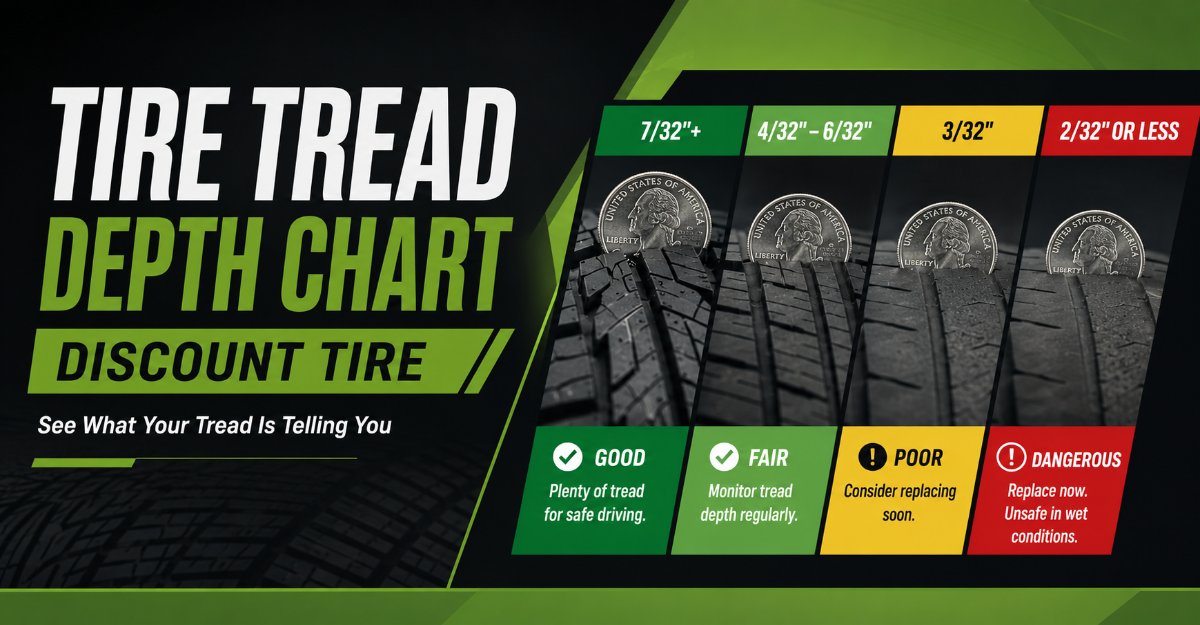
The tire tread depth chart Discount Tire uses follows a Green, Yellow, and Red system measured in 32nds of an inch. Green indicates safe tread between 6/32 and 12/32, Yellow warns of decreasing wet traction at 4/32 to 5/32, and Red requires immediate replacement at 3/32 or less due to severe safety risks.
Key Facts / At a Glance
- Tread depth is the vertical measurement from the top of the tire rubber to the bottom of the deepest groove.
- Most new passenger tires start with 10/32 of an inch of tread.
- Stopping distances on wet roads increase drastically once tread drops below 4/32 of an inch.
- Tires measuring 2/32 of an inch are legally bald in most states and pose an extreme hydroplaning risk.
- Checking your tire tread depth takes less than two minutes and should be performed monthly.
What Is the Discount Tire Tread Depth Chart?
The Discount Tire tread depth chart divides tire wear into three distinct zones based on the remaining rubber. This classification system aligns with guidelines set by the Department of Transportation and major tire manufacturers. The primary purpose of this chart is to predict a tire’s ability to grip the road and evacuate water.
| Zone | Depth (32nds of an inch) | Status | Required Action |
|---|---|---|---|
| GREEN | 6/32″ to 12/32″ | Good | None. Tires have maximum traction for rain and light snow. |
| YELLOW | 4/32″ to 5/32″ | Caution | Plan replacement. Wet weather stopping distance increases. |
| RED | 2/32″ to 3/32″ | Danger | Replace immediately. Tires are legally bald and highly unsafe. |
Understanding the Green Zone
Tires in the Green Zone retain deep grooves capable of channeling gallons of water per second away from the contact patch. A new all-season tire typically starts at 10/32 of an inch. While in the Green Zone, the tire maintains its original structural integrity, handling characteristics, and resistance to punctures. Drivers in regions with heavy rain or snow should strictly maintain tires in this zone.
Understanding the Yellow Zone
The Yellow Zone serves as a financial and safety planning window. When a tire hits 5/32 of an inch, the void volume (the empty space in the grooves) is cut in half. The tire can no longer evacuate water efficiently at highway speeds. Discount Tire technicians recommend replacing tires at 4/32 of an inch rather than waiting for the legal limit.
Understanding the Red Zone
Tires in the Red Zone are structurally compromised. At 2/32 of an inch, the physical wear bars molded into the bottom of the tire grooves sit flush with the outer tread. Driving on Red Zone tires compromises evasive maneuvering, drastically increases braking distance, and makes a blowout highly probable under heavy loads or high heat.
Why Does 4/32 of an Inch Trigger a Warning?
The 4/32 of an inch mark triggers a warning because it represents the mathematical tipping point for wet-weather traction. Tread patterns do not exist for dry pavement grip. They exist exclusively to create channels that force water out from under the tire.
When tread depth drops below 4/32 of an inch, the tire cannot push water away fast enough. The water gathers beneath the rubber, lifting the vehicle off the road surface. This phenomenon is known as hydroplaning. Automotive testing facilities have proven that a vehicle traveling at 70 mph on tires with 2/32 of an inch of tread will take up to 100 feet longer to stop on a wet road compared to tires with 4/32 of an inch. That 100-foot difference dictates whether a driver stops safely or triggers a severe collision.
How Do You Measure Your Tire Tread Depth?
Measuring your tire tread depth requires verifying the lowest point of wear across the entire width of the tire. You cannot rely on a single measurement in the center. Here are the three primary methods to evaluate your tire health.
Method 1: The Discount Tire Free Drive-Thru Check
The most accurate professional method requires zero specialized tools on your part. Discount Tire operates dedicated drive-thru lanes specifically for air pressure and tread depth checks.
- Pull into the dedicated lane: Locate the lane marked “Air Check” at your local store. No appointment is necessary.
- Remain in your vehicle: A tire technician will approach your window to begin the inspection.
- Allow the physical inspection: The technician will use a digital or manual stick gauge to measure the inner, center, and outer grooves of all four tires. They will also inspect for sidewall bubbling and dry rot.
- Review the report: The technician will provide a verbal summary and a printed or emailed report detailing the exact 32nds of an inch remaining on each corner of your vehicle.
Method 2: Using a Dedicated Tread Depth Gauge
A dedicated tread depth gauge is the most precise tool for at-home inspections. These tools cost under ten dollars and provide exact measurements rather than the estimations provided by coins.
- Park on a flat surface: Ensure the steering wheel is turned fully to one side to expose the front tire treads.
- Insert the gauge: Push the measurement pin into the deepest part of the major circumferential groove.
- Press the housing flush: Push the flat base of the gauge flat against the top of the tread block.
- Read the measurement: Pull the gauge away carefully and read the measurement shown on the graduated scale. Repeat this on the inner edge, center, and outer edge of the tire.
Method 3: The Quarter and Penny Tests
The coin tests provide a quick visual baseline if you lack a proper gauge. They rely on the fixed distances between the edge of the coin and the portraits of the Presidents.
- The Quarter Test (The Safety Standard): Insert a standard US quarter upside down into the tread groove. If the top of the tread touches the top of George Washington’s head, you have exactly 4/32 of an inch remaining. If you can see the space above his head, your tires are in the Yellow or Red zone.
- The Penny Test (The Legal Minimum): Insert a standard US penny upside down into the groove. If the tread aligns with the top of Abraham Lincoln’s head, you have exactly 2/32 of an inch remaining. Seeing the space above Lincoln’s head means the tire is legally bald and you must replace it today.
Which Tread Depth Do Different Drivers Need?
Different driving habits and environments demand different tread depth strategies. A uniform replacement rule does not apply to every vehicle type.
1. The Daily Commuter (Sedans and Crossovers)
Commuters prioritize longevity and wet traction on paved roads.
- Optimal Tire: All-Season Touring.
- Replacement Threshold: 4/32 of an inch. Highway speeds require maximum water evacuation to prevent hydroplaning during sudden stops.
- Expert Tip: Rotate commuter tires every 5,000 to 7,000 miles to ensure all four tires reach the 4/32 threshold simultaneously.
2. The Performance Driver (Sports Cars)
Performance drivers rely on maximum grip for cornering and acceleration.
- Optimal Tire: Summer or Ultra-High-Performance (UHP).
- Replacement Threshold: 5/32 of an inch.
- Expert Tip: Performance rubber undergoes “heat cycling.” The repeated heating and cooling hardens the rubber compound. A performance tire often ages out and loses its sticky characteristics well before the tread physically wears down to the Red zone.
3. The Off-Road and Truck Driver
Truck drivers need deep voids to grip loose terrain like mud, gravel, and snow.
- Optimal Tire: All-Terrain (A/T) or Mud-Terrain (M/T).
- Replacement Threshold: 6/32 of an inch.
- Expert Tip: Off-road traction relies entirely on the sharp “biting edges” of the tread blocks. Once an All-Terrain tire wears down to 5/32 of an inch, it functionally becomes a street tire and will instantly pack with mud, leaving the truck stranded.
4. The Winter Driver
Cold climates require specific rubber compounds and deep grooves to bite into snowpack.
- Optimal Tire: Dedicated Winter Tire.
- Replacement Threshold: 6/32 of an inch.
- Expert Tip: Winter tires feature thousands of tiny slits called sipes. These sipes open up to grab snow. When the tire wears past 6/32, these sipes disappear, and the tire loses its ability to clear snow effectively.
How Long Does Tire Wear Take and What Does It Cost?
Understanding the timeline of tire wear helps you budget for replacements without compromising safety. The average American drives 12,000 miles per year. Under normal driving conditions with proper alignment, a standard all-season tire wears down approximately 1/32 to 2/32 of an inch every 12 months.
A new tire starting at 10/32 of an inch will typically take three to five years to reach the 4/32 replacement warning zone. Trying to squeeze extra time out of a tire by driving it from 4/32 down to 2/32 saves the average driver roughly 15 percent of the tire’s total lifespan. In financial terms, you might delay a $600 purchase by a few months, but you take on thousands of dollars in collision risk due to compromised braking.
Drivers of All-Wheel Drive (AWD) vehicles face strict requirements regarding tread depth matching. AWD drivetrains require all four tires to have a nearly identical rolling circumference. If one tire suffers unrepairable damage and the other three are sitting at 5/32 of an inch, the mechanical tolerance of the AWD system will force you to replace all four tires at once to prevent destroying the vehicle’s transfer case.
What Do Uneven Tire Wear Patterns Mean?
Tire tread rarely wears down perfectly evenly. Inspecting the tread across the entire width of the tire reveals the mechanical health of your vehicle. Ignoring uneven wear will ruin a brand-new set of tires in thousands of miles.
- Inner or Outer Edge Wear: Excessive wear on one side of the tire indicates a severe camber alignment issue. The tire leans too far in or out. You must get an alignment check immediately. Tread depth in the center of the tire does not matter if the steel cords are showing on the inner edge.
- Center Wear: Rapid wear down the exact center of the tire signals chronic over-inflation. The excess air pressure causes the center of the tire to balloon outward, bearing the entire weight of the car. Lower your tire pressure to the specification listed on the sticker inside the driver’s door jamb.
- Cupping (Dips and Scallops): Random, scooped-out divots in the tread indicate worn suspension components. Bad shock absorbers or struts cause the tire to bounce violently down the highway, scrubbing off patches of rubber every time it lands. Mechanical repairs are required before mounting new tires.
- Feathering: If the tread blocks feel smooth when you rub your hand one way but sharp the other way, the vehicle has a toe alignment problem. The tires are scrubbing sideways as they roll forward.
Frequently Asked Questions
Do new tires start at 10/32 of an inch? Most standard all-season passenger car tires start at 10/32 or 11/32 of an inch. However, performance summer tires often start shallower at 8/32 of an inch to prevent tread squirm, while off-road truck tires start much deeper, ranging from 13/32 to 18/32 of an inch.
Can you replace just one tire if the tread is low? You should only replace a single tire if the remaining tires are nearly brand new (within 2/32 of an inch of the new tire). If the other tires are halfway worn, you must replace tires in pairs across the same axle to maintain safe braking and handling stability.
Is 3/32 tire tread safe for highway driving? No. At 3/32 of an inch, the tire is in the Red zone and provides dangerously poor wet-weather traction. Highway speeds require deep grooves to clear water quickly. Driving at 70 mph with 3/32 of an inch of tread severely heightens the risk of instantaneous hydroplaning.
How often should you get your tread depth checked? You should manually check your tire pressure and tread depth once every 30 days. You should also request a professional tread check during every scheduled oil change or before departing on a road trip exceeding 500 miles.
Does tire age matter if the tread depth is still good? Yes. Rubber degrades over time due to UV exposure and oxygen oxidation. Even if a tire has 8/32 of an inch of tread remaining, it becomes unsafe if it is more than six years old. The hardened rubber will lose its grip, and the sidewalls will develop dangerous micro-cracks.
What does the discount tire tread depth chart recommend for winter driving? The chart aligns with winter safety experts who recommend replacing tires used in snow when they reach 6/32 of an inch. Snow traction requires deep voids to pack and eject snow, making the standard 4/32 Yellow zone limit insufficient for harsh winter climates.