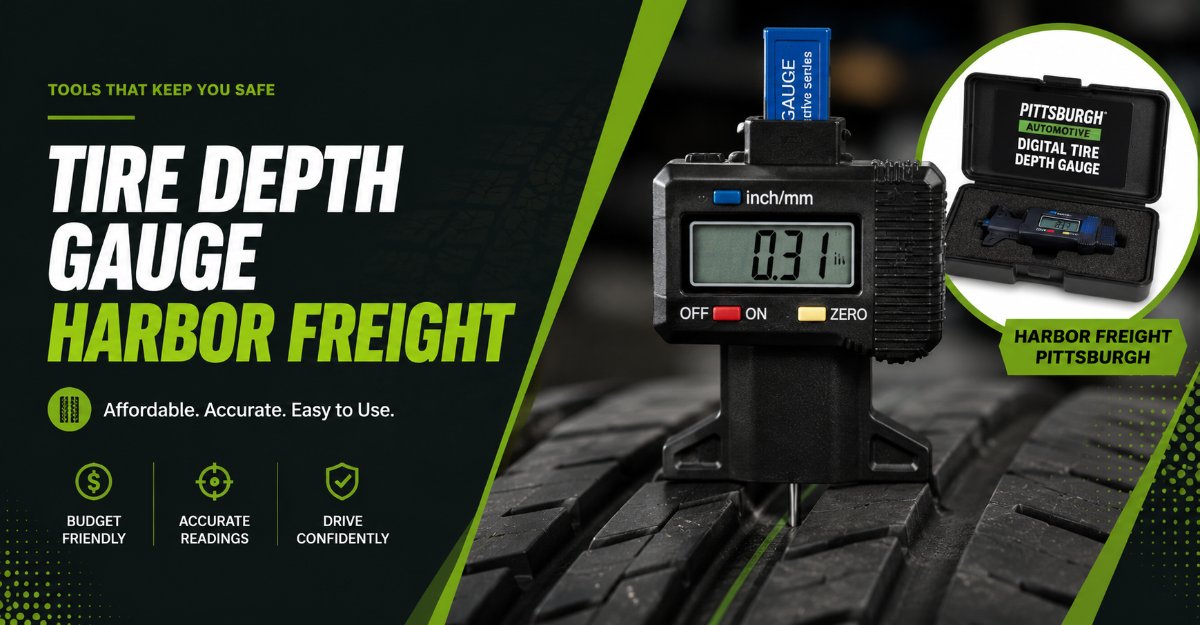
Finding a tire depth gauge harbor freight sells is impossible because the retailer does not stock a dedicated standard plunger tool. Instead, the most effective solution is using a Pittsburgh digital caliper. This instrument features a built-in depth rod that provides highly precise tread measurements for vehicle safety inspections.
Key Facts / At a Glance
- Harbor Freight omits standard single-purpose plunger tread gauges from its primary tool catalog.
- The Pittsburgh 6-inch Digital Caliper serves as the expert-recommended workaround for tire measurements.
- Legal tire replacement limits trigger at 2/32 of an inch (1.6 millimeters) of remaining tread depth across North America.
- Digital calipers offer 0.001-inch accuracy compared to the standard 1/32-inch stepped increments of basic pocket gauges.
- Measuring tread depth in three separate zones across the tire face reveals critical suspension and wheel alignment health.
Why Is a Dedicated Tire Depth Gauge Harbor Freight Tool Missing?
Harbor Freight does not sell a standalone tire tread depth gauge because their inventory model prioritizes multi-purpose diagnostic instruments over single-use pocket items. Retail tool ecosystems typically reserve highly specific, low-cost plastic tools for automotive parts store checkout counters. Harbor Freight focuses heavily on broader automotive diagnostics, carrying extensive lines of tire pressure gauges, pneumatic inflators, and specialized mechanical equipment.
The absence of a simple stick gauge pushes shoppers toward a more robust, versatile solution. Professional mechanics rarely rely on basic plastic stick gauges for diagnostic work. Instead, precision measuring tools offer superior accuracy and cross-functional utility in a workshop environment. By stocking digital calipers, Harbor Freight provides a tool capable of measuring tire tread, brake pad thickness, rotor runout, and bolt diameters within a single purchase.
What Is the Best Harbor Freight Alternative for Measuring Tires?
The Pittsburgh 6-inch Digital Caliper is the definitive Harbor Freight substitute for a dedicated tire depth gauge. Every standard digital caliper features a rigid depth rod that extends from the bottom of the handle when the primary jaws slide open. This rod perfectly mimics the plunging pin of a traditional tire gauge. Harbor Freight offers two distinct versions of this tool, each catering to a different user persona.
Pittsburgh 6 in. Composite Digital Caliper (Item 63586)
The composite plastic version of the Pittsburgh caliper costs approximately $9.99 and represents the best value for casual drivers. The carbon fiber composite body provides a unique advantage for tire measurement because the plastic depth rod will not scratch clear-coated aluminum alloy wheels if you slip during the measurement process. This tool measures accurately to 0.01 inches (0.2 millimeters), which easily exceeds the precision required for tire tread evaluation. The primary drawback of the composite body is a slight flex under heavy thumb pressure, which can alter micro-measurements.
Pittsburgh 6 in. Stainless Steel Digital Caliper (Item 63711)
The stainless steel variant costs roughly $19.99 and serves as the mandatory choice for dedicated DIY mechanics. The hardened steel body eliminates flexing, ensuring the depth rod drops flawlessly into tire grooves without bending. This model increases accuracy to 0.001 inches (0.02 millimeters) and handles the physical abuse of a garage environment far better than the composite version. However, users must exercise caution to avoid grinding the sharp metal depth rod against delicate wheel finishes.
How Do You Measure Tread Depth With a Digital Caliper?
Using a digital caliper to check tire health requires extending the tool’s hidden depth rod straight down into the lowest point of the rubber groove. The process takes less than two minutes for all four tires, requires minimal technical skill, and provides absolute mathematical certainty regarding your remaining traction. The single most important factor determining success is keeping the base of the caliper perfectly flat against the top of the tire tread.
Before You Start
- Time Required: 2 minutes total.
- Difficulty: Beginner.
- Tools Required: Pittsburgh Digital Caliper, clean shop towel.
- Prerequisites: Park the vehicle on flat ground and turn the steering wheel completely to one side to expose the front tire treads.
Step 1: Zero the Calibration
Turn the digital caliper on using the power button. Push the sliding jaw completely closed so that the jaws touch and the bottom depth rod retracts perfectly flush with the base of the tool body. Press the “ZERO” button on the digital screen. You will know this step worked when the display reads exactly 0.00. Failing to zero the tool introduces a permanent mathematical offset to every subsequent reading.
Step 2: Position the Caliper Body
Rest the absolute bottom flat edge of the caliper body directly against the highest flat surface of the tire tread. Bridge the tool across a primary circumferential groove (the wide channels running the length of the tire). Ensure the tool sits at a perfect 90-degree perpendicular angle to the tire surface.
Step 3: Extend the Depth Rod
Use your thumb to slowly roll the caliper wheel, sliding the primary jaws open. This action forces the narrow depth rod out of the bottom of the tool and down into the tire groove. Continue pushing until the tip of the rod makes solid contact with the absolute bottom of the rubber channel.
Step 4: Read and Convert the Measurement
Read the measurement on the LCD screen. Most standard tire specifications utilize fractions of an inch. Press the “mm/inch/F” toggle button on the Pittsburgh caliper to switch the readout into fractional mode. If your specific model lacks a fraction button, use the decimal inch reading and multiply it by 32 to find your remaining tread out of 32nds of an inch (for example, a reading of 0.125 inches equals 4/32 of an inch).
Common Mistakes and How to Fix Them:
- Dead Batteries: The tool screen flashes or fails to turn on. Replace the LR44 battery. For better cold-weather performance in unheated garages, upgrade to an SR44 silver oxide battery.
- Slipping Off the Tread Block: The tool shifts and falls completely into the groove, giving a massive false reading. Pull the tool out, reset to zero, and carefully bridge the gap again.
What Are the Standard Tire Tread Safety Limits?
Understanding the numbers on your digital caliper is critical for deciding when to replace your tires. Automotive regulatory bodies and tire manufacturers use a standardized scale based on 32nds of an inch to determine safety limits and hydroplaning risks.
| Depth (Inches) | Depth (Millimeters) | Safety Status | Required Action |
|---|---|---|---|
| 6/32″ or greater | 4.8 mm or greater | Excellent | Safe for all driving conditions including heavy rain. |
| 5/32″ | 4.0 mm | Good | Standard wear, monitor annually. |
| 4/32″ | 3.2 mm | Caution | Hydroplaning risk increases. Replace winter tires immediately. |
| 3/32″ | 2.4 mm | Warning | Wet weather stopping distances double. Plan replacement. |
| 2/32″ or lower | 1.6 mm or lower | Fail | Legally bald. Unsafe. Replace immediately. |
Tire engineers design horizontal rubber bumps molded deep into the bottom of the primary grooves, known as treadwear indicator bars. When the outer surface of the tire wears down completely flush with these internal bars, the tire has exactly 2/32 of an inch of tread remaining. Modern fluid dynamics testing proves that tires with less than 4/32 of an inch of tread cannot effectively evacuate water at highway speeds, resulting in a severe loss of steering control during heavy rain.
How Does a Caliper Compare to a Standard Pocket Gauge?
Choosing between a Harbor Freight caliper and a traditional pocket gauge bought from an auto parts store comes down to a balance of precision, cost, and versatility.
| Feature | Harbor Freight Digital Caliper | Standard Pocket Depth Gauge |
|---|---|---|
| Retail Price | $9.99 to $19.99 | $2.00 to $8.00 |
| Accuracy Level | Extremely High (0.001 inches) | Moderate (1/32 inch increments) |
| Tool Versatility | Measures bolts, rotors, brake pads, pipes | Single-purpose tire application |
| Readability | Large high-contrast LCD screen | Small etched lines requiring good lighting |
| Power Source | Requires LR44/SR44 batteries | Fully analog, no batteries required |
| Durability | Sensitive to drops, moisture, and dust | Highly rugged, drop-proof metal or plastic |
Casual drivers who only check their tires once a year are better served by the traditional “Quarter Test.” Inserting a Washington quarter upside down into the tread groove provides a quick gauge. If the top of Washington’s head is visible, the tire has less than 4/32 of an inch and requires replacement soon. However, DIY mechanics who perform their own oil changes and brake jobs should invest in the digital caliper, as it replaces multiple specialty diagnostic tools in the toolbox.
What Are Common Tire Measurement Mistakes?
Obtaining an accurate tread measurement requires avoiding physical placement errors that can trick the tool into displaying a false sense of security. The most frequent error involves resting the caliper depth rod directly on top of the molded treadwear indicator bar rather than the true bottom of the groove. Measuring on top of this raised bump subtracts exactly 2/32 of an inch from your reading, leading you to believe the tire is significantly more worn than it actually is.
Another critical physical error is angled measurement, known mechanically as cosine error. If the caliper leans forward or backward rather than sitting perfectly perpendicular to the tire face, the depth rod travels diagonally. A diagonal path is longer than a straight vertical path, which artificially inflates the depth reading. This mistake causes drivers to believe they have safe tread levels when the tire is actually dangerously bald.
Finally, drivers routinely measure only the dead center of the tire and ignore the inner and outer shoulders. Measuring all three zones is mandatory for diagnosing suspension health. If the center measures 3/32 but the outer edges measure 6/32, the tire is severely overinflated. Conversely, if the inner edge is completely bald while the rest of the tire shows healthy tread, the vehicle has a severe negative camber or toe-out alignment problem dragging the inside of the tire across the pavement.
Frequently Asked Questions
Can I use a tire pressure gauge to measure tread depth? No. A tire pressure gauge measures internal air pressure (PSI) through the valve stem. Tread depth requires a linear measurement tool to calculate the physical height of the exterior rubber grooves. These are entirely different diagnostic processes requiring completely different tools.
Does the lack of a tire depth gauge harbor freight inventory stocks mean I should shop elsewhere? Only if you strictly require a $2 analog stick gauge. For professional or enthusiastic DIY mechanics, purchasing the Pittsburgh digital caliper at Harbor Freight is actually a superior decision due to the tool’s unmatched accuracy and ability to measure other automotive components.
How often should I check my tire tread depth? You should measure your tire tread depth every 3,000 miles or exactly when you perform a routine oil change and tire rotation. Frequent checks allow you to catch uneven wear patterns early, saving the tire from premature destruction caused by bad alignment.
What is the penny test and is it still accurate? The penny test involves inserting a Lincoln penny upside down into the tread. If you see all of Lincoln’s head, the tire is below 2/32 of an inch. While historically popular, tire safety experts now recommend the quarter test (which measures 4/32 of an inch) because tires lose significant wet weather traction long before they reach the 2/32 legal minimum.
Are the Pittsburgh digital calipers waterproof? No. Standard Harbor Freight digital calipers are not IP67 rated for water resistance. Exposing the digital screen or the sliding electronic scale mechanism to heavy rain, snow, or shop chemicals will permanently short out the motherboard and ruin the tool.