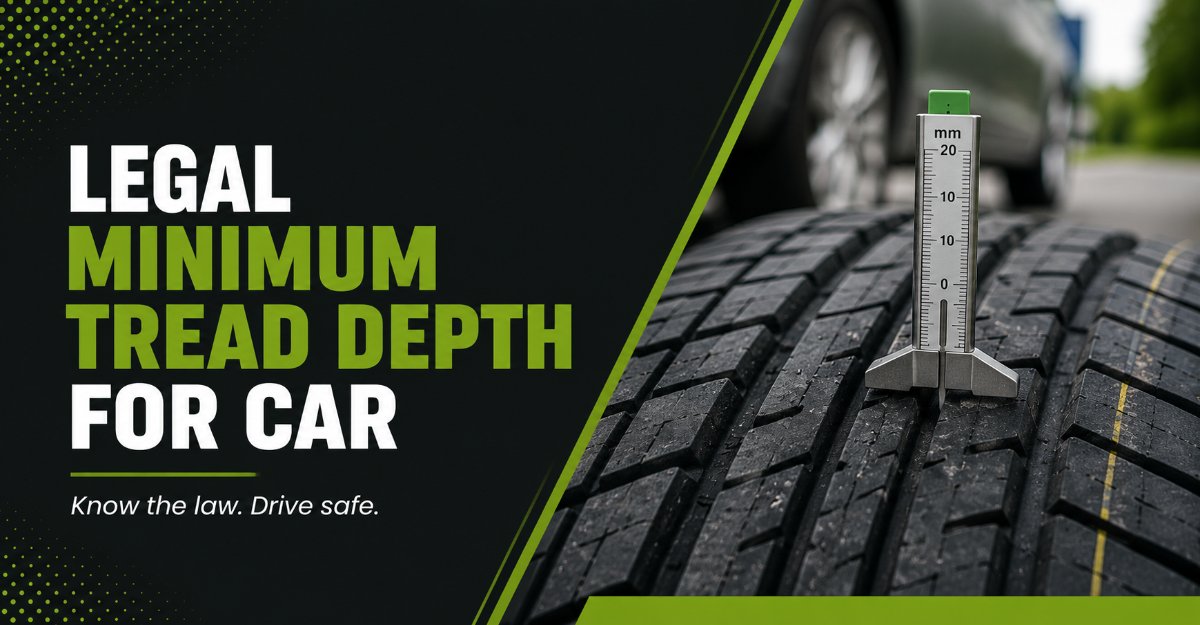
The legal minimum tread depth for car tires is 1.6mm, which equals 2/32 of an inch, measured across the central three-quarters of the tread width and around the entire circumference. This statutory limit applies in the United States, the United Kingdom, and the European Union. However, automotive safety experts strongly recommend replacing tires when they reach 3mm to maintain safe braking distances on wet roads.
Key Facts At A Glance
- The absolute legal minimum tread depth for car passenger vehicles is 1.6mm (2/32 inch).
- The 1.6mm minimum must cover the central 75 percent of the tire width continuously.
- Severe winter regions mandate a stricter 4mm (5/32 inch) legal minimum for snow tires.
- Tires at the 1.6mm limit require up to 44 percent more distance to stop on wet pavement compared to new tires.
- Driving below the legal limit voids your insurance policy and incurs heavy financial penalties.
What Is The Legal Minimum Tread Depth For Car Tires By Region?
The legal minimum tread depth for car passenger vehicles varies based on your jurisdiction and the season. Standard summer and all-season tires carry a universal 1.6mm baseline in most Western nations. Dedicated winter driving zones enforce stricter limits because snow evacuation requires deeper grooves than water evacuation.
| Region / Condition | Standard Legal Minimum | Winter Tire Legal Minimum | Expert Safety Recommendation |
|---|---|---|---|
| United States | 2/32 inch (1.6mm) | 2/32 inch (varies by state) | Replace at 4/32 inch (3mm) |
| United Kingdom & EU | 1.6mm | 1.6mm | Replace at 3mm |
| Severe Winter Zones (Sweden, Austria) | 1.6mm | 4mm (Mandatory in winter) | Replace at 4mm |
State inspection criteria in the US and the Ministry of Transport (MOT) tests in the UK will fail any vehicle presenting tires below these statutory minimums. A tire measuring 1.7mm will pass a legal inspection, but it provides severely degraded performance compared to a new tire.
Why Do Experts Recommend Changing Tires At 3mm?
Safety organizations recommend replacing tires at 3mm because water displacement capacity drops dramatically before the tire reaches the 1.6mm legal limit. Tread grooves act as channels to evacuate water from beneath the rubber contact patch. When these channels shrink, the tire loses its ability to process standing water.
A new tire with 8mm of tread can evacuate up to 30 liters of water per second at highway speeds. When the tread reaches 3mm, the water displacement capacity drops significantly, but the tire maintains enough grip to steer. At the 1.6mm legal limit, the grooves are too shallow to clear water efficiently. The tire rides entirely on top of the water surface. This phenomenon is called hydroplaning or aquaplaning, resulting in a total loss of steering and braking control.
How Does Tread Depth Affect Stopping Distance?
Tread depth directly dictates how quickly a vehicle can stop on wet pavement. Independent testing by automotive research facilities demonstrates that stopping distances increase exponentially as tread wears down.
When braking from 50 mph (80 km/h) on a wet road, stopping distances change drastically based on groove depth. A new tire at 8mm requires 25.9 meters to stop. A worn tire at 3mm requires 31.7 meters to stop. A legally bald tire at 1.6mm requires 39.5 meters to stop. That extra 13.6 meters of stopping distance at the legal limit is the difference between a safe stop and a severe collision.
Expert Insight: Do not treat the legal limit as a performance target. The 1.6mm threshold was established decades ago. Modern heavy vehicles and high-speed highways demand the superior water evacuation provided by 3mm of tread.
How Do You Check Tire Tread Depth?
You should measure your tire tread depth once a month and before any long highway journey. You can evaluate the remaining rubber using household coins, a dedicated gauge, or the visual indicators built into the tire itself.
Option A: The Coin Test
The coin test provides a quick, free approximation of your remaining tread. It acts as a pass or fail metric rather than giving you an exact numerical measurement.
- USA Penny Test: Insert a US penny into the main tread groove with Abraham Lincoln’s head facing upside down. If you can see the very top of Lincoln’s head, your tread is below 2/32 inch (1.6mm). You must replace the tire immediately.
- USA Quarter Test: Insert a US quarter with George Washington’s head facing upside down. If the tread touches the top of Washington’s head, you have exactly 4/32 inch (3mm). Your tires are safe, but you should monitor them closely.
- UK and EU 20p Test: Insert a 20p or 1 Euro coin into the main groove. If the outer metallic band of the coin remains visible above the rubber, your tread is likely below the 1.6mm legal limit.
Option B: Using A Tread Depth Gauge
A physical tread depth gauge provides the exact numerical measurement required to confirm legal compliance. You can purchase analog stick gauges or digital gauges at any auto parts store.
- Park safely: Park the vehicle on a flat surface. Turn the steering wheel fully to the left or right to expose the front tire treads completely.
- Position the tool: Push the gauge probe down into the deepest part of a main circumferential groove.
- Seat the base: Press the flat base of the gauge firmly against the top surface of the tire tread. Make absolutely sure the metal probe is not resting on a raised wear bar.
- Read the measurement: Check the analog markings or digital display.
- Check multiple zones: Repeat this measurement on the inner, middle, and outer grooves of the same tire. The legal minimum tread depth for car regulations requires 1.6mm across the central three-quarters of the tire.
Option C: Inspecting Tread Wear Indicators
Tread Wear Indicators (TWI) are small horizontal blocks of rubber molded into the bottom of the main longitudinal grooves. Manufacturers place these bars exactly 1.6mm above the base of the tire. When the main tread surface wears down flush and level with these raised bars, the tire has reached the absolute legal limit and requires immediate replacement.
Expert Insight: Always check the inside edge of your front tires. The middle of the tire may show a healthy 4mm, but bad wheel alignment can secretly wear the inside edge down to the steel belts, making the tire highly dangerous and highly illegal.
Which Tread Depth Tools Are The Most Accurate?
Selecting the right tool ensures you know exactly when your vehicle approaches the legal minimum tread depth for car regulations. Drivers should keep at least one measurement device in their glovebox.
| Tool Type | Price Estimate | Accuracy Level | Advantages and Disadvantages |
|---|---|---|---|
| Household Coins | Free | Low (Pass/Fail) | Advantage: Always available. Disadvantage: Cannot provide the exact numbers needed for safety inspections. |
| Plastic Card Gauge | Free to $2 | Low | Advantage: Often given away at tire shops. Disadvantage: Graduations are hard to read precisely. |
| Analog Stick Gauge | $3 to $7 | High | Advantage: Extremely reliable, no batteries required. Disadvantage: Small etched numbers require good lighting to read. |
| Digital Depth Gauge | $10 to $25 | Very High | Advantage: Instant decimal readouts remove all guesswork. Disadvantage: Batteries can die in the glovebox. |
What Are The Penalties For Driving Below The Legal Minimum Tread Depth?
Driving a car with tires below the legal minimum tread depth carries severe financial and legal consequences. Law enforcement agencies classify bald tires as a critical safety hazard.
In the United Kingdom, police issue a massive penalty for non-compliance. Drivers receive 3 penalty points on their license and a maximum fine of 2,500 GBP per illegal tire. If all four tires fall below 1.6mm, you face a 10,000 GBP fine and instant license disqualification.
In the United States, penalties vary by local jurisdiction. Police officers routinely issue traffic citations ranging from $100 to $300 for unsafe equipment. In severe cases involving commercial vehicles or egregious neglect, highway patrol officers will legally impound the vehicle until the tires are replaced.
Furthermore, driving below the legal minimum tread depth will instantly void your auto insurance policy. If you cause an accident on wet roads and the claims adjuster discovers your tires measure under 1.6mm, the insurance company will deny coverage for your vehicle and leave you personally liable for the other party’s damages.
What Do Uneven Tire Wear Patterns Mean?
Tire wear rarely happens perfectly evenly across the entire surface. Diagnosing unusual wear patterns helps you fix mechanical issues before they destroy your new set of tires.
- Center Wear: The tread is noticeably shallower in the very middle of the tire than on the outer edges. This indicates severe over-inflation. The tire balloons outward under excessive pressure, forcing the center of the rubber to bear the entire weight of the vehicle.
- Shoulder Edge Wear: The tread is worn down flat on both the inner and outer edges, but remains deep in the middle. This indicates chronic under-inflation. The tire sags in the center, transferring all the vehicle weight to the structural shoulders of the tire.
- One-Sided Wear: Only the inner edge or only the outer edge is worn down smoothly. This points directly to poor wheel alignment, specifically a camber issue. Your wheels are leaning too far inward or outward relative to the road surface.
- Cupping and Scalloping: The tread develops strange dips, scoops, or lumpy hollows around the circumference. This indicates total suspension failure. Worn shock absorbers or broken struts allow the wheel to bounce violently up and down on the pavement, chewing chunks of rubber out of the tire.
When Should Different Drivers Replace Their Tires?
Your driving environment dictates when you should discard your tires. While the legal minimum tread depth for car tires remains 1.6mm, different driver profiles face different risk factors.
The City Commuter: Drivers who strictly navigate low-speed urban traffic can safely push their tires closer to the 3mm threshold. Lower driving speeds drastically reduce the risk of hydroplaning. However, city drivers must remain vigilant about dry stopping distances to avoid rear-ending other cars or hitting pedestrians.
The Highway Cruiser: Drivers commuting long distances at 70 mph should replace their tires at 4mm (5/32 inch). Hydroplaning risk increases exponentially with speed. A tire traveling at high speeds requires significantly deeper grooves to displace water than a tire traveling at 30 mph.
The Winter Warrior: Drivers living in areas with heavy snow and ice must replace winter tires at 4mm (5/32 inch). Winter tires rely on tiny zig-zag slits called sipes to bite into packed snow. When tread drops below 4mm, these sipes physically disappear, rendering the specialized winter rubber completely useless on ice.
Frequently Asked Questions
Can I drive with 1.5mm tread on my tires?
No. Driving with 1.5mm of tread is strictly illegal in the US, UK, and EU. Your vehicle will fail safety inspections, you risk heavy fines from law enforcement, and your insurance provider will void your coverage in the event of an accident.
Are front tires allowed to have less tread than rear tires?
No. The 1.6mm legal minimum tread depth for car regulations applies equally to every tire on the vehicle. However, front tires on front-wheel-drive cars handle steering, braking, and acceleration, meaning they will naturally wear out much faster than the rear tires.
Do trailers and caravans need 1.6mm of tread?
Yes. Light trailers and caravans towed by passenger cars are subject to the exact same 1.6mm minimum tread depth law as the towing vehicle. You must inspect trailer tires regularly, as they often degrade from dry rot before the tread actually wears down.
Should I put my newest tires on the front or the back?
You should always install the two newest tires with the deepest tread on the rear axle, regardless of whether your car is front-wheel, rear-wheel, or all-wheel drive. Deep tread on the rear prevents the back of the car from hydroplaning and spinning out during emergency maneuvers in the rain.
Does a spare tire need to meet the legal tread limit?
If you drive on the spare tire, it must meet the 1.6mm legal limit. A full-size spare tire sitting in your trunk does not technically violate the law, but it serves absolutely no purpose if it is flat or bald when you suffer a blowout on the highway. Always check your spare tire condition annually.