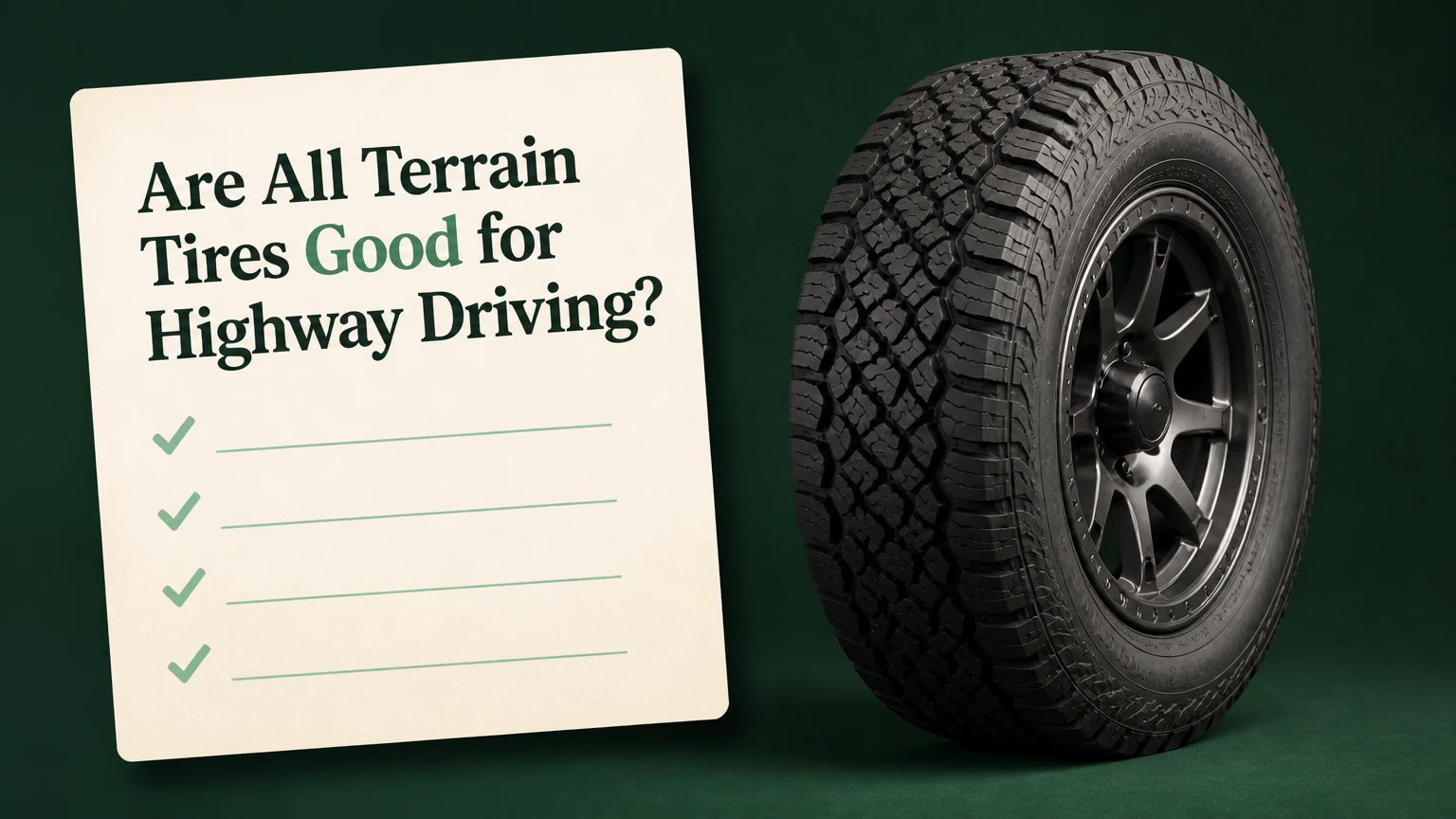
All-terrain tires are suitable for highway driving when you also need gravel, dirt-road, snow, or puncture resistance, but highway-terrain tires usually deliver quieter rides, sharper handling, better fuel economy, and shorter pavement stopping distances. The best choice depends on your off-road percentage, winter conditions, vehicle load, and tolerance for noise and stiffness.
Key Facts at a Glance
- All-terrain tires are road-legal highway tires designed for mixed pavement and light-to-moderate off-road use.
- Highway-terrain tires generally outperform A/T tires in cabin noise, ride comfort, steering precision, fuel consumption, and dry-road braking.
- Typical A/T fuel-economy loss is about 1-3% compared with a similar H/T tire, although size, weight, pressure, and alignment can change the result.
- A/T tires with the Three-Peak Mountain Snowflake symbol meet a defined severe-snow traction test, but they do not replace dedicated winter tires on ice.
- Aggressive LT-metric A/T tires can ride harshly on lightly loaded SUVs because their stiff casings need more load to work properly.
- Vehicle placard pressure, correct load index, correct speed rating, and regular rotation matter more than the tire label alone.
What Are All-Terrain Tires?
All-terrain tires are hybrid tires that divide their design priorities between paved roads and unpaved surfaces. A/T models typically use wider tread voids, larger tread blocks, reinforced casings, and compounds that resist cutting and chipping from gravel or rock.
The category includes mild crossover tires, passenger-rated SUV tires, light-truck A/T tires, and aggressive hybrid designs sometimes called rugged-terrain tires. The label does not guarantee identical highway behavior. A mild P-metric A/T can feel close to an H/T tire, while a heavy Load Range E tire can feel substantially firmer and louder.
The practical definition is therefore functional: an A/T tire sacrifices some pavement refinement to retain traction and durability away from pavement. That compromise benefits drivers who regularly leave sealed roads, encounter rough shoulders, or need one tire for several surfaces.
How does A/T construction change highway behavior?
A/T tread blocks flex more than the closely linked ribs on many H/T tires. Block movement creates tread squirm during lane changes and cornering, while larger voids interrupt the contact pattern and generate more air and impact noise.
Sipes cut through tread blocks to create additional biting edges in rain, slush, and snow. Sipes can improve grip, but their effectiveness depends on rubber compound, temperature, tread depth, road surface, and the tire’s actual winter certification.
Reinforced sidewalls and extra casing material improve resistance to bruising and punctures. The same construction increases unsprung mass and reduces sidewall compliance, transmitting more sharp impacts through the suspension.
A/T tires are not automatically superior in every wet-road condition. Deep grooves can evacuate water effectively, but open tread blocks, compound differences, and reduced pavement contact can produce longer wet braking than a comparable H/T tire.
Are all-terrain tires good for highway driving?
All-terrain tires are good highway tires for drivers who need mixed-surface capability, but they are not the most efficient highway choice for a vehicle that stays on pavement. A mild A/T tire can provide stable highway manners, while an aggressive A/T or R/T tire usually brings more noise, vibration, weight, and rolling resistance.
The word “good” depends on the operating environment. A commuter covering 20,000 mostly paved miles annually may value quietness and wet braking more than sidewall protection. An overland driver traveling 90% on pavement may accept those compromises because a puncture on an isolated gravel road has a higher consequence.
At normal speeds, a correctly sized A/T tire with adequate tread and proper inflation can cruise safely on highways. Safety depends on condition, speed rating, load capacity, alignment, pressure, and weather. Four-wheel drive does not compensate for worn or unsuitable tires.
When are A/T tires the right highway choice?
A/T tires make sense when at least one of these conditions applies:
- The vehicle regularly travels gravel, forestry, ranch, construction, or poorly maintained roads.
- The driver needs stronger resistance to sharp stones, pothole edges, and casing damage.
- The region receives snow where a 3PMSF-rated A/T is useful.
- A truck carries changing loads or travels to remote locations where tire damage is difficult to repair.
- The owner accepts modest noise and fuel-economy penalties for broader surface capability.
A/T tires are usually unnecessary for a pavement-only crossover, an urban sedan, or a family SUV whose dirt-road use consists of occasional dry driveways. In those cases, an H/T or touring all-season tire normally provides the better daily-driving result.
How do A/T tires compare with H/T, R/T, and M/T tires?
Highway-terrain tires prioritize pavement comfort and efficiency, A/T tires balance pavement with general off-road use, rugged-terrain tires move toward aggressive off-road performance, and mud-terrain tires prioritize loose or muddy terrain over highway refinement.
| Tire type | Typical pavement share | Typical off-road use | Highway behavior |
|---|---|---|---|
| H/T | 90-100% | Gravel driveway, maintained dirt | Quietest, smoothest, most efficient |
| Mild P-metric A/T | 70-90% | Gravel, sand, light trail | Moderate noise, balanced steering |
| Standard LT A/T | 50-80% | Rock, gravel, work roads | Heavier, firmer, stronger casing |
| R/T or hybrid | 40-70% | Rock, mud, overlanding | Noticeable hum, firm ride |
| M/T | 20-50% | Deep mud, rocks, technical trails | Loudest, least efficient on pavement |
Which tire type suits different driving patterns?
| Driving pattern | Recommended type | Reason | Main compromise |
|---|---|---|---|
| 98% pavement, 2% gravel | H/T or touring all-season | Maximizes comfort and wet-road control | Limited sidewall protection |
| 80% pavement, 20% camping roads | Mild or balanced A/T | Handles gravel and occasional trails | More tread noise |
| 60% pavement, 40% remote roads | LT A/T | Adds casing durability and load capacity | Higher weight and harshness |
| 50% pavement, 50% mud and rock | R/T or M/T | Preserves loose-surface traction | Poorer highway refinement |
R/T and M/T tires deserve particular caution. Their aggressive shoulder blocks may look appropriate on a daily-driven truck, but appearance does not improve emergency braking, fuel consumption, or wet-road steering.
What are the highway trade-offs of A/T tires?
A/T tires generally trade refinement for durability and loose-surface traction. Typical differences vary by tread design, size, load range, vehicle, and road surface, so the figures below are practical ranges rather than universal test results.
| Highway attribute | Mild A/T versus H/T | Aggressive A/T versus H/T | Driver consequence |
|---|---|---|---|
| Cabin noise increase | 1-3 dB | 3-6 dB | More audible tread hum above 55 mph |
| Fuel-economy change | 1-2% lower | 2-5% lower | Higher annual fuel cost |
| Added tire mass | 2-6 lb per tire | 8-20 lb per tire | Slower response and heavier steering |
| Expected tread warranty | 50,000-65,000 miles | 40,000-60,000 miles | More variation with rotation and use |
| Highway ride | Moderately firm | Firm to harsh | More impact through the cabin |
| Cornering feel | Slight tread flex | Noticeable tread squirm | Less immediate steering response |
These ranges should not be presented as guaranteed outcomes. A lightweight A/T in the original size may outperform a heavier H/T in fuel economy if the H/T is oversized, underinflated, or poorly aligned.
Are A/T tires noisier and less comfortable?
A/T tires are usually noisier and firmer than H/T tires, especially as tread blocks wear into an uneven pattern. The noise comes from repeated block impacts, air moving through voids, and the tread’s changing contact frequency at speed.
Mild A/T tires reduce that penalty through smaller voids, variable-pitch tread designs, and more continuous center ribs. Aggressive A/T, R/T, and M/T tires produce a stronger hum that can become tiring during long trips.
Ride comfort also depends on load range. A Load Range E tire installed on a lightly loaded half-ton truck may require substantially more pressure and use a stiffer casing than the suspension needs. Matching the tire’s construction to the vehicle’s actual axle loads is more effective than selecting the maximum available load rating.
Do A/T tires reduce fuel economy?
A/T tires can reduce fuel economy because larger tread blocks flex, heavier assemblies increase rotating mass, and deeper or wider tread raises rolling resistance. A typical reduction is 1-3% for a moderate A/T, with larger losses possible after upsizing or switching to a heavy LT design.
For a vehicle averaging 20 mpg and traveling 15,000 miles per year, a 3% decrease equals roughly 23 additional gallons of fuel annually. The actual cost depends on fuel price and the vehicle’s baseline consumption.
Pressure has a larger effect than many buyers expect. Underinflation increases sidewall flex, heat, and rolling resistance, while overinflation reduces the intended contact pattern and can accelerate center wear. Use the vehicle manufacturer’s door-jamb pressure, not the maximum pressure molded into the sidewall, unless a qualified tire professional specifies otherwise.
Are all-terrain tires good in rain and snow?
A/T tires can perform well in rain and light snow, but tread depth alone does not prove superior wet or winter traction. A/T wet performance depends on compound chemistry, siping, groove layout, contact pressure, temperature, and the condition of the asphalt.
The Three-Peak Mountain Snowflake, or 3PMSF, symbol identifies a tire that passed a standardized severe-snow traction test. The symbol is useful when comparing A/T tires, but it does not mean the tire has the ice grip, cold flexibility, or braking performance of a dedicated winter tire.
| Condition | Mild A/T | 3PMSF A/T | Dedicated winter tire |
|---|---|---|---|
| Warm wet asphalt | Good to very good | Good to very good | Fair to good |
| Cold wet asphalt | Good | Good to very good | Very good |
| Packed snow | Fair to good | Good | Very good |
| Deep snow | Fair | Good, vehicle dependent | Very good |
| Glare ice | Poor to fair | Poor to fair | Best available |
| Dry summer highway | Very good | Good | Poorer wear and handling |
A/T tires may be a sensible one-set solution in regions with occasional snow and significant gravel travel. Drivers who face frequent freezing rain, polished ice, or prolonged sub-freezing conditions should use winter tires where practical.
Does deep A/T tread prevent hydroplaning?
Deep A/T tread does not automatically provide the best hydroplaning resistance. Hydroplaning depends on speed, water depth, inflation, tread design, tire width, vehicle weight, and the grooves’ ability to maintain a path to the outside of the tread.
A highway tire with continuous circumferential channels may disperse standing water more consistently than an aggressive A/T with large independent blocks. Drivers should reduce speed in standing water regardless of tire type, because no tread design can eliminate hydroplaning risk.
How should you choose an A/T tire for highway use?
Choose an A/T tire by matching its size, load index, speed rating, construction, winter symbol, and tread aggression to the vehicle and driving pattern. The tire’s marketing category is less informative than its complete sidewall specification and independent performance testing.
Use this selection sequence:
- Read the door-jamb placard for the original tire size, pressure, and minimum load requirement.
- Select a tire with equal or greater load index and the vehicle’s required speed rating.
- Decide between P-metric and LT-metric construction based on actual payload and towing needs.
- Choose mild, balanced, or aggressive tread according to the percentage of unpaved travel.
- Check for 3PMSF certification if severe snow matters.
- Confirm wheel clearance, overall diameter, and legal fitment before upsizing.
- Compare wet braking, noise, warranty, and owner-test data rather than relying on appearance.
A tire shop should verify axle loads when a truck carries a slide-in camper, heavy tools, or a trailer tongue load. A vehicle’s gross axle weight rating remains the governing limit.
Which A/T construction fits each driver?
| Driver profile | Highway share | Suitable construction | Practical examples |
|---|---|---|---|
| Daily commuter | 95-100% | Mild P-metric A/T or H/T | Crossover A/T, touring all-season |
| Camper and gravel-road user | 75-90% | Balanced P-metric or light LT A/T | 3PMSF A/T with moderate voids |
| Work truck operator | 60-85% | LT A/T matched to axle load | Load Range C, D, or E as required |
| Heavy towing user | 70-90% | LT A/T with suitable load index | Tire selected from axle and trailer data |
| Technical off-road driver | 30-60% | R/T or M/T, if highway trade-offs are accepted | Hybrid or mud-terrain design |
The common mistake is buying the heaviest tire available for a light vehicle. A stronger tire is not automatically safer when its mass, pressure requirement, and casing stiffness degrade steering, braking, and ride quality.
How do you maintain A/T tires on the highway?
Maintain A/T tires with the vehicle’s placard pressure, frequent inspections, rotation, alignment checks, and prompt vibration diagnosis. Highway speeds generate substantial heat, so pressure and structural condition must be checked before long trips, with the tires cold.
Inspect for:
- Uneven shoulder or center wear.
- Cuts, bulges, exposed cords, or lodged stones.
- Feathering across tread blocks.
- Tread depth below the legal or manufacturer-recommended limit.
- Valve-stem damage and slow pressure loss.
- Mismatched diameter on an all-wheel-drive vehicle.
Rotate according to the tire maker’s interval, commonly every 5,000-8,000 miles, unless the vehicle manufacturer specifies another schedule. A/T tread blocks can develop cupping when shocks, bushings, wheel balance, or alignment are compromised.
A useful practitioner rule is to measure tread depth across several positions rather than judging wear by appearance. A tire can look deep in the center while its shoulders have lost the wet-weather traction needed for highway rain.
Why do A/T tires hum, vibrate, or wear unevenly?
A/T highway problems usually result from tread pattern, imbalance, pressure, alignment, suspension wear, or incorrect fitment. Aggressive tread can create some normal noise, but a new rhythmic hum, steering vibration, or rapid wear requires diagnosis rather than dismissal as an A/T characteristic.
| Symptom | Likely cause | First inspection | Corrective action |
|---|---|---|---|
| Vibration at 55-70 mph | Balance, radial force variation, bent wheel | Wheel balance and rim runout | Road-force balance or repair wheel |
| Rhythmic humming | Cupping, feathering, aggressive tread | Run hand across blocks | Rotate, inspect shocks, align |
| Center tread wear | Excessive inflation | Cold pressure and tread gauge | Set placard pressure |
| Both shoulders worn | Underinflation or overload | Pressure history and axle load | Correct pressure, verify load |
| Pulling to one side | Alignment or tire conicity | Swap front tires if permitted | Alignment and tire evaluation |
| Rapid edge damage | Low pressure or rough-road impact | Sidewall and shoulder inspection | Correct pressure, replace damaged tire |
A road-force balancer can identify tire-and-wheel assemblies that balance conventionally but still generate force variation at speed. This is particularly useful with heavy LT tires and large aftermarket wheels.
What does an A/T tire setup cost over its life?
A/T ownership cost includes purchase price, fuel, rotation, alignment, and the opportunity cost of sacrificing pavement performance. Typical retail pricing varies by country and size, but a four-tire set commonly falls into these ranges.
| Vehicle and size | Typical price per tire | Four-tire purchase | Typical service additions |
|---|---|---|---|
| Crossover, 16-18 inch | $150-$230 | $600-$920 | $80-$180 mounting and balancing |
| Half-ton truck, 17-20 inch | $210-$350 | $840-$1,400 | $100-$220 installation |
| Heavy-duty truck, 18-20 inch | $250-$450 | $1,000-$1,800 | $120-$250 installation |
| 33-35 inch off-road size | $330-$500+ | $1,320-$2,000+ | $150-$300 installation |
A warranty of 50,000-65,000 miles is common for road-oriented A/T tires, but warranty mileage is not a guaranteed service life. Towing, gravel, alignment faults, heat, rotations, and driving style can reduce usable mileage.
A lighter tire that lasts longer on pavement can cost less overall than an aggressive tire with a higher purchase price. Compare total operating cost, not only the tire-shop invoice.
Which drivers should choose A/T tires?
Daily highway commuter
A daily commuter should choose an H/T or mild P-metric A/T when paved driving exceeds about 90%. The H/T option normally provides lower noise, smoother ride quality, and more predictable pavement braking, while a mild A/T is justified by frequent gravel, rough shoulders, or occasional trail access.
Weekend camper
A weekend camper spending roughly 75-90% of mileage on pavement should consider a balanced A/T with moderate voids and, where relevant, 3PMSF certification. The tire should retain a highway speed rating and avoid unnecessary LT construction if the vehicle’s load does not require it.
Heavy hauler or towing driver
A towing driver should select an LT A/T only after checking axle loads, payload, trailer tongue weight, and the vehicle manufacturer’s fitment requirements. Stiffer sidewalls can improve stability under load, but they do not automatically shorten braking distances, and an unloaded truck may ride harshly.
Winter-region driver
A driver facing repeated snow and ice should prioritize dedicated winter tires over an A/T label. A 3PMSF A/T is a compromise for mixed climates, not a substitute for winter rubber when ice braking and low-temperature grip dominate the safety requirement.
The Bottom Line
Are all terrain tires good for highway driving? Yes, when highway travel is combined with gravel, dirt, snow, hauling, or puncture exposure; no, if the vehicle remains almost entirely on pavement and the priority is maximum comfort, efficiency, and pavement braking. Choose a mild A/T for occasional off-road use, a balanced LT A/T for heavier mixed work, and an H/T tire for predominantly paved travel.
The correct decision also requires the right load index, speed rating, pressure, rotation schedule, and winter capability. An A/T tire can be a safe highway choice, but its value comes from the surfaces it can reach, not from outperforming a highway tire on asphalt.
Frequently Asked Questions
Can I use all-terrain tires on a 2WD truck?
Yes, all-terrain tires work on two-wheel-drive trucks when the tire size, load index, speed rating, and axle capacity are correct. Traction remains limited by the driven axle, weight distribution, road conditions, and differential configuration. A/T tires improve loose-surface capability, but they cannot make a 2WD truck equivalent to a four-wheel-drive vehicle.
How fast can I drive on all-terrain tires?
Drive within the tire’s marked speed rating and the vehicle manufacturer’s limit. A/T tires may carry ratings such as S, T, or H, corresponding to different tested maximum speeds, but the rating assumes correct load, pressure, condition, and temperature. Heavy loads, underinflation, damage, or severe heat require reduced speed.
Should all four tires be the same A/T model?
All four tires should normally match in size, construction, tread design, and similar wear depth, especially on full-time four-wheel-drive and all-wheel-drive vehicles. Significant diameter differences can stress driveline components. Follow the vehicle manufacturer’s replacement guidance before mixing brands or tread patterns.
Are A/T tires worse for emergency braking?
A/T tires can require longer emergency braking distances on dry or wet pavement than a comparable H/T or touring tire, particularly when the A/T has large flexible blocks, heavy construction, or a compound optimized for durability. Actual results vary by model, temperature, tread depth, ABS calibration, road surface, and vehicle load.
Do A/T tires need different air pressure?
A/T tires do not automatically need a different pressure for highway use. Start with the vehicle’s door-jamb placard pressure and adjust only when a tire professional calculates a pressure for a changed load, size, or construction. Never use reduced trail pressure at highway speed because excess flex can create heat and casing damage.