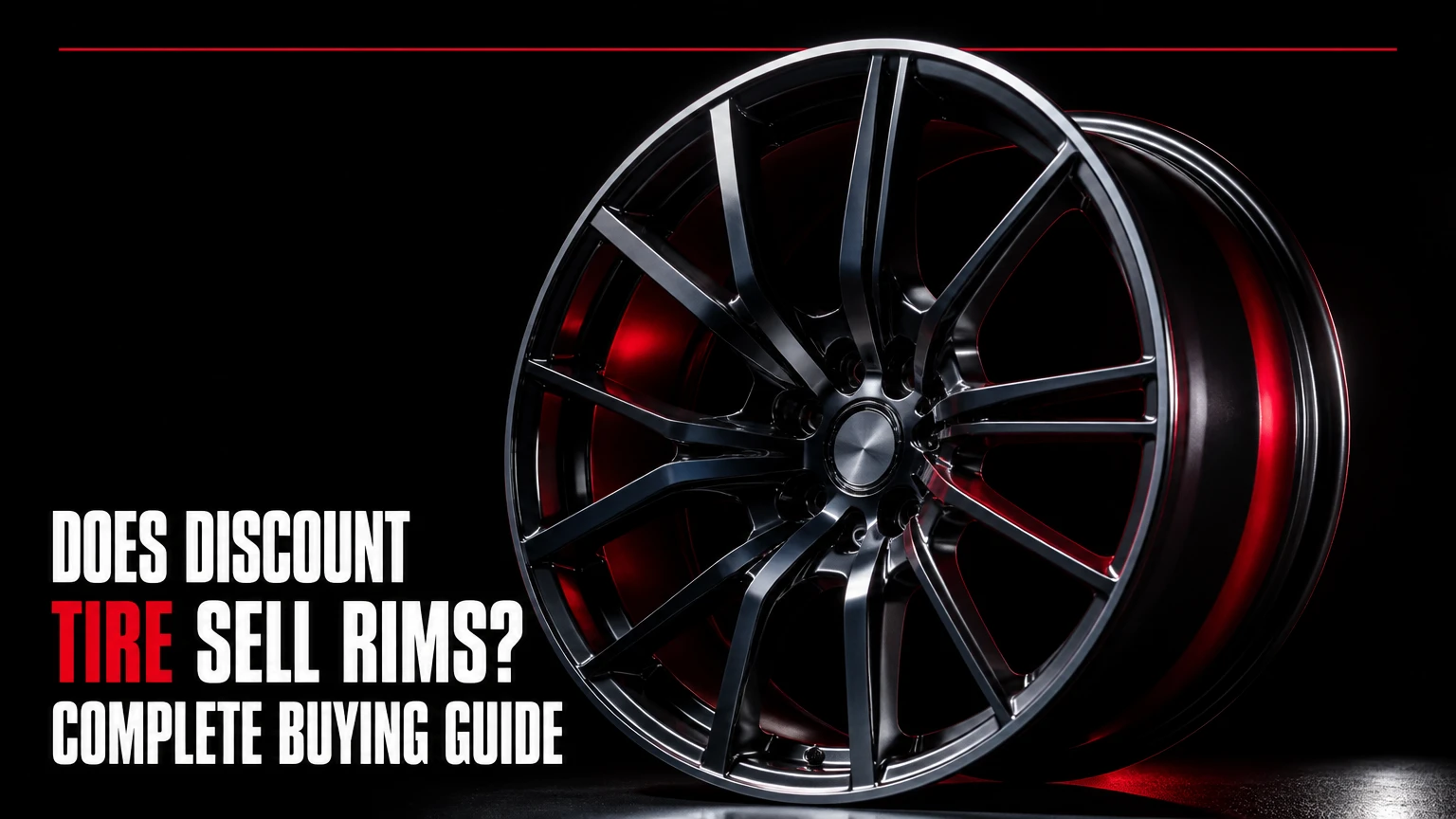
Yes, Discount Tire sells rims, which the retailer generally calls wheels, for cars, trucks, SUVs, trailers, and ATV or UTV applications. Customers can buy wheels separately or combine four wheels with tires in a vehicle-specific package, then arrange installation or pickup through a local store.
Key Facts at a Glance
- Discount Tire sells custom, aftermarket, and replacement-style wheels online and in stores.
- Available categories include car, truck, trailer, and ATV or UTV wheels.
- Vehicle details should be entered before shopping because bolt pattern alone does not confirm fitment.
- Wheel and tire packages use one installation charge, but mounting and balancing are not automatically free.
- Aftermarket wheels commonly require compatible lug nuts or lug bolts.
- Hub-centric rings may reduce vibration in certain installations, but Discount Tire does not describe them as universally required.
Does Discount Tire Sell Rims for Every Vehicle?
Discount Tire sells rims for a broad range of passenger and specialty vehicles, but it does not stock every design in every possible size at every location. Its online wheel catalog covers cars, trucks, trailers, and ATV or UTV applications, with local inventory determined after the customer selects a vehicle and preferred store.
The word rim is commonly used by drivers to mean the complete metal wheel. Discount Tire primarily labels these products as wheels, custom wheels, aftermarket wheels, or truck rims. Entering the vehicle’s year, make, model, and trim narrows the catalog to compatible products.
Available styles include painted, chrome, machined, mesh, split-spoke, and multi-spoke wheels. Popular listed brands include Fuel, MB Wheels, Method, HRE, American Racing, Bravado, Drag, and Black Rhino. Brand availability varies by size, vehicle, warehouse, and selected store.
| Wheel category | Common application | Typical listed brands or styles | Main buying concern |
|---|---|---|---|
| Passenger-car alloy | Daily driving and appearance upgrades | Drag, MB Wheels, TSW-style designs | Brake clearance and offset |
| Truck and SUV | Off-road use, towing, aggressive stance | Fuel, Method, Black Rhino | Load rating and suspension clearance |
| Performance wheel | Reduced weight and handling response | Enkei, Motegi, forged designs | Wheel weight and tire compatibility |
| Steel or budget wheel | Winter tires and basic replacements | Entry-level painted wheels | Corrosion resistance and weight |
| Trailer wheel | Boat, utility, and cargo trailers | Trailer-specific designs | Load capacity and bolt pattern |
| ATV or UTV wheel | Recreational and off-road vehicles | Specialty off-road styles | Machine-specific fitment |
What Types of Rims Does Discount Tire Carry?
Discount Tire carries wheels differentiated by material, construction, finish, diameter, width, offset, and intended vehicle use. The best category depends on whether the buyer prioritizes cost, appearance, winter durability, towing capacity, off-road clearance, or lower unsprung weight.
Alloy Wheels
Alloy wheels are the most common choice for appearance upgrades and ordinary road use. They offer more styling options than basic steel wheels and are often lighter, although actual weight varies substantially by diameter, width, and construction method.
A larger wheel is not automatically lighter or more performance-oriented. An inexpensive 20-inch cast wheel may weigh more than a well-designed 18-inch wheel, which can affect acceleration, braking, steering response, and ride comfort.
Truck and Off-Road Wheels
Truck rims are available in aggressive spoke designs, darker finishes, and offsets that can move the wheel farther outward. Discount Tire notes that trucks and SUVs commonly use 5-lug, 6-lug, or 8-lug patterns, often in diameters from 17 to 22 inches.
A wider stance can improve appearance, but excessive negative offset may cause tire rubbing, additional bearing load, exposed tread, or clearance problems. Lift height, fender shape, suspension travel, and tire diameter must all be considered.
Forged and Lightweight Wheels
Forged wheels are designed for buyers who prioritize strength-to-weight performance and are prepared to pay more. Discount Tire advises comparing published wheel weights because the savings vary by model and size.
Forged construction does not eliminate the need to verify load rating, offset, brake clearance, and tire compatibility. A premium wheel with the wrong specifications remains an incorrect fit.
Replacement-Style and Budget Wheels
Budget wheels can replace a damaged wheel, support a winter tire set, or update a vehicle without premium pricing. Discount Tire currently promotes several wheel models below $150 each, although the final price depends on the required diameter and specifications.
Low-cost wheels are not necessarily unsafe. The practical distinction is usually finish quality, weight, design complexity, brand positioning, and available sizing rather than price alone.
How Do You Find Rims That Fit?
The safest method is to enter the exact year, make, model, and trim into Discount Tire’s vehicle selector or Wheel Visualizer. The system filters options using wheel diameter, width, bolt pattern, center bore, offset, brake clearance, load rating, tire size, and hardware compatibility.
Selecting only the make and model may be insufficient. Different trims can have larger brakes, different suspension packages, staggered wheel sizes, or different load requirements. Trucks may also require the correct cab, bed, drivetrain, or heavy-duty configuration.
Specifications That Determine Wheel Fitment
| Specification | What it measures | What goes wrong when incorrect |
|---|---|---|
| Bolt pattern | Number and spacing of wheel studs or bolts | Wheel cannot mount securely |
| Diameter | Wheel size measured across the bead seat | Tire mismatch or brake interference |
| Width | Distance between inner bead seats | Poor tire fit or suspension contact |
| Offset | Hub-mounting position relative to wheel center | Rubbing, poor stance, or bearing stress |
| Center bore | Opening that fits over the vehicle hub | Wheel may not seat or center correctly |
| Load rating | Weight each wheel is designed to carry | Structural risk under vehicle or trailer load |
| Brake clearance | Space around calipers and rotors | Spokes or barrel may contact brakes |
| Lug seat type | Contact shape between hardware and wheel | Improper clamping and loosening risk |
The Wheel Visualizer can preview colors, finishes, spoke patterns, and sizes on a selected vehicle. It is useful for narrowing choices, but a visual preview should not replace final fitment verification for modified suspensions, oversized brakes, lift kits, spacers, or unusually large tires.
Does Discount Tire Guarantee Wheel Fitment?
Discount Tire advertises a 100% Fitment Guarantee for online purchases and states that its technicians confirm fitment at installation. When adjustments are required, the company says it will help select a comparable option and provide a refund for the previous purchase.
The guarantee depends on accurate vehicle information. A customer who selects the wrong trim, hides suspension modifications, or installs the wheel on a different vehicle may not receive the same protection.
Fitment also covers more than whether the bolt holes line up. Correct installation should account for brake clearance, center bore, wheel hardware, load capacity, offset, tire size, and TPMS requirements.
How Much Do Rims Cost at Discount Tire?
Discount Tire wheel prices commonly begin below $150 per wheel for promoted budget models, while larger, specialized, and premium wheels can cost several hundred dollars each. The total for four wheels also includes any required hardware, tires, TPMS service, installation, taxes, and optional protection products.
A current Discount Tire package example lists four 18-inch Liquid Metal wheels at $728, which equals $182 per wheel before installation. That same product page pairs the wheels with four Michelin tires priced separately and states that installation costs are added in the cart.
Typical Wheel-Purchase Budget
| Purchase component | Typical planning range | Four-wheel estimate | Notes |
|---|---|---|---|
| Budget wheels | $100-$150 each | $400-$600 | Size and fitment can raise price |
| Midrange alloy wheels | $150-$300 each | $600-$1,200 | Common for daily drivers and trucks |
| Premium or forged wheels | $400 or more each | $1,600 or more | Weight and construction vary |
| Installation hardware | $45-$65 per set | $45-$65 | Current kit examples fall in this range |
| Four tires | Vehicle-dependent | $500-$1,400 or more | Brand, size, and rating drive cost |
| Installation and TPMS | Quoted in cart or store | Vehicle-dependent | Not automatically free |
These are planning ranges rather than a universal price list. A 15-inch wheel for a compact car and a 22-inch load-rated truck wheel are different products with different material and engineering requirements.
Discount Tire also runs temporary wheel promotions. Because discounts, qualifying brands, and expiration dates change, buyers should check the current cart rather than rely on an older advertised offer.
Are Installation and Balancing Included?
Installation is available, but buyers should not assume that mounting and balancing are free. Discount Tire states that wheel and tire packages use a single package installation charge and that mounting and balancing charges apply.
This corrects a common oversimplification. Buying wheels and tires together may reduce the installation cost compared with purchasing and installing them separately, but “package” does not automatically mean free labor.
Customers can buy online, schedule installation at a preferred store, or pick up a mounted and balanced set for self-installation. TPMS setup can also be handled during the appointment when required.
Wheels Only vs Wheel and Tire Package
| Buying option | Included products | Main advantage | Main limitation |
|---|---|---|---|
| Four wheels only | Wheels without new tires | Reuse compatible existing tires | Existing tires may not fit new diameter or width |
| Four tires only | Tires fitted to current wheels | Lower total cost when wheels are undamaged | No appearance or size change |
| Wheel and tire package | Four wheels and four tires | One coordinated fitment and installation process | Higher upfront purchase |
| Mounted-set pickup | Wheels and tires prepared for pickup | Buyer can install at home | Correct torque and safe lifting remain buyer responsibilities |
| In-store installation | Products fitted by technicians | Final fitment and TPMS support | Requires appointment time and installation charge |
A package is often the more efficient option when changing wheel diameter or width because the old tires may no longer be compatible. Wheels-only purchasing makes more sense when the current tires are recent, correctly sized, undamaged, and approved for the new wheel width.
Do New Rims Need Different Lug Nuts?
Aftermarket rims frequently require different lug nuts or lug bolts because original equipment hardware may have the wrong seat shape, diameter, length, or external dimensions. Discount Tire recommends a vehicle-specific installation kit and states that original hardware almost never fits aftermarket wheels correctly.
Current installation-kit examples on Discount Tire’s site are priced from $45 to $65 per set. The correct kit can depend on thread pitch, lug count, wheel-seat design, exposed or closed-end styling, and whether the vehicle uses nuts or bolts.
Never reuse hardware merely because the thread engages. A ball-seat lug on a conical-seat wheel can appear tight while producing the wrong contact surface and clamping force.
Are Hub-Centric Rings Always Required?
No. Discount Tire describes hub-centric rings as components that can help a lug-centric aftermarket wheel fit more like a hub-centric wheel and may reduce road vibration, but the company explicitly states that they are not necessary for every installation.
This distinction matters because some buying guides call hub rings “essential” without considering the wheel and vehicle combination. A wheel with a center bore matching the vehicle hub does not need a ring to fill a gap.
Where a ring is specified, it must match both the vehicle hub diameter and the wheel’s center bore. It should seat cleanly without distortion, debris, corrosion, or interference.
How Do You Buy Rims From Discount Tire?
Buying rims from Discount Tire usually requires five steps: identify the exact vehicle, filter compatible wheels, compare specifications and appearance, review required hardware, and schedule installation or pickup.
1. Enter the Exact Vehicle
Provide the year, make, model, and trim. Confirm the tire size, cab or bed configuration, brake package, and any suspension modifications.
2. Use the Wheel Visualizer
Preview different brands, finishes, spoke designs, and diameters. The tool can also accept a license plate to identify many vehicles, although manual entry may be needed for new models or vanity plates.
3. Compare More Than Appearance
Check diameter, width, offset, center bore, load rating, wheel weight, brake clearance, and tire compatibility. For towing, the wheel’s load capacity matters as much as its bolt pattern.
4. Review Hardware and TPMS
Confirm whether the purchase needs new lug hardware, wheel locks, hub rings, valve stems, or TPMS sensors. Ask whether existing sensors can be transferred or should be replaced.
5. Choose Installation or Pickup
Select a store, review local availability, and book an appointment. Discount Tire’s catalog can display wheels that are available immediately or expected within several days, although timing varies by location and product.
Should You Buy Rims Separately or as a Package?
Buy rims separately when your existing tires are recent and fully compatible with the new wheels. Choose a wheel and tire package when changing wheel diameter, replacing worn tires, building a winter set, or wanting one coordinated fitment and installation transaction.
The package approach reduces compatibility guesswork. Discount Tire lets customers choose a prebuilt package or build one by combining compatible wheels and tires for the selected vehicle.
A package still requires a complete price review. Installation, TPMS components, hardware, disposal, taxes, and optional services can affect the checkout total.
Which Wheels Should You Choose?
The correct wheel depends on the vehicle’s technical requirements and the owner’s intended use. Appearance should be the final filter, not the first.
| Buyer situation | Recommended direction | Reason | Check before buying |
|---|---|---|---|
| Daily commuter | Stock-size alloy wheel | Preserves tire availability and ride quality | Weight and brake clearance |
| Winter driver | Separate budget wheel set | Avoids seasonal tire remounting | Corrosion resistance and TPMS |
| Off-road truck | Load-rated truck wheel | Supports terrain and vehicle weight | Offset, tire rubbing, and suspension travel |
| Towing vehicle | Wheel with verified load rating | Reduces overload risk | Axle rating and loaded vehicle weight |
| Performance car | Lightweight compatible wheel | Can reduce unsprung mass | Brake package and published weight |
| Cosmetic upgrade | Same-diameter aftermarket wheel | Changes appearance with fewer fitment variables | Offset and lug-seat design |
Expert Rule 1: Keep the Original Diameter When Unsure
Staying near the factory wheel diameter usually preserves tire sidewall, ride comfort, speedometer accuracy, and replacement-tire availability. Plus-sizing can work, but it reduces the margin for error.
Expert Rule 2: Do Not Choose Offset by Appearance Alone
A wheel that looks flush in a visualizer may behave differently under steering lock or suspension compression. Modified vehicles require physical measurements and experienced fitment advice.
Expert Rule 3: Match the Wheel to the Tire’s Job
A heavy off-road wheel may be appropriate for a truck but counterproductive on a commuter car. A delicate premium finish may look excellent yet demand more careful cleaning in winter climates.
What Causes Vibration After Installing New Rims?
Vibration after installing new rims can result from incorrect balancing, improper torque, tire defects, wheel damage, center-bore mismatch, missing specified hub rings, debris on the hub surface, or an incorrect wheel specification. Hub rings are one possible cause, not the automatic explanation.
The vibration pattern provides useful clues:
- Steering-wheel vibration at highway speed often points toward a front wheel or tire issue.
- Seat or floor vibration can indicate a rear wheel or tire problem.
- Vibration immediately after installation warrants a torque, fitment, and balance inspection.
- Vibration after a pothole impact may indicate a bent wheel or damaged tire.
- A shake only under braking may originate from brakes or suspension rather than the new rims.
Do not keep driving at speed when the wheel feels loose, produces knocking sounds, or causes severe steering movement. Stop safely and have the installation inspected.
Common Mistakes When Buying Rims
The most expensive errors usually happen before checkout.
- Selecting the wrong trim: Performance brakes or heavy-duty packages may require different clearance.
- Checking only the bolt pattern: Correct bolt spacing does not confirm offset, center bore, load rating, or brake fit.
- Reusing incompatible lug hardware: The wrong seat shape can prevent safe clamping.
- Ignoring tire width limits: A tire can be unsafe on a wheel that is too narrow or too wide.
- Choosing extreme offset: Aggressive stance can create rubbing and suspension problems.
- Assuming installation is free: Discount Tire states that mounting and balancing charges apply to packages.
- Ignoring load rating: This is particularly important for trucks, trailers, towing, and cargo use.
- Ordering before disclosing modifications: Lift kits, lowering springs, spacers, and upgraded brakes can change fitment.
Does Discount Tire Sell Rims Online and In Stores?
Yes. Discount Tire allows customers to browse and buy wheels online, select a local store, check product availability, and schedule professional installation. Customers can also begin at a store when they need help confirming fitment or sourcing a specific design.
Online shopping provides a wider comparison view, while an in-store consultation is valuable for modified vehicles and unusual fitments. The best process often combines both: build a shortlist online, then confirm the final choice with a technician.
Frequently Asked Questions
Can Discount Tire put new tires on rims I already own?
Discount Tire may be able to install tires on customer-owned wheels when the wheels are the correct size, serviceable, and compatible with the vehicle and tires. The store should inspect the wheel condition, load specification, valve or TPMS setup, and fitment before accepting the job.
Does Discount Tire repair bent or cracked rims?
Discount Tire lists rim repair or refinishing as a service available at select locations, so availability is not universal. Contact the selected store before visiting, describe whether the wheel is bent, cracked, leaking, or cosmetically damaged, and ask whether repair is handled on-site or through another provider.
Can I reuse my existing tires on new rims?
Existing tires can be reused only when their diameter and approved rim-width range match the new wheels and the tires remain safe to reinstall. Tire age, tread depth, bead condition, prior repairs, and uneven wear can make replacement the better decision.
Will bigger rims affect ride quality?
Bigger rims commonly require lower-profile tires to keep the total tire diameter close to the original size. Less sidewall usually produces a firmer ride and provides less impact protection against potholes, although handling response may feel sharper.
Does Discount Tire sell OEM rims?
Discount Tire focuses heavily on aftermarket and replacement-style wheels. Exact factory-branded OEM availability can vary, and a local store may be able to source certain hard-to-find products. Buyers seeking an exact factory wheel should provide the VIN, trim, size, finish, and original wheel details.
Can I install a mounted wheel package myself?
A mounted package can be picked up for self-installation, but the vehicle must be lifted safely and the wheels tightened in the correct sequence to the manufacturer’s torque specification. Recheck torque after the initial driving period according to the installer’s instructions.
The Bottom Line
Yes, Discount Tire sells rims for cars, trucks, SUVs, trailers, and recreational vehicles. Its strongest advantages are vehicle-based filtering, a wheel visualizer, package-building tools, local installation, and an advertised online fitment guarantee.
Enter the exact vehicle and trim before shopping. Then compare diameter, width, offset, load rating, center bore, brake clearance, hardware, TPMS needs, and the complete installed price. Do not assume every package includes free mounting or that every aftermarket wheel requires hub-centric rings. The correct wheel is the one that fits safely before it improves the vehicle’s appearance.