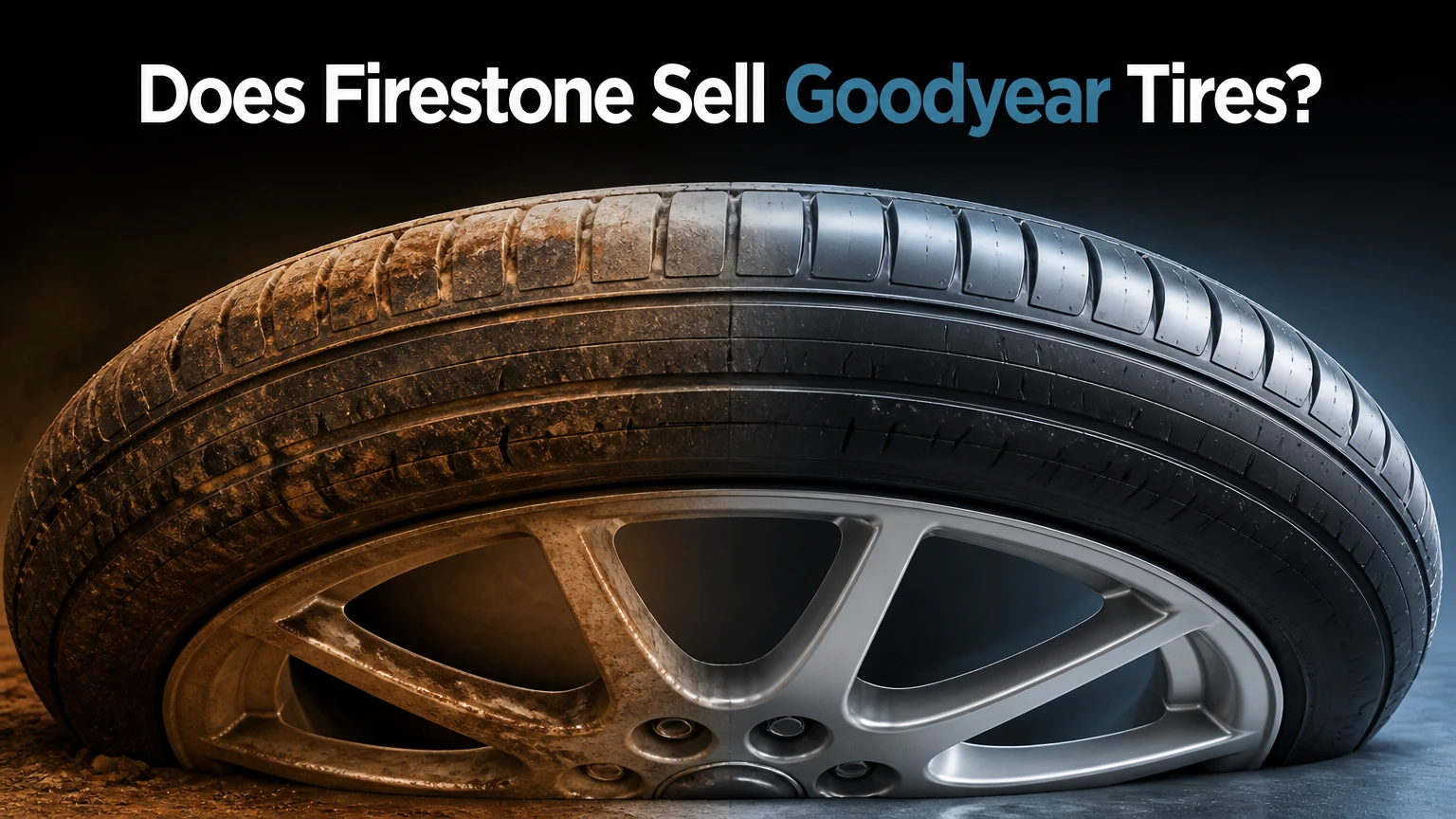
Firestone Complete Auto Care generally does not sell Goodyear tires through its regular corporate-store inventory. Its current tire selection emphasizes Firestone, Bridgestone, SureDrive, and selected third-party brands, although availability can vary by vehicle, tire size, location, and individual store inventory.
Key Facts at a Glance
- Goodyear is not listed among the standard tire brands promoted by Firestone Complete Auto Care.
- Firestone Complete Auto Care is operated by Bridgestone Retail Operations.
- Bridgestone acquired the Firestone Tire & Rubber Company in 1988.
- Firestone locations may still repair, balance, rotate, or replace a Goodyear tire as a paid service.
- Brand-specific warranties and free-service benefits may not transfer to Goodyear tires.
- Local inventory and outside-tire installation policies should be confirmed directly with the selected store.
Does Firestone Sell Goodyear Tires at Its Stores?
Most Firestone Complete Auto Care stores do not offer Goodyear as a standard retail tire brand. Firestone’s current public tire catalog shows products from Firestone, Bridgestone, SureDrive, Toyo, Kumho, and other selected brands, but Goodyear does not appear in its promoted brand lineup.
This distinction matters because “Firestone” can describe several different businesses. Firestone Complete Auto Care is a national, company-operated automotive service network. A separately owned repair shop may also have Firestone in its business name because it sells Firestone products or has a historical dealer relationship.
An independent shop can choose to stock several competing brands. Therefore, a local business named “Firestone Tire” might carry Goodyear even though it is not part of Firestone Complete Auto Care’s normal corporate inventory.
Use the store’s official website and telephone number to verify which type of business it is. Do not assume that every business with a Firestone sign follows the same purchasing system.
Why Does Firestone Usually Not Carry Goodyear?
Firestone Complete Auto Care is part of Bridgestone’s retail organization, while Goodyear is a separate tire manufacturer and market competitor. Bridgestone acquired the Firestone Tire & Rubber Company in May 1988, bringing the Firestone brand and service network into the Bridgestone organization.
That ownership relationship influences what Firestone stores promote. The company can serve several price and performance levels using brands already represented in its portfolio:
| Customer need | Common Firestone-store option | Position in the selection |
| Premium touring | Bridgestone Turanza or Alenza | Comfort, refinement, longer-distance driving |
| SUV or light truck | Firestone Destination or Bridgestone Dueler | Highway, all-terrain, and utility applications |
| Performance | Firestone Firehawk or Bridgestone Potenza | Responsive handling and performance fitments |
| Winter traction | Bridgestone Blizzak or selected Firestone winter tires | Snow and cold-weather applications |
| Economy replacement | SureDrive All Season | Basic daily-driving value |
| Selected third-party fitments | Toyo or Kumho models | Additional sizes and vehicle coverage |
Firestone’s online inventory specifically presents Firestone, Bridgestone, SureDrive, Toyo, and other available products across its vehicle and tire-type pages. Its homepage describes the core lineup as Firestone, Bridgestone, and SureDrive.
The practical reason is inventory efficiency. A retailer can cover common passenger, SUV, truck, winter, performance, and budget needs without stocking a direct competitor’s entire catalog.
Can a Firestone Location Special-Order Goodyear Tires?
A Firestone Complete Auto Care location might be able to discuss a nonstandard order, but shoppers should not assume that Goodyear tires can be special-ordered. Corporate purchasing systems, local warehouses, installer agreements, and manager-level policies can limit which products a store can obtain.
Ask the store these exact questions:
- “Can this location order a Goodyear tire in size 225/65R17?”
- “Is the tire supplied by Firestone or treated as an outside product?”
- “Will Firestone’s installation or road-hazard coverage apply?”
- “Will I receive Goodyear’s manufacturer warranty documents?”
- “What is the complete installed price?”
A vague answer such as “we can probably get it” is insufficient. Request the exact Goodyear model, service description, delivery date, quantity, DOT production information when available, and out-the-door price in writing.
How Should You Check Local Inventory?
Search by the vehicle’s year, make, model, and trim before calling. Firestone’s tire-shopping system filters products according to vehicle fitment, and its website notes that suitable choices depend on the vehicle, driving habits, and road conditions.
Then call the actual installation location. Online catalogs may show network-level availability rather than what is physically present at one store.
Provide the complete tire specification, not only the rim diameter. For example, “225/65R17 102H” is more useful than “17-inch tire” because width, aspect ratio, construction, wheel diameter, load index, and speed rating can all affect compatibility.
Will Firestone Install Goodyear Tires Bought Elsewhere?
Some Firestone locations may install customer-supplied Goodyear tires, but acceptance is a store-policy question rather than a guaranteed nationwide service. The shop may decline outside products, limit its workmanship warranty, require inspection, or charge a different labor rate.
Before shipping tires to a Firestone location, obtain direct approval. Confirm:
- The location accepts customer-supplied tires.
- The exact size and quantity are correct.
- The shipment may be addressed to the store.
- Installation includes mounting, balancing, new valve components, and TPMS service when required.
- Old-tire disposal and state fees are included.
- The shop will install tires with the supplied age and condition.
- The tires have not been previously mounted, damaged, or improperly stored.
Firestone describes its standard replacement service as removing the existing tire and installing a new tire, with mounting and balancing included in the replacement process. That description does not establish a universal obligation to accept products purchased from another seller.
The safest process is to select the installer before ordering. A lower online tire price can become more expensive after shipping, installation, disposal, TPMS kits, and separate road-hazard coverage are added.
Will Firestone Repair or Rotate Goodyear Tires?
Firestone Complete Auto Care can inspect and service tires even when the tire was not purchased there, subject to tire condition and store policy. Its advertised tire-repair services include flat-tire diagnosis, slow-leak service, rotation, valve-stem inspection, bead inspection, balancing checks, and TPMS recommendations.
However, ordinary paid service is different from a free benefit attached to a tire purchase. Firestone specifically states that rotations are available on Bridgestone or Firestone tires regardless of where those tires were purchased. That wording should not be interpreted as a promise of free rotation for every Goodyear tire.
| Service | Possible for Goodyear tires? | Important limitation |
| Pressure and visual inspection | Usually | Tire must be safe to inspect and handle |
| Wheel balancing | Usually | Charged as a normal service unless covered separately |
| Tire rotation | Usually | Free-rotation benefits may be limited to qualifying brands or purchases |
| Tread puncture repair | Sometimes | Damage must be within the safely repairable area |
| Sidewall repair | No | Sidewall injuries generally require replacement |
| Manufacturer warranty claim | Not normally through Firestone | Goodyear or an authorized Goodyear seller may need to process it |
| Road-hazard claim | Depends on plan | Coverage follows the seller and contract terms |
A puncture is not automatically repairable. The U.S. Tire Manufacturers Association states that a tire should be removed from service when an injury may extend into the shoulder or belt-edge area. Proper evaluation normally requires removing the tire from the wheel so its interior can be inspected.
Does Firestone’s Warranty Cover Goodyear Tires?
Firestone’s branded tire warranty does not automatically cover a Goodyear tire. Firestone’s published limited-warranty information identifies Bridgestone, Firestone, SureDrive, Fuzion, and Primewell passenger and light-truck tires as covered brands. Goodyear is not included in that list.
A Goodyear tire may instead have one or more of these protections:
- Goodyear’s manufacturer defect warranty
- A model-specific tread-life warranty
- A road-hazard plan sold by the original retailer
- Installation workmanship coverage from the installer
- A vehicle manufacturer’s original-equipment tire process
Keep the purchase invoice, installation invoice, rotation records, alignment records, and inflation-maintenance records. Mileage-warranty claims commonly depend on documented maintenance and measurable remaining tread depth.
Do not assume that paying Firestone to repair or rotate a Goodyear tire transfers the tire into Firestone’s warranty program. Service history and warranty responsibility are separate matters.
Where Should You Buy Goodyear Tires?
Buy Goodyear tires from a seller that can supply the exact model, size, service description, and warranty support you need. Goodyear’s own sales network, independent authorized dealers, national tire retailers, vehicle dealerships, and established online tire sellers are common options.
Compare the complete transaction rather than the advertised tire-only price:
| Cost component | What to verify | Why it matters |
| Tire price | Price per tire and quantity | Some promotions require four tires |
| Mounting | Labor per tire | May be separate from the listed price |
| Balancing | Standard or road-force balance | Corrects wheel-and-tire weight variation |
| Valve or TPMS kit | Per-wheel charge | Certain stems and seals should be renewed |
| Disposal fee | Per old tire | Often excluded from online pricing |
| Sales and state fees | Local tax and environmental fees | Changes the final total |
| Road-hazard plan | Coverage term and exclusions | Separate from a defect warranty |
| Alignment | Inspection or full adjustment | Uneven wear can damage new tires |
| Rotation | Free, paid, or mileage-limited | Influences long-term ownership cost |
Ask every seller for the same out-the-door quote. A tire that appears $20 cheaper online can cost more after installation and coverage are added.
What Is the Firestone Equivalent of a Goodyear Tire?
There is no exact model-for-model equivalent because each tire uses its own tread design, compound, casing, ratings, and available sizes. The most useful comparison is by vehicle type and driving requirement.
| Driver requirement | Goodyear family to research | Firestone-store alternative to research |
| Long-life passenger touring | Assurance | Bridgestone Turanza, Alenza, or Firestone touring model |
| Four-season traction | Assurance WeatherReady | Bridgestone WeatherPeak or Firestone WeatherGrip |
| Highway truck and SUV use | Wrangler highway models | Firestone Destination LE series or Bridgestone Dueler |
| All-terrain driving | Wrangler all-terrain models | Firestone Destination A/T or Bridgestone Dueler A/T |
| Sport-oriented street use | Eagle | Firestone Firehawk or Bridgestone Potenza |
| Winter driving | WinterCommand or Ultra Grip | Bridgestone Blizzak or Firestone winter model |
| Basic budget replacement | Entry-level Goodyear fitment | SureDrive All Season |
| Run-flat requirement | Goodyear run-flat fitment | Bridgestone DriveGuard where compatible |
Firestone identifies Destination as an SUV and off-road family, Firehawk as a performance-oriented family, and Bridgestone lines such as Potenza, Turanza, Alenza, Dueler, DriveGuard, Ecopia, and Blizzak across distinct use cases.
Do not choose solely by product-family name. Compare the exact tire’s size, service description, treadwear warranty, severe-snow certification, traction design, noise characteristics, and current price.
Is Goodyear Better Than Firestone?
Neither brand is universally better because performance varies more by tire model and application than by logo. A premium touring Goodyear should not be compared with an entry-level Firestone, just as a Firestone performance tire should not be judged against a Goodyear highway truck tire.
Use decision-weighted criteria:
| Criterion | What to compare | Practical decision rule |
| Vehicle fitment | Exact size and approved specifications | Reject any tire that does not meet manufacturer requirements |
| Climate | Heat, rain, snow, and ice exposure | Prioritize conditions faced regularly |
| Driving pattern | City, highway, towing, off-road, or performance | Select the correct tire category first |
| Warranty | Exact mileage and exclusions | Compare the specific size because coverage can vary |
| Wet braking | Independent test for the exact model | More important than broad brand reputation |
| Snow rating | Three-Peak Mountain Snowflake marking | Use when severe winter service is required |
| Ride and noise | Model reviews and test measurements | Important for high annual mileage |
| Installed cost | Complete invoice total | Compare equal services and protection |
A Goodyear model may be the better choice when it has the required fitment, tested performance, or warranty. A Firestone or Bridgestone model may be better when it provides stronger value, easier local support, or a more suitable design for the driver’s conditions.
The brand question narrows the search. The model comparison makes the decision.
Can You Mix Firestone and Goodyear Tires?
Firestone and Goodyear tires can sometimes be used on the same vehicle, but matching all four tires is normally preferable. The critical safety factors are tire size, construction, load index, speed rating, tread design, tread depth, vehicle requirements, and axle placement, not the brand name alone.
The U.S. Tire Manufacturers Association advises that replacement tires use the size, load index, and speed rating recommended by the vehicle manufacturer. When only one tire must be replaced, USTMA recommends pairing it with the tire having the deepest remaining tread and placing that pair on the rear axle.
Goodyear likewise advises placing two new matching tires on the rear axle when only two are replaced, provided they match the existing tires in size and construction.
When Is Mixing Tires Especially Risky?
Mixing becomes more problematic when:
- The vehicle has all-wheel drive or four-wheel drive.
- Tread-depth differences exceed the vehicle manufacturer’s limit.
- One axle has summer tires and the other has all-season tires.
- Different sizes or constructions are installed on the same axle.
- Speed or load ratings fall below the required specification.
- Directional tires are installed in the wrong orientation.
- Run-flat and conventional tires are combined without manufacturer approval.
Some AWD systems tolerate only a small difference in tire circumference. Check the owner’s manual before replacing one or two tires, because an incorrect mismatch can affect traction-control behavior or drivetrain operation.
How Do You Buy the Right Tire?
The safest purchase process has six steps:
- Read the door-jamb placard. Record the original tire size and recommended cold inflation pressure.
- Check the owner’s manual. Look for load, speed, axle, run-flat, and AWD replacement requirements.
- Identify your actual use. Separate highway commuting, towing, winter driving, performance driving, and off-road needs.
- Compare exact models. Review size-specific warranty, ratings, certifications, availability, and installed price.
- Confirm the seller and installer. Establish warranty responsibility and outside-product policies before payment.
- Inspect the final installation. Verify tire model, size, direction, pressure, valve or TPMS service, and invoice details.
Goodyear defines load index as the tire’s maximum supported weight when properly inflated. That value is part of the service description and should meet the vehicle manufacturer’s requirement.
Firestone also recommends using the vehicle-specific shopping process rather than choosing a tire without confirming fitment.
Common Buying Mistakes
Assuming Every Firestone-Named Shop Is Corporate
An independent dealer may have different brands, pricing, warranties, and installation policies. Confirm the business identity before relying on national-store information.
Comparing Only the Tire Price
Mounting, balancing, TPMS parts, disposal, taxes, road-hazard coverage, and alignment can materially change the final bill. Compare written out-the-door totals.
Treating Warranty Mileage as Expected Life
A mileage warranty is conditional coverage, not a prediction that every driver will reach that mileage. Alignment, inflation, rotation, suspension condition, climate, road surface, and driving style affect wear.
Selecting by Brand Without Checking the Model
Brands produce economy, touring, performance, winter, truck, and specialty tires. An exact-use comparison is more reliable than calling one entire brand premium or budget.
Replacing One AWD Tire Without Measuring the Others
A new full-depth tire can have a different rolling circumference from three worn tires. Consult the manufacturer’s limits before installing it.
Frequently Asked Questions
Does Firestone sell other tire brands?
Yes. Firestone Complete Auto Care promotes Firestone, Bridgestone, and SureDrive as core brands, while its online inventory also displays selected products from manufacturers such as Toyo and Kumho. The exact brands and models available depend on tire size, vehicle fitment, warehouse supply, and local store inventory.
Can Firestone balance Goodyear tires?
A Firestone location can generally perform paid wheel-balancing service on a compatible Goodyear tire and wheel assembly. Balancing corrects weight differences that can cause vibration and uneven wear. Confirm the price and whether any previous purchase package covers the service before scheduling.
Can Firestone rotate tires purchased elsewhere?
Firestone provides tire-rotation services, but the price and included benefits depend on the brand, purchase history, and service package. Firestone specifically states that Bridgestone and Firestone tires can be rotated regardless of purchase location, so owners of other brands should ask whether normal service charges apply.
Will Firestone install only two new tires?
A store may install two tires when the fitment is safe and consistent with vehicle requirements. The two new tires should generally be installed on the rear axle to improve stability on wet roads, while size, construction, load index, and speed rating must remain appropriate.
Is Firestone owned by Goodyear?
No. Firestone is part of Bridgestone, not Goodyear. Bridgestone acquired the Firestone Tire & Rubber Company in 1988. Goodyear remains a separate tire manufacturer, which helps explain why Goodyear products are not part of Firestone Complete Auto Care’s normal promoted lineup.
Can a damaged Goodyear tire always be patched?
No. A qualified technician must remove and inspect the tire to determine whether the damage is safely repairable. Tread-area punctures may qualify under industry procedures, but shoulder, belt-edge, and sidewall injuries generally require replacement rather than a plug or patch.
The Bottom Line
Does Firestone sell Goodyear tires? Firestone Complete Auto Care generally does not carry Goodyear as a standard retail brand. Its normal selection centers on Firestone, Bridgestone, SureDrive, and selected additional manufacturers, although an independent Firestone-named dealer may stock different products.
Firestone may still inspect, balance, rotate, repair, or install a Goodyear tire as a paid service, depending on the location and tire condition. Call the selected store before ordering, confirm its outside-tire policy, and compare the complete installed cost rather than the tire-only price.