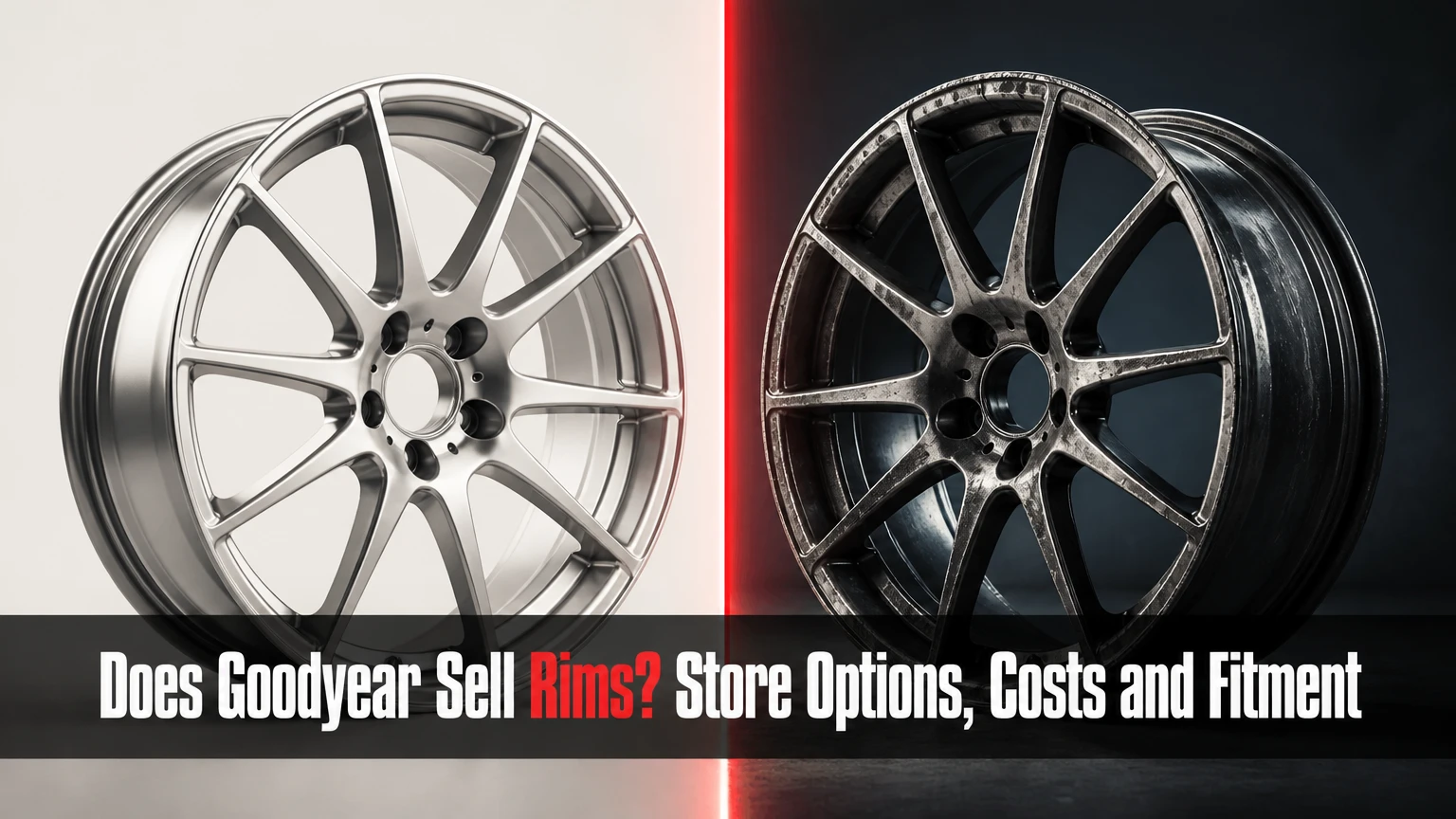
Goodyear does not manufacture consumer vehicle rims as a primary product line; Goodyear is principally a tire manufacturer. However, participating Goodyear Auto Service locations may sell, order, mount, and balance third-party wheels, so the exact answer is yes for some stores, but the rims will generally carry another brand and depend on local availability.
Key Facts at a Glance
- Goodyear-branded consumer products are primarily tires, while aftermarket wheels usually come from separate wheel manufacturers.
- A Goodyear Auto Service location may order compatible steel or alloy wheels through its commercial distributors.
- Wheel selection, brands, prices, delivery times, and installation services vary by store and vehicle.
- Typical aftermarket wheel prices range from about $60 for basic steel wheels to more than $1,500 for forged performance wheels.
- Safe fitment requires the correct bolt pattern, diameter, width, offset, center bore, load rating, and brake clearance.
- A wheel and tire package can include mounting, balancing, TPMS service, installation, lug hardware, and disposal fees.
Does Goodyear Sell Rims or Only Tires?
Goodyear sells rims through some retail service locations, but Goodyear itself is not primarily a wheel manufacturer. The distinction matters because a customer searching for a “Goodyear rim” may expect a wheel made and branded by Goodyear, while a store will more commonly source a wheel from an independent manufacturer.
Goodyear’s core consumer catalog centers on tires for cars, SUVs, trucks, trailers, and specialty applications. Goodyear Auto Service locations are retail and repair businesses that can provide services beyond manufacturing, including tire installation and, at participating locations, wheel sales.
A store may offer a complete wheel and tire package using Goodyear tires plus aftermarket wheels from brands such as American Racing, Enkei, Konig, KMC, Moto Metal, or TSW. Those brand examples are not a guarantee of current inventory. The local store must confirm available distributors, finish, size, load rating, and vehicle fitment.
What is the difference between Goodyear and Goodyear Auto Service?
Goodyear is the tire company; Goodyear Auto Service is a retail service channel that may sell products from other manufacturers. A local franchise or company-operated store can have different suppliers and services, so a national website answer cannot guarantee that every location can order the same wheel.
The practical rule is simple: ask the store whether it sells aftermarket wheels for your exact vehicle, rather than asking whether Goodyear manufactures rims. The wording directs the employee toward fitment and inventory instead of brand ownership.
Can a Goodyear Store Order Aftermarket Wheels?
A Goodyear store may order aftermarket wheels when its local supplier has a suitable product in stock. The store normally checks the vehicle application, wheel specifications, distributor availability, delivery charge, and return conditions before finalizing the order.
Many locations do not keep a broad wheel inventory on the showroom floor. A digital catalog or distributor lookup is more common, especially when the customer wants a particular diameter, finish, offset, or winter wheel. Delivery may take one to several business days for a stocked item, while special finishes or backordered sizes can take longer.
How does buying wheels through Goodyear work?
The normal process has five stages:
- Provide the vehicle details. Give the store the year, make, model, trim, drivetrain, engine, and any brake or suspension modifications.
- Define the objective. Explain whether you need an OEM-style replacement, winter wheel set, larger appearance package, off-road wheel, or complete tire package.
- Review verified options. The store checks diameter, width, bolt pattern, offset, center bore, load capacity, brake clearance, and tire compatibility.
- Approve the written quote. Confirm wheel brand, finish, quantity, lug nuts, TPMS plan, mounting, balancing, taxes, delivery, and return terms.
- Schedule installation. The shop mounts and balances the tires, installs the assemblies, torques the fasteners, and checks the TPMS system.
The most important checkpoint is the written fitment record. A wheel that physically attaches to the hub can still be unsafe if its load rating, offset, brake clearance, or tire size is wrong.
What Types of Rims Can You Buy Through Goodyear?
Goodyear locations may source steel, cast aluminum alloy, or forged alloy wheels, but the available category depends on the vehicle and local distributor. Steel wheels usually prioritize cost and winter durability, cast alloy wheels cover most daily-driver applications, and forged wheels target lower mass and high performance.
| Wheel type | Typical price per wheel | Typical weight position | Common application |
|---|---|---|---|
| Basic steel | $60-$150 | Heavier than alloy | Winter tires, fleet cars, work trucks |
| Cast aluminum alloy | $120-$400 | Medium weight | Passenger cars, SUVs, daily driving |
| Flow-formed alloy | $250-$700 | Lower than cast alloy | Sport compacts, performance SUVs |
| Forged aluminum alloy | $500-$1,500+ | Lowest for comparable strength | Sports cars, luxury vehicles, track use |
Prices are typical retail ranges, not Goodyear quotations. Wheel diameter, width, finish, load rating, brand, and seasonal demand can move the price substantially.
Are steel wheels better than alloy wheels for winter?
Steel wheels are often the practical winter choice because they usually cost less and tolerate minor impacts without the same replacement expense as premium alloy wheels. Steel also makes it easier to keep a dedicated winter tire set mounted, reducing repeated seasonal tire dismounting.
Steel wheels are heavier, can corrode when their coating is damaged, and offer fewer style choices. Alloy wheels resist rust and usually weigh less, but road salt, potholes, and curb impacts can damage finishes or bend and crack the wheel.
For a vehicle with large factory wheels, a smaller winter wheel is acceptable only when it clears the brake caliper and matches the manufacturer’s approved tire diameter and load requirements.
Which Wheel Specifications Determine Fitment?
The correct wheel must match more than diameter and lug count. Bolt pattern, offset, center bore, width, load rating, brake clearance, and tire size collectively determine whether an aftermarket wheel is safe and usable on a particular vehicle.
| Specification | Example value | What it controls | Typical failure if wrong |
|---|---|---|---|
| Diameter | 17 inches | Tire diameter and brake clearance | Tire mismatch or caliper contact |
| Width | 7.5 inches | Tire range and sidewall position | Poor handling or sidewall distortion |
| Bolt pattern | 5×114.3 | Lug count and circle diameter | Wheel cannot seat safely |
| Offset | ET45 | Hub-to-wheel mounting position | Suspension or fender rubbing |
| Center bore | 66.1 mm | Hub fit and wheel centering | Vibration if poorly centered |
| Load rating | 1,650 lb per wheel | Supported vehicle weight | Overloaded wheel and safety risk |
What do bolt pattern, offset, and center bore mean?
Bolt pattern identifies the number of wheel fasteners and the diameter of the circle through their centers, such as 5×114.3. Offset, written as ET, measures the mounting face’s position relative to the wheel centerline; a lower offset generally moves the wheel outward, while a higher offset moves it inward.
Center bore is the hole that fits over the vehicle’s hub. An oversized aftermarket bore can be safe when the wheel is properly centered with hub-centric rings of the correct dimensions, but rings do not correct a wrong bolt pattern, inadequate load rating, or brake interference.
Wheel width changes tire shape and inner clearance. A wider wheel can move the inner lip closer to suspension components and the outer lip closer to the fender, even when its diameter matches the original wheel.
What other fitment checks does a Goodyear technician perform?
A competent fitment check should confirm:
- The wheel clears the brake caliper, rotor, and suspension.
- The tire’s overall diameter remains within the vehicle’s acceptable range.
- The wheel’s load rating meets or exceeds the axle requirement.
- The tire’s speed rating and load index suit the vehicle.
- The valve stem and TPMS sensor fit the new wheel.
- The lug nut seat matches the wheel’s design.
- The wheel does not contact the fender at full steering lock or suspension compression.
One practitioner rule matters here: never approve a wheel solely because an online catalog lists the same year and model. Trim level, performance brakes, all-wheel drive, and factory suspension packages can change fitment.
How Much Do Goodyear Rims and Installation Cost?
A complete wheel purchase commonly costs about $300-$1,600 before tires, depending on material and quantity. Mounting and balancing often add approximately $20-$30 per tire, while TPMS parts, lug hardware, taxes, alignment, and disposal can raise the final invoice.
| Cost component | Typical per-wheel or per-vehicle range | Usually required? | Main price variable |
|---|---|---|---|
| Basic steel wheel | $60-$150 per wheel | For a second seasonal set | Diameter and load rating |
| Cast alloy wheel | $120-$400 per wheel | For most aftermarket packages | Brand, finish, and size |
| TPMS service kit | $5-$15 per wheel | Often during tire installation | Valve and sensor design |
| New TPMS sensor | $40-$80 per sensor | Only if needed | Vehicle protocol and programming |
| Mount and balance | $20-$40 per tire | Yes for new assemblies | Tire size and package discount |
| Four-wheel alignment | $90-$150 per vehicle | Only when needed | Vehicle and local labor rate |
These are typical market ranges, not guaranteed Goodyear prices. A store may bundle mounting and balancing, charge separately for installation, or use a package price that makes individual line items difficult to compare.
What should the written quote include?
Request a line-by-line quote showing four wheels, four tires if applicable, lug nuts, TPMS sensors or service kits, mounting, balancing, installation, taxes, disposal, delivery, and warranty terms. Ask whether the price includes re-torquing after the first 50-100 miles, because some shops recommend that inspection after wheel installation.
An alignment should not be automatic simply because new rims were installed. It makes sense after suspension work, impact damage, uneven tire wear, steering symptoms, or a change in wheel and tire dimensions that alters clearance. Alignment cannot correct a wheel with the wrong offset.
Is Buying Wheels at Goodyear Better Than Buying Online?
Goodyear offers a lower-risk installation path and local support, while online wheel retailers usually offer broader selection and sometimes lower product prices. The better choice depends on whether fitment certainty, immediate service, brand selection, or total purchase cost carries the most weight.
| Buying route | Typical wheel selection | Fitment support | Typical price position | Main risk |
|---|---|---|---|---|
| Goodyear Auto Service | Local distributor catalog | Technician-assisted | Mid to high retail | Limited local inventory |
| Online wheel retailer | Hundreds of designs and sizes | Catalog and phone support | Often lower product price | Return freight and fitment error |
| Vehicle dealer | OEM replacement wheels | VIN-based parts lookup | Highest for new OEM | Limited aftermarket styling |
| Used marketplace | Discontinued and OEM options | Buyer responsibility | 30%-70% below new retail | Damage, corrosion, wrong specs |
Online pricing can be attractive, but the delivered cost includes shipping, mounting, balancing, TPMS work, lug hardware, and any return freight. A $100 saving can disappear if the wheel arrives with the wrong center bore or requires a second installation appointment.
Goodyear is not always the best source for rare vintage wheels, aggressive custom offsets, or highly specialized motorsport products. A dealer may be safer for an exact OEM replacement, while a specialist wheel retailer may offer more choices for a custom build.
What is the advantage of a Goodyear wheel and tire package?
A package puts wheel selection, tire installation, balancing, and local troubleshooting under one service relationship. If the finished assembly vibrates, leaks, or has a TPMS issue, the customer can return to the installing location instead of coordinating between separate sellers.
The trade-off is selection and price. Local stores may only access distributors serving their market, and a package may cost more than buying wheels online and using an independent installer.
What Happens During Wheel Installation?
Wheel installation normally includes tire mounting, balancing, valve or TPMS service, vehicle installation, and final torque verification. A typical appointment takes about one to three hours when the wheels and tires are already at the store, excluding delays caused by special-order delivery or sensor programming.
The technician removes the old assemblies, inspects the hub and brake area, mounts the tires, and balances each assembly. The shop then installs the wheels with the correct hardware and torque specification, checks air pressure, and confirms that the assembly clears the vehicle at steering lock.
TPMS treatment depends on the vehicle. Existing sensors may transfer if compatible and undamaged, while new sensors may require programming or relearning through the vehicle’s prescribed procedure. Goodyear’s tire installation information emphasizes proper installation and balancing, but the precise sensor process varies by vehicle manufacturer.
Before leaving, inspect the wheel finish, verify the tire size, check the dashboard for a TPMS warning, and confirm that no wheel contacts the caliper or suspension.
What Problems Can Occur After Installing New Rims?
The most common post-installation problems are vibration, air loss, wheel rubbing, TPMS warnings, loose-feeling hardware, and incorrect spare-tire compatibility. Each symptom points to a different cause, so replacing parts without diagnosis can waste money.
Why do new wheels vibrate at highway speed?
A vibration appearing around 50-70 mph most often indicates wheel imbalance, a tire seating problem, a bent wheel, hub corrosion, or incorrect centering. Rebalancing is the first inspection, but persistent vibration requires checking radial runout, hub contact surfaces, lug torque, and hub-centric fit.
A missing hub-centric ring can contribute to centering problems when the aftermarket wheel’s center bore is larger than the hub. Rings cannot rescue a wheel with an incompatible bolt pattern or inadequate clearance.
Why do aftermarket wheels need different lug nuts?
Aftermarket wheels may use a conical, mag, or ball-seat lug design that differs from the vehicle’s original hardware. Factory lug nuts can bottom out, fail to seat against the wheel, or damage the mounting surface when used with an incompatible aftermarket wheel.
Confirm the thread pitch, seat type, shank length, key pattern, and required socket before installation. A wheel quote should identify whether the necessary lug nuts and locks are included.
Can larger rims make the spare tire unusable?
A larger wheel does not automatically make the spare unusable, but a different tire diameter, wheel offset, brake clearance, or drive-axle requirement can make the factory spare unsuitable. This issue is particularly important on all-wheel-drive vehicles, where significant rolling-diameter differences can stress the drivetrain.
Keep the original spare only after confirming its tire diameter, brake clearance, lug hardware, and the vehicle manufacturer’s temporary-spare instructions. The owner’s manual controls the final decision.
Which Situations Need Special Wheel Advice?
Winter tire sets, leased vehicles, trucks, electric vehicles, and modified cars each create different wheel requirements. A wheel that works for a standard front-wheel-drive sedan may be unsuitable for an EV’s weight, a truck’s payload, or a lease return’s appearance standards.
- Winter driving: Consider steel wheels or winter-rated alloy wheels, and confirm brake clearance before downsizing.
- Pickup trucks: Match the wheel load rating to the truck’s axle and tire requirements, not merely the advertised diameter.
- Electric vehicles: Account for higher curb weight, tire noise, aerodynamic covers, and the vehicle maker’s load specifications.
- Leased vehicles: Keep the original wheels and tires if the lease contract requires factory equipment at return.
- Modified suspension: Verify rubbing at full steering lock and during compression, not only while the vehicle is parked.
- OEM restoration: A dealer or specialist marketplace may locate exact factory wheels more reliably than a general tire retailer.
The honest limitation is important: Goodyear installation does not make an unsuitable wheel safe. The store can provide professional fitment assistance, but the customer still needs to disclose lift kits, lowering springs, spacers, oversized brakes, and other modifications.
What Should You Ask Before Ordering Rims?
Ask the store for the exact wheel brand, part number, size, offset, center bore, bolt pattern, load rating, finish warranty, and return policy. Also confirm whether the quote includes compatible lug nuts, TPMS sensors, balancing, installation, taxes, and delivery.
Use this checklist before paying a deposit:
- Is the wheel approved for my exact year, trim, drivetrain, and brake package?
- What are the diameter, width, offset, center bore, and load rating?
- Does the wheel use my factory lug nuts or require new hardware?
- Will the existing TPMS sensors transfer and communicate correctly?
- Does the package include mounting, balancing, valve service, and installation?
- What is the delivery date, and what happens if the wheel is backordered?
- Can I return the wheel after it has been mounted?
- Will the original spare clear the new brake and tire setup?
- Is the finish covered against peeling, corrosion, or road damage?
- Does the shop recommend an alignment based on an actual inspection?
The wheel part number is more useful than a descriptive name such as “17-inch black rim.” Part numbers identify the manufacturer’s precise dimensions and finish, making later replacement and warranty claims easier.
FAQ
Can I bring my own rims to Goodyear?
Some Goodyear locations may install customer-supplied wheels, but policies, labor rates, warranty coverage, and liability terms vary. Ask before purchasing the wheels, because a store may refuse unknown products, require proof of fitment, or exclude customer-supplied parts from installation warranties.
Does Goodyear sell OEM replacement wheels?
Goodyear stores may be able to source an OEM-style or replacement wheel, but a vehicle dealer or OEM parts distributor is usually the more direct source for an exact factory wheel. Provide the vehicle identification number and wheel part number when factory matching matters.
Can Goodyear put my existing tires on new rims?
A Goodyear Auto Service location may remount existing tires if the tire size matches the new wheel and the tires pass inspection. The technician should check tread, age, sidewall damage, bead condition, and approved rim-width range before accepting the job.
Do new rims affect tire pressure monitoring?
New rims can affect TPMS when the existing sensors do not fit the valve hole, use a different protocol, or become damaged during transfer. The vehicle may need sensor programming or a relearn procedure after installation, and the dashboard warning should be absent before normal driving.
Is a wheel alignment required after buying rims?
A wheel alignment is not automatically required after installing correctly fitted wheels. An alignment is appropriate when the vehicle pulls, the steering wheel is off-center, tires wear unevenly, suspension components changed, or an impact may have altered geometry.
Can I buy Goodyear-branded rims online?
Listings labeled “Goodyear wheels” may describe wheels packaged with Goodyear tires, used OEM wheels carrying Goodyear tires, or inaccurate marketplace titles. Verify the wheel manufacturer, part number, dimensions, bolt pattern, offset, center bore, and load rating before treating an online listing as a Goodyear product.
The Bottom Line
Does Goodyear sell rims? Some Goodyear Auto Service locations sell or order third-party wheels, but Goodyear is principally a tire manufacturer rather than a consumer wheel brand. The safest purchase starts with a vehicle-specific fitment check and a written quote covering wheel specifications, lug hardware, TPMS, mounting, balancing, delivery, and warranty terms.
Choose Goodyear when local installation and one-point support matter more than maximum selection or the lowest online price. Choose a dealer for exact OEM replacement wheels, a specialist retailer for unusual sizes or custom offsets, and a used marketplace only when you can independently verify condition and specifications.