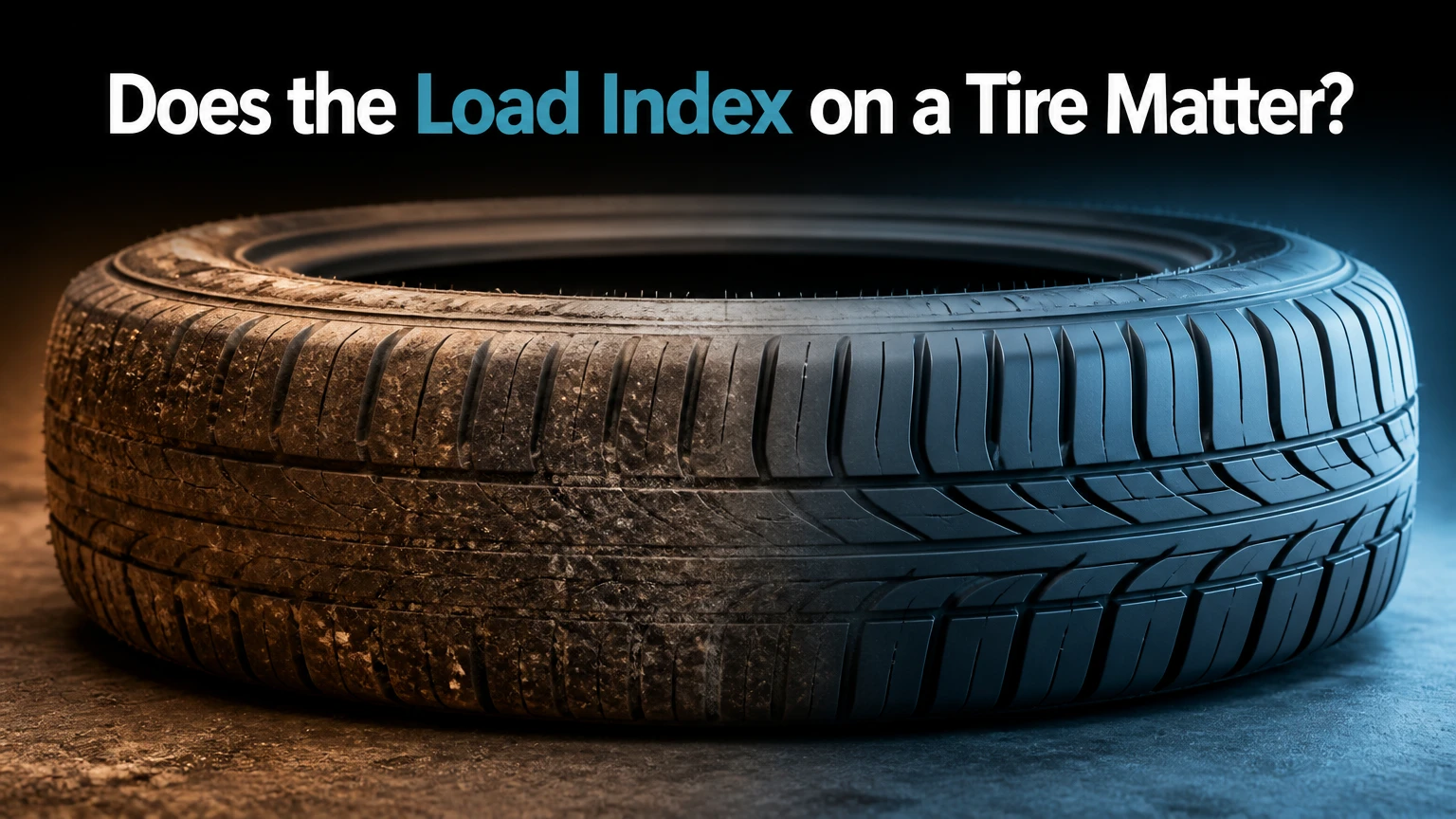
Yes, the load index on a tire matters because it identifies how much weight one properly inflated tire is designed to support under specified operating conditions. Replacement tires should meet or exceed the vehicle manufacturer’s required load index; using an inadequate rating can generate excessive heat, damage the tire, reduce handling stability, and increase failure risk.
Key Facts at a Glance
- A tire’s load index is a numerical code, not the weight itself.
- The rated capacity applies to one tire under specified conditions.
- Replacement tires should not have a lower load capacity than the vehicle manufacturer requires.
- A higher load index does not increase the vehicle’s legal payload or axle rating.
- Normal inflation should follow the vehicle placard unless an approved load-and-inflation specification requires otherwise.
- Load index, load range, speed rating, and tire size describe different attributes.
Why Does the Load Index on a Tire Matter?
The load index matters because a tire must support changing forces, not merely the vehicle’s parked weight. Passenger weight, cargo, braking, cornering, pothole impacts, towing tongue weight, speed, temperature, and pressure loss can all increase the stress carried by an individual tire.
A tire operating beyond its designed capacity flexes more than intended. Repeated sidewall and casing flex creates heat, and excessive heat can weaken rubber compounds, cords, and internal bonds. Michelin states that exceeding load or speed limits can cause heat buildup that reduces durability and raises the risk of tire damage or failure.
The effect is not always immediate. An overloaded tire may initially appear normal, especially during a short urban trip. The risk becomes greater during sustained highway driving, hot weather, low inflation, heavy cargo, or a combination of these conditions.
The practical rule is straightforward: use the complete tire specification approved for the vehicle, including size, load index, construction type, and speed rating.
What Does a Tire Load Index Mean?
A tire load index is a standardized numerical code that corresponds to the maximum load one tire can carry when properly inflated and operated under the rating’s specified conditions. For example, the number 91 in 205/55R16 91V is the load index, while V is the speed rating.
The number is not a direct measurement. A load index of 100 does not mean 100 pounds or 100 kilograms. The index must be converted through an industry load-index table.
Common Passenger Tire Load Indexes
| Load index | Capacity per tire | Capacity per tire |
| 85 | 1,135 lb | 515 kg |
| 88 | 1,235 lb | 560 kg |
| 91 | 1,356 lb | 615 kg |
| 94 | 1,477 lb | 670 kg |
| 95 | 1,521 lb | 690 kg |
| 98 | 1,653 lb | 750 kg |
| 100 | 1,764 lb | 800 kg |
| 102 | 1,874 lb | 850 kg |
| 105 | 2,039 lb | 925 kg |
| 110 | 2,337 lb | 1,060 kg |
| 115 | 2,679 lb | 1,215 kg |
| 120 | 3,086 lb | 1,400 kg |
The relationship is progressive but not a simple fixed number of pounds per index point. Always use a recognized chart rather than estimating capacity.
Where Can You Find the Required Load Index?
Find the approved tire specification on the vehicle tire placard, usually attached to the driver-side door jamb, door edge, glove compartment, or fuel door. The owner’s manual may also identify approved tire sizes and service descriptions. USTMA recommends using these vehicle sources rather than guessing from the tires currently installed.
Check three places:
- Vehicle placard: Use this as the primary reference for original size and recommended cold inflation pressure.
- Owner’s manual: Check for alternative sizes, loading instructions, towing notes, and special tire requirements.
- Current tire sidewall: Confirm what is installed, but do not assume a previous owner or installer selected the correct specification.
A sidewall code such as 225/60R18 100H identifies a 225 mm nominal width, 60 aspect ratio, radial construction, 18-inch wheel diameter, load index 100, and H speed rating.
Can You Use a Lower Tire Load Index?
Do not install a replacement tire with a lower load index or lower load-carrying capacity than the vehicle manufacturer specifies unless the vehicle or tire manufacturer has explicitly approved that exact alternative fitment. USTMA states that replacement tires should have the recommended load index and should not provide less load-carrying capacity than the original specification.
NHTSA has similarly stated that replacement tires should have “at least the equal maximum load rating” as the original tires.
A lower number can reduce the tire’s reserve capacity during:
- Full passenger and cargo loading
- Emergency braking or abrupt lane changes
- High ambient temperatures
- Extended highway operation
- Towing or carrying hitch weight
- Driving with pressure below specification
- Pothole or curb impacts
Two tires can share the same dimensions yet have different service descriptions. A 225/50R17 94V tire and a 225/50R17 98V XL tire fit the same nominal wheel size, but they do not provide the same rated load capacity.
Is a Higher Load Index Always Better?
A higher load index is generally acceptable when the tire size, speed rating, construction, wheel fitment, and other vehicle requirements remain compatible. However, a higher tire rating does not increase the vehicle’s gross vehicle weight rating, gross axle weight rating, suspension capacity, wheel capacity, or towing limit. Michelin specifically notes that fitting a higher-rated tire does not raise the vehicle manufacturer’s allowable load.
Higher-rated tires may use different casing materials, reinforcement, inflation requirements, or tread construction. These differences can affect steering response, rolling resistance, noise, impact harshness, and unsprung weight, but the result depends on the actual tire model. The index number alone does not prove that a tire will ride harder or handle better.
Original Versus Higher Load Index
| Decision factor | Factory-equivalent rating | Higher compatible rating |
| Meets required capacity | Yes | Yes |
| Raises vehicle payload | No | No |
| Fitment verification needed | Yes | Yes |
| Likely ride match | Closest to original design | May differ by tire construction |
| Useful for carrying more than GVWR | No | No |
| Safe default choice | Usually | Only after full-spec confirmation |
Choose a higher index for a valid fitment reason, not because the larger number appears automatically safer.
Is Tire Load Capacity Simply Multiplied by Four?
No. Multiplying one tire’s capacity by four produces a theoretical combined tire capacity, but it is not a reliable method for selecting tires or calculating how much the vehicle may carry.
Vehicles do not distribute weight evenly across all four corners. Engines, batteries, passengers, cargo, fuel, and trailer tongue weight can place more load on one axle. Weight also transfers forward under braking, rearward during acceleration, and outward during cornering.
Use these limits instead:
- The manufacturer-required tire specification
- Front and rear gross axle weight ratings
- Gross vehicle weight rating
- Wheel load rating
- Suspension and brake limits
- Payload shown on the vehicle label
- Trailer and hitch ratings when towing
The tire capacity must be sufficient, but it is only one limit within the complete vehicle system. The lowest applicable limit controls.
Does Maximum Capacity Require Maximum Sidewall Pressure?
A tire’s load capacity depends on inflation pressure, but drivers should not automatically inflate every tire to the maximum pressure molded on its sidewall. The vehicle placard’s recommended cold pressure is the normal starting point because the manufacturer selected it for the original tire specification, axle loading, ride, handling, braking, and durability.
The sidewall maximum pressure is a tire limit, not a universal vehicle pressure recommendation. Continental explains that inflation pressure affects maximum load capacity, while Michelin notes that ratings apply when the tire is properly inflated and loaded.
For ordinary driving, follow the placard. For heavy loading, towing, non-original tire sizes, LT conversions, campers, or commercial service, use an approved load-and-inflation table and guidance from the vehicle or tire manufacturer.
Never reduce pressure merely to soften the ride. Underinflation increases casing flex and heat, even when the vehicle is below its maximum payload.
What Is the Difference Between SL, XL, HL, and LT?
SL, XL, HL, and LT describe construction or service categories, while the load index provides a standardized capacity code. A tire buyer must consider both because two tires of similar dimensions may achieve their capacities through different constructions and inflation ranges.
| Marking | Meaning | Typical application | Key selection rule |
| SL | Standard Load | Passenger cars and light-duty crossovers | Use where the vehicle approves SL capacity |
| XL or RF | Extra Load or Reinforced | SUVs, performance cars, heavier passenger vehicles | Match factory XL/RF when specified |
| HL | High Load | Heavy vehicles and some EV applications | Use when the original specification requires HL |
| P-metric | Passenger tire sizing | Cars, minivans, light SUVs and pickups | Verify capacity when replacing LT tires |
| LT | Light Truck | Pickups, vans, towing and commercial use | Follow load range and pressure tables |
| C-type commercial | Commercial van tire | Cargo vans and European-style vans | Do not substitute solely by matching dimensions |
Michelin describes XL tires as reinforced tires that carry higher loads than standard tires of the same size when operated at the appropriate higher pressure. It also identifies HL tires as a solution for unusually heavy vehicles, including some electric vehicles.
An XL marking does not by itself tell you the capacity. Read the numerical load index as well.
How Is Load Index Different From Load Range?
Load index identifies a tire’s rated weight capacity through a numerical code. Load range describes a construction and pressure category, especially on light-truck and trailer tires, and is often expressed as letters such as C, D, or E.
The older term “ply rating” does not necessarily report the tire’s actual number of physical plies. Modern materials can achieve a historical strength category with fewer casing layers.
| Attribute | Load index | Load range |
| Typical format | 91, 100, 115, 120/116 | C, D, E, F |
| Main meaning | Standardized capacity code | Construction and inflation category |
| Common on | Passenger, SUV, LT and other tires | LT and trailer tires |
| Direct weight capacity | Found through an index table | Requires size-specific load table |
| Can be compared alone | No, size and service matter | No, size and pressure matter |
Never choose a truck tire solely because it has Load Range E. The tire’s size, single or dual application, load index, approved pressure, wheel rating, and vehicle requirements must all agree.
What Does a Dual Load Index Mean?
A dual load index, such as 120/116, is commonly used on light-truck and commercial tires. The first number identifies the capacity when the tire is used in a single-wheel position, and the second identifies its capacity when two tires are installed side by side in a dual-wheel position.
The dual rating is lower per tire because paired tires rarely share load with perfect equality. Road crown, pressure variation, tread-depth differences, suspension movement, and uneven surfaces can place more weight on one tire than the other.
Do not add the single ratings when calculating a dual-wheel axle. Use the dual value for each tire, then confirm that the axle, wheel, and vehicle ratings support the load.
Does Load Index Matter More on an Electric Vehicle?
Load index is particularly important on an electric vehicle because a large traction battery can increase curb weight and axle loading. However, EV ownership does not mean every vehicle automatically requires an XL, HL, or “EV-specific” tire. The correct requirement is the specification established by that vehicle’s manufacturer.
If the original tire is marked XL or HL, preserve that construction requirement and meet or exceed its load index. Michelin advises that vehicles supplied with HL tires should continue using the required HL rating.
EV tire selection may also account for:
- Immediate motor torque
- Regenerative braking forces
- Low cabin noise
- Rolling resistance and driving range
- High vehicle mass
- Model-specific pressure recommendations
Do not substitute a lower-rated passenger tire merely because its dimensions match the wheel.
How Does Load Index Affect Trucks and Towing?
A suitable tire load index is necessary for towing, but installing stronger tires does not increase the truck’s published payload or tow rating. The vehicle’s frame, axles, brakes, cooling system, suspension, hitch, wheels, and tires each retain their own limits.
Before towing, check:
- Loaded vehicle weight
- Front and rear axle weight
- Trailer gross weight
- Tongue or pin weight
- Tire single or dual capacity
- Cold inflation pressure
- Wheel and valve-stem ratings
Tongue weight usually transfers load to the tow vehicle’s rear axle. A truck may remain below its overall GVWR yet overload the rear axle or rear tires.
Weighing the loaded combination by axle is more reliable than estimating from curb weight. Use a certified vehicle scale and compare the measured axle loads with the vehicle certification label and tire capacities.
Can You Mix Different Load Indexes?
Avoid mixing different load indexes on the same axle unless the vehicle or tire manufacturer has approved the combination. Tires on one axle should match in size, construction, load capability, speed rating, tread pattern, and similar tread depth whenever possible.
A different index may also indicate a different casing stiffness or construction category. That difference can change deflection, steering response, braking balance, and stability-control behavior.
USTMA recommends that even when replacing only one or two tires, the replacements retain the manufacturer-recommended size, load index, and speed rating. When only two tires are replaced, USTMA generally recommends placing the new pair on the rear axle to improve wet-road stability.
For all-wheel-drive vehicles, also follow the manufacturer’s limits on circumference and tread-depth differences.
What Are the Signs of an Overloaded Tire?
An overloaded or underinflated tire may run unusually hot, feel unstable, lose pressure, wear heavily at the shoulders, or develop visible casing damage. These signs require immediate attention, but their absence does not prove the tire is correctly rated.
Watch for:
- Repeated pressure loss without an obvious puncture
- Both shoulders wearing faster than the center
- Sidewall bulges, waviness, cracking, or discoloration
- A hot-rubber smell after loaded highway driving
- Steering that feels delayed or unusually soft
- Rear-end sway while towing
- Vibration that increases with speed or load
- Cord exposure or tread separation
Stop driving if a tire develops a bulge, exposed cords, tread separation, severe vibration, or rapid pressure loss. Do not attempt to solve overloading by exceeding the tire, wheel, or vehicle pressure limits.
Common Load-Index Mistakes
Choosing by Vehicle Weight Divided by Four
Average weight per tire ignores front-to-rear distribution, cargo location, axle limits, dynamic load transfer, and trailer tongue weight.
Reading the Current Tire as the Required Specification
A previously installed tire may be incorrect. Confirm the door placard and owner’s manual before ordering replacements.
Treating a Higher Index as Extra Payload
The higher rating only changes the tire’s capability. It does not modify GVWR, GAWR, wheel capacity, suspension limits, or legal payload.
Inflating Every Tire to the Sidewall Maximum
The molded maximum is not the standard daily-driving recommendation. Start with the vehicle placard and use approved load tables for special applications.
Assuming the Same Size Means the Same Capacity
Identical width, aspect ratio, and wheel diameter do not guarantee the same load index, SL/XL category, speed rating, or service suitability.
Selecting LT Tires Only for Appearance
An LT conversion can change tire mass, pressure requirements, ride, braking response, and capacity calculations. Complete the conversion with professional load-table verification.
How to Choose the Correct Replacement Tire
Use a specification-first process rather than shopping by price, tread appearance, or size alone.
- Photograph the vehicle tire placard.
- Record the complete original size and service description.
- Read the owner’s manual for alternatives or special conditions.
- Confirm whether the specification requires SL, XL, HL, LT, run-flat, or another construction.
- Select an equal-or-greater approved load index.
- Match or exceed the required speed rating unless the manufacturer permits a documented exception.
- Confirm the tire fits the wheel width and diameter.
- Check wheel, valve, axle, and vehicle pressure limits.
- Inflate to the approved cold pressure.
- Recheck pressure after installation and before heavy loading.
Michelin and USTMA both advise verifying the manufacturer’s size and service-rating requirements rather than relying only on visible dimensions.
Frequently Asked Questions
Does a Higher Load Index Make a Tire Last Longer?
Not automatically. Tire life depends on pressure maintenance, alignment, rotation, driving style, road conditions, temperature, tread compound, vehicle weight, and construction. A higher index can prevent overloading when greater capacity is genuinely required, but it does not guarantee more mileage on a vehicle already using the correct rating.
Does Load Index Affect Ride Comfort?
It can, but the index alone cannot predict ride quality. A higher-rated tire may have a reinforced casing, greater mass, or different pressure requirements, yet tread design, sidewall geometry, rubber compound, wheel diameter, and inflation pressure may influence comfort more than the numerical index.
Can I Use XL Tires if My Car Came With SL Tires?
An XL tire may be acceptable when its size, load index, speed rating, wheel fitment, and manufacturer approval suit the vehicle. Run it at the vehicle-approved pressure unless a legitimate load table specifies otherwise. XL construction does not authorize exceeding the car’s payload or axle limits.
Does the Load Index Apply to a Temporary Spare?
Yes. Temporary spare tires have their own load, speed, pressure, and distance restrictions. The spare must be compatible with the vehicle position and intended emergency use. Follow the pressure and operating limits printed on the spare and stated in the owner’s manual.
Is Load Index the Same as Speed Rating?
No. The load index is the number identifying load capacity, while the speed rating is the adjacent letter identifying speed capability under specified conditions. In 225/45R18 95W, 95 is the load index and W is the speed rating.
Can Incorrect Tire Pressure Reduce Load Capacity?
Yes. A tire carrying a given load at insufficient pressure flexes excessively and generates additional heat. The capacity printed in an index table assumes the required operating conditions. Check pressure when tires are cold and use the vehicle placard or an approved application-specific load table.
The Bottom Line
The answer to “does the load index on a tire matter?” is unequivocally yes. The rating identifies whether each tire has enough capacity for the vehicle’s required loading conditions, and replacements should meet or exceed the manufacturer’s specification.
Use the driver-door placard and owner’s manual as the primary references. Do not downgrade the rating, estimate capacity by dividing vehicle weight by four, inflate automatically to the sidewall maximum, or assume a higher index increases vehicle payload. When tire size, construction, towing use, or vehicle loading changes, verify the full fitment with the vehicle manufacturer, tire manufacturer, or a qualified tire professional.