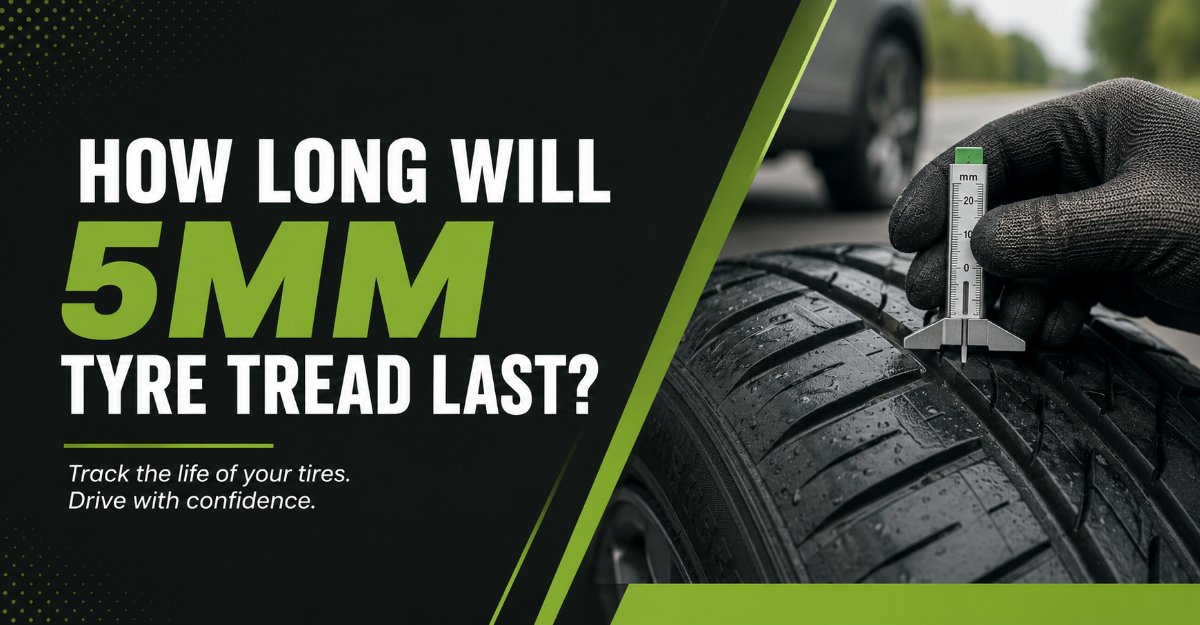
When calculating how long will 5mm tyre tread last, drivers can expect between 15,000 and 20,000 miles of remaining use before reaching the 1.6mm legal limit. For the average motorist, this equals roughly one to two years of driving, though vehicle weight, tyre compound, and maintenance heavily dictate the final mileage.
Key Facts at a Glance
- Brand new passenger car tyres begin with 8mm to 9mm of tread depth.
- A tyre at 5mm has consumed approximately 50 percent of its usable rubber life.
- The legal tread limit in the UK and Europe is 1.6mm across the central three-quarters of the tyre.
- Wet weather braking performance begins to decline noticeably when tread drops below 3mm.
- Average passenger tyres lose roughly 1mm of tread depth for every 5,000 to 6,000 miles driven.
- Electric vehicles wear down tyres up to 20 percent faster due to heavy battery weight and instant torque.
Understanding 5mm Tyre Tread Depth
A tyre measuring 5mm of tread depth is in the middle of its operational lifespan. New passenger vehicle tyres leave the factory with 8mm to 9mm of rubber. The tread grooves exist to channel standing water away from the contact patch, preventing hydroplaning and ensuring mechanical grip with the road surface. As friction slowly erodes the rubber, the volume of these channels shrinks.
At 5mm, the tyre retains excellent dry grip and highly effective water dispersion capabilities. The tyre has 3.4mm of legal wear remaining before hitting the absolute legal minimum of 1.6mm. However, automotive safety experts strongly recommend replacing tyres at 3mm. Therefore, at 5mm, you have exactly 2mm of optimally safe wear remaining.
What Does 5mm Mean for Vehicle Safety?
Vehicle safety relies heavily on the tyre’s ability to displace water. At 5mm of tread depth, a standard tyre can still evacuate up to 25 litres of water per second at 50 miles per hour. This volume ensures the rubber maintains physical contact with the tarmac during heavy rain.
Braking distances remain highly stable at 5mm. Independent testing by automotive safety boards demonstrates that a vehicle traveling at 50 miles per hour in wet conditions will stop in approximately 36 metres on tyres with 5mm of tread. When that tread falls to 1.6mm, the stopping distance increases to over 44 metres. Driving on 5mm tread guarantees you are operating well within the manufacturer safety margins for emergency stopping.
Calculating Your Remaining Mileage
Determining your exact remaining mileage requires a simple mathematical projection based on average wear rates. A standard touring tyre on a front-wheel-drive internal combustion vehicle loses about 1mm of tread every 5,500 miles under normal driving conditions.
To calculate your specific timeline, follow this step-by-step projection method:
Step 1: Establish Your Wear Target Decide whether you plan to replace your tyres at the safety recommendation limit (3mm) or the strict legal minimum limit (1.6mm).
Step 2: Calculate Usable Depth Left Subtract your target limit from your current 5mm depth.
- Safety Target Calculation: 5mm current depth minus 3mm safety target equals 2.0mm of optimal wear remaining.
- Legal Target Calculation: 5mm current depth minus 1.6mm legal target equals 3.4mm of legal wear remaining.
Step 3: Multiply by the Average Wear Rate Multiply your remaining millimetres by the baseline wear rate of 5,500 miles.
- Miles until the 3mm safety limit: 2.0mm multiplied by 5,500 miles equals 11,000 miles.
- Miles until the 1.6mm legal limit: 3.4mm multiplied by 5,500 miles equals 18,700 miles.
Drivers who navigate primarily on smooth motorways may extend this wear rate to 7,000 miles per millimetre, while urban drivers dealing with constant braking and roundabouts may see wear rates drop to 4,000 miles per millimetre.
How Does Tyre Category Affect Remaining Lifespan?
The rubber compound of the tyre drastically alters how long the remaining 5mm will survive on the road. Harder compounds resist friction longer but offer less cornering grip, while softer compounds stick to the road aggressively but degrade rapidly.
Below is a breakdown of expected remaining mileage from 5mm down to 1.6mm based on primary tyre categories.
| Tyre Category | Remaining Mileage (5mm to 1.6mm) | Compound Characteristics | Primary Use Case |
|---|---|---|---|
| Touring / All-Season | 18,000 to 25,000 miles | Harder silica blend designed for longevity | Daily commuting and diverse weather |
| Summer / High Performance | 10,000 to 15,000 miles | Soft, sticky rubber for dry tarmac grip | Sports cars and high-speed cornering |
| Winter / Snow | 8,000 to 12,000 miles | Highly flexible rubber meant for freezing temperatures | Snow, ice, and sub-7°C climates |
| All-Terrain / 4×4 | 20,000 to 30,000 miles | Thick, rugged blocks resistant to chipping | Heavy SUVs and off-road driving |
The Impact of Electric Vehicles on Tyre Wear
Electric vehicles change the mathematics of tyre wear completely. EVs are significantly heavier than traditional internal combustion engine vehicles due to dense lithium-ion battery packs. Furthermore, electric motors deliver 100 percent of their torque instantly to the wheels upon acceleration.
This combination of extreme weight and instant torque strips rubber off the tyre much faster. If you drive an electric vehicle, you must reduce the standard wear projection by 20 percent. A 5mm tread on an EV will typically only last 12,000 to 15,000 miles before hitting the legal limit. EV owners should invest in EV-specific tyres, which utilize reinforced sidewalls and specialized compounds to mitigate this accelerated wear.
What Maintenance Issues Destroy Tyre Tread?
Mechanical and maintenance failures can cut your remaining 15,000 miles in half. Tyres only wear evenly if the vehicle suspension geometry is correct and the air pressure perfectly matches the load.
Improper inflation stands as the leading cause of premature tyre death. Under-inflated tyres lack the structural rigidity to support the car, forcing the weight onto the outer shoulders of the tyre. Over-inflated tyres balloon outwards, pushing the center of the tread against the road while lifting the shoulders off the tarmac. Both scenarios concentrate friction on a narrow band of rubber, burning through your remaining 5mm in a matter of months.
Neglecting tyre rotation also guarantees uneven wear. Front tyres handle the vast majority of steering and braking forces. On a front-wheel-drive car, the front tyres also handle all the acceleration. Without rotating tyres front-to-back every 5,000 miles, the front set will reach 1.6mm while the rear set still sits comfortably at 4mm.
Diagnosing Common Wear Patterns
You can troubleshoot your vehicle’s mechanical health by measuring the 5mm tread across three points: the inner edge, the center, and the outer edge.
- Heavy wear on the center only: If the center is at 3mm but both edges remain at 5mm, the tyre is over-inflated. The immediate fix is to release air until you reach the PSI listed inside the driver side door jamb.
- Heavy wear on both shoulders: If the center is at 5mm but both outer edges are at 3mm, the tyre is under-inflated. Inflate the tyre immediately to prevent heat buildup and potential blowouts.
- Asymmetrical edge wear: If the inside edge is heavily worn but the outside edge remains at 5mm, the vehicle suffers from improper wheel alignment. Potholes and curb strikes knock the suspension out of specification. The fix requires an immediate professional four-wheel alignment.
Factors Influencing How Long Will 5mm Tyre Tread Last
Maximizing the lifespan of your current rubber requires proactive management. The environment you drive in and how you manipulate the pedals directly impacts the friction generated at the contact patch.
Urban driving destroys tyres faster than highway cruising. Stop-and-go traffic forces the tyre to constantly grip the road to halt vehicle momentum and then grip again to overcome inertia during acceleration. Motorway driving, by contrast, involves rolling momentum with minimal abrasive steering inputs.
Aggressive cornering and hard braking generate extreme heat. Heat softens the rubber compound, making it more susceptible to tearing away against the micro-abrasions of the asphalt. Smooth pedal application and gentle steering inputs keep the tyre cool, preserving the structural integrity of the rubber.
When Should You Replace a Tyre with 5mm Tread?
A tyre measuring 5mm usually requires no immediate replacement action unless secondary damage exists. However, tread depth is not the only metric that dictates tyre safety.
Age degrades rubber just as effectively as mileage. Rubber compounds naturally oxidize and harden over time due to ultraviolet light exposure and atmospheric ozone. If a tyre is more than six years old, the rubber may become brittle and crack, regardless of having 5mm of tread remaining. You can verify tyre age by checking the four-digit DOT code on the sidewall, where the first two digits represent the week of manufacture and the last two represent the year.
Furthermore, winter drivers must adopt different replacement standards. Winter tyres rely on tiny slits in the tread blocks called sipes to bite into snow and ice. These sipes do not extend all the way down to the base of the tyre. Once a winter tyre drops to 4mm, it loses its snow-clearing functionality entirely. If you have a winter tyre at 5mm heading into December, you must plan to replace it before the season ends.
The Financial Economics of 5mm Tyres
Understanding the financial value of your current tyres helps budget for future replacements. Premium tyres cost roughly $0.01 to $0.02 per mile in pure rubber wear.
Because 5mm represents approximately half of the tyre’s original usable life, a tyre at this depth retains roughly 40 percent to 50 percent of its economic value compared to a brand new equivalent. While replacing a set of four tyres ranges from $400 for budget options to over $1,200 for premium brands, you do not need to spend this capital immediately. You have a comfortable 10,000 mile window to save and shop for promotional deals before the 3mm safety limit forces a purchase.
Frequently Asked Questions
Is 5mm tyre tread considered good? Yes, 5mm is a very healthy amount of tread. It represents approximately 50 percent of the tyre’s original lifespan. Tyres at this depth provide excellent dry traction, strong wet weather braking, and reliable resistance to hydroplaning at motorway speeds.
How long does 1mm of tyre tread last? Under normal driving conditions on a standard passenger vehicle, 1mm of tyre tread lasts between 5,000 and 6,000 miles. This rate accelerates on electric vehicles or heavy SUVs, dropping to roughly 4,000 miles per millimetre of wear.
Does a 5mm tyre pass an MOT or state inspection? A tyre with 5mm of tread will easily pass an MOT or standard state safety inspection. The strict legal minimum requirement for a passing grade is 1.6mm across the central three-quarters of the tyre tread continuously around the entire circumference.
How do you measure 5mm tyre tread accurately? The most accurate tool is a calibrated tyre tread depth gauge inserted into the main central grooves. Alternatively, many tyres feature Tread Wear Indicators molded into the grooves at the 1.6mm mark. If the tyre surface is several millimetres above these indicator bars, you have a safe amount of tread.
Can I mix a 5mm tyre with a brand new 8mm tyre? You should never mix a 5mm tyre with an 8mm tyre on the same axle. The difference in overall diameter and grip levels will confuse the vehicle’s traction control system and pull the steering during heavy braking. Always replace tyres in axle pairs.
The Bottom Line
When asking exactly how long will 5mm tyre tread last, the math points to a highly usable 15,000 to 20,000 miles of remaining life. You are perfectly safe to continue driving on these tyres through all standard weather conditions. Monitor your air pressure monthly, rotate the tyres on schedule, and begin budgeting for a new set once the depth approaches the critical 3mm safety threshold.