Most passenger tires should be inspected for replacement around 40,000-60,000 miles, but mileage is only an estimate. Replace a tire sooner when tread reaches 2/32 inch, structural damage appears, or the tire’s age and condition exceed the manufacturer’s guidance. Tire type, inflation, alignment, climate, driving style, and vehicle load can move the replacement point substantially.
Key facts at a glance
Typical passenger-tire life is approximately 40,000-60,000 miles, while some touring tires carry 70,000-80,000-mile warranties.
A tire at the U.S. legal tread limit of 2/32 inch has little wet-weather safety margin left.
The last four DOT code digits identify the tire’s production week and year, such as 3423 for week 34 of 2023.
NHTSA recommends inspecting tires regularly and replacing them when aging, damage, or wear makes them unsafe; it does not impose one universal six-year replacement law.
Tire manufacturers commonly recommend annual professional inspections after five years in service and replacement by ten years from manufacture, but the tire brand’s policy controls.
A bulge, exposed cord, deep sidewall crack, or sudden air loss requires immediate inspection and often replacement, regardless of mileage.
How Many Miles Before Tire Change?
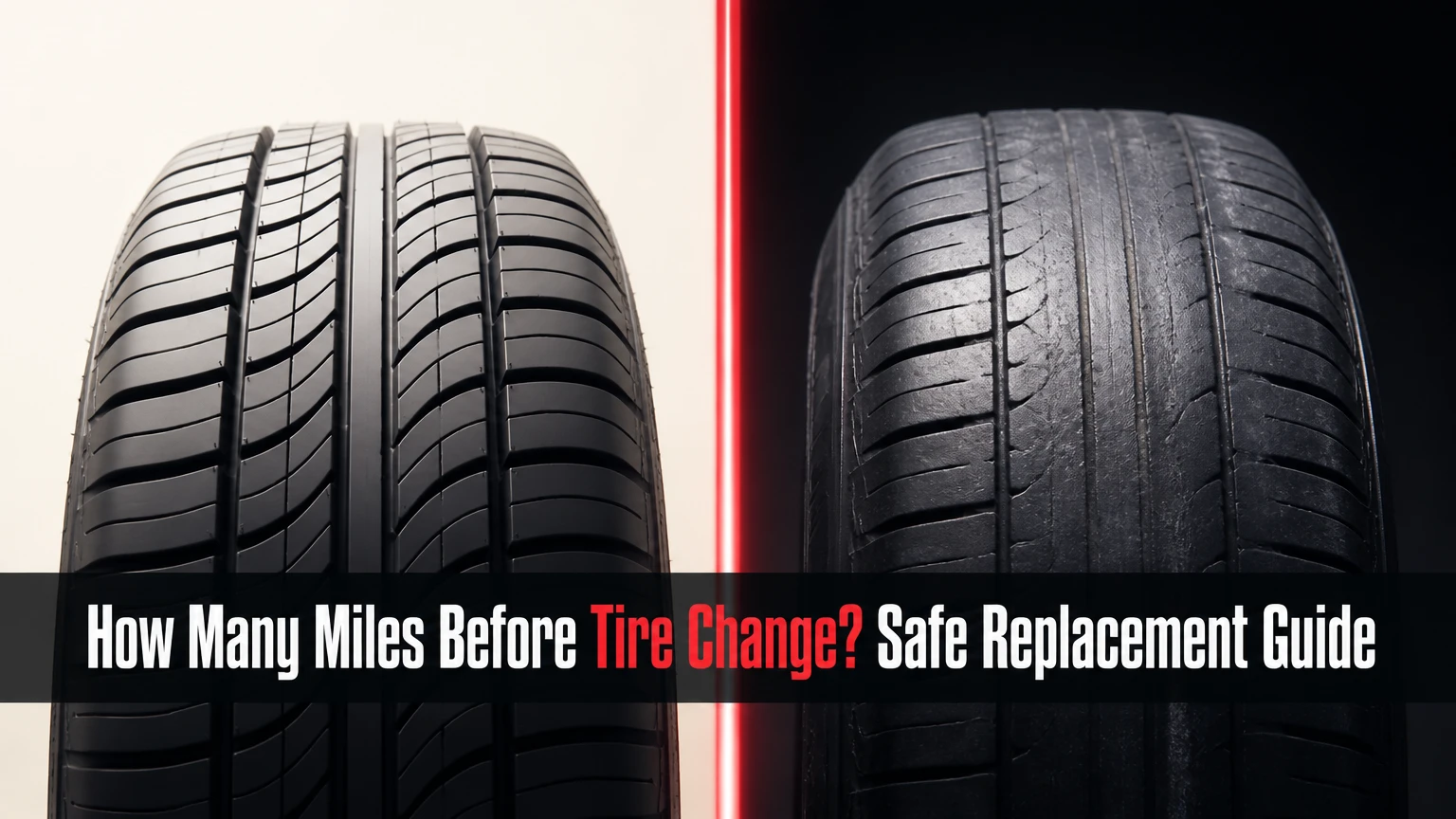
A typical standard all-season tire lasts 40,000-60,000 miles, although touring tires may reach 70,000-80,000 miles and performance tires may wear out near 20,000-35,000 miles. The correct replacement point is the first limit reached: unsafe tread, age-related deterioration, damage, or the tire manufacturer’s service recommendation.
Mileage estimates assume correct inflation, regular rotation, sound alignment, moderate loads, and normal road surfaces. A front-wheel-drive sedan used for short city trips can wear its front tires faster than a rear-wheel-drive car used mainly on highways. Aggressive cornering, hard acceleration, emergency braking, gravel, potholes, and hot pavement also reduce usable mileage.
The mileage printed in a treadwear warranty is a conditional maximum, not a guaranteed service life. A tire advertised with an 80,000-mile warranty may receive a prorated adjustment if it fails early, but warranty coverage normally requires documented rotations, correct inflation, matching tire specifications, and compliance with the warranty terms.
Typical mileage by tire category
| Tire category | Typical usable mileage | Typical U.S. price per tire | Primary trade-off |
|---|---|---|---|
| Touring all-season | 60,000-80,000 miles | $120-$220 | Longer life, moderate snow and cornering grip |
| Standard all-season | 40,000-60,000 miles | $90-$180 | Balanced cost, comfort, and weather performance |
| Ultra-high-performance summer | 20,000-35,000 miles | $170-$350 | Strong dry grip, faster tread wear |
| Winter or snow | 25,000-40,000 miles | $120-$250 | Cold-weather traction, rapid warm-weather wear |
| Highway all-terrain | 40,000-60,000 miles | $170-$300 | Utility and durability, more noise and rolling resistance |
| Mud-terrain | 20,000-40,000 miles | $200-$400 | Off-road traction, poor highway tread longevity |
The same category can produce very different results. A premium touring tire on a properly aligned commuter vehicle may outlast an inexpensive all-season tire subjected to underinflation and frequent curb impacts.
Does Tire Age Matter More Than Mileage?
Tire age can require replacement even when tread remains deep, because rubber compounds harden and structural materials deteriorate through heat, oxygen, ozone, ultraviolet exposure, and repeated flexing. A low-mileage vehicle stored outdoors can therefore need tires before a high-mileage vehicle with newer, well-maintained rubber.
Find the DOT code on the sidewall. The final four digits show the production week and year: 3423 means the 34th week of 2023. The code may appear on only one sidewall, so inspect both sides if necessary.
NHTSA’s tire-aging research describes the process directly: “Tire aging is a complex phenomenon.” That complexity explains why a single age number cannot replace a physical inspection. Temperature, inflation, storage, load, and construction affect how quickly a tire loses flexibility.
NHTSA does not establish a universal rule that every tire must be replaced at six years. Several manufacturers recommend professional inspection after five years in service and replacement at ten years from manufacture, while some brands or vehicle manufacturers specify shorter periods. Read the tire warranty and vehicle owner’s manual, then treat visible aging as an immediate condition issue rather than waiting for a calendar threshold.
Age-related replacement signals
Replace or professionally evaluate an aging tire when it has:
- Circumferential cracks between tread blocks or on the sidewall.
- Deep ozone cracks that open when the sidewall flexes.
- A hardened, glossy tread surface with reduced flexibility.
- Bulges, bubbles, exposed cords, or separation between tread layers.
- Repeated pressure loss without a repairable puncture.
- A production date beyond the tire maker’s stated maximum service age.
A tire’s manufacture date is not the same as its installation date. A tire manufactured in 2021 and installed in 2023 is already two years old when it enters service.
What Tread Depth Means Replacement Time?
Replace a passenger tire at or below 2/32 inch of remaining tread because that is the common U.S. legal bald-tire threshold, but do not treat 2/32 inch as a recommended target for every road condition. Wet braking and hydroplaning resistance usually deteriorate before the legal limit, particularly when the tread is uneven or the rubber has aged.
The most accurate home check uses a tread-depth gauge costing roughly $5-$15. Measure the main grooves at the inner, center, and outer tread areas, and repeat at several positions around the tire. Record the lowest reading, because one worn section can indicate a mechanical problem even when the average tread appears acceptable.
| Measured tread depth | Practical interpretation | Recommended action |
|---|---|---|
| 8/32 inch or more | New to moderately worn tread | Maintain pressure and rotation schedule |
| 6/32-7/32 inch | Normal serviceable range | Monitor wear pattern and plan ahead |
| 4/32-5/32 inch | Reduced wet-weather margin | Consider replacement before heavy rain or winter |
| 3/32 inch | Near end of useful service | Schedule replacement soon |
| 2/32 inch or less | Common legal bald-tire threshold | Replace immediately |
| Wear bars flush with tread | Tread has reached molded indicators | Replace immediately |
Tread-wear indicator bars are molded across the longitudinal grooves. When the surrounding tread is level with those bars, the tire has reached approximately 2/32 inch. The penny test can identify a severely worn tire, but a coin cannot measure 4/32 or 5/32 inch accurately and should not replace a gauge.
A tire can fail before its tread reaches the wear bars. A puncture in the sidewall, tread separation, or internal impact damage is a structural failure, not a tread-depth problem.
How Does Tire Type Change Mileage?
Tire construction and rubber compound determine much of the mileage difference. Long-wearing touring tires use compounds and tread designs optimized for steady highway service, while summer performance tires use softer compounds that trade tread life for cornering and braking grip.
Winter tires wear rapidly on warm pavement because their flexible cold-weather compound becomes too soft at moderate temperatures. The often-cited 45°F changeover point is a useful rule for many winter tires, but the tire manufacturer’s temperature guidance should take priority. Using snow tires through a hot summer can remove thousands of miles of expected life.
| Driving pattern | Best-fitting tire type | Expected mileage pattern | Main replacement risk |
|---|---|---|---|
| 70% highway commuting | Touring all-season | 60,000-80,000 miles | Aging before tread wears out |
| Short urban trips | Standard all-season | 35,000-55,000 miles | Curb strikes, braking, underinflation |
| Spirited dry-road driving | Performance summer | 20,000-35,000 miles | Soft-compound shoulder wear |
| Frequent snow and ice | Dedicated winter | 25,000-40,000 miles | Warm-weather tread degradation |
| Paved roads with occasional trails | Highway all-terrain | 40,000-60,000 miles | Uneven wear and alignment damage |
| Heavy towing or work loads | Load-rated truck tire | 30,000-55,000 miles | Heat, overload, and shoulder wear |
All-season does not mean every-season. A three-peak mountain snowflake tire meets a defined severe-snow performance requirement, while an ordinary all-season tire may be inadequate on ice or deep snow.
How Much Does a Tire Change Cost?
Replacing four passenger tires typically costs about $500-$1,400 in the United States, including common mounting and balancing charges but excluding unusual taxes, alignment work, road-hazard coverage, or specialty sizes. One tire commonly costs $90-$350 before installation, depending on size, brand, speed rating, load rating, and category.
| Replacement job | Typical tire cost | Typical service cost | Typical total |
|---|---|---|---|
| One standard all-season tire | $90-$180 | $25-$60 | $115-$240 |
| Two matched passenger tires | $180-$360 | $50-$120 | $230-$480 |
| Four touring all-season tires | $480-$880 | $100-$220 | $580-$1,100 |
| Four performance or truck tires | $680-$1,400 | $120-$280 | $800-$1,680 |
| Four tires plus alignment | $480-$1,400 | $180-$450 | $660-$1,850 |
A tire replacement appointment usually takes 45-90 minutes for four tires when the shop has the correct inventory. An alignment may add 60-120 minutes. TPMS sensor replacement, seized wheel hardware, run-flat tires, and oversized wheels can increase both time and price.
Compare the installed price, not only the tire’s shelf price. Installation may include valve stems, balancing, disposal, TPMS service, taxes, and a road-hazard plan.
Can You Replace Only One or Two Tires?
Replacing one tire is acceptable only when the replacement matches the existing tires closely in size, construction, model, speed rating, and tread depth, and the vehicle manufacturer permits that arrangement. Replacing two tires is more common, but the newer pair should generally be installed on the rear axle, including on front-wheel-drive vehicles, to reduce the risk of rear loss of traction on wet roads.
The exact rule changes for all-wheel-drive vehicles. Some AWD systems allow only a small rolling-circumference difference, often around 2/32-4/32 inch of tread depth, while others require all four tires to match closely. Subaru, Audi, BMW, and other manufacturers publish model-specific limits. A tire shop should measure all four tires before an AWD replacement.
| Situation | Usually acceptable solution | Important constraint |
|---|---|---|
| One punctured tire, same model available | Replace one | Match tread depth and construction |
| Two worn tires on a two-wheel-drive car | Replace two | Install newer pair on rear axle |
| AWD vehicle with one damaged tire | Match all four or manufacturer-approved solution | Check circumference tolerance |
| Different tire brands on one axle | Avoid when possible | Match size, rating, and tread design |
| Front and rear staggered sizes | Replace by axle or full set | Do not rotate unless vehicle permits |
| Tire with sidewall damage | Replace, not patch | Sidewall repairs are unsafe |
Mixing a summer tire with an all-season tire on the same axle can change braking and steering behavior. Mixing tire models is sometimes unavoidable, but four matching tires provide the most predictable handling.
How Can You Extend Tire Life?
Correct cold inflation pressure and routine rotation produce the largest controllable mileage gains. Use the pressure printed on the driver-door placard or in the owner’s manual, not the maximum pressure molded into the sidewall; the sidewall number is a component limit, not the vehicle’s recommended setting.
Check pressure monthly and before long trips, when the tires are cold. Rotate according to the vehicle manual, commonly every 5,000-8,000 miles, and inspect alignment whenever a tire develops one-sided wear or the steering wheel is off-center.
Maintenance practices that preserve tread
- Check cold pressure monthly. A 3-5 PSI loss can increase heat and shoulder wear, although the exact mileage penalty varies by tire and vehicle.
- Rotate on schedule. Front tires often wear faster on front-wheel-drive cars because they steer, brake, and transmit engine torque.
- Align after impact damage. A pothole can alter toe or camber without producing an obvious pull.
- Balance tires after vibration begins. Wheel imbalance creates repeated vertical loading and can contribute to cupping.
- Use the correct load rating. Overloading raises carcass temperature and accelerates structural deterioration.
- Store seasonal tires cool and dry. Keep them away from sunlight, ozone-producing electric motors, solvents, and standing water.
- Drive gently during the first several hundred miles. New tires need a short break-in period for tread surfaces and mold-release residues to stabilize.
A tire rotation cannot correct a worn suspension component. If cupping returns after rotation, inspect shocks, struts, bushings, wheel bearings, and balance rather than repeatedly moving the tires.
What Causes Uneven Tire Wear?
Uneven tire wear usually identifies a maintenance or suspension problem, so replacing the tire without fixing the cause often destroys the replacement quickly. Read the wear pattern across the tread, then verify pressure, alignment angles, wheel balance, and suspension condition.
| Wear pattern | Most likely cause | Corrective action |
|---|---|---|
| Both outer shoulders worn | Underinflation or heavy cornering | Set placard pressure; inspect alignment |
| Center rib worn | Overinflation | Correct cold pressure; inspect pressure history |
| One inner or outer edge worn | Camber or toe misalignment | Perform four-wheel alignment |
| Repeating scallops or cups | Imbalance, worn shocks, or suspension play | Balance wheel; inspect suspension |
| Diagonal tread depressions | Toe error or rotation issue | Measure alignment and rotate correctly |
| Single flat spot | Locked-wheel braking or severe imbalance | Inspect tire and braking system |
| Tread feathering | Excessive toe angle | Correct alignment before replacement |
Replace a tire immediately for a sidewall bulge, exposed steel or textile cord, tread separation, a cut reaching the internal structure, or damage caused by driving while severely underinflated. A nail in the central tread area may be repairable if the puncture is small and the tire was not driven flat, but the decision requires an internal inspection after removal.
What Changes for EVs, AWD Cars, and Low-Mileage Vehicles?
Electric vehicles can wear tires faster than comparable gasoline cars because battery mass increases vehicle weight and instant motor torque can produce rapid acceleration. EV-specific tires may use reinforced construction, acoustic foam, and low rolling resistance compounds, so the vehicle placard and tire maker’s load and pressure specifications matter more than a generic mileage estimate.
AWD cars require closer matching among all four tires because different rolling circumferences can make the center differential or clutch pack compensate continuously. That heat and slip can create drivetrain wear. Follow the owner’s manual before replacing fewer than four tires.
Low-mileage vehicles face an opposite problem: age may end tire service before mileage does. A car driven 3,000 miles annually can still have ten-year-old tires with substantial tread, but parked storage does not stop oxidation. Inspect the sidewalls, tread grooves, valve area, and spare tire every year.
Expert rules of thumb
- The lowest tire measurement controls the decision. An average of 5/32 inch cannot make one tire with a 2/32-inch shoulder safe.
- Rear-axle traction matters more than familiar steering feel. Drivers often want new tires on the front because worn front tires are visible, but new tires on the rear generally reduce oversteer risk in rain.
- A warranty number is a selection clue, not a forecast. A high UTQG treadwear rating can help compare tires within the same brand and category, but UTQG numbers are not directly comparable across manufacturers.
- Tire age begins at manufacture. Buying a discounted tire with an old DOT code can reduce the time available before age-related replacement.
- A vibration is a symptom, not a normal tire characteristic. Persistent vibration after balancing may indicate a bent wheel, belt separation, radial-force variation, or suspension damage.
How Do You Decide Whether to Change Tires Now?
Use mileage as a planning signal, then make the final decision from tread depth, tire age, damage, wear pattern, and vehicle requirements. A tire at 50,000 miles with 5/32 inch of even tread and no damage may remain serviceable, while a tire at 18,000 miles with a bulge or severe shoulder wear requires replacement.
Inspect all four tires monthly. Measure tread depth before winter travel, before a long road trip, and whenever the vehicle develops pulling, vibration, noise, or pressure loss.
A practical decision sequence is:
- Read the DOT date code and compare it with the tire manufacturer’s age guidance.
- Measure tread depth at multiple points across each tire.
- Inspect sidewalls, tread blocks, bead areas, and repair history.
- Compare tread depths across axles, especially on AWD vehicles.
- Diagnose uneven wear before fitting replacement tires.
- Confirm the replacement tire’s size, load index, speed rating, and seasonal suitability.
- Replace the appropriate axle or complete set according to the vehicle manual.
The correct answer to how many miles before tire change is therefore a range, not a fixed odometer number. Plan for inspection around 40,000 miles, but replace when condition, age, tread, damage, or manufacturer guidance reaches its limit first.
Frequently Asked Questions
Can tires last 80,000 miles?
Some premium touring all-season tires can approach 80,000 miles under favorable conditions, including correct pressure, regular rotations, mild driving, and good alignment. An 80,000-mile warranty does not guarantee 80,000 miles of safe service. Tread depth, age, cracking, punctures, and the vehicle’s maintenance history still determine replacement.
Should I replace tires at five years?
Five years is a sensible point for annual professional inspections, not an automatic replacement date for every tire. Several manufacturers advise inspection after five years in service, while many recommend replacement by ten years from manufacture. Replace sooner if cracking, hardening, bulges, separation, or repeated air loss appears.
How often should tires be rotated?
Most vehicles require tire rotation every 5,000-8,000 miles, but the owner’s manual provides the controlling interval and rotation pattern. Directional tires, staggered tire sizes, and some performance vehicles cannot use a conventional front-to-rear pattern. Record each rotation because warranty claims may require maintenance documentation.
Is the penny test accurate enough?
The penny test can reveal tread near the common 2/32-inch limit, but it cannot measure intermediate depths accurately. A $5-$15 tread-depth gauge gives a better result and reveals differences between the center and shoulders. Use a professional inspection when tread wear is uneven, the tire is old, or damage is visible.
Are used tires safe to buy?
Used tires can be safe only when their age, tread depth, repair history, load rating, and structural condition are verified. Avoid tires with sidewall repairs, exposed cords, irregular bulges, severe cracking, or unknown storage history. A low price does not compensate for an undocumented tire that may already be near its service-age limit.
Do front tires wear faster than rear tires?
Front tires often wear faster on front-wheel-drive vehicles because they handle steering, braking, and engine torque. Rear tires can wear faster on some rear-wheel-drive vehicles or when alignment is incorrect. Rotation equalizes wear only when performed on schedule and when the suspension and tire pressures are correct.