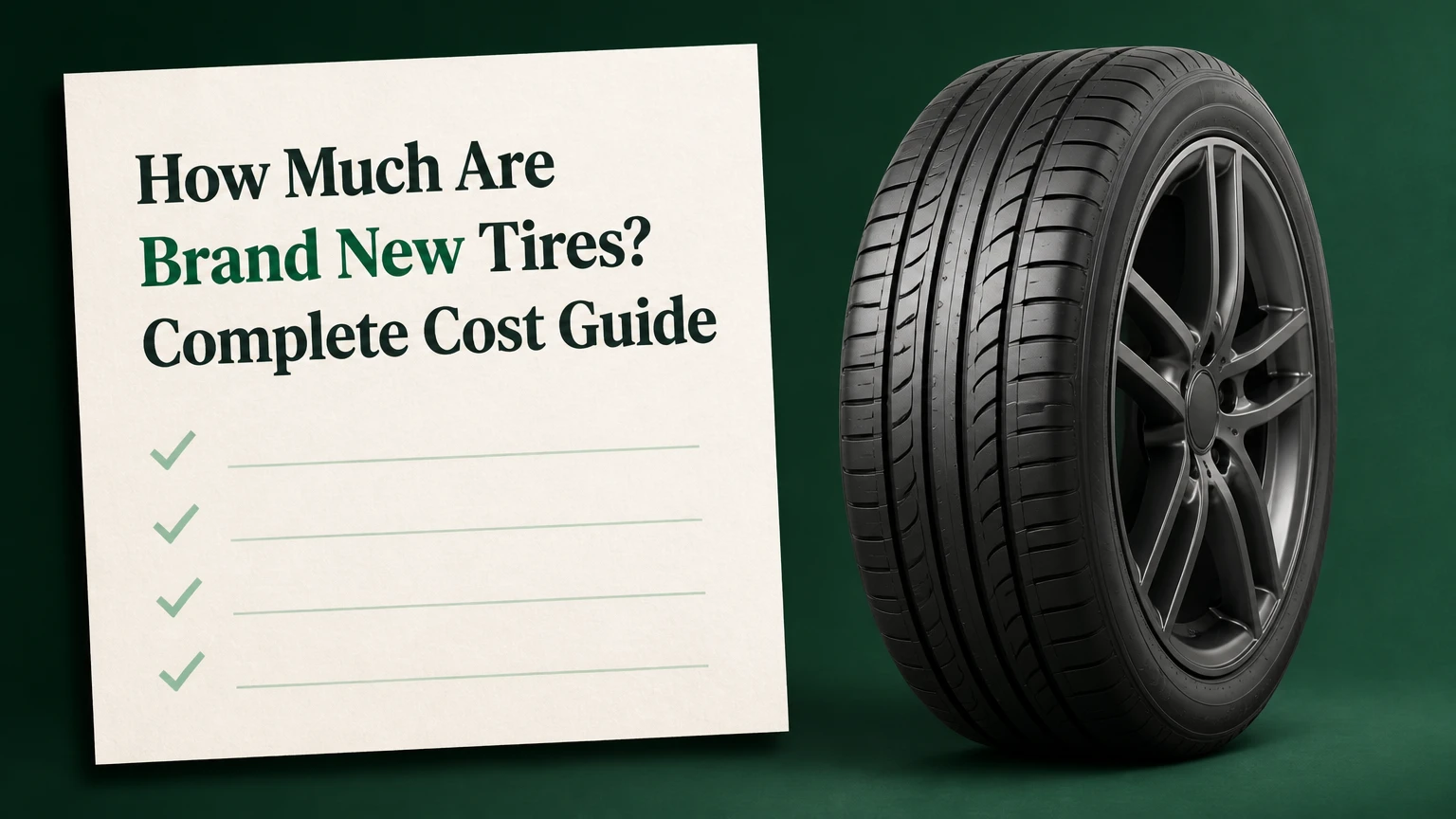
Brand new tires typically cost $80-$250 each for an ordinary passenger car, or about $450-$1,200 for a set of four after basic installation. Larger SUV, truck, run-flat, all-terrain, and performance tires commonly raise the installed total to $800-$2,500 or more, depending on size, brand, load rating, and service fees.
Key Facts at a Glance
- A standard passenger tire commonly costs $80-$250 before installation.
- Four installed car tires commonly total $450-$1,200.
- SUV and truck tires often cost $150-$450 each.
- Mounting and balancing may add about $15-$50 per tire.
- An alignment is a separate service and is not required after every tire installation.
- The correct tire size, load index, and speed rating matter more than finding the lowest advertised price.
How Much Are Brand New Tires in 2026?
Most drivers should budget $450-$1,200 for four new passenger-car tires installed, although compact-car budget tires can cost less and premium or specialized tires can cost considerably more. Tire diameter, vehicle weight, performance requirements, brand tier, warranty, and local labor rates determine where the final invoice falls.
The advertised tire price is only the starting point. Your receipt can also include mounting, computer balancing, valve stems or tire-pressure monitoring system service kits, old-tire disposal, state tire fees, sales tax, road-hazard coverage, and an alignment when the vehicle actually needs one.
Typical New-Tire Prices by Vehicle
| Vehicle or tire category | Tire-only price each | Four tires before service | Typical installed total |
| Subcompact or compact car | $70-$170 | $280-$680 | $380-$850 |
| Midsize sedan | $90-$230 | $360-$920 | $470-$1,100 |
| Crossover or small SUV | $120-$300 | $480-$1,200 | $600-$1,450 |
| Large SUV or pickup | $170-$450 | $680-$1,800 | $820-$2,100 |
| Performance car | $200-$600 | $800-$2,400 | $950-$2,700 |
| Run-flat-equipped vehicle | $180-$500 | $720-$2,000 | $850-$2,300 |
| All-terrain truck | $190-$500 | $760-$2,000 | $900-$2,400 |
| Electric vehicle fitment | $150-$450 | $600-$1,800 | $750-$2,100 |
These are typical U.S. budgeting ranges rather than fixed national prices. Retail inventory, local competition, wheel diameter, speed rating, extra-load construction, and manufacturer rebates can move a quote significantly.
What Does a Set of Four New Tires Really Cost?
A realistic out-the-door estimate for four ordinary car tires is about $500-$1,100, including standard mounting and balancing. A low advertised set price can become noticeably higher once installation packages, taxes, recycling charges, TPMS parts, and optional protection plans appear on the invoice.
Some tire retailers combine mounting, balancing, disposal, valve service, rotations, rebalancing, inspections, and flat repair into one installation charge. Others list each item separately. Discount Tire, for example, states that its installation package includes mounting-related labor, required valve or TPMS parts, and life-of-tire services such as rotations and rebalancing.
Example Out-the-Door Tire Budgets
| Example purchase | Tire subtotal | Services and fees | Estimated final cost |
| Four budget 16-inch car tires | $360 | $100-$180 | $460-$540 |
| Four mid-range 17-inch sedan tires | $640 | $120-$220 | $760-$860 |
| Four premium 18-inch crossover tires | $1,000 | $140-$260 | $1,140-$1,260 |
| Four all-terrain pickup tires | $1,400 | $180-$320 | $1,580-$1,720 |
| Four performance run-flat tires | $1,800 | $180-$350 | $1,980-$2,150 |
Ask the seller for an out-the-door quote for four installed tires. That wording makes it harder to compare a tire-only online price with a fully installed local-shop estimate.
Which Extra Charges Appear on a Tire Invoice?
Mounting, balancing, disposal, taxes, and valve or TPMS service are the most common additions. An alignment, road-hazard plan, lug hardware, wheel repair, and suspension work should appear only when purchased or required.
Common Tire Installation Costs
| Charge | Typical amount | When it applies |
| Mounting and balancing | $15-$50 per tire | Almost every loose-tire installation |
| Rubber valve stem | $2-$8 per wheel | Vehicles without reusable metal TPMS stems |
| TPMS service kit | $5-$20 per wheel | Rebuilding seals, nuts, cores, or washers |
| Old-tire disposal | $2-$10 per tire | When the shop keeps the removed tires |
| State tire or recycling fee | $1-$5 per tire | Depends on state law |
| Road-hazard plan | About 10%-20% of tire price | Optional damage protection |
| Two-wheel alignment | $50-$100 | Certain older or limited-adjustment vehicles |
| Four-wheel alignment | $100-$200 | Many modern cars, SUVs, and trucks |
| Wheel repair | $75-$200+ per wheel | Bent, cracked, or damaged wheel |
| Sales tax | Varies by location | Applied according to local rules |
Published alignment estimates commonly place two-wheel service around $50-$100 and four-wheel service around $100-$200, though luxury vehicles, modified suspensions, and seized adjustment hardware can cost more.
Why Do Some New Tires Cost So Much More?
Tire price rises when the product requires more material, stronger internal construction, advanced compounds, higher speed capability, greater load capacity, lower noise, specialized winter traction, or reinforced run-flat sidewalls. Large-diameter tires also cost more because fewer low-cost models may be available in those sizes.
Brand name alone does not explain the entire difference. Two tires in the same size may target different outcomes. One may emphasize long tread life and ride comfort, while another uses a softer compound for shorter braking distances and sharper handling.
Major Price Factors
- Wheel diameter: An 18-inch, 20-inch, or 22-inch tire generally costs more than a common 15-inch or 16-inch fitment.
- Width and profile: Wide, low-profile tires require specialized construction and have fewer budget options.
- Load index: Trucks, large SUVs, commercial vans, and towing vehicles require higher load capacity.
- Speed rating: High-performance ratings can increase compound and construction costs.
- Tire category: Winter, run-flat, all-terrain, mud-terrain, and high-performance tires often cost more than standard touring tires.
- Warranty coverage: Longer mileage warranties and bundled maintenance may increase the initial price.
- Vehicle-specific engineering: Some replacement tires are optimized for EV weight, noise, rolling resistance, or original-equipment specifications.
How Does Tire Type Affect the Price?
A standard touring all-season tire is usually the least expensive practical option for normal commuting. Winter, all-weather, summer-performance, all-terrain, mud-terrain, and run-flat tires cost more when their specialized construction or compound adds measurable capability.
| Tire type | Typical price each | Common use | Main limitation |
| Touring all-season | $80-$250 | Daily commuting and highway use | Limited severe-snow performance |
| All-weather, 3PMSF-rated | $110-$300 | Year-round driving with occasional snow | Usually costs more than basic all-season |
| Dedicated winter | $100-$350 | Repeated freezing, snow, and ice | Wears faster in warm weather |
| Summer performance | $140-$500 | Warm-weather wet and dry grip | Unsuitable for freezing conditions |
| All-terrain | $170-$450 | Pavement, gravel, dirt, light trails | More road noise and rolling resistance |
| Mud-terrain | $220-$600 | Deep mud and aggressive off-road use | Noise, weight, and faster street wear |
| Run-flat | $180-$500 | Vehicles designed without a conventional spare | Firmer ride and higher replacement cost |
A tire should match the environment in which it will be used. Paying extra for mud-terrain construction on a highway-only truck adds noise and weight without providing much daily value. Conversely, buying ordinary all-season tires for repeated snow and ice may save money at checkout but sacrifice cold-weather traction.
Does Tire Size Change the Cost?
Yes. Tire size can change the price by hundreds of dollars per set, even when the vehicle and brand remain similar. Larger rim diameters, wider tread sections, lower sidewalls, higher load indexes, and uncommon fitments tend to reduce the number of inexpensive choices.
A sidewall code such as P225/50R17 94V identifies the tire’s class, width, sidewall proportion, construction, wheel diameter, load index, and speed rating.
- P: Passenger-vehicle classification
- 225: Approximate section width in millimeters
- 50: Sidewall height equals 50% of the section width
- R: Radial construction
- 17: Fits a 17-inch wheel
- 94: Load index
- V: Speed rating
Replacement tires should match the vehicle manufacturer’s approved size and should not have a lower load-carrying capacity. USTMA advises drivers to use the tire-information label or owner’s manual rather than guessing from appearance.
Should You Buy the Cheapest Brand New Tires?
The cheapest tire can be reasonable for a low-mileage secondary vehicle, but price alone is a poor selection method. Compare wet braking, expected tread life, warranty terms, noise, ride quality, retailer support, and the annual mileage you expect to drive.
A $90 tire that lasts 30,000 miles costs 0.30 cents per mile of tread purchase, while a $150 tire lasting 60,000 miles costs 0.25 cents per mile. The more expensive tire produces the lower tire cost per mile before installation.
That calculation is not a complete safety comparison, but it exposes a common buying mistake. Low purchase price and low lifetime cost are not the same thing.
Where Budget Tires Make Sense
Budget tires may be suitable when:
- The vehicle covers limited annual mileage.
- The climate is moderate.
- The driver does not require high-performance handling.
- The tire comes from a traceable manufacturer.
- A reputable installer supports the product.
- The tire meets the vehicle’s size, load, and speed requirements.
Avoid an unknown tire simply because it is the lowest listing. A warranty has limited practical value when the brand lacks a dependable dealer network or replacement inventory.
Should You Replace Two Tires or All Four?
Replacing all four tires gives the most consistent grip, handling, and water evacuation. When only two tires are replaced, USTMA recommends placing the new pair on the rear axle because the deeper rear tread improves wet-road stability and reduces the risk of oversteer.
On an all-wheel-drive vehicle, tread-depth differences can create additional concerns. Some manufacturers specify a maximum allowable difference in circumference or tread depth between tires. Check the owner’s manual before installing one or two tires, especially when the remaining pair is substantially worn.
Replacement Quantity Guide
| Situation | Likely purchase | Important condition |
| Four tires evenly worn | Four tires | Best handling consistency |
| Two tires worn, two still serviceable | Two tires | Install new pair on rear axle |
| One tire damaged, others nearly new | One tire may work | Match model, size, and tread depth closely |
| AWD vehicle with large tread difference | Often four tires | Follow manufacturer tolerance |
| One axle has a different tire type | Correct the mismatch | Maintain compatible categories |
| Staggered performance setup | Replace by axle | Front and rear sizes may differ intentionally |
“Don’t guess” is USTMA’s direct advice when determining replacement specifications.
Do New Tires Always Require an Alignment?
No. New tires do not automatically require an alignment, because mounting tires does not change suspension geometry. An alignment is justified when the car pulls, the steering wheel sits off-center, the old tires show uneven wear, suspension components were replaced, or the vehicle recently hit a curb or major pothole.
Balancing and alignment solve different problems. Balancing corrects weight distribution around each rotating wheel and tire assembly. Alignment adjusts suspension angles that control how the wheels point relative to the vehicle and road.
Buying an alignment with new tires can protect the investment when evidence of misalignment exists. Buying one automatically, without checking the old wear pattern or measuring the vehicle, may be unnecessary.
How Long Does New-Tire Installation Take?
Installing four ordinary tires commonly takes 45-90 minutes of shop time after the vehicle enters the service bay. A busy waiting room, wheel damage, seized lug nuts, TPMS problems, alignment work, or specialty wheels can extend the appointment.
The tires themselves may require additional ordering time. Common sizes can be available the same day, while uncommon, performance, or specialty truck sizes may require several days. Some retailers advertise same-day or next-day installation for locally available inventory.
Schedule enough time for a final inspection and torque check. Before leaving, confirm that the invoice lists the installed size and that the shop returned any wheel-lock key or removed hardware.
How Can You Tell Whether New Tires Are Actually Fresh?
Check the four-digit DOT date code near the end of the Tire Identification Number. The first two digits identify the manufacturing week, and the last two identify the year. A code of 1826 means the tire was manufactured during the 18th week of 2026.
An unused tire does not need to have been manufactured during the current month to be legitimately sold as new. Storage conditions, retailer practices, warranty start date, and the tire manufacturer’s policies also matter.
NHTSA explains that tire components age because of time, storage, environmental conditions, sunlight, heat, and maintenance. The agency notes that some vehicle and tire manufacturers recommend replacement after six to ten years regardless of remaining tread.
Inspect all four installed tires rather than checking only one. Confirm that the dates are reasonably consistent and ask about older inventory before authorizing installation.
Where Is the Best Place to Buy New Tires?
The best seller is the one that offers the correct fitment, a competitive installed price, accessible warranty service, and useful aftercare. A cheap online listing may remain a good deal, but only after shipping, installation, disposal, and future rotation costs are included.
| Seller type | Typical advantage | Possible disadvantage |
| Independent tire shop | Flexible pricing and personal service | Smaller inventory |
| National tire chain | Broad network and lifetime services | Installation packages vary |
| Warehouse club | Competitive member pricing | Appointment availability |
| Online tire retailer | Large selection and easy comparison | Separate installer coordination |
| Vehicle dealership | Vehicle-specific familiarity | Often higher labor or tire pricing |
| General repair shop | Convenient with other repairs | Fewer tire brands or sizes |
Ask each seller the same five questions:
- What is the total price for four installed tires?
- Are mounting, balancing, disposal, and TPMS service included?
- Are rotations and rebalancing included later?
- How are warranty claims handled?
- Is road-hazard protection included or optional?
What Tire Warranty Are You Actually Buying?
Tire warranties are divided into several categories, and none guarantee that every damaged tire will be replaced free of charge. Read the mileage, time, maintenance, and documentation requirements before treating a warranty as a financial benefit.
A treadwear warranty may offer prorated credit when the tread wears out before the stated mileage. A workmanship and materials warranty addresses manufacturing defects. A road-hazard plan may cover punctures, impact damage, or non-repairable road damage, depending on exclusions.
Mileage warranties often require documented rotation, correct inflation, alignment maintenance, and even wear. Performance tires, original-equipment tires, staggered setups, commercial use, or improper maintenance may receive reduced or excluded coverage.
How Do You Save Money Without Buying the Wrong Tires?
The safest savings come from comparing complete installed quotes, choosing the right performance category, using manufacturer rebates, and avoiding features your driving does not require. Downsizing quality or load capacity is not an acceptable saving strategy.
Use this process:
- Read the vehicle’s door-jamb tire label.
- Record the approved size and pressure.
- Identify your climate and actual driving pattern.
- Compare three tires in the same category.
- Request installed prices from at least three sellers.
- Check current manufacturer rebates.
- Compare included rotations, balancing, and flat repair.
- Decline extras that do not fit your risk or driving needs.
- Keep the invoice and maintenance records.
Discount Tire notes that installation packages may include future rotations, rebalancing, flat repairs, inspections, and pressure checks. A slightly higher initial quote can therefore produce a lower ownership cost than a tire-only bargain with repeated service charges.
What Should You Check After Installation?
Check the installed size, inflation pressure, DOT dates, valve caps, lug-nut condition, and warning lights before treating the job as complete. The pressure should follow the vehicle placard, not simply the maximum pressure molded onto the tire sidewall.
Drive conservatively at first and pay attention to vibration, pulling, unusual noise, or a tire-pressure warning. Return promptly when the vehicle shakes at speed, because the assembly may need rebalancing or inspection.
The common claim that every new passenger tire requires exactly 500 miles of break-in is too broad. Break-in guidance varies by tire type and manufacturer. Michelin’s motorcycle guidance, for example, recommends progressively loading new tires and using moderate braking, acceleration, and cornering during the early rides rather than treating one fixed mileage as universal.
Expert Buying Insights
A Larger Wheel Can Increase Every Future Tire Bill
Optional wheels may look better, but moving from a common 17-inch fitment to an uncommon 20-inch low-profile fitment can increase replacement cost, reduce budget choices, and make impact damage more likely. Consider future tire prices before selecting an upgraded wheel package.
The Lowest Quote May Exclude Years of Maintenance
A retailer that includes rotations, rebalancing, pressure checks, and repairable puncture service may offer better total value than a seller charging less on installation day. Compare the ownership package, not only the tire subtotal.
Tire Category Matters More Than Brand Prestige
A highly rated summer tire remains the wrong product for freezing weather. A premium mud-terrain tire remains inefficient for a commuter that never leaves pavement. Choose the category first, then compare brands within that category.
Frequently Asked Questions
How much does one brand new tire cost?
One brand new passenger tire commonly costs $80-$250 before installation. Small budget tires may cost less, while run-flat, all-terrain, performance, EV-specific, truck, and oversized tires can cost $300-$600 or more each. Add mounting, balancing, disposal, taxes, and possible TPMS service to estimate the installed price.
Can I buy only one new tire?
You can buy one tire when the other three have similar tread depth and the replacement closely matches their size, model, construction, load index, and speed rating. A single new tire may be unsuitable when the remaining tires are significantly worn or the vehicle manufacturer limits tread-depth differences on AWD systems.
Are expensive tires always better?
Expensive tires are not automatically better for every driver. Higher prices may buy better wet grip, quieter operation, stronger high-speed capability, longer tread life, specialized winter traction, or retailer support. The best value is the tire that meets your vehicle specifications and driving conditions without charging for capability you will never use.
Is road-hazard coverage worth buying?
Road-hazard coverage is most useful for expensive low-profile tires, pothole-heavy roads, vehicles without a spare, and drivers who cannot comfortably absorb an unexpected replacement. It may be less valuable for inexpensive tires or plans with high prorated charges, exclusions, short coverage periods, or difficult claim procedures.
Do I need new valve stems with new tires?
Rubber snap-in valve stems are commonly replaced during tire installation because the part is inexpensive and ages with exposure. Vehicles with metal TPMS stems may need a service kit containing seals, washers, nuts, and valve cores rather than an entirely new sensor. Ask whether the required parts are included.
How often should new tires be rotated?
Follow the vehicle and tire manufacturer’s schedule, which commonly falls near normal maintenance intervals. Rotation patterns vary for front-wheel drive, rear-wheel drive, AWD, directional tires, staggered sizes, and vehicles using different front and rear fitments. Keep rotation records when a treadwear warranty requires proof.
The Bottom Line
How much are brand new tires? Most drivers will spend $80-$250 per tire or approximately $450-$1,200 for four ordinary passenger tires installed. Larger, stronger, performance-focused, run-flat, winter, EV, SUV, and truck tires can raise the total to $800-$2,500 or more.
Start with the vehicle’s required size, load index, and speed rating. Then compare complete installed quotes, warranty access, included maintenance, climate suitability, and expected tread life. The correct tire at a fair total price is safer and usually cheaper over time than the lowest advertised tire.