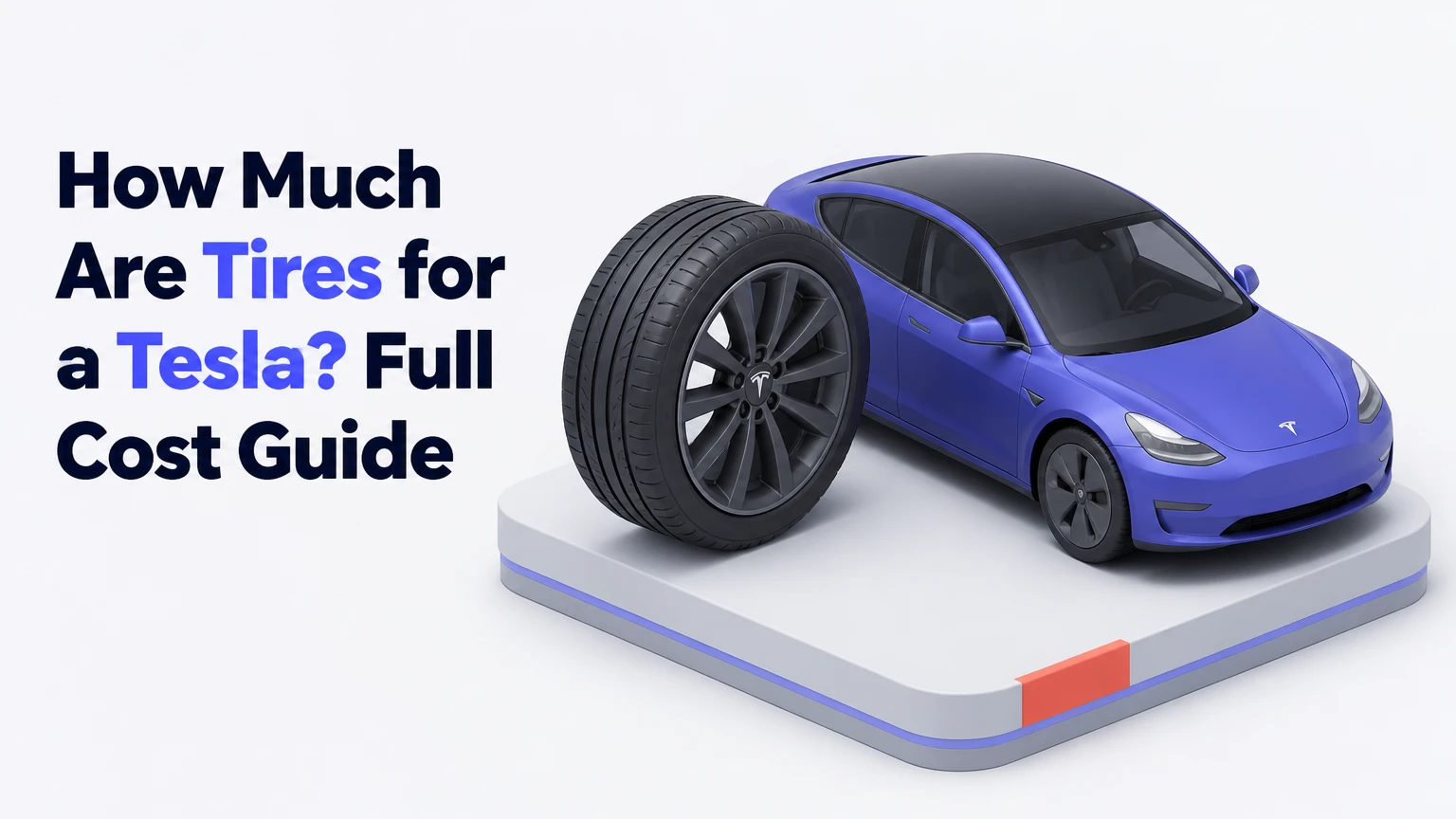
Tesla tires typically cost $230-$600 per tire, or about $1,000-$2,400 for four installed, before local tax and optional protection plans. Model 3 and Model Y owners with 18- or 19-inch wheels often spend $1,100-$1,700, while 21- or 22-inch Model S, Model X, and performance tires can exceed $2,000.
Key Facts at a Glance
- A Tesla tire replacement normally costs $250-$450 per tire, excluding or partly including installation depending on the retailer.
- A complete four-tire set commonly totals $1,100-$1,800 installed for Model 3 and Model Y vehicles.
- Large performance wheels, staggered fitments, winter tires, and premium compounds can push a set above $2,000.
- Tesla tires must match the door-jamb placard’s size, load index, speed rating, and inflation pressure.
- Tesla-marked T0, T1, or T2 tires may improve noise, efficiency, or ride quality, but a Tesla marking is not automatically required for every replacement.
- Typical service life is 20,000-40,000 miles, although alignment, inflation, acceleration, road surfaces, and tire compound can change that result substantially.
How Much Are Tires for a Tesla?
A Tesla tire costs approximately $230-$600, with the wheel diameter and tire category creating the largest price difference. Installation usually adds $20-$60 per tire, although mounting, balancing, valve service, and disposal may be bundled into the advertised price at Costco, Discount Tire, or a Tire Rack installer.
A practical budget for a Tesla owner looks like this:
| Replacement situation | Tire-only price | Typical installed total | Main cost driver |
|---|---|---|---|
| Model 3, 18-inch all-season set | $920-$1,200 | $1,050-$1,450 | Efficient touring compound |
| Model Y, 19-inch all-season set | $1,040-$1,400 | $1,200-$1,650 | XL load construction |
| Model 3 or Y, 20-inch performance set | $1,300-$1,800 | $1,450-$2,050 | Low-profile performance tread |
| Model S or X, 21-inch premium set | $1,600-$2,200 | $1,800-$2,500 | Large wheel and speed rating |
| Winter tire and wheel package | $1,600-$3,000 | $1,700-$3,200 | Four tires, wheels, sensors, storage |
These are typical United States retail ranges, not a quote. Brand, region, promotions, tire availability, and tax can move the final invoice by several hundred dollars. A tire advertised at $280 may become $330-$370 after mounting, balancing, disposal, TPMS service, and road-hazard coverage.
What Does Each Tesla Model Cost?
Model 3 and Model Y tires generally offer the lowest replacement cost because their common 18- and 19-inch sizes have wider retail availability. Model S and Model X tires cost more because their larger wheels, higher load requirements, and performance fitments reduce the number of suitable products.
| Tesla model and wheel | Typical size examples | Price per tire | Four installed, typical |
|---|---|---|---|
| Model 3 Aero, 18-inch | 235/45R18 | $230-$300 | $1,050-$1,450 |
| Model 3 Sport, 19-inch | 235/40R19 | $280-$370 | $1,250-$1,700 |
| Model 3 Performance, 20-inch | 235/35R20 front, 275/30R20 rear | $350-$500 | $1,550-$2,200 |
| Model Y Gemini, 19-inch | 255/45R19 | $260-$340 | $1,200-$1,600 |
| Model Y Induction, 20-inch | 255/40R20 | $320-$430 | $1,400-$1,950 |
| Model Y Performance, 21-inch | 255/35R21 front, 275/35R21 rear | $400-$600 | $1,750-$2,500 |
| Model S, 19- or 21-inch | Vehicle-specific | $300-$550 | $1,400-$2,400 |
| Model X, 20- or 22-inch | Vehicle-specific | $350-$650 | $1,600-$2,800 |
The examples are not interchangeable across model years. Tesla has changed tire dimensions, wheel designs, load indexes, and staggered configurations over time, so the driver’s door placard and Tesla’s current fitment information take priority over a generic online chart.
Do Teslas Need Special Tires?
Teslas do not require a separate tire category in every case, but they do require tires that meet the vehicle’s specified dimensions, load index, speed rating, and pressure requirements. EV-oriented tires and Tesla-marked tires can improve efficiency, noise, and load performance, yet “EV tire” on a product page does not replace checking the vehicle specification.
Why Are Tesla Tires More Expensive?
Tesla vehicles place greater demands on tires because battery mass increases curb weight and electric motors deliver immediate torque. The resulting loads can accelerate tread wear, especially when a driver makes frequent hard launches or carries heavy cargo.
The main attributes are:
- Extra-load construction: Many Tesla applications use an XL tire, but the exact load index on the placard matters more than the letters XL alone.
- Low rolling resistance: Efficient compounds can reduce energy loss and support driving range, sometimes with a firmer ride or less ultimate cornering grip.
- Acoustic foam: Some original-equipment tires contain an inner polyurethane foam insert that reduces cavity resonance. Foam is not a structural requirement.
- High speed rating: Performance Tesla variants may specify W- or Y-rated tires, which are not equivalent to lower-rated touring products.
- Rigid sidewalls: Low-profile tires resist cornering deformation but transmit more impact harshness and are more vulnerable to pothole damage.
Michelin’s electric-mobility guidance identifies weight, torque, noise, and rolling resistance as important EV tire selection factors. That guidance supports choosing by the complete specification rather than by price alone.
What Do T0, T1, and T2 Mean?
T0, T1, and T2 markings identify Tesla-specific homologation versions developed with a tire manufacturer. The markings can indicate a tuned combination of noise control, rolling resistance, handling, and load behavior, but they do not form a universal ranking in which T2 is always better for every Tesla.
A Tesla-marked tire is most useful when the owner wants the original ride and efficiency characteristics. A non-marked tire can still be appropriate when it matches the required dimensions and ratings and has acceptable noise, wet braking, and load performance.
Which Tire Type Should You Choose?
Choose a touring or EV-focused all-season tire for commuting, a performance summer tire for maximum warm-weather grip, and a three-peak mountain snowflake tire for regular severe snow. No single tire maximizes range, tread life, quietness, dry grip, and winter traction simultaneously.
| Driving priority | Suitable category | Example products | Main compromise |
|---|---|---|---|
| Range and quiet commuting | EV touring all-season | Hankook iON evo AS, Michelin Primacy | Less aggressive cornering |
| Balanced daily driving | Touring all-season | Continental ProContact RX, Pirelli P7 | Moderate snow capability |
| Dry and wet performance | Max-performance summer | Michelin Pilot Sport 4S | Faster wear and lower cold-weather safety |
| Occasional snow | All-weather, 3PMSF rated | Michelin CrossClimate 2 | More noise and rolling resistance |
| Budget replacement | Value all-season | Vredestein Quatrac Pro, Pirelli all-season variants | Product availability varies |
The Hankook iON evo AS is designed specifically around EV weight, noise, and efficiency goals. The Michelin Pilot Sport 4S prioritizes warm-weather grip instead and is a poor choice for frequent freezing temperatures. The Continental ExtremeContact DWS06 Plus can suit mixed-weather drivers, but its severe-snow certification and size availability should be checked for the exact Tesla fitment.
An expert rule of thumb is to compare the tire’s wet-braking rating, load index, tread warranty, and measured noise before comparing brand prestige. A cheaper tire that wears 10,000 miles sooner can cost more per mile than a premium tire.
Where Should You Buy and Install Tesla Tires?
Tesla Service offers the simplest vehicle-specific route, while independent tire retailers often reduce total cost and provide broader warranty options. The best installer is one that confirms the Tesla lift points, uses suitable pucks or adapters, follows the wheel torque specification, and can service the vehicle’s TPMS system.
| Service channel | Typical service cost | Strength | Limitation |
|---|---|---|---|
| Tesla Service or Mobile Service | $100-$250 labor-related total | Vehicle-specific convenience | Tire inventory and total price may be higher |
| Discount Tire or America’s Tire | $0-$200 after package pricing | Competitive pricing and road-hazard options | Quality depends on location and technician |
| Costco Tire Center | $80-$180 service-related total | Membership pricing and included services | Appointment delays can occur |
| Tire Rack installer | $80-$180 local installation | Broad online selection | Installer quality must be screened |
| Independent EV-capable shop | $100-$250 | Flexible diagnosis and alignment | Not every shop owns correct lift adapters |
Tesla Mobile Service can be convenient for some tire-related appointments, but mobile capability varies by job and location. A shop may sell a tire online and still lack the equipment or training to lift a Tesla safely, so ask that question before booking.
How Do You Confirm the Correct Tire?
Confirm the tire by reading the driver’s door-jamb placard and matching the complete marking, not merely the wheel diameter. A marking such as 235/45R18 98W XL contains the width, aspect ratio, construction, wheel diameter, load index, speed rating, and load construction.
Use this sequence:
- Photograph the door-jamb placard.
- Record front and rear sizes separately if the car has staggered wheels.
- Match the load index and speed rating or choose a higher approved rating.
- Check whether the tire is directional or has an asymmetric inside/outside requirement.
- Confirm winter clearance if using a separate wheel and tire package.
- Verify the product’s approved rim width and maximum load.
- Ask the retailer whether the tire is Tesla-marked, EV-specific, or a conventional replacement.
The letters XL alone do not prove that a tire is suitable. A tire can be XL yet have the wrong load index, speed rating, width, diameter, or axle application.
What Happens During Replacement?
A professional Tesla tire replacement normally takes 60-120 minutes for four tires, excluding an alignment or unusual TPMS diagnosis. The technician removes the wheels, mounts and balances the tires, inspects the wheels and brakes, checks inflation, verifies sensor operation, and tightens the wheel fasteners to the applicable Tesla specification.
What Should the Installer Check?
The installer should inspect the inner shoulder, bead area, valve stem, wheel lip, and tread for damage before returning the vehicle. Tesla’s low-profile performance tires can hide inner-edge wear that is not visible while the car sits on the ground.
Tesla owner manuals specify using the vehicle’s approved lift points and following the stated wheel-fastener torque. The torque value is not universal across every Tesla model, wheel, and production year, so a shop should use the current owner’s manual rather than a generic 129 lb-ft chart.
Tesla’s Model 3 Owner’s Manual states, “Always use a torque wrench to tighten the lug nuts to the specified torque.” The instruction matters because both under-tightening and over-tightening can damage wheel interfaces or compromise clamping force.
How Are TPMS Sensors Reset?
Direct TPMS-equipped Teslas generally relearn sensor information after driving, while newer configurations may use different sensor arrangements or software procedures. After installation, verify the tire pressures on the touchscreen and follow the vehicle’s displayed wheel or tire configuration instructions.
A practical checkpoint is a stable pressure reading after 10-20 minutes of driving above neighborhood speeds. A persistent warning requires sensor diagnosis, not repeated inflation guesses.
How Long Do Tesla Tires Last?
Tesla tires commonly last 20,000-40,000 miles, but mileage is only a rough planning range. A heavy Model Y driven aggressively may wear tires near the lower end, while a conservatively driven Model 3 on touring tires can exceed 40,000 miles under favorable alignment and road conditions.
| Wear factor | Typical effect | Inspection response |
|---|---|---|
| Hard acceleration | Rapid drive-axle tread loss | Measure tread every 3,000-5,000 miles |
| Low inflation | Shoulder wear and heat buildup | Check cold pressure monthly |
| Misalignment | Inner-edge or outer-edge wear | Request alignment readings |
| Performance compound | Strong grip with shorter life | Budget for earlier replacement |
| Uneven rotation schedule | Front/rear wear imbalance | Follow the tire manufacturer’s interval |
| Rough roads and potholes | Casing, wheel, and sidewall damage | Inspect after every severe impact |
Tesla guidance commonly recommends checking tire condition and pressure regularly, while rotation intervals depend on tread-depth difference and tire type. A fixed 6,250-mile interval can be useful for some setups, but staggered tires or directional tires may not permit ordinary front-to-rear rotation.
Replace a tire when tread reaches the legal wear indicator, when structural damage appears, or when an alignment problem has produced unsafe localized wear. Age, cracking, repeated repairs, and exposed cords can also require replacement before the tread is gone.
Can You Use Non-Tesla-Marked Tires?
You can use non-Tesla-marked tires if the tire meets the vehicle’s complete approved specification and performs acceptably for the intended conditions. Tesla-specific markings are a refinement, not a universal legal requirement.
A non-marked replacement may be sensible when it offers stronger wet braking, a longer tread warranty, better winter traction, or lower cost. The trade-off may include more cabin noise, a small efficiency difference, altered steering response, or a different ride feel.
Do not choose a tire solely because an online listing says “fits Tesla.” Confirm the exact size, load index, speed rating, axle position, and wheel compatibility.
What If Only One Tire Is Damaged?
Replace one Tesla tire only when the remaining tires have closely matched tread depth, model, size, and wear. If the damaged tire is significantly more worn, replacing the axle pair is usually safer and may preserve predictable handling and all-wheel-drive behavior.
For an all-wheel-drive Tesla, ask the tire manufacturer or Tesla Service about allowable tread-depth difference before installing a single new tire. A new tire beside a substantially worn tire changes rolling circumference and can affect traction-system behavior.
A repair may be preferable when the puncture is in the repairable central tread area, the tire has not been driven severely underinflated, and the puncture meets the repair shop’s safety standard. Sidewall and shoulder punctures generally require replacement. Acoustic foam does not automatically make a puncture unrepairable, but the technician may need to access or trim the foam around the repair area.
Why Do Tesla Tires Wear on the Inside?
Tesla tires often develop inner-edge wear because negative camber, toe alignment, heavy vehicle mass, and rear-drive torque concentrate load on the inside shoulder. Inner wear is a symptom to measure, not proof that every Tesla needs a fixed alignment change.
Inspect the inner shoulder with the wheel turned or the car raised safely. A smooth tread surface can conceal steel exposure or cords on the inside edge, particularly on Model S, Model X, and performance Model 3 or Model Y configurations.
Ask for a four-wheel alignment printout if wear returns after replacement. Correcting toe often matters more than simply rotating the tire, and suspension damage from a pothole can create a new alignment problem within a short distance.
What Should You Do About Foam Detachment?
A vibration after tire installation or at highway speed requires stopping to inspect the wheel and tire before assuming foam detachment. Detached acoustic foam can shift inside the casing and create an imbalance, but a bent wheel, missing balance weight, separated belt, or damaged tire can produce similar symptoms.
A qualified technician should remove the tire, inspect the casing, rebalance the assembly, and follow the tire manufacturer’s repair or replacement guidance. Do not cut out internal foam at home, and do not continue driving at speed with a new vibration.
What Are the Common Tesla Tire-Buying Mistakes?
The most expensive mistakes involve buying by wheel diameter alone, ignoring the load index, and selecting a tire for performance that conflicts with the climate. Four avoidable errors deserve special attention:
- Using a generic tire-size chart: Model year and trim can change the required fitment.
- Assuming XL is sufficient: XL does not replace the required load index or speed rating.
- Choosing summer tires for cold conditions: Summer compounds lose grip as temperatures fall, even before snow appears.
- Allowing an unprepared shop to lift the vehicle: The shop should identify approved lift points and use suitable adapters.
- Skipping alignment diagnosis: New tires cannot correct worn suspension or toe error.
- Comparing tire prices without installation: Mounting, balancing, disposal, taxes, and protection plans can change the final total.
One practitioner rule is to request the out-the-door price in writing. The quote should identify tire brand and model, size, load and speed rating, installation, balancing, TPMS service, disposal, tax, and warranty coverage.
Frequently Asked Questions
Are Tesla tires run-flat tires?
Most Tesla vehicles do not come equipped with run-flat tires as a general rule. Many use conventional tubeless tires without a spare wheel, so a puncture can require a repair, roadside service, a tire-inflation kit, or a replacement tire. Check the sidewall for run-flat markings rather than assuming the vehicle has run-flat capability.
Does Tesla replace tires for free?
Tesla does not generally provide free tire replacement for ordinary tread wear or road damage. Tesla Service may sell and install replacement tires, while tire warranties, road-hazard plans, or manufacturer workmanship coverage may reduce the bill in specific circumstances. Warranty terms come from the tire seller or manufacturer.
Should Tesla tires be rotated?
Tesla tires should be rotated when the tire type, tread direction, and axle sizes permit rotation and when tread-depth measurements show a benefit. Staggered or directional setups may limit rotation options. Check pressure and inspect all four tires at each service visit, even when physical rotation is impossible.
Can a Tesla use winter tires?
A Tesla can use dedicated winter tires when the tire size, load index, speed rating, wheel clearance, and TPMS arrangement are correct. Dedicated winters provide better cold-weather and snow traction than all-season tires, while all-weather 3PMSF products offer a compromise for drivers who experience occasional rather than prolonged snow.
How much does Tesla mobile tire service cost?
Tesla mobile tire service commonly costs more than a tire retailer’s installation because convenience and vehicle-specific service are included. A typical owner should compare the complete Tesla quote with an installed quote from Discount Tire, Costco, Tire Rack, or an EV-capable independent shop rather than comparing labor alone.
How much are tires for a Tesla over the vehicle’s life?
A Tesla driven 12,000 miles annually may need a tire set roughly every two to three years, producing a typical tire budget of about $400-$900 per year before unusual damage, alignment repairs, or winter equipment. Aggressive driving and large performance wheels can raise that annual cost substantially.
The Bottom Line
How much tires are for a Tesla depends mainly on model, wheel diameter, tire category, and whether the car uses staggered performance sizes. Budget $1,100-$1,800 installed for a typical Model 3 or Model Y set, and $1,600-$2,800 for many large-wheel Model S, Model X, or performance configurations.
The safe purchase method is consistent: read the door-jamb placard, match every required rating, compare an installed out-the-door quote, and use a shop that understands Tesla lift points and TPMS. Choose the tire for your climate and driving priorities, not for the Tesla marking or the lowest advertised price alone.