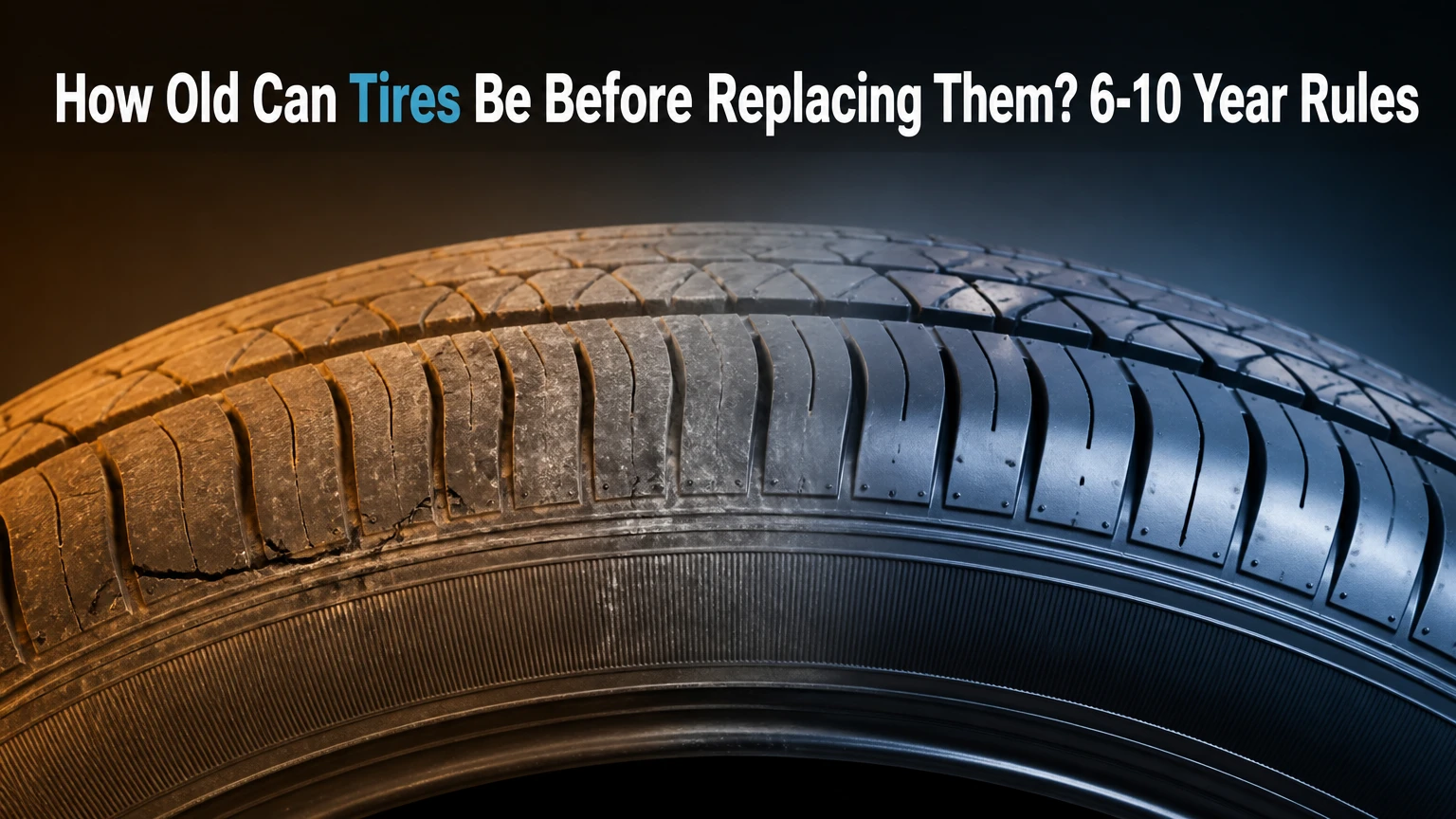
Tires should usually be replaced between 6 and 10 years after their manufacturing date, even when tread remains. Replace any tire immediately for a bulge, exposed cord, deep crack, severe leak, impact damage, or unsafe tread. The vehicle manufacturer and tire maker’s age guidance takes priority because 10 years is a maximum recommendation, not a universal legal deadline.
Key Facts at a Glance
- Tire age begins on the manufacturing date, not the purchase or installation date.
- Michelin recommends removing tires from service 10 years after manufacture, while many manufacturers call for inspection after five or six years.
- A four-digit DOT date code identifies the production week and year, such as 1125 for week 11 of 2025.
- Tread depth does not reveal hidden aging in the sidewall, inner liner, or belt adhesion.
- A tire with a bulge, exposed cord, severe cracking, or sudden pressure loss should not remain in service at any age.
- The United States has no single federal rule declaring every 10-year-old passenger tire illegal, although some manufacturers and fleets impose stricter limits.
How Old Can Tires Be Before Replacing?
A practical replacement window is 6-10 years from the tire’s manufacturing date, with annual professional inspection beginning at five years. Replace closer to six years when the vehicle maker, tire manufacturer, climate, storage history, loading, or visible condition creates a smaller safety margin. Never treat ten years as permission to continue driving without an inspection.
Michelin’s consumer guidance states, “Michelin recommends that tires be removed from service 10 years from their date of manufacture,” including spare tires. Bridgestone and Continental publish similar 10-year maximum recommendations, while some vehicle manufacturers recommend replacement at six years. These are manufacturer safety recommendations, not one global expiration statute.
Age is only one replacement trigger. A five-year-old tire with a sidewall bulge is unsafe, and a seven-year-old tire with severe weather checking may be more dangerous than its tread suggests. Tire age should therefore be evaluated with tread, damage, inflation history, heat exposure, and the tire’s service conditions.
Five-, six-, and ten-year decision points
| Tire age from manufacture | Recommended action | Reason |
|---|---|---|
| 0-4 years | Inspect monthly and maintain pressure | Normal service period when damage and wear are controlled |
| 5 years | Arrange yearly professional inspection | Rubber aging becomes a more important risk factor |
| 6 years | Check vehicle and tire-maker guidance | Several manufacturers use six years as a replacement recommendation |
| 7-9 years | Replace if condition, climate, or guidance warrants | Remaining safety margin narrows despite usable tread |
| 10 years | Remove from service | Common maximum manufacturer recommendation, including spares |
The six-year point is not a universal legal deadline. The ten-year point is not a guarantee of safety until the day before replacement. Both numbers are decision markers that must be combined with physical inspection and published manufacturer instructions.
Why Do Tires Age Even When Parked?
Tires age because oxygen, ozone, heat, ultraviolet radiation, and time alter rubber compounds and the bonds between rubber and reinforcing materials. Parking reduces tread wear, but it does not stop oxidation inside the sidewall, tread base, inner liner, or belt area.
A tire contains natural and synthetic rubber, carbon black or silica, steel belts, textile cords, and protective chemicals called antiozonants. Oxygen slowly reacts with the rubber, while ozone attacks exposed surfaces and can create fine cracks. Heat accelerates these reactions, which is why a tire stored outdoors in Arizona or inside a hot trunk can age faster than a similar tire kept in a cool garage.
Inflation pressure also matters. Underinflation increases sidewall flexing and heat during driving, while overloading raises structural stress. Long periods of underinflation can produce internal fatigue even when the exterior appears acceptable.
What age-related failure can occur?
Aging may reduce rubber flexibility, wet grip, and resistance to impact. In advanced cases, cracks can grow through the sidewall or tread base, and separation can develop between rubber layers or around reinforcing belts.
External inspection cannot reliably reveal every internal defect. A tire shop can inspect the sidewall, tread, bead, and inner liner, but no visual inspection can certify that an old tire has unlimited remaining life. That limitation is why manufacturers publish maximum service-age guidance.
How Do You Read a DOT Date Code?
Find the final four-digit group in the tire’s Department of Transportation identification number. The first two digits give the manufacturing week, and the final two digits give the manufacturing year, so code 1125 means the tire was manufactured during week 11 of 2025.
The complete DOT string may appear on only one sidewall. If the code is not visible on the outward-facing side, inspect the inner sidewall or ask a technician to read it safely. The date code normally appears in an oval or rounded block at the end of the identification sequence, although molding styles differ by brand.
DOT date-code examples
| Four-digit code | Manufacturing date | Age calculation example |
|---|---|---|
| 0124 | Week 1 of 2024 | About 2 years old in early 2026 |
| 3622 | Week 36 of 2022 | About 3 years and 5 months old in early 2026 |
| 1125 | Week 11 of 2025 | About 1 year old in early 2026 |
| 4820 | Week 48 of 2020 | More than 5 years old in early 2026 |
The tire’s manufacturing week is more precise than a simple model year. A tire made in week 02 and one made in week 51 of the same year may differ by nearly 12 months.
Three-digit date codes identify tires manufactured before 2000. Those tires are far beyond normal service life and should be removed, but the presence of a three-digit code is not itself a reason to scrap a recently manufactured tire. A modern tire uses four digits.
Does Tread Depth Determine Replacement?
Tread depth determines wear-related replacement, but tread depth alone cannot determine whether an aging tire remains safe. In the United States, 2/32 inch is commonly used as the legal minimum tread depth, while 4/32 inch is a prudent replacement threshold for stronger wet-road performance.
A penny test may indicate that tread is near the legal limit, but it cannot measure age, internal damage, rubber hardness, or belt separation. Use a tread-depth gauge for a numeric reading and compare the result across the tire’s grooves.
| Tread depth | Typical interpretation | Recommended response |
|---|---|---|
| 8/32-11/32 inch | New or lightly worn passenger tire | Continue inspection and rotation |
| 6/32-7/32 inch | Moderate remaining tread | Monitor wear and wet braking |
| 4/32-5/32 inch | Reduced wet-weather reserve | Plan replacement, especially before heavy rain |
| 3/32 inch | Limited wet-weather margin | Replace soon |
| 2/32 inch or less | Common legal wear limit | Replace immediately |
Uneven wear can make a tire unsafe before the average tread measurement reaches 2/32 inch. Cupping, shoulder wear, feathering, and one-sided wear may indicate alignment, suspension, wheel-balance, or inflation problems.
Do Tire Types Age Differently?
Tire categories age differently because rubber compounds, operating temperatures, seasonal storage, and expected grip levels vary. No category receives an exemption from the tire maker’s maximum age recommendation, but summer and winter tires can lose their intended performance before tread disappears.
| Tire type | Typical aging concern | Practical inspection point |
|---|---|---|
| All-season touring | Heat, ozone, and long-term mileage | Inspect annually from year 5 |
| Summer performance | Soft compound hardening and grip loss | Replace earlier if dry grip or wet braking declines |
| Winter or snow | Hardening reduces cold-weather flexibility | Assess after 4-6 winter seasons |
| Light-truck or commercial | High load, heat, and flex cycles | Follow load-rating and fleet guidance |
| Temporary spare | Heat, pressure neglect, and long storage | Check before every long trip and at service intervals |
Winter-tire age is better measured by both calendar years and seasons used. A winter tire stored indoors for eight months each year may accumulate fewer heat cycles than a tire used all year, but its rubber still oxidizes during storage.
Performance tires can become noticeably less compliant as their compounds harden. That change may matter before visible cracking appears, particularly for high-speed driving, wet braking, and track use. Track-day tires deserve separate manufacturer guidance because repeated high temperatures can accelerate degradation.
How Old Can a Spare Tire Be?
A spare tire should be treated as aging continuously, whether it is mounted under the vehicle, stored in a trunk, or carried as a temporary compact spare. Replace a spare according to its DOT date and manufacturer guidance, and inspect it before relying on it during a roadside emergency.
Underbody spares face water, road salt, gravel, mud, and temperature swings. Trunk-mounted spares face heat and sometimes low pressure. A compact temporary spare may have ample tread but still require replacement because its rubber and casing have aged.
Check the spare’s:
- DOT date code.
- Inflation pressure against the vehicle placard.
- Sidewall for cracks, bulges, and cuts.
- Tread for punctures or embedded objects.
- Wheel and hoist mechanism for corrosion.
A temporary spare is usually limited by a speed rating and distance instruction printed on the sidewall or vehicle manual. Those limits still apply to a new spare, and an old spare should not be used beyond them.
How Many Tires Should You Replace?
Replace all four tires when the existing set is similarly aged, worn, or mismatched. Replace two tires on a two-wheel-drive vehicle only when the remaining pair has adequate, closely matched tread and the vehicle or tire manufacturer permits that arrangement.
When replacing only two tires, new tires generally belong on the rear axle, regardless of whether the vehicle is front-wheel drive, rear-wheel drive, or all-wheel drive. Better rear hydroplaning resistance helps reduce oversteer on wet roads.
All-wheel-drive vehicles can be more sensitive to tread-diameter differences. Some manufacturers specify a maximum tread-depth difference, such as 2/32 or 4/32 inch, but the correct limit is vehicle-specific. Check the owner’s manual before replacing one tire.
| Replacement situation | Typical action | Main constraint |
|---|---|---|
| Four tires aged 6-10 years | Replace all four | Match size, load index, speed rating, and type |
| One tire damaged, other three under 2/32 inch | Replace four | Remaining tread is near wear limit |
| One tire damaged, other three nearly new | Replace one or two | Match model and tread depth where permitted |
| AWD vehicle with one failed tire | Follow manufacturer procedure | Maintain permitted circumference difference |
| Two tires replaced | Install newer pair on rear axle | Confirm rotation direction and fitment |
A tire retailer may be able to shave a replacement tire to match the remaining tread, but shaving is not appropriate for every tire or vehicle. It also does not correct age-related rubber degradation in the older tires.
Is New Old-Stock Rubber Safe to Buy?
A new tire is not necessarily newly manufactured. A tire that has spent two or three years in a properly controlled warehouse may be usable, but its DOT date reduces the remaining service window from the day it is installed.
Ask for the DOT date before purchase, particularly when buying discounted, specialty, trailer, recreational-vehicle, or uncommon-size tires. Storage quality matters: a cool, dry, dark warehouse is less demanding than an outdoor rack exposed to sunlight and temperature extremes.
| Tire age when sold | Practical buying view | Questions to ask |
|---|---|---|
| Under 1 year | Fresh stock | Confirm correct size and warranty |
| 1-2 years | Usually reasonable with proper storage | Ask how the tire was stored |
| 3-4 years | Accept only with meaningful discount and evidence of storage | Confirm manufacturer service guidance |
| 5 years or older | Poor choice for most passenger applications | Request a newer production date |
Some tire manufacturers state that properly stored, unused tires can be sold for several years, but saleability is not the same as maximum installed service life. The DOT date remains the reference point.
What Are the Immediate Reasons to Replace a Tire?
Replace a tire immediately when it has a sidewall bulge, exposed cord, deep structural crack, tread separation, puncture outside the repairable area, or repeated unexplained pressure loss. Do not drive at highway speed to “use up” remaining tread after finding structural damage.
Inspection checklist
Inspect each tire monthly and before long trips. Use a flashlight, tread-depth gauge, and accurate pressure gauge.
- Look for web-like cracks in the sidewall, shoulder, and grooves.
- Check for bulges or blisters, which indicate damaged internal plies.
- Search for exposed steel or textile cord.
- Measure tread depth in several grooves, not just one location.
- Compare pressure with the cold-pressure placard on the driver-door jamb.
- Check for nails, cuts, flat spots, and irregular wear.
- Confirm that the valve stem and TPMS sensor do not leak.
- Inspect the inner sidewall when possible, because curb damage may face inward.
A fingernail test is not a reliable certification of tire safety. Hard rubber can indicate aging, but pliable rubber does not prove that internal belts remain intact. Professional inspection is the appropriate next step for an old tire with uncertain history.
Persistent pressure loss is a diagnostic clue, not a direct age measurement. A tire losing 2 psi per month may have a puncture, leaking valve, bead leak, wheel corrosion, temperature effects, or aging rubber. Have the leak located before assuming replacement is the only cause.
How Much Does Age-Based Replacement Cost?
Typical passenger-car tire replacement costs about $100-$200 per tire for many standard sizes, while performance, light-truck, run-flat, and large-SUV tires commonly cost $220-$450 or more each. Installation, balancing, disposal, alignment, and TPMS service can add $20-$60 per tire.
| Expense | Typical range | When it applies |
|---|---|---|
| Standard passenger tire | $100-$200 each | Common compact and midsize vehicles |
| Performance or run-flat tire | $180-$350 each | Specialty compounds or reinforced sidewalls |
| Light-truck or large-SUV tire | $220-$450+ each | Larger diameter, load rating, and casing |
| Mounting and balancing | $20-$60 each | Most professional installations |
| Four-wheel alignment | $80-$180 | Uneven wear or steering pull |
| TPMS service | $0-$40 per wheel | Valve replacement or sensor work |
A four-tire replacement commonly totals $500-$1,800 before unusual fitments, taxes, alignment, or premium brands. Delaying replacement can appear economical, but a blowout can add towing, wheel damage, bodywork, and loss-of-control consequences.
What About RVs, Classics, and Low-Mileage Cars?
Low-mileage vehicles often age out before they wear out. RVs, collector cars, trailers, and weekend vehicles can experience long storage periods, high static loads, sunlight, and infrequent pressure checks, so their tires deserve an age-first maintenance plan.
Use the following approach:
- Record every DOT date, including the spare.
- Inflate tires to the vehicle manufacturer’s cold-pressure specification.
- Inspect before storage and again before driving.
- Keep tires away from direct sunlight, solvents, and ozone-producing equipment.
- Move or reposition stored vehicles according to the storage plan.
- Replace tires based on manufacturer age guidance, even with low mileage.
A garage protects against ultraviolet exposure but does not stop aging. Tire cradles, clean floors, moderate temperatures, and correct pressure can reduce stress, but they cannot reset the manufacturing date.
Heavy vehicles require particular caution. An RV tire may have low mileage yet carry substantial load at high pressure, and an underinflated RV tire can generate damaging heat rapidly. Follow the tire placard, weigh the loaded vehicle when necessary, and use commercial or RV-specific inspection guidance.
Common Mistakes That Shorten Tire Life
Checking only the tread
Deep tread does not certify sound internal construction. Pair tread measurements with the DOT date, sidewall inspection, pressure history, and professional assessment.
Treating the purchase date as the age
A tire bought in 2026 may have been manufactured in 2024. Use the final four DOT digits, not the invoice date, to calculate service age.
Applying harsh tire dressings
Petroleum-based solvents and aggressive cleaning chemicals can damage rubber surfaces and remove protective compounds. Use mild soap and water unless the tire manufacturer specifies another product.
Ignoring alignment and inflation
Incorrect alignment can destroy a tire’s shoulder in a few thousand miles. Underinflation increases flexing and heat, while overinflation reduces the contact patch and can worsen impact harshness.
Mixing incompatible tires
Mixing summer, winter, all-season, run-flat, or substantially different tread designs can alter handling. Maintain the vehicle maker’s requirements for size, load index, speed rating, axle pairing, and drivetrain compatibility.
Assuming tire age is a warranty diagnosis
A tire may be old without qualifying for a defect warranty claim. Warranty terms usually depend on workmanship, materials, treadwear, road hazards, and proof of purchase, while normal aging is commonly excluded.
The Bottom Line: How Old Can Tires Be Before Replacing?
For the query “how old can tires be before replacing,” use 10 years from manufacture as a maximum manufacturer recommendation, not as a guaranteed-safe lifespan or universal legal expiration date. Begin annual professional inspections at five years, treat six years as a serious replacement decision point, and replace sooner for damage, severe cracking, poor tread, heat exposure, or vehicle-specific guidance.
The DOT date, not the purchase date, controls the age calculation. A tire with excellent tread can still have reduced rubber flexibility or hidden structural deterioration, while a newer tire can become unsafe immediately after impact damage or severe underinflation. When age and condition disagree, follow the more conservative replacement decision.
FAQ
Can tires last 15 years if they look new?
A tire should not remain in normal service for 15 years, even if its tread looks deep and its sidewalls appear clean. Michelin and other manufacturers commonly recommend removal at 10 years from manufacture, while oxidation, heat cycles, and internal fatigue may reduce performance earlier. Replace a 15-year-old tire rather than relying on appearance.
Are eight-year-old tires automatically unsafe?
Eight-year-old tires are not automatically illegal everywhere, but they are old enough to require a careful professional inspection and comparison with manufacturer guidance. Climate, storage, pressure history, load, and visible condition change the risk. Many owners should replace at eight years, particularly when the vehicle operates in high heat or carries heavy loads.
Should I replace tires after five years?
Five years is usually an inspection milestone rather than an automatic replacement date. Michelin advises annual inspection after five years, and some vehicle manufacturers recommend replacement at six years. Replace at five years when cracking, uneven wear, persistent pressure loss, severe heat exposure, or a demanding vehicle application reduces the safety margin.
Can I use tires with different DOT dates?
Tires can have different DOT dates if they meet the vehicle’s size, load, speed, construction, and fitment requirements, but large age differences reduce consistency. Keep the newest and most similar tires on the rear axle when replacing only two, and follow the vehicle manufacturer’s instructions for AWD systems.
Does tire storage stop the aging clock?
Storage does not stop the aging clock because rubber continues to oxidize after manufacture. Cool, dry, dark indoor storage can slow environmental damage compared with outdoor exposure, but the DOT date remains unchanged. Inspect stored tires before installation and apply the tire maker’s maximum service-age recommendation.
Can a tire shop tell whether an old tire is safe?
A qualified tire technician can identify visible damage, tread wear, pressure problems, irregular wear, and some signs of aging, but no visual inspection can guarantee that an old tire has no internal defect. Professional inspection improves the decision; it does not override the tire manufacturer’s age limit or an obvious replacement condition.