When drivers ask how thick are car tires, the measurement depends entirely on the zone. A standard passenger car tire is 13 to 15 millimeters thick at the top crown section and 6 to 8 millimeters thick along the flexible sidewall. This total car tire thickness includes the outer rubber tread, the underlying base rubber layer, and the internal steel belts and fabric body plies.
At a Glance:
- The tread face of a standard tire contains 7 to 9 millimeters of usable rubber over a 6-millimeter structural base.
- Standard sidewalls measure 6 to 8 millimeters thick to allow necessary vertical flexibility.
- Run-flat tires feature heavily reinforced sidewalls that reach 12 to 15 millimeters in total thickness.
- The legal minimum tread depth is 1.6 millimeters, but wet weather traction severely declines below 3 millimeters.
- Sidewall punctures cannot be repaired because the 6-millimeter rubber flexes continuously during driving.
What are the different layers inside a tire made of?
The layers inside a tire consist of the halobutyl inner liner, polyester body plies, woven steel belts, base rubber, and the silica-infused cap tread. The halobutyl inner liner acts as a 2-millimeter airtight seal that holds the pressurized air. Above this liner sit the body plies. These plies use nylon or polyester cords to give the tire its fundamental shape and load-bearing strength. The steel belts wrap tightly over the body plies across the crown section to prevent punctures and stabilize the tread face. A thin coat of base rubber insulates these steel belts from intense heat. Finally, the cap tread provides the outer 8 millimeters of physical road grip. According to a 2023 technical bulletin from the U.S. Tire Manufacturers Association, a tire casing provides all structural integrity while the visible rubber functions merely as a protective shell and traction surface.
How much rubber is actually between the rim and the road?
There is only about 13 to 15 millimeters of actual physical rubber separating the metal rim from the road surface at the contact patch. Drivers often look at the tall sidewall profile and assume there is a massive block of rubber carrying the vehicle. That assumption is mathematically false. The vast majority of a car tire profile is simply empty space filled with pressurized air. The physical barrier between the rim and the asphalt consists solely of the tread face and the underlying steel belts. When you hit a deep pothole, the air inside the chamber compresses rapidly. If the impact compresses the air completely, the heavy metal rim smashes through those 13 millimeters of rubber directly into the pavement. This pinch shock frequently destroys the wheel and severs the internal tire layers.
How much tread depth do brand new tires start with?
Most standard passenger car tires start with exactly 8 millimeters (10/32 of an inch) of tread depth. Light truck and heavy-duty SUV tires start thicker, usually measuring between 11 and 14 millimeters. The manufacturer determines this starting depth based on heat dissipation and payload requirements. Thicker rubber retains more heat during continuous highway driving. Standard touring tires cap the tread depth at 8 millimeters to prevent the rubber compound from overheating and delaminating at high speeds. Truck tires require extra rubber depth to grip loose dirt and support heavier commercial payload weights. Once the tire hits the road, this starting measurement immediately begins wearing down.
How long does it take for a tire to lose one millimeter of thickness?
A standard passenger tire loses one millimeter of tread thickness every 6,000 to 8,000 miles under normal driving conditions. Soft performance tires wear out much faster, often losing a millimeter of rubber every 3,000 miles. A 2021 tread wear report by the National Highway Traffic Safety Administration confirms that driving style and alignment dictate the exact degradation rate. Aggressive braking and high-speed cornering shear microscopic layers of rubber off the tire with every maneuver. A poor suspension alignment dragging the tire sideways will aggressively strip away a millimeter of thickness in just 1,000 miles. Regular tire rotations distribute this friction evenly across all four wheels.
| Tire Category | Miles to Lose 1mm | Starting Depth | Expected Lifespan |
|---|---|---|---|
| Standard Touring | 6,000 – 8,000 miles | 8 mm | 50,000 miles |
| High Performance | 3,000 – 4,000 miles | 7 mm | 20,000 miles |
| All-Terrain Truck | 5,000 – 7,000 miles | 12 mm | 45,000 miles |
| Dedicated Winter | 4,000 – 5,000 miles | 11 mm | 30,000 miles |
What is the minimum safe tread depth for rain and highway driving?
The absolute minimum safe tread depth for rain and highway driving is 3 millimeters (4/32 of an inch). This differs significantly from the 1.6-millimeter legal limit enforced by most local transportation departments. Driving on 1.6 millimeters of tread in wet conditions guarantees a dangerous loss of traction. At highway speeds, a tire needs deep channels to evacuate standing water away from the contact patch. A tread worn down to 1.6 millimeters cannot channel water fast enough. Water pressure builds under the rubber block and lifts the vehicle off the pavement, causing severe hydroplaning. A 2022 wet braking study by AAA tested worn tires and proved that stopping distances increase by a massive 43 percent when braking on tires worn below the 3-millimeter safety threshold.
| Tread Depth Remaining | Water Evacuation Rate | Hydroplaning Risk | Highway Stopping Distance (Wet) |
|---|---|---|---|
| 8 mm (Brand New) | 100% Efficiency | Very Low | Baseline Standard |
| 4 mm (Half Worn) | 70% Efficiency | Moderate | + 15 feet over baseline |
| 3 mm (Safe Minimum) | 50% Efficiency | High | + 30 feet over baseline |
| 1.6 mm (Legal Limit) | 10% Efficiency | Extreme | + 60 feet over baseline |
How to check tire tread depth accurately?
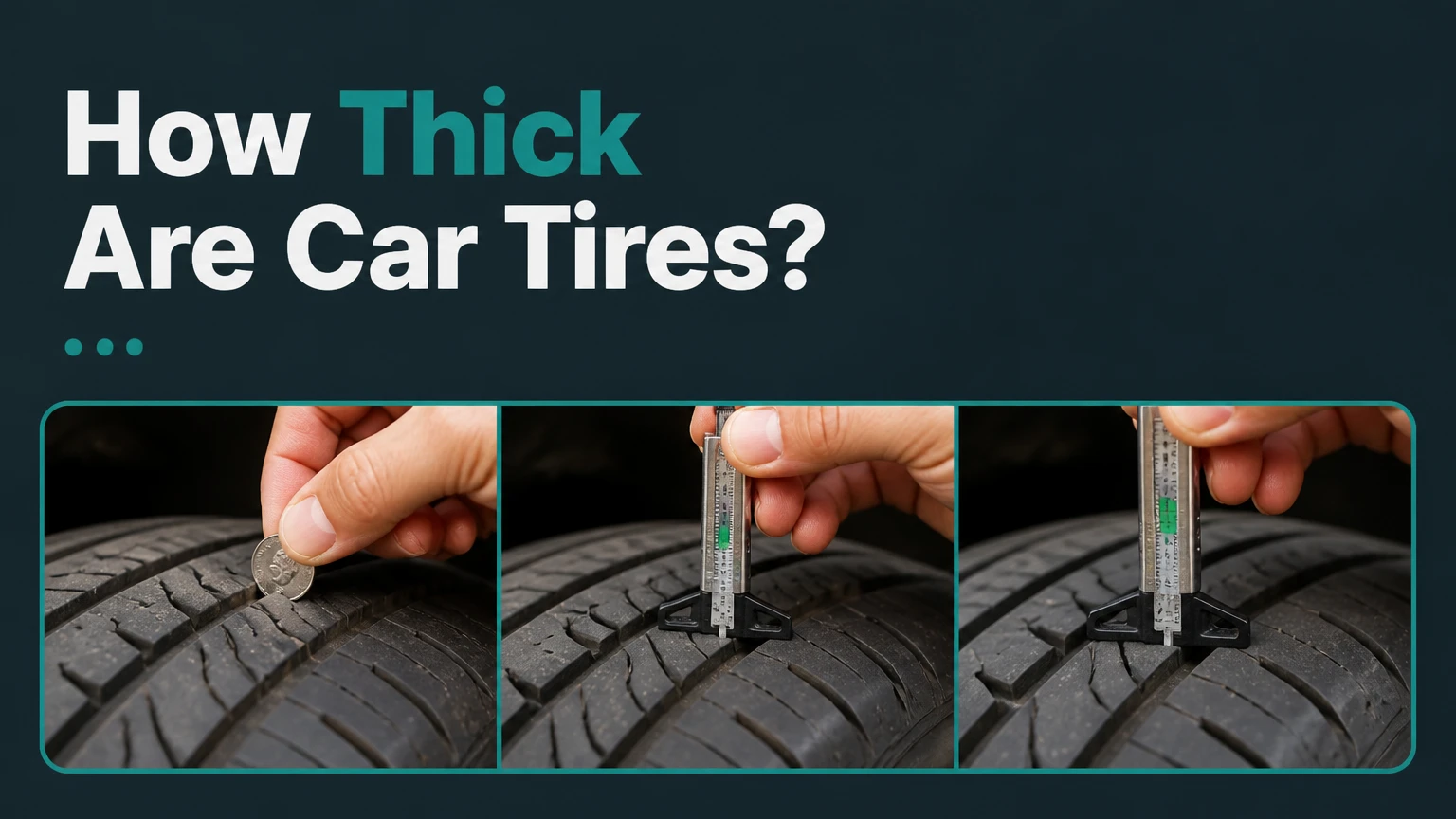
To check tire tread depth accurately, use a dedicated measurement gauge in the main grooves rather than relying on a coin.
- Park the vehicle on a completely flat, well-lit surface.
- Insert a dedicated tread depth gauge directly into the main center groove.
- Read the exact millimeter marking on the gauge barrel.
- Repeat this measurement on the outer and inner edges of the same tire.
A dedicated gauge provides the precise data required for modern highway safety. Mechanics check multiple grooves because tires rarely wear perfectly evenly across the profile. A bad alignment can leave 5 millimeters of rubber on the outside edge while grinding the inside edge down to the bare steel cords. You must also check the physical wear bars. These small rubber bridges sit at the bottom of the main grooves. When the surrounding tread wears down flush with these bars, the tire has reached the 1.6-millimeter legal limit.
How thick are run flat tires compared to standard tires?
Run-flat tires have sidewalls measuring 12 to 15 millimeters thick, which is nearly double the 6 to 8 millimeters found on standard passenger tires. This massive difference in thickness comes from heavy rubber inserts built directly into the inner sidewall structure. A standard car tire relies entirely on internal air pressure to hold the weight of the vehicle. When a standard tire loses air, the thin sidewall collapses instantly. A run-flat tire supports the vehicle using sheer material density. The 15-millimeter reinforced rubber can hold up a 4,000-pound car even at zero air pressure. This thick physical barrier allows the driver to travel 50 miles to a repair shop without needing a spare tire. The main trade-off for this safety feature is a noticeably stiffer ride quality.
| Vehicle Tire Type | Crown Tread Thickness | Sidewall Thickness | Sidewall Reinforcement |
|---|---|---|---|
| Standard Passenger Car | 13 – 15 mm | 6 – 8 mm | Standard nylon plies |
| Run-Flat Tire (RFT) | 13 – 15 mm | 12 – 15 mm | Heavy rubber inserts |
| Off-Road Heavy SUV | 16 – 19 mm | 10 – 15 mm | 3-ply Kevlar or nylon |
| Ultra-Low-Profile | 10 – 12 mm | 3 – 5 mm | High-density rubber |
How thick are off road truck tires?
Off-road truck tires feature sidewalls between 10 and 15 millimeters thick and a top crown section that frequently exceeds 18 millimeters. Engineers build heavy-duty mud-terrain and all-terrain tires to survive brutal physical impacts. Standard car tires use a two-ply sidewall construction. Off-road tires upgrade to a robust three-ply sidewall structure. They layer thick nylon, polyester, and occasionally Kevlar cords to prevent sharp rocks from slicing through the side rubber. This extreme thickness prevents catastrophic trail punctures. The thick crown tread also houses massive rubber blocks that bite deep into mud and loose gravel for mechanical traction. The physical weight of the tire increases dramatically due to this extra material. A standard car tire weighs roughly 20 pounds, while a heavily layered off-road truck tire easily exceeds 55 pounds.
How thick are low profile sports car tires?
Low-profile sports car tires have highly compressed sidewalls measuring just 3 to 5 millimeters thick. Tire engineers strip away the excess rubber to maximize cornering stiffness for high-performance vehicles. A standard 8-millimeter thick sidewall flexes and rolls over itself when a car takes a corner at high speed. This flex makes the steering feel sloppy and delayed. A 4-millimeter low-profile sidewall eliminates that flex completely. The sports car responds instantly to rapid steering inputs. However, this thin physical barrier offers almost zero impact protection. Deep potholes regularly destroy low-profile tires because there is not enough rubber to absorb the kinetic shock. The impact punches straight through the thin rubber, severing the internal fabric cords and severely bending the expensive metal wheel underneath.
Are winter tires thicker than summer tires?
Yes, winter tires are thicker than summer tires by roughly 3 to 4 millimeters at the top tread face. A brand new dedicated winter tire starts with 11 to 12 millimeters of usable tread depth. Summer performance tires usually start with just 7 to 8 millimeters of rubber. Winter tires require this extra thickness to function in deep snow conditions. The deep grooves pack loose snow into the tread block, and snow gripping snow provides the highest level of winter traction. The rubber compound itself is also engineered differently. Summer tires use a dense rubber that hardens in freezing weather. Winter tires utilize a hydrophilic, silica-heavy compound that remains highly pliable below 45 degrees Fahrenheit. This thicker, softer rubber wears away very quickly if driven continuously on hot summer pavement.
How does sidewall thickness affect ride comfort?
Sidewall thickness dictates ride comfort by determining exactly how much impact energy reaches the vehicle cabin. Thinner, heavily reinforced sidewalls transfer road bumps directly into the suspension. Thicker, flexible sidewalls act as the primary shock absorber for the vehicle. When a car hits a bump, the air inside the tire compresses rapidly. A standard 8-millimeter sidewall bulges outward slightly to accommodate this sudden pressure spike. This split-second bulge absorbs the harshness of the impact before the metal vehicle suspension even moves. A 15-millimeter run-flat sidewall cannot bulge. It is mathematically too thick and structurally too rigid. The impact energy bypasses the tire and slams straight into the cabin. Drivers who switch from run-flat tires to standard tires consistently report a massive improvement in daily driving comfort.
Does driving on an underinflated tire change its thickness?
Yes, driving on an underinflated tire rapidly and permanently reduces the thickness of the outer tread edges. An underinflated tire sags heavily in the middle. The center of the tread lifts away from the road, shifting the entire weight of the vehicle directly onto the outer shoulders. This focused friction grinds away the edge rubber at a highly accelerated rate. Beyond exterior tread wear, underinflation destroys the internal sidewall. A sagging tire forces the sidewall rubber to fold sharply every time the wheel rotates. This continuous extreme bending generates massive internal heat. The heat melts the industrial adhesive holding the polyester body plies together, causing the tire layers to separate internally. The sidewall might look suitably thick from the outside, but its structural strength drops to zero.
Does scrubbing a tire against a curb ruin the sidewall thickness?
Scrubbing a tire against a curb ruins the sidewall thickness only if the scrape cuts deep enough to expose the internal structural cords. A light cosmetic scuff that removes a fraction of a millimeter of outer rubber leaves the overall sidewall perfectly safe. The outer weather-resistant rubber exists specifically to protect the internal cords from moisture and road debris. However, if the curb gouges the tire deeply enough that you can see white or silver fabric cords, the tire thickness is fatally compromised. Once a deep gouge removes that protective barrier, rainwater infiltrates the tire casing. The steel belts rust aggressively, and the nylon cords rot from the inside out. You must replace the tire immediately if any structural cords become visible after a curb strike.
What happens when the tire internal cords break?
When internal cords break, pressurized air forces its way through the damaged inner plies and pushes violently against the thin outer rubber layer. This internal failure creates a highly visible bulge or bubble on the side of the tire. The internal nylon and polyester cords provide all the structural strength for the casing. The 6-millimeter outer rubber is just a weatherproof shell. Hitting a deep pothole pinches the sidewall against the metal rim hard enough to snap those internal cords instantly. Once snapped, only the thin outer shell holds back 35 pounds of air pressure per square inch. The tire becomes a ticking time bomb. The bubble will eventually burst without warning. You cannot safely drive a vehicle with a sidewall bubble at any speed.
Can a nail pierce a car tire sidewall?
Yes. A standard nail or sharp screw easily pierces a car tire sidewall because it only faces 6 to 8 millimeters of soft, unreinforced rubber. The sidewall contains no heavy steel belts to deflect sharp objects. When a nail strikes the top crown section of the tire, it hits a dense 15-millimeter barrier heavily reinforced with woven steel mesh. The steel belts often bend or snap the nail before it reaches the internal air chamber. The side of the tire lacks this metallic armor. A nail kicked up by the front tire can effortlessly slice straight through the rear tire’s thin sidewall. Even small trail debris like sharp rocks or shattered glass can easily penetrate this highly vulnerable structural zone.
Why can you not repair a puncture in the tire sidewall?
You cannot repair a sidewall puncture because the side of the tire continuously bends and flexes heavily under load. This nonstop mechanical bending forces any chemical patch or rubber plug to work its way loose. Tire repair shops strictly limit patches to the central tread area. The thick steel belts in the crown section hold the surrounding rubber rigid, which keeps a rubber plug perfectly stationary inside the hole. The sidewall entirely lacks those rigid steel belts. Every time the punctured area rolls down and touches the pavement, the 6-millimeter rubber folds outward. When it rotates up, the rubber snaps back straight. No commercial adhesive or rubber plug can withstand this relentless cycle of stretching and compressing. A repaired sidewall will blow out rapidly at highway speeds.
The Bottom Line
A standard car tire utilizes a 13 to 15-millimeter thick tread section to grip the road and a flexible 6 to 8-millimeter sidewall to absorb impacts. While a tire profile may look massive from the outside, the actual rubber separating your wheel from the pavement is surprisingly thin. Maintaining proper air pressure and replacing tires before they hit the 3-millimeter safety threshold are the only ways to preserve this essential protective barrier. Check your tread depth regularly with a dedicated gauge to ensure your vehicle remains safe in unpredictable weather conditions.