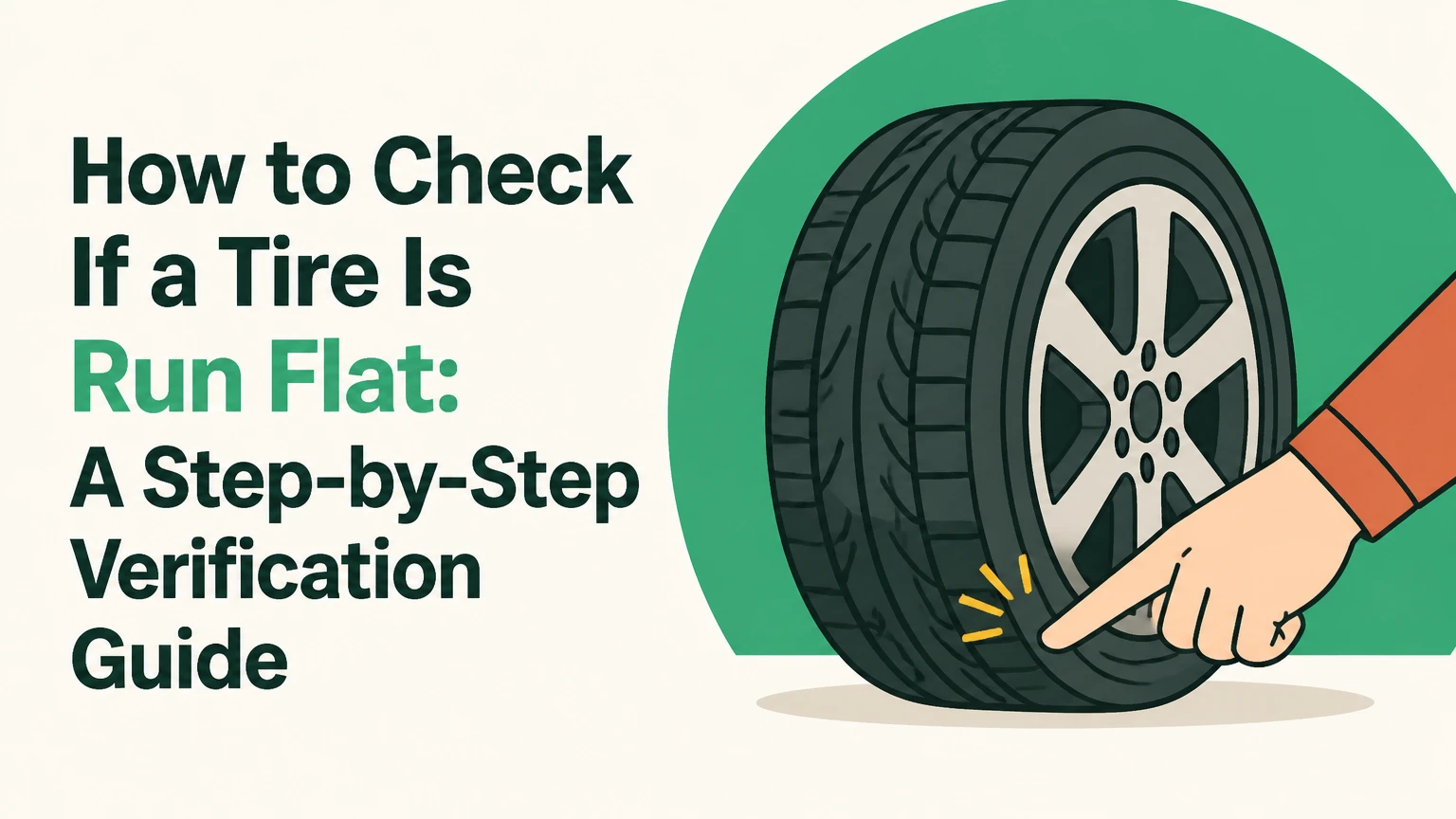
To check if a tire is a run-flat tire (RFT), inspect the outer sidewall for specific manufacturer acronyms like RFT, SSR, ZP, or ROF, or locate the universal ISO run-flat symbol near the tire bead. You can verify all four tires in 5 to 10 minutes using basic cleaning supplies and a flashlight with zero specialized mechanical skills required. The single most critical factor for success is clearing away road grime to read the small molded codes near the wheel rim.
Before You Start
- Time Required: 5–10 minutes total (1–2 minutes per wheel).
- Difficulty Level: Beginner (no wheel removal required).
- Cost: $0–$5 (uses household cleaning items).
- Tools & Materials Needed:
- Microfiber cloth or clean cotton rag (Quantity: 1)
- Spray bottle with water or dedicated rubber/sidewall cleaner (Quantity: 20–30 mL)
- LED flashlight or smartphone light (Quantity: 1)
- Inspection mirror or smartphone front camera (Quantity: 1, optional for inner sidewalls)
Phase 1: Inspect the Tire Sidewall Markings
Run-flat tires (also known as Self-Supporting Tires or Extended Mobility Tires) use reinforced sidewall rubber to hold up the vehicle when air pressure drops to zero. Because they look visually identical to standard radial tires when inflated, identification relies entirely on molded sidewall codes.
Step 1: Clean the Sidewall Rubber
Spray 20–30 mL of water or sidewall cleaner directly onto the outer face of the tire rubber, focusing on the ring between the tread edge and the metal wheel rim. Wipe the surface firmly in a circular motion with your microfiber cloth to remove brake dust, dried mud, and road grime that obscure small embossed lettering.
You’ll know it worked when: The dark black rubber reflects light cleanly without grey dust spots or mud patches obscuring any text.
Mistake to Avoid: Spraying oily tire dressing (silicone shine) before reading the text. This creates a high-glare reflection that makes low-relief molded rubber letters nearly impossible to read under flashlight illumination.
Step 2: Scan for Brand-Specific Run-Flat Acronyms
Hold your flashlight at a 45-degree angle to the sidewall to create contrasting shadows inside the embossed lettering, then scan the circumference of the tire for manufacturer-specific run-flat codes. Tire manufacturers do not use a single universal name; each brand uses its own proprietary trademark.
Look for these exact codes molded into the outer rubber:
| Manufacturer | Primary Run-Flat Designation Codes | Secondary / Technology Names |
| Bridgestone | RFT (Run-Flat Technology) | DriveGuard |
| Continental | SSR (Self-Supporting Runflat) | ContourSilent (Not Run-Flat) |
| Dunlop | DSST (Dunlop Self-Supporting) | ROF (RunOnFlat) |
| Goodyear | ROF (RunOnFlat) | EMT (Extended Mobility Technology) |
| Michelin | ZP (Zero Pressure) | ZP Tech |
| Pirelli | Run Flat | r-f |
| Hankook | HRS (Hankook Runflat System) | — |
| Yokohama | ZPS (Zero Pressure System) | — |
| Kumho | XRP (eXtended Runflat Performance) | — |
| Nokian | FRT (Flat Run Technology) | — |
You’ll know it worked when: You locate one of the exact 2- to 4-letter acronyms listed above embossed near the tire model name (e.g., Michelin Pilot Sport 4 ZP or Bridgestone Turanza RFT).
Mistake to Avoid: Confusing XL (Extra Load) or M+S (Mud and Snow) for run-flat indicators. XL simply means higher load capacity at elevated PSI; it has zero zero-pressure capability.
Step 3: Check for the Universal ISO Run-Flat Symbol
Scan the lower perimeter of the tire sidewall near the wheel rim (the bead area) for the official ISO run-flat graphic symbol. This symbol consists of a stylized graphic depicting a flat tire profile with a thick curved inner wall or a stylized snail-shell shape with an arrow.
You’ll know it worked when: You spot a small circular icon (~10–15 mm wide) near the tire size text depicting a reinforced tire profile.
Mistake to Avoid: Searching near the center tread. The ISO symbol is almost always placed on the lower third of the sidewall profile near the wheel rim flange.
Step 4: Verify the Inner Sidewall (If Outer Face is Blank)
If the outer sidewall shows no acronyms but the tire model is known to offer run-flat versions, turn your vehicle’s steering wheel to full lock (left or right) to expose the inner tire face. Use your flashlight and microfiber cloth to clean and inspect the inner sidewall.
You’ll know it worked when: You confirm either the presence of a run-flat acronym on the inside face or verify that neither side carries the designation.
Mistake to Avoid: Assuming asymmetrical directional tires were installed correctly. Independent shops occasionally mount directional or asymmetrical tires inside-out, hiding the primary branding on the inner frame.
Phase 2: Cross-Verify Vehicle & Trunk Setup
Checking the vehicle’s factory specifications confirms whether the car was designed for run-flat tires, which helps determine if a previous owner swapped them for standard tires.
1.Check the Driver Door Jamb Placard:Locate original factory tire specifications.
Open the driver’s door and inspect the yellow-and-white tire information sticker located on the B-pillar. Read the factory tire sizing line (e.g., 225/45R18 91V RFT or 225/45R18 Extra Load). If the vehicle placard explicitly lists RFT, RSC (Runflat System Component), or MOE (Mercedes-Benz Original Extended), your vehicle shipped from the factory on run-flat tires.
2.Inspect the Trunk Floor Compartment:Confirm presence or absence of spare tire hardware.
Lift the trunk floor panel completely. Examine the storage cavity underneath. Vehicles designed for run-flat tires almost universally omit a spare tire, scissor jack, and lug wrench to save weight and cargo space. If you find a empty molded plastic tray or an OEM mobility kit (air compressor and liquid sealant canister) instead of a spare tire, the vehicle was engineered for run-flats.
3.Verify TPMS Instrument Cluster Light:Ensure active pressure monitoring is installed.
Turn the ignition switch to the “ON” position without starting the engine. Watch the gauge cluster during the bulb test sequence. Look for the yellow horseshoe symbol with an exclamation point inside (TPMS). Run-flat tires strictly require a functional TPMS system because drivers cannot visually feel or see when a run-flat tire has lost air pressure.
Common Mistakes and How to Fix Them
1. Confusing Self-Sealing Tires (ContiSeal / SelfSeal) with Run-Flats
- The Error: mistaking self-sealing tire technology for self-supporting run-flats.
- Why it Happens: Brands like Continental (ContiSeal) and Michelin (SelfSeal) place prominent technology badges on the sidewall. These tires contain an internal sticky sealant coat that plugs nail punctures up to 5mm, but they cannot support the vehicle without air pressure.
- The Fix: Look specifically for SSR (Continental) or ZP (Michelin). If the tire only says ContiSeal or SelfSeal, it is a standard tire with puncture sealant, not a run-flat.
2. Assuming a Stiff-Looking Uninflated Tire is Run-Flat
- The Error: Pressing your foot or thumb into a tire tread to gauge stiffness.
- Why it Happens: Low-profile performance tires have short, rigid sidewalls that feel firm even when underinflated.
- The Fix: Never rely on physical pressure tests or visual deflection while parked. Rely exclusively on the embossed sidewall codes detailed in Step 2.
3. Misinterpreting Mercedes “MOE” as a Standard Run-Flat
- The Error: Assuming MOE (Mercedes-Benz Original Extended) behaves identically to an ISO-standard run-flat.
- Why it Happens: MOE tires feature reinforced sidewalls engineered specifically for Mercedes ride comfort, but they offer reduced run-flat distance (approx. 30 miles / 50 km at reduced speed) compared to standard ISO run-flats (50 miles / 80 km).
- The Fix: Treat MOE tires as run-flats for identification purposes, but adhere to the stricter 30-mile limping limit if pressure loss occurs.
4. Relying Solely on the Car Manual or Trunk Setup
- The Error: Assuming you have run-flats because your trunk has no spare tire.
- Why it Happens: Secondhand car buyers often assume the fitted tires match factory specs. Previous owners frequently replace expensive run-flat tires with cheaper standard tires before selling the vehicle.
- The Fix: Always verify the actual rubber on all four wheels. If you have standard tires and no spare, purchase a tire repair kit or space-saver spare immediately.
Variations: Checking Unmounted Tires or Damaged Markings
Scenario A: Checking an Unmounted Tire (Off the Rim)
If you are inspecting a loose tire off the wheel rim:
- Place the tire flat on the ground.
- Grasp the top bead opening with both hands and push down vertically with your body weight.
- Result: A standard tire sidewall flexes easily under hand pressure. A self-supporting run-flat sidewall resists collapse firmly due to the thick internal rubber inserts.
Scenario B: Markings Are Scuffed Off by Curb Damage
If severe curb rash or sidewall abrasion has scrubbed away the brand acronyms:
- Locate the DOT Serial Number on the lower inner or outer sidewall (a string starting with “DOT” followed by 8 to 12 alphanumeric characters).
- Note the full 12-digit code (e.g.,
DOT CX96 1BC 1223). - Enter the DOT code and tire model name into the manufacturer’s online technical database or call a local dealer to retrieve the exact factory manufacturing specs for that batch.
FAQ: Frequently Asked Questions
Can you mix run-flat tires and standard tires on the same car?
No, you should never mix run-flat and standard tires on the same vehicle. Run-flat tires have significantly stiffer sidewall structures and different handling characteristics. Mixing them causes unpredictable steering balance, uneven grip, and erratic stability control (ESP) system interventions during emergency maneuvers.
Do run-flat tires require special wheels or rims?
Run-flat tires can mount on standard wheel rims, but optimal safety requires EH2 (Extended Hump) or EH2+ rims. EH2 rims feature a raised inner ridge that prevents the tire bead from slipping off the wheel rim into the center drop-well when tire pressure drops to zero.
Can you repair a punctured run-flat tire?
Most manufacturers (including Pirelli, Continental, and Goodyear) advise against repairing run-flat tires if they have been driven underinflated. Driving on an uninflated run-flat degrades the internal reinforced rubber structure. Michelin permits limited repairs under strict inspection conditions if internal structural damage has not occurred.
How far can you drive on a flat run-flat tire?
Most standard run-flat tires are rated to drive for 50 miles (80 km) at a maximum speed of 50 mph (80 km/h) following complete air loss. Always check your specific tire manufacturer’s guidelines, as heavy vehicle loads reduce this distance.