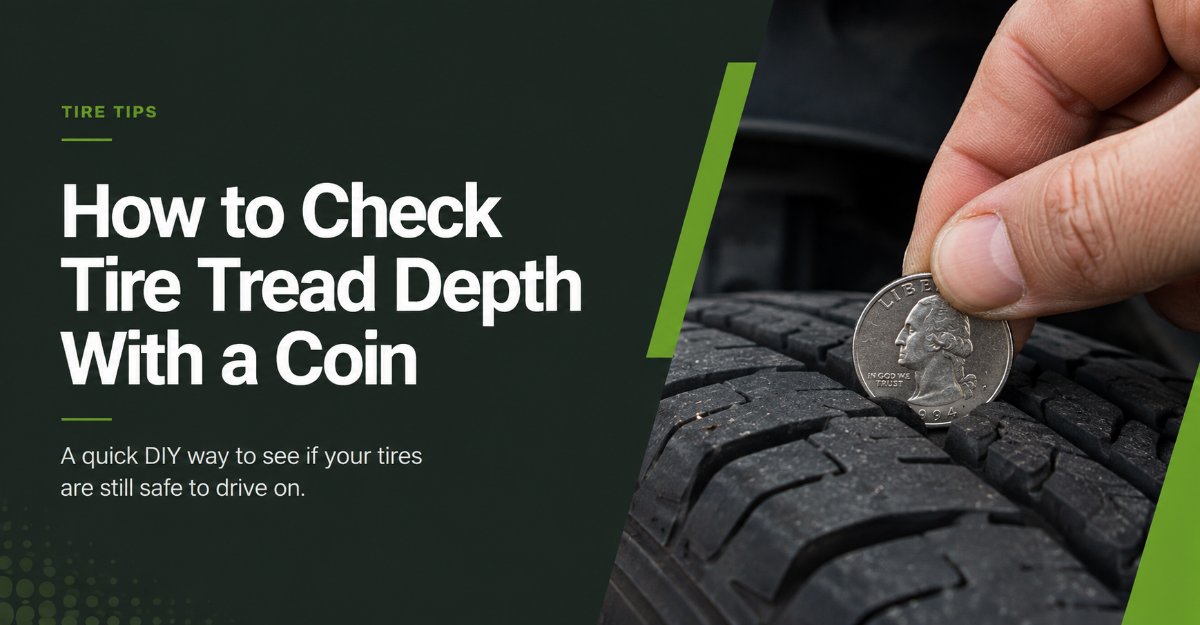
To check tire tread depth with a coin, insert the coin upside down into the lowest part of the tire groove. If the tread covers the top of the character’s head or the outer rim design, your tires have safe tread depth remaining. If the entire design is visible, you must replace the tires immediately.
Key Facts / At a Glance
- The absolute legal minimum tread depth in most of North America and Europe is 2/32 of an inch or 1.6 millimeters.
- The United States penny test measures the 2/32 of an inch legal minimum, while the quarter test measures a safer 4/32 of an inch wet-weather margin.
- Tires lose up to 50 percent of their water evacuation capabilities before reaching the legal minimum depth.
- Uneven tread wear indicates severe wheel alignment or tire pressure problems, requiring measurements at three different points across the same tire.
- Dedicated digital tread depth gauges provide exact millimeter readings and remove the visual guesswork inherent to the coin test.
What Is the Tire Tread Coin Test?
The coin test is a manual diagnostic method used to estimate the remaining functional lifespan of an automotive tire. Tires rely on deep grooves to channel water away from the contact patch. When these grooves wear down, the tire physically cannot disperse water, leading to a dangerous condition called hydroplaning where the vehicle floats on top of standing water. The coin test uses the standardized dimensions of national currency to measure groove depth quickly without specialized mechanical tools.
Before You Start: Choosing the Right Coin
You must select the correct coin based on your geographic location and your personal safety margins. Different coins measure entirely different depth thresholds.
The Penny Test for Legal Minimums (United States and Canada)
The United States penny measures exactly 2/32 of an inch (1.6 millimeters) from its outer edge to the top of Abraham Lincoln’s head. You should use this test only to determine absolute legal compliance. If you can see the top of Lincoln’s head, the tire is legally bald and unsafe for any road conditions. Modern safety experts consider the penny test outdated for daily driving, as a tire at 2/32 of an inch cannot safely stop on wet pavement.
The Quarter Test for Wet Weather (United States and Canada)
The United States quarter measures exactly 4/32 of an inch (3.17 millimeters) from its edge to the top of George Washington’s head. You should use the quarter test to determine real-world safety in wet conditions. If the tread touches Washington’s head, you have sufficient depth to evacuate rainwater. If there is a gap between the tread and his head, you need to begin shopping for replacement tires.
The 20p Test for Legal Minimums (United Kingdom)
The 7-sided 20 pence coin features a raised outer border that measures exactly 1.6 millimeters wide. You should use this coin in the United Kingdom to check against national legal standards. If you can see any part of that outer band when the coin is resting inside the groove, your tires are illegal. Driving on tires below this limit in the UK can result in a massive fine per tire and penalty points on your license.
The 1 Euro Test for Replacement Planning (Eurozone)
The 1 Euro coin features a distinct gold-colored outer rim that measures exactly 3 millimeters wide. You should use this coin to measure a safe replacement window. If the entire gold rim is visible outside the groove, your tires have less than 3 millimeters of tread remaining. While the legal limit in Europe is 1.6 millimeters, tire manufacturers strongly advise replacing summer tires at the 3-millimeter mark.
Preparation, Time, and Difficulty
- Total Time Required: 3 minutes for all four tires.
- Difficulty Level: Beginner.
- Tools Needed: One region-appropriate coin. A flashlight or smartphone light. A damp cloth to clean the tire surface.
- Prerequisites: The vehicle must be parked on flat, level ground with the engine turned off and the parking brake firmly engaged.
Step-by-Step Guide: How to Check Tire Tread Depth With a Coin
Checking your tire tread depth correctly requires methodical inspection. Performing this task incorrectly can result in a false sense of security.
Step 1: Park Safely and Turn the Steering Wheel
Turn your steering wheel completely to the left or the right before turning off the engine. Turning the wheel exposes the entire width of the front tires, pulling them out from beneath the wheel well. You will know this step worked when you can see the inner, center, and outer tread blocks clearly without kneeling on the ground.
- Common Mistake: Leaving the wheels perfectly straight makes it physically impossible to view the inner edge of the tire, which is often where hidden suspension wear occurs.
Step 2: Clean Debris From the Tire Grooves
Wipe the primary circumferential grooves with a damp cloth and remove any small stones trapped in the rubber. The primary grooves are the thickest channels running continuously around the entire circumference of the tire. You will know the area is prepped when the bottom of the groove looks smooth and unobstructed.
- Common Mistake: Placing the coin on top of compressed mud or a pebble will artificially elevate the coin, making the tread look dangerously low.
Step 3: Insert the Coin Straight Down
Hold the coin firmly by its edges and push it straight down into the lowest part of the groove. The character’s head must be facing you, and it must be positioned upside down so the head enters the groove first. You will know it is seated correctly when the edge of the coin rests flat against the hard rubber base of the channel.
- Common Mistake: Tilting the coin forward toward yourself creates a diagonal sightline that makes the tread look significantly deeper than it actually is.
Step 4: Inspect the Visibility of the Graphic
Lower your head so your eyes are perfectly level with the top of the tire tread block. Look directly at the coin to see where the rubber intersects with the printed graphic.
- Common Mistake: Looking down at the coin from a standing position obscures the measurement line. You must crouch down to view the intersection at a flat ninety-degree angle.
Step 5: Test Three Different Spots Across the Tire Width
Measure the outer groove, the center groove, and the inner groove on the same tire. Record the lowest measurement of the three points. Once finished with one tire, repeat this exact process on the remaining three wheels. You will know you have accurate data when you have checked twelve total measurement points across the vehicle.
- Common Mistake: Checking only the center groove. Overinflated tires wear heavily in the center, while underinflated tires wear heavily on the edges. Relying on a single point can mask a tire that is bald on the inside shoulder.
Troubleshooting Common Mistakes and Measurement Errors
Even simple manual diagnostic tests can yield incorrect data if performed poorly. Here are the most frequent failure modes and how to correct them.
Misreading the Angle of Insertion
Tilting the coin makes the tread appear acceptable even when the tire is completely bald. Always ensure the coin is perfectly perpendicular to the tire surface. If your tire has angled or swept directional grooves, find the deepest central channel rather than the stylized outer blocks to take your measurement.
Ignoring Uneven Wear Patterns
Discovering different measurements across a single tire indicates a mechanical failure in your vehicle’s suspension. If the inner edge fails the coin test but the center passes, you likely have negative camber wear or a failed ball joint. You must replace the tire and immediately schedule a four-wheel computerized alignment to prevent the new tires from suffering the same rapid wear.
Confusing Wear Bars With the Groove Base
Modern tires feature small, raised rubber bridges called Tread Wear Indicators molded horizontally inside the main grooves. These bars sit exactly at 2/32 of an inch. If you rest your coin on top of a wear bar rather than the true bottom of the groove, your test will instantly fail. Always place the coin in the empty space between the wear bars.
Comparing the Coin Test to Alternative Methods
Different measurement methods serve different driver needs. The coin test is highly accessible, but it lacks the precision required for high-mileage drivers.
| Measurement Method | Pros | Cons | Ideal For | Verdict |
|---|---|---|---|---|
| The Penny Test | Free, instant, universal availability. | Only flags critical, illegal failure levels. | Quick emergency roadside checks. | Use only to verify if a vehicle is legally permitted on the road. |
| The Quarter Test | Flags early wet-weather risk factors accurately. | Cannot provide a numerical tread baseline. | Safe winter and rainy season preparation. | Best manual method for everyday safety checks. |
| Dedicated Depth Gauge | Provides exact millimeter or inch fraction readouts. | Costs money; requires intentional storage. | Mechanics and performance vehicle owners. | Choose this if you rotate your own tires and track tread degradation. |
| Tread Wear Indicators | Built directly into the tire from the factory. | Only warns the driver when it is already too late. | Casual visual inspections while walking to the car. | Use this as a passive warning system, not a primary diagnostic tool. |
Which Measurement Method Should You Choose?
Your specific driving environment dictates the strictness of your tire maintenance plan. What is safe for a dry climate is highly dangerous for a wet one.
For Everyday Urban Commuters
Urban commuters should rely on the Quarter Test once a month. City driving frequently involves sudden stops and unexpected rain slicking up oily pavement. Replacing tires when the tread reaches Washington’s head ensures you maintain optimal braking distances in variable urban weather.
For Winter and Wet-Climate Drivers
Drivers facing snow, slush, or heavy monsoons should abandon coins entirely and purchase a digital gauge. You must shift your baseline safety margin up to 6/32 of an inch or 4.8 millimeters. Deep snow requires massive grooves to claw through powder. A tire that passes the quarter test will still spin helplessly in winter conditions.
For High-Mileage and Commercial Drivers
Commercial fleet drivers must use calibrated mechanical or digital tread depth gauges. Professional driving requires precise, loggable data to track wear trends and predict replacement costs months in advance. The visual ambiguity of a coin test is completely unacceptable for commercial liability purposes.
Frequently Asked Questions
Do front and rear tires wear down differently?
Yes, front and rear tires wear at completely different rates. Front tires handle the majority of braking forces and all of the steering friction, causing them to wear out significantly faster than rear tires on most vehicles. You must check all four tires independently to get an accurate assessment of vehicle safety.
What happens if your tire tread is too low?
When tire tread falls below 4/32 of an inch, the physical space required to evacuate water disappears. At highway speeds, the tire traps water underneath the rubber, lifting the vehicle completely off the asphalt. This causes instant loss of steering and braking control, resulting in high-speed collisions.
Can you pass a state inspection with borderline tire tread?
You can technically pass a state vehicle inspection if your tires measure exactly at the 2/32 of an inch legal minimum. However, passing an inspection does not mean the vehicle is safe to drive in the rain. Inspectors measure against absolute legal minimums, not against modern dynamic safety standards.
How often should you check your tire tread depth?
You should perform a tread depth check once every thirty days, and always perform a check before embarking on a road trip exceeding three hundred miles. Monthly checks allow you to spot uneven alignment wear before it destroys a brand-new set of tires.
Is the penny test still relevant for modern vehicles?
The penny test is largely obsolete for modern vehicle safety. Modern vehicles, particularly electric vehicles and large luxury SUVs, weigh thousands of pounds more than cars from the twentieth century. This extreme weight requires substantially more tread depth to stop safely, rendering the 2/32 of an inch metric dangerously inadequate.