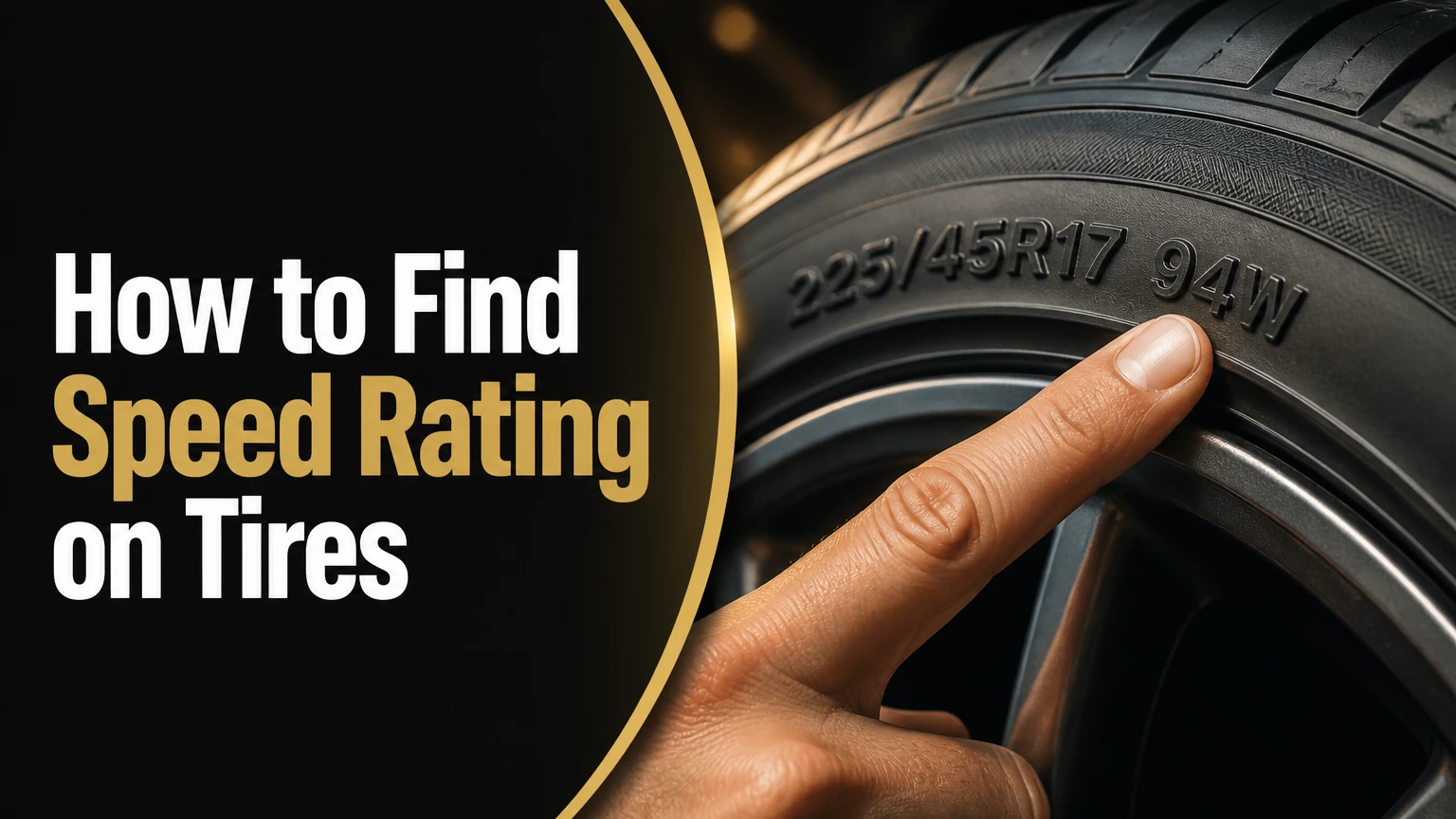
To learn how to find speed rating on tires, locate the tire-size code molded into the sidewall and read the final letter in the service description. In a marking such as 225/45R17 94W, the number 94 is the load index, while W is the tire’s speed rating.
At a Glance
- A tire speed rating normally appears as the final letter after the load index.
- In 205/55R16 91V, the speed symbol is V.
- The speed rating describes laboratory-tested high-speed capability under controlled load and inflation conditions.
- The rating is not permission to drive at that speed on public roads.
- Replacement tires should normally meet or exceed the vehicle manufacturer’s required rating.
- Damage, underinflation, excess load, and heat can reduce a tire’s safe operating capability.
Before You Start
Finding a tire speed rating is a low-difficulty inspection that normally takes two to five minutes per tire. No wheel removal is usually required, although the code may face inward on some installations.
| Requirement | Typical amount | Purpose |
| Inspection time | 2-5 minutes per tire | Locate and decode the marking |
| Flashlight | 1 | Reveal shallow molded characters |
| Damp cloth | 1 | Remove dirt and tire dressing |
| Mild soap solution | 100-250 ml | Clean stubborn road film |
| Smartphone camera | 1 | Enlarge difficult markings |
| Vehicle owner’s manual | 1 | Confirm original specifications |
Park on a flat surface, apply the parking brake, turn off the engine, and allow hot tires to cool before cleaning them. Do not crawl under a vehicle supported only by a jack.
How to Find Speed Rating on Tires Step by Step
The tire speed symbol is easiest to find by locating the complete tire-size sequence first. Work from the large size characters toward the smaller service description instead of searching randomly through every molded number.
Step 1: Inspect the Outer Sidewall
Stand beside the tire and examine the smooth rubber area between the wheel rim and the tread shoulder. Look for a large sequence similar to 205/55R16, 225/60R18, or 245/40ZR19.
The speed rating is not usually a separate label saying “speed rating.” It is integrated into the alphanumeric service description.
Rotate the steering wheel outward when checking a front tire. This exposes more of the sidewall and reduces the need to kneel beneath the vehicle.
Success checkpoint: You can see a complete tire-size code containing width, aspect ratio, construction type, and wheel diameter.
Common mistake: Drivers often inspect the DOT serial number instead. The DOT code identifies manufacturing and traceability information, not the normal service-description speed symbol.
Step 2: Clean the Molded Characters
Wipe the sidewall with a damp cloth. If tire shine, mud, or brake dust fills the lettering, use mild soap and a soft or medium-bristle brush.
Avoid petroleum-based cleaners, solvents, gasoline, wire brushes, or sharp tools. These can damage the rubber or create cuts that resemble sidewall cracking.
Shine a flashlight across the lettering from the side rather than directly at it. Low-angle light creates shadows inside shallow molded characters and makes the sequence easier to read.
Success checkpoint: Individual numbers and letters have clear edges in normal light or in a smartphone photo.
Common mistake: Heavy tire dressing can make black molded characters look flat. Cleaning the area is more reliable than guessing from the last visible letter.
Step 3: Find the Load Index and Final Letter
Read immediately to the right of the main tire size. Most modern passenger tires display a two-digit or three-digit load index followed by one letter.
For example:
- 205/55R16 91V: 91 is the load index and V is the speed rating.
- 225/45R17 94W: 94 is the load index and W is the speed rating.
- 235/60R18 103H: 103 is the load index and H is the speed rating.
- 275/35ZR20 102Y: 102 is the load index and Y is the specific modern speed rating.
The load index and speed symbol form the service description. They should be interpreted together because a tire’s rated capability depends on carrying no more than its specified load.
Success checkpoint: You have identified a number-letter combination such as 91V, 94W, 103H, or 102Y.
Common mistake: The R inside a code such as 205/55R16 normally means radial construction. It is not the tire’s R speed rating because it appears inside the size code rather than after the load index.
Step 4: Isolate the Speed Symbol
The final letter in the service description is the speed rating. Compare that letter with a recognized tire speed-rating chart.
A V-rated tire has a different tested speed category from an H-rated or W-rated tire. The letters are not arranged alphabetically by speed because the rating system developed over time, which explains why H appears between U and V in standard charts.
Record the complete code rather than writing down only the final letter. A tire shop needs the width, aspect ratio, construction, diameter, load index, and speed rating to recommend a proper replacement.
Success checkpoint: You can state the full specification, such as 225/45R17 94W, without omitting the load index.
Common mistake: Do not confuse the speed symbol with letters such as XL, M+S, LT, SL, RF, or RFT. Those markings describe load construction, seasonal classification, vehicle category, or run-flat technology.
Step 5: Check the Inner Sidewall if Necessary
Some tires display the full service description more clearly on the inward-facing sidewall. Use a flashlight and smartphone camera to inspect behind the wheel without placing your body beneath the vehicle.
Turn front wheels left or right to improve access. For rear tires, rolling the vehicle forward by a small distance may move the code into a visible position. Ensure the area is clear before moving the vehicle.
Do not lift the vehicle solely to read a sidewall code unless you have proper lifting equipment and understand safe support procedures. A tire shop can inspect an inward-facing code quickly on a lift.
Success checkpoint: The inner-sidewall marking confirms the same size and service description as the outer marking.
Common mistake: Assuming every tire prints every optional marking identically on both sides. The required identification information may be divided or presented differently depending on tire design and market rules.
How Do You Read the Full Tire Code?
A tire code identifies several specifications in a fixed sequence. Reading each component prevents the speed letter from being confused with construction or load markings.
| Example component | Meaning | Value in 225/45R17 94W |
| 225 | Section width | Approximately 225 mm |
| 45 | Aspect ratio | Sidewall height is 45% of width |
| R | Construction | Radial tire |
| 17 | Wheel diameter | Fits a 17-inch wheel |
| 94 | Load index | Maximum load category from a load chart |
| W | Speed rating | Up to 168 mph or 270 km/h in test classification |
The speed rating applies to the tire when it is properly inflated, correctly loaded, undamaged, and operated within the manufacturer’s conditions. It does not override traffic laws or guarantee performance at the rating limit.
Tire Speed Rating Chart
The following chart lists common passenger and light-vehicle speed symbols. Maximum speeds are standardized category limits, not recommended driving speeds.
| Symbol | Maximum mph | Maximum km/h | Common application |
| M | 81 | 130 | Temporary spare or specialty tire |
| N | 87 | 140 | Spare or limited-use light-vehicle tire |
| P | 93 | 150 | Select specialty or winter tire |
| Q | 99 | 160 | Winter and some off-road tires |
| R | 106 | 170 | Commercial or heavy-duty applications |
| S | 112 | 180 | Family cars, vans, and older vehicles |
| T | 118 | 190 | Passenger cars and crossovers |
| U | 124 | 200 | Touring applications |
| H | 130 | 210 | Touring and performance vehicles |
| V | 149 | 240 | Performance cars and sport sedans |
| W | 168 | 270 | Ultra-high-performance vehicles |
| Y | 186 | 300 | High-performance and supercar tires |
| (Y) | Above 186 | Above 300 | Tires approved beyond the Y category |
| Z or ZR | Above 149 historically | Above 240 historically | Broad high-speed designation requiring a modern service symbol |
A tire’s rating should never be assessed from the chart alone. Confirm the full service description, vehicle requirements, load capacity, tire condition, and manufacturer instructions.
What Do ZR, W, Y, and (Y) Mean?
ZR is a historical high-speed designation, while W and Y provide more specific modern speed categories. A code such as 245/40ZR19 98Y uses ZR within the tire size and Y at the end of the service description.
Modern examples include:
| Marking | Interpretation | Rated category |
| 245/40R19 98W | Standard radial code with W service symbol | Up to 168 mph |
| 245/40ZR19 98W | High-speed ZR size with W service symbol | Up to 168 mph |
| 275/35ZR20 102Y | ZR size with Y service symbol | Up to 186 mph |
| 275/35ZR20 (102Y) | Parenthesized Y service description | Above 186 mph under specified conditions |
ZR alone does not provide the same precision as W, Y, or (Y). When both markings appear, use the final service-description symbol to identify the tire’s specific category.
Parentheses matter. A Y without parentheses carries a different classification from a parenthesized service description such as (102Y).
Where Can You Find the Factory-Required Rating?
The current tire tells you what is installed, but the vehicle manufacturer’s specification tells you what should normally be installed. Check the driver-side door opening, owner’s manual, manufacturer parts system, or a reliable tire-fitment database.
The tire information placard commonly lists the original tire size, cold inflation pressure, and seating capacity. Depending on the vehicle and market, it may display a complete service description or only the tire size and pressure.
Use the following order:
- Check the driver-side door jamb or door edge.
- Read the tire and loading information label.
- Check the owner’s manual tire section.
- Search using the exact year, make, model, trim, wheel size, and powertrain.
- Confirm unusual fitments with a dealer or qualified tire professional.
Trim level matters. A performance version may require a higher rating than the base model even when both vehicles share the same model name.
Speed Rating Versus Load Index
The load index states how much weight one tire can support at its rated conditions. The speed rating states the tested speed category under controlled conditions.
| Feature | Load index | Speed rating |
| Code type | Two-digit or three-digit number | One letter, sometimes parenthesized |
| Example | 94 | W |
| Main function | Maximum load category | Maximum test-speed category |
| Position | Before final letter | Final part of service description |
| Reference needed | Load-index chart | Speed-rating chart |
| Replacement rule | Meet required load capacity | Meet required speed category |
Neither specification replaces the other. A tire with a high speed rating but insufficient load capacity is not suitable for the vehicle.
Can You Install a Higher Speed Rating?
A higher speed-rated tire can usually replace a lower-rated tire when its size, load capacity, construction, and other required specifications remain compatible. For example, a manufacturer-approved V-rated replacement may be used where an H-rated tire was originally required.
Higher ratings can bring trade-offs:
- Firmer sidewall construction may sharpen steering response.
- Performance compounds may wear faster.
- Ride comfort may become firmer.
- Purchase price may increase.
- Cold-weather performance may differ by tire category.
- Rolling resistance can change between models.
The letter alone does not predict every characteristic. A premium H-rated touring tire may outperform a budget V-rated tire in wet braking, noise, tread life, or ride comfort because tread design and compound quality also matter.
Can You Use a Lower Speed Rating?
A lower speed rating should not normally replace the manufacturer’s required rating. Downrating can alter steering response, heat resistance, stability, and the vehicle’s approved tire specification.
Limited exceptions may apply to dedicated winter tires where local rules permit a lower rating. In those cases, drivers may need a dashboard label or software speed limit that matches the winter tire’s lower maximum category.
Before downrating, verify:
- Vehicle manufacturer instructions
- Local tire and vehicle laws
- Insurer requirements
- Tire retailer policy
- Seasonal tire exceptions
- Maximum vehicle operating speed
Do not downrate solely because normal road speeds are below the tire’s rating. The rating also relates to heat management and structural performance, not only the speedometer reading.
Can You Mix Different Speed Ratings?
Matching all four tires is the preferred arrangement. Different speed ratings can create inconsistent handling, steering response, heat behavior, and traction characteristics.
When an emergency or supply problem forces a temporary mismatch, follow professional guidance for the specific vehicle. Many tire-industry recommendations place the tires with the best traction and stability on the rear axle to reduce the risk of rear-end grip loss.
Additional concerns apply to:
- All-wheel-drive vehicles with strict circumference limits
- Performance vehicles with staggered tire sizes
- Vehicles using run-flat tires
- Cars with electronically controlled differentials
- Winter and all-season tire combinations
The vehicle’s practical maximum operating capability becomes limited by the lowest-rated installed tire. Replace temporary mismatches as soon as reasonably possible.
What Affects a Tire’s Real Safe Speed?
A speed rating is achieved under controlled laboratory conditions. Real-world safety can be reduced by improper pressure, excess load, high ambient temperature, age, impact damage, repairs, tread wear, and poor road conditions.
| Condition | Effect on tire | Required response |
| Underinflation | Increased flexing and heat buildup | Set pressure to vehicle specification |
| Overloading | Excess carcass stress | Reduce cargo or use correct load rating |
| Sidewall bulge | Indicates structural damage | Stop driving and replace tire |
| Low tread depth | Reduced wet grip | Measure tread and replace when required |
| Heat exposure | Raises internal temperature | Inspect pressure and condition |
| Puncture repair | May affect high-speed suitability | Follow tire-maker repair rules |
| Uneven wear | Reduces contact consistency | Correct alignment or suspension fault |
| Old rubber | Greater cracking and degradation risk | Inspect age and manufacturer guidance |
A W-rated tire with low pressure and sidewall damage is not safe merely because W corresponds to 168 mph. Condition and maintenance remain decisive.
Common Mistakes and How to Fix Them
Mistaking the R in the Tire Size for the Rating
In 225/45R17, R means radial construction. Find the load index after the wheel diameter, then read the letter following that number.
Reading the DOT Date Code Instead
A four-digit code such as 2325 means the tire was manufactured during week 23 of 2025. It is not a speed rating. Look elsewhere on the sidewall for the service description.
Using Only the Current Tire as the Specification
Previous owners sometimes install an incorrect tire. Compare the installed code with the vehicle placard, manual, or manufacturer fitment information.
Ignoring the Load Index
A replacement tire must provide adequate load capacity as well as the correct speed category. Match the complete service description unless the vehicle manufacturer approves another specification.
Assuming a Higher Rating Means Better in Every Condition
A higher speed category does not guarantee better snow traction, longer tread life, quieter operation, or better fuel economy. Compare the complete tire model and its intended use.
Guessing an Obscured Letter
Clean the sidewall and photograph it under angled light. If the marking remains unreadable, inspect the opposite side or ask a tire shop to identify the exact model and specification.
What If the Speed Rating Is Missing?
A speed rating may appear missing because the code is dirty, damaged, facing inward, or printed in a different section of the sidewall. Temporary spares and specialty tires may also use markings that differ from common passenger-tire layouts.
Try these methods:
- Clean the sidewall using soap and water.
- Use a flashlight at a low angle.
- Take a high-resolution photo and zoom in.
- Inspect the inner sidewall.
- Search the exact brand, model, and size.
- Check the purchase invoice or retailer record.
- Ask a tire professional to inspect the tire.
Do not choose a replacement from partial information. Two tires with the same size may have different load indexes, speed ratings, reinforced constructions, or original-equipment specifications.
Typical Cost and Tread-Life Differences
Speed rating can influence price and treadwear, but brand, size, season, compound, warranty, and vehicle type often create larger differences. The following figures are broad retail patterns rather than fixed market prices.
| Rating group | Typical use | Common price tendency | Typical tread-life tendency |
| S and T | Standard passenger vehicles | Lower to moderate | Often longer |
| H | Touring cars and crossovers | Moderate | Moderate to long |
| V | Performance touring | Moderate to high | Moderate |
| W and Y | Ultra-high performance | High | Often shorter |
| Q and R winter | Snow and specialty use | Size-dependent | Seasonal use pattern |
A higher-rated tire may last longer than a lower-rated budget tire when it uses a superior compound and receives proper maintenance. Speed rating should therefore be treated as one specification, not a complete measure of value.
Expert Rules for Choosing a Replacement
First, match the vehicle rather than the driver’s usual speed. Manufacturers select a service description based on load, chassis behavior, heat generation, and performance targets.
Second, compare complete tire models within the correct specification. Wet braking, temperature range, tread design, ride quality, and warranty can matter more in daily use than moving from H to V without a clear reason.
Third, treat winter tires separately. A lower winter-tire rating may be acceptable when approved, but the driver must respect the lower limit and local labeling rules.
Finally, inspect all four tires. Finding the correct code on one tire does not prove that every tire matches.
Limitations of Tire Speed Ratings
A tire speed rating does not measure every safety characteristic. It does not directly state wet braking distance, hydroplaning resistance, snow traction, puncture resistance, remaining tread life, or the tire’s current structural condition.
Laboratory certification also cannot account for every combination of road temperature, pothole impacts, repairs, wheel damage, inflation error, cargo weight, and aging. Use the rating as a compatibility requirement, not as a promise of safe high-speed driving.
Frequently Asked Questions
Is the speed rating always the last letter?
The speed rating is normally the final letter in a modern passenger tire’s service description, such as V in 91V. Extra markings may follow elsewhere on the sidewall, including XL, M+S, or manufacturer codes, so identify the service-description sequence before deciding which letter is the rating.
What does H mean on a tire?
An H speed rating corresponds to a maximum test category of 130 mph or 210 km/h under specified load, inflation, and laboratory conditions. H-rated tires are common on touring cars, sedans, and crossovers that require more heat resistance and handling capability than many S-rated or T-rated applications.
What does 91V mean on a tire?
In 91V, 91 is the tire’s load index and V is its speed rating. The V category corresponds to 149 mph or 240 km/h in controlled testing. The complete 91V service description must be evaluated against the vehicle manufacturer’s required load capacity and speed category.
Does every tire on a car need the same rating?
All four tires should normally have matching specifications and compatible performance characteristics. Mixed speed ratings can create different steering, traction, and heat behavior. When a temporary mismatch is unavoidable, follow vehicle and tire-industry guidance, then restore a matched set as soon as possible.
Can a tire shop find the rating from the vehicle number?
A tire shop can often identify original tire specifications using the vehicle identification number, year, make, model, trim, and wheel size. Modified wheels, optional packages, staggered fitments, and imported vehicles may require direct inspection because database information does not always reflect later changes.
Does a higher speed rating make a tire safer?
A higher rating provides a higher laboratory-tested speed category, but it does not automatically make a tire safer in every situation. Tire condition, inflation, load, tread depth, temperature suitability, wet grip, and construction quality can have a greater effect on normal-road safety.
Conclusion
The correct method for how to find speed rating on tires is to locate the full sidewall size, find the load index immediately after the wheel diameter, and read the final letter in that service description. In 225/45R17 94W, W is the speed rating.
Confirm the installed code against the vehicle manufacturer’s required specification before buying tires. Match or exceed the required speed rating and load capacity unless the manufacturer, local law, and a qualified tire professional approve a specific exception.