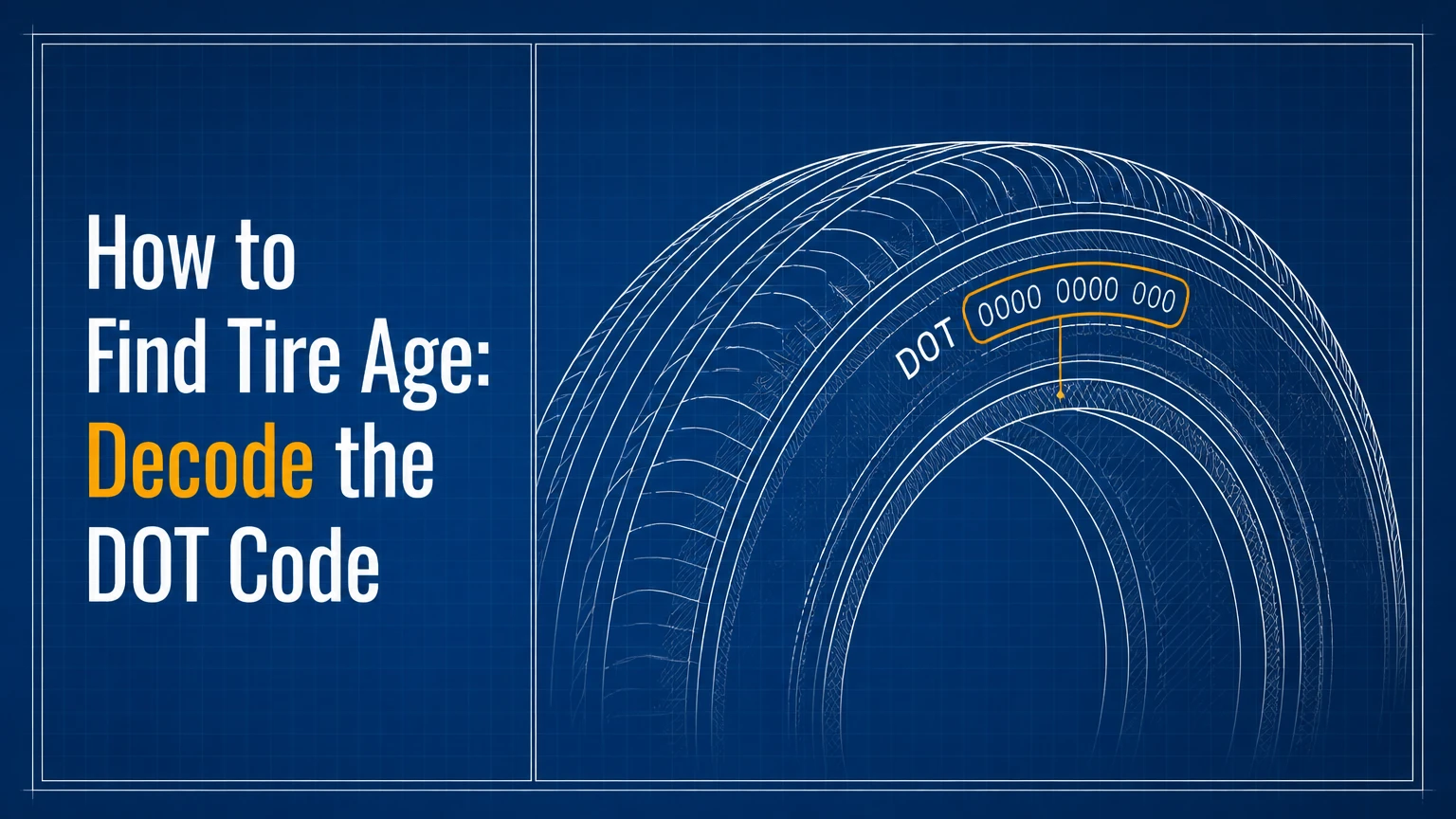
To find tire age, locate the DOT code on the tire sidewall and read its final four digits as week and year of manufacture. A code ending in 2423 means the tire was produced during the 24th week of 2023. Tire age is separate from tread depth, mileage, and whether the tire has been driven.
Key Facts at a Glance
The last four digits of a modern DOT code show the manufacturing week and year in WWYY format.
A code ending in 1221 means the tire was made in week 12 of 2021, not December 2021.
The complete date code may appear only on the inner sidewall, so the outer sidewall can be insufficient.
Tire manufacturers commonly recommend replacement around 10 years from manufacture, while many vehicle makers advise inspection or replacement earlier.
A three-digit date code indicates manufacture before 2000 and makes the tire too old for normal road use.
Tread depth cannot reveal a tire’s age or detect every form of heat, oxidation, and internal rubber deterioration.
What Does Tire Age Mean?
Tire age is the elapsed time since a tire was manufactured, not the time since installation or the number of miles driven. A tire produced in 2021 remains a 2021 tire if it spent four years in a warehouse, on a spare-wheel carrier, or in a garage.
Rubber compounds gradually change through thermo-oxidative aging. Oxygen, heat, sunlight, ozone, moisture, underinflation, and long periods of vehicle storage can accelerate surface cracking or internal deterioration. The DOT date cannot measure storage conditions, but it provides the essential starting point for a safety assessment.
Tread wear answers a different question: how much usable tread remains. A low-mileage tire can have deep tread but aged sidewalls, while a heavily driven tire may be newer but worn out. NHTSA’s tire-aging review explains that age-related failure involves material degradation and that mileage alone cannot predict the condition of every tire.
A tire’s manufacture date is therefore a screening measurement, not a complete condition diagnosis. A tire with an acceptable date can still be unsafe because of a bulge, puncture repair, exposed cords, severe uneven wear, or chronic underinflation.
Where Can You Find the DOT Code?
The DOT code is molded into the lower sidewall near the wheel rim. Search for the raised letters DOT, followed by a longer series of letters and numbers. A flashlight, phone camera, and clean cloth make the inspection faster, especially on a dirty black sidewall.
The date appears at the end of the Tire Identification Number, often called the TIN. The complete TIN is required on at least one sidewall, but some tires carry a shortened TIN without the date on the opposite sidewall. Goodyear describes the final four digits as the manufacturing date, with the first pair identifying the week and the second pair identifying the year.
A visible string such as DOT 4B08 CXAR 1224 should be read from the end. The plant and characteristic codes precede the date; 1224 is the relevant date portion. The characters 4B, 08, and CXAR are not separate month, day, and year values.
Do not confuse the DOT marking with other sidewall information. Tire size, load index, speed rating, maximum load, maximum inflation pressure, UTQG grades, and molded safety warnings may appear nearby, but none of those markings gives the manufacturing date.
Before You Start
| Requirement | Typical value | Practical note |
|---|---|---|
| Inspection time | 5-15 minutes per vehicle | Add time if the date faces inward |
| Difficulty | Basic visual inspection | No tire removal is needed for an exposed code |
| Cost | $0 at home | A shop may charge a normal inspection fee |
| Tools | Flashlight, phone camera, cloth | Use a mirror for limited wheel access |
| Safety prerequisite | Parked vehicle, parking brake applied | Never place hands under an unsupported vehicle |
| Access problem | Inner sidewall or hidden code | Use a tire shop rather than removing a tire yourself |
Inspect the tire while the vehicle is parked on level ground. Turn the steering wheel to expose the front tire sidewalls, but do not crawl beneath a vehicle supported only by a jack. Rear tires and inner sidewalls may require a mirror, wheel removal, or professional equipment.
Record the date code from all four road tires and the spare. Tires fitted to the same axle may have been manufactured in different weeks or years, particularly after a replacement.
How to Find Tire Age in Five Steps
Step 1: Find the DOT Marking
Locate the raised DOT letters on the sidewall close to the rim. Follow the marking toward its final group of characters rather than stopping at the first two numbers.
The DOT marking can be difficult to see because manufacturers mold it into the rubber instead of printing it with contrasting ink. Wipe away dirt, direct a flashlight across the sidewall at a shallow angle, and photograph the area with your phone.
You’ll know it worked when: you can identify a continuous alphanumeric string that begins with DOT.
Common mistake: reading the tire size, such as 225/65R17, as the date. Tire size describes dimensions and wheel fitment; it does not identify manufacture time.
Step 2: Check Both Sidewalls
Inspect the opposite sidewall if the visible code ends in letters or stops before a four-digit group. On many passenger tires, the full TIN with the date is molded on one side only, while the other side shows a partial identification number.
The date may face the vehicle, particularly when a tire was mounted with its serial side inward. Directional tread patterns do not change the need to inspect the inner sidewall. If the wheel blocks your view, a technician can read the code during rotation or remove the wheel safely.
You’ll know it worked when: the TIN ends with a three-digit or four-digit date group.
Common mistake: assuming a missing date means the tire has no age code. The more likely explanation is that the full TIN is on the inner sidewall.
Step 3: Isolate the Final Digits
Use only the final three or four digits of the complete TIN. Modern tires use four digits, while tires manufactured before 2000 use three digits.
| Example ending | Code type | Meaning | Approximate production period |
|---|---|---|---|
| 0124 | Four digit | Week 01 of 2024 | Early January 2024 |
| 2423 | Four digit | Week 24 of 2023 | June 2023 |
| 5220 | Four digit | Week 52 of 2020 | Late December 2020 |
| 159 | Three digit | Week 15 of a year ending in 9 | Before 2000 |
| 159 with triangle | Three digit with triangle | Week 15 of 1999 | Pre-2000 |
Valid modern week values generally run from 01 through 52, although some production calendars include week 53. A code with 00 as its week or a clearly impossible ending such as 6824 should be rechecked because it may have been misread or may not be the date portion.
You’ll know it worked when: the final four digits form a plausible WWYY sequence.
Common mistake: interpreting 1221 as December 2021. The correct interpretation is week 12 of 2021, usually around March.
Step 4: Convert the Code to a Manufacturing Date
Split a four-digit code into two pairs. The first pair is the production week, and the second pair is the last two digits of the production year.
For example:
- 2423 = week 24 of 2023
- 4822 = week 48 of 2022
- 0625 = week 6 of 2025
- 0119 = week 1 of 2019
The week code does not identify a precise day. To estimate calendar timing, multiply the week number by seven and compare it with a calendar, but treat the result as approximate because manufacturing weeks and calendar weeks do not align perfectly.
To estimate chronological age, count from the beginning of the coded production week to today. For a practical safety decision, the difference of a few days is less important than whether the tire is approaching a manufacturer’s inspection or replacement recommendation.
You’ll know it worked when: you can write down both a production week and a production year without guessing a month.
Common mistake: using the tire’s installation date. The age calculation starts at manufacture, not at purchase, mounting, or first use.
Step 5: Record and Compare Every Tire
Write each DOT date beside the tire position, such as front left, front right, rear left, rear right, and spare. Photographing the code creates a useful maintenance record for future inspections or a used-car purchase.
A difference of several weeks between tires is usually a purchasing-history issue, not automatically a safety defect. A difference of several years deserves closer examination because replacement tires may have been mixed with an older set.
You’ll know it worked when: every tire has a recorded date or a documented reason why its date could not be viewed.
Common mistake: checking only the newest-looking tire. The oldest tire, including an unused spare, often determines the immediate inspection priority.
How Do You Read a Three-Digit Tire Date Code?
A three-digit code means the tire was manufactured before 2000. The first two digits identify the production week, and the final digit identifies the year within an ambiguous decade. A triangle symbol after the digits was used on some tires to indicate the 1990s rather than the 1980s.
For example, 159 could mean week 15 of 1989 or week 15 of 1999. 159▲ generally identifies week 15 of 1999. The triangle is not present on every legacy tire, so the absence of a triangle does not reliably establish the decade.
The practical decision is straightforward: a three-digit date code identifies a tire that is at least roughly 26 years old in 2026. That age is far beyond the replacement windows published by major tire manufacturers and vehicle makers, regardless of remaining tread.
A three-digit code does not mean the rubber instantly failed when the calendar reached 2000. The safety problem is that the tire is now extremely old and its date may be difficult to interpret accurately. Do not install or drive on such a tire; replace it through a qualified tire retailer.
When Should an Old Tire Be Replaced?
There is no single universal legal expiration date for every tire, vehicle, climate, and use pattern. Tire manufacturers commonly advise removing tires at 10 years from manufacture, while some vehicle manufacturers advise inspection after five years and replacement around six years.
| Tire age from manufacture | Typical action | Reason | Decision priority |
|---|---|---|---|
| Under 5 years | Inspect during routine maintenance | Age alone is usually not the deciding factor | Condition, pressure, and wear |
| 5-6 years | Arrange professional inspections at least annually | Rubber aging becomes more relevant | Sidewalls, tread base, vibration |
| 6-9 years | Follow the vehicle and tire maker’s stricter guidance | Heat and storage history can reduce margin | Replacement planning |
| 10 years or more | Replace regardless of tread appearance | Major manufacturers commonly recommend retirement | Do not postpone for extra tread |
| Any age with bulge or exposed cord | Remove immediately | Structural damage can cause rapid failure | Stop driving on the tire |
Michelin, Bridgestone, Continental, Goodyear, Ford, and BMW publish age-related guidance, but their exact recommendations differ. Michelin’s consumer guidance commonly states that tires should be professionally inspected after five years and replaced at 10 years as a precaution, while some vehicle manuals specify a six-year limit.
Treat those figures as manufacturer recommendations, not a guarantee that a six-year tire is unsafe or that a nine-year tire is safe. Climate, inflation history, ultraviolet exposure, load, speed, and visible damage change the risk. A tire shop should inspect aging tires because surface appearance cannot reveal every internal defect.
Which Tire Conditions Override the Age Calculation?
Replace or remove a tire at any age when it has a sidewall bulge, deep crack, exposed cord, tread separation, repeated air loss, severe impact damage, or an unsafe puncture repair. A tire with adequate age but structural damage is not made safe by its remaining tread.
Check the tread for exposed wear bars, irregular shoulder wear, cupping, heel-and-toe wear, and embedded objects. Measure tread depth with a gauge rather than estimating by sight. Legal minimums vary by location, and winter traction can become poor well before the legal limit.
Expert insight: a slow leak can create more heat damage than a high-mileage history because underinflation increases sidewall flex. Heat and flex may damage internal components before a driver sees a dramatic tread change.
How Do Tire Age, Tread, and Storage Compare?
Tire age, tread depth, mileage, and storage history measure different risk factors. A sound decision uses all four rather than allowing one favorable measurement to override a serious defect.
| Factor | What it measures | Useful inspection method | Limitation |
|---|---|---|---|
| DOT age | Time since manufacture | Final WWYY digits | Does not reveal storage conditions |
| Tread depth | Remaining tread rubber | Calibrated tread-depth gauge | Does not reveal internal aging |
| Mileage | Distance driven | Vehicle service records | Driving style and alignment alter wear |
| Storage history | Heat, UV, moisture, load exposure | Owner records and visual inspection | Often incomplete or unverifiable |
| Inflation history | Flex and heat stress | Pressure records, leak checks | Past underinflation may leave hidden damage |
| Physical condition | Cracks, bulges, separation, punctures | Professional visual and hands-on inspection | Internal damage may require specialized assessment |
Unused does not mean unaged. A full-size spare can have 100 percent tread and still be older than the four tires on the vehicle. Tires stored outdoors, beside electric motors that generate ozone, or in direct sunlight may age faster than tires kept indoors in cool, dry conditions.
A tire’s manufacture date is also not a freshness guarantee. New tires are normally sold through established distribution channels, but buyers should inspect the date when purchasing clearance, specialty, vintage, recreational-vehicle, or uncommon-size tires.
What If the DOT Code Is Missing or Damaged?
A missing visible date code usually means the complete TIN faces inward, not that the tire lacks a manufacturing date. Inspect the inner sidewall with a mirror or ask a tire shop to expose the code during a rotation.
| Problem | Likely cause | Safe response | Avoid |
|---|---|---|---|
| Code ends in letters | Partial TIN on outward side | Inspect the opposite sidewall | Assuming the tire is undated |
| Mud or brake dust covers code | Surface contamination | Clean gently and use angled light | Abrading the molded rubber |
| Curb damage erased digits | Sidewall abrasion | Compare records and ask a technician | Guessing the tire’s age |
| Tire mounted inward | Full TIN hidden behind wheel | Use a shop or professional lift | Crawling under an unsupported car |
| Code is only three digits | Pre-2000 manufacture | Replace the tire | Treating it as a current tire |
| Code appears impossible | Misread characters or wrong marking | Photograph and verify with retailer | Using a plant code as the date |
Do not scrape aggressively at molded characters. Removing rubber can make the code less legible and may damage the sidewall. If the date window is destroyed, the safest practical approach is replacement when age cannot be verified, especially on a high-speed passenger vehicle, trailer, motorhome, or motorcycle.
The corresponding tire on the same axle can provide useful purchasing context, but it cannot prove the damaged tire’s date. Matching dates are evidence of a shared batch, not a substitute for the missing code.
Does the Method Work for Trailer, RV, and Light-Truck Tires?
The same final-digit method generally applies to highway tires marked with ST, LT, or passenger-car designations. An ST tire ending in 3022 was manufactured in week 30 of 2022, just like a passenger tire with the same date ending.
Trailer and RV tires deserve stricter inspection because long storage, high loads, sun exposure, and extended periods of underinflation can combine. A trailer tire may accumulate few miles while experiencing high sidewall stress when loaded or parked for months.
Check the spare, valve stems, inflation pressure, load rating, and sidewalls before every substantial trip. Replace tires according to the tire manufacturer’s published age guidance and the vehicle or trailer maker’s manual, with five to six years often used as a conservative planning interval for heavily stored recreational equipment.
A low annual mileage pattern is not a reason to extend the interval automatically. Parked tires still experience oxidation, and a vehicle that sits on one section of tread can develop flat spotting or localized stress.
Common Mistakes and How to Fix Them
| Mistake | Why it fails | Correction | Practical consequence |
|---|---|---|---|
| Reading the first numbers after DOT | Those characters identify plant or tire characteristics | Use the final three or four digits | Prevents a false age |
| Checking one sidewall only | The full TIN may face inward | Inspect both sides | Finds the actual manufacture week |
| Reading WWYY as month and year | Tire dates use production weeks | Decode 12 as week 12 | Avoids a wrong month |
| Trusting tread depth alone | Tread does not measure oxidation | Combine date and condition checks | Reduces hidden-aging risk |
| Ignoring the spare | Spares can be older than road tires | Record the spare separately | Prevents an emergency failure |
| Assuming six years is a universal law | Recommendations vary by maker and market | Consult the manual and tire maker | Produces a condition-based decision |
Expert insight: the oldest tire is not always the tire with the oldest-looking tread. Alignment, road camber, and inflation can make a newer tire appear worse, while a lightly used older tire may look nearly new.
Expert insight: tire age should be recorded at installation, not discovered during a roadside failure. A date photograph, purchase receipt, and tire-position log make later replacement decisions much more reliable.
Expert insight: replacing only one tire can create handling and traction differences. Ask the vehicle manufacturer or tire professional about axle pairing, tread-depth matching, and whether a full-axle replacement is appropriate.
How Much Does It Cost to Check Tire Age?
Finding and decoding a visible DOT date costs nothing at home. A professional inspection may be free with a tire rotation or may carry a typical service charge of approximately $0-$40, depending on the shop and region.
| Service or purchase decision | Typical cost range | Time range | Best use |
|---|---|---|---|
| Home visual check | $0 | 5-15 minutes | Exposed sidewall date |
| Phone photograph and record | $0 | 2-5 minutes | Maintenance documentation |
| Tire rotation with date check | $20-$80 | 30-60 minutes | Hidden inner-sidewall codes |
| Wheel removal for inspection | $20-$60 | 20-45 minutes | Blocked or inward-facing date |
| Four replacement passenger tires | $400-$1,200 | 1-2 hours | Typical compact to midsize vehicle |
| RV or trailer replacement set | $500-$2,000 or more | 1-3 hours | Load-rated specialty applications |
Prices vary substantially with tire size, brand, load range, wheel design, taxes, balancing, disposal fees, and local labor rates. Online DOT decoders can explain a code, but they cannot determine whether a tire has internal damage or unsafe storage history.
A Practical Inspection Schedule
Check tire dates at least annually and whenever buying a used vehicle, changing seasonal tires, storing an RV, or preparing a trailer for a long trip. Record the date, tire position, tread depth, cold inflation pressure, and visible condition.
For a used car, inspect all four road tires and the spare before agreeing on a price. If one or more tires are near a replacement recommendation, include a complete tire replacement estimate in the purchase calculation rather than valuing the tires by tread depth alone.
For fleets, store the complete DOT codes in the maintenance system with vehicle identification, axle position, installation date, and inspection findings. A fleet policy can set an earlier retirement threshold, such as six years, but that is an operational rule rather than a universal DOT requirement.
Frequently Asked Questions
Can You Find Tire Age Without the DOT Code?
You usually cannot determine an exact manufacturing date without the DOT code or a manufacturer record. A purchase invoice, installation receipt, vehicle service record, or tire retailer database may establish an approximate date, but those records often show sale or installation rather than manufacture. If the molded code is destroyed, replacement is safer than guessing.
Are Tires From 2021 Too Old in 2026?
A tire made in 2021 is approximately four to five years old in 2026, so age alone does not automatically require replacement. The tire still needs inspection for cracking, bulges, uneven wear, pressure loss, heat damage, and tread condition. Follow the specific tire manufacturer’s guidance and the vehicle owner’s manual.
Do New Tires Expire Before They Are Used?
New tires continue to age before installation because rubber degradation begins after manufacture. Proper indoor storage slows deterioration, while heat, sunlight, ozone, and moisture can accelerate it. Check the DOT date on newly purchased tires, particularly for uncommon sizes, clearance stock, spare tires, and recreational vehicles.
Can a Tire Shop Read an Inner-Sidewall Date?
A tire shop can normally read an inner-sidewall date during a rotation, wheel removal, or tire service. Technicians have safe lifting equipment and can inspect areas that are inaccessible from outside. Do not place your body under a vehicle supported only by a jack to reach the code.
Does Tire Age Affect Tire Pressure?
Age does not directly set the correct inflation pressure, because the recommended pressure comes from the vehicle placard or owner’s manual. Aging, cracking, valve damage, and bead leaks can increase air loss, while underinflation generates heat and flex that accelerate deterioration. Check pressure cold at least monthly and before long trips.
Should You Replace All Four Tires When One Is Old?
Replacing all four tires is often the simplest way to restore consistent age, tread, and handling, but the correct choice depends on drivetrain, tread-depth difference, tire type, and vehicle-maker instructions. Replacing only one tire can create traction or rolling-circumference differences, so consult a tire professional before mixing a new tire with older tires.
The Bottom Line
To find tire age, locate the DOT code, inspect both sidewalls, and decode the final four digits as the production week and year. Record every tire, including the spare, because tire age is independent of tread depth and mileage.
A modern code such as 2423 means week 24 of 2023. A three-digit code identifies a pre-2000 tire and warrants replacement. Use the manufacture date with physical condition, inflation history, storage exposure, vehicle guidance, and tire-maker recommendations. The DOT date starts the safety assessment; it does not finish it.