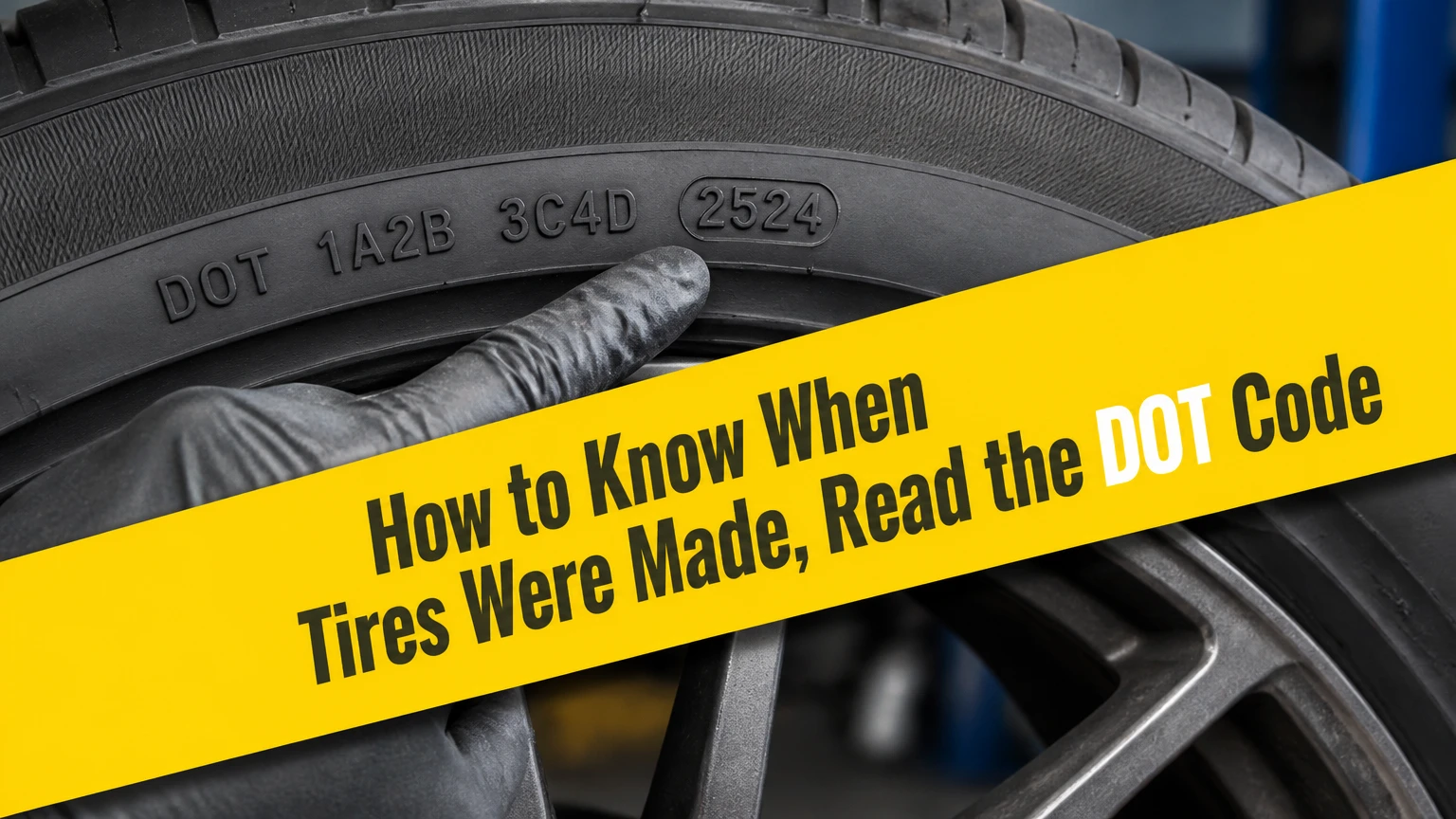
To know when tires were made, find the DOT tire identification number on the sidewall and read its final four digits. The first two digits identify the production week, and the last two identify the year. A code of 2425 means the tire was produced in week 24 of 2025, not necessarily in June.
Key Facts at a Glance
The last four digits of a modern DOT code show the tire’s production week and year.
The date code may appear on only one sidewall, often the side facing the vehicle.
A four-digit code such as 1823 means week 18 of 2023.
A three-digit date code identifies a tire made before 2000 and is too ambiguous for normal road use today.
Tire age begins at manufacture, not at retail sale or installation.
Tread depth cannot reveal a tire’s age or confirm that its internal structure remains sound.
How to Know When Tires Were Made
A tire’s manufacturing date is encoded in the DOT tire identification number, usually called the DOT code or DOT TIN. Look for the raised letters DOT on either sidewall, then locate the final four consecutive digits in the complete code.
For example, DOT X9AB CDEF 3522 indicates production during the 35th week of 2022. The characters before 3522 identify manufacturing information, such as the plant and tire characteristics; they do not provide the production date.
The date identifies a production week rather than an exact day. Week 01 generally falls near the beginning of January, while week 52 occurs near the end of December, but the code does not specify the weekday. A tire marked 0124 was made in the first production week of 2024.
What Does a DOT Code Contain?
The DOT TIN links a tire to manufacturing and identification information. The date portion is the part consumers normally need, but the remaining characters help tire manufacturers and regulators trace products during safety campaigns or recalls.
| Code portion | Typical appearance | What it identifies | Consumer use |
|---|---|---|---|
| DOT prefix | DOT | U.S. compliance identification | Confirms the marking begins a TIN |
| Plant code | 2-3 letters or numbers | Manufacturing facility | Helps identify production source |
| Tire size code | 2 characters | Manufacturer size reference | Does not replace the sidewall size |
| Brand characteristics | 3-4 characters | Construction or product attributes | Useful for manufacturer traceability |
| Date code | 4 digits | Week and year of manufacture | Determines tire age |
The full TIN structure can vary by manufacturer and regulatory revision. The reliable consumer rule is simple: the final four digits of a modern complete DOT TIN are the date code.
Where Is the Tire Date Code?
The date code is molded into a tire sidewall, not printed on the tread, wheel, valve stem, or vehicle registration label. Inspect the outward-facing sidewall first, but check the inward-facing sidewall if the DOT string ends without four digits.
Federal tire-marking rules permit a manufacturer to place the complete TIN on one sidewall and a shortened TIN on the other. Mounting orientation therefore determines whether the date is visible without removing the tire.
Use a bright flashlight and turn the steering wheel to create more viewing space around the front tires. Never place any part of your body under a vehicle supported only by a jack. For rear tires, a tire shop can read the inward sidewall safely on a lift.
How Do You Find the Complete Code?
Follow these steps:
- Park on level ground. Set the parking brake and switch off the vehicle.
- Clean the sidewall lightly. Use water, mild soap, and a nylon brush if dirt fills the molded characters.
- Find “DOT.” Search the sidewall near the bead, shoulder, or lower sidewall.
- Trace the entire character string. Do not stop at the first group after DOT.
- Locate the final four digits. They may appear in a rounded rectangular or oval-shaped molded area.
- Check the opposite sidewall. Look there if the visible code has no four-digit ending.
- Photograph each code. A phone image makes comparisons between tires easier.
You will know you found the date when four digits appear together at the end of the complete TIN. A random four-digit number elsewhere on the sidewall may be a mold, specification, or approval marking rather than the manufacturing date.
How Do You Decode Four Digits?
Read the first two digits as the production week and the last two digits as the production year. The code 4021 means the tire was manufactured in week 40 of 2021, while 0824 means week 08 of 2024.
| Date code | Production week | Production year | Approximate calendar period |
|---|---|---|---|
| 0124 | 01 | 2024 | Early January 2024 |
| 1823 | 18 | 2023 | Early May 2023 |
| 3522 | 35 | 2022 | Late August 2022 |
| 4821 | 48 | 2021 | Late November 2021 |
| 1020 | 10 | 2020 | Early March 2020 |
The week is a two-digit value from 01 through 52 in normal consumer tire codes. The year is also two digits, so 2319 means week 23 of 2019, not 1919.
A date code does not reveal when a tire was shipped, sold, installed, or first driven. Those events may happen months or years after production. Keep the invoice and installation date separately if you need a complete ownership record.
Does 2425 Mean June 2025?
Code 2425 means week 24 of 2025, which falls around mid-June, but the code does not guarantee a specific June date. Production weeks follow manufacturing and regulatory conventions, so calendar conversions are approximate.
That distinction matters when a seller describes a tire as “made in June.” The defensible statement is manufactured in week 24 of 2025. The date code supplies a week and year, not a day.
How Are Tires Made Before 2000 Identified?
Tires manufactured before 2000 can have a three-digit date code. The first two digits indicate the production week, and the final digit indicates the year within a decade, creating unavoidable ambiguity.
For example, 149 may mean week 14 of 1989 or week 14 of 1999. Some 1990s tires have a small triangle after the three digits to distinguish them from tires made in the 1980s, but the marking may be difficult to see or may not be present.
| Date marking | Possible interpretation | Modern safety decision | Recommended action |
|---|---|---|---|
| 149 | Week 14 of 1989 or 1999 | More than 25 years old | Replace |
| 231△ | Week 23 of 1991 or 1999, triangle present | More than 25 years old | Replace |
| 402 | Week 40 of 1982 or 1992 | More than 30 years old | Replace |
| 4-digit code | Week and year after 1999 | Age can be calculated | Inspect condition and history |
A three-digit code is not a usable sign of a roadworthy tire today. Even if the tire was made in 1999 rather than 1989, its age exceeds the service-life guidance published by major tire manufacturers.
What If the Tire Has an E-Mark Instead?
An E-mark identifies European regulatory approval, but it does not replace the DOT date code when a tire is also intended for the U.S. market. The marking usually appears as a capital E inside a circle followed by approval digits, while the manufacturing date is normally found in a separate DOT TIN.
Tires sold primarily outside the United States may use regional identification systems, manufacturer date markings, or other approval codes. An E-mark alone does not tell you the production week and year.
| Marking | Primary meaning | Is it the manufacturing date? | Best next step |
|---|---|---|---|
| DOT | U.S. tire identification prefix | No | Find the final four digits |
| E in circle | European type approval | No | Search for a separate TIN |
| UTQG | Treadwear, traction, temperature ratings | No | Do not use for age |
| M+S or 3PMSF | Mud-and-snow or severe-snow designation | No | Do not use for age |
| Tire size | Width, aspect ratio, wheel diameter | No | Use only to verify fitment |
Industrial, agricultural, racing, and specialty tires may follow different marking rules. Contact the tire manufacturer with photographs and the full sidewall markings when a complete date code is absent.
Which Tires Should You Check?
Check every tire that may be used on the road, including the spare. A vehicle’s four installed tires can have different production dates, and an unused spare can be older than the tires currently carrying the vehicle.
Inspect the full set during a used-car purchase, annual maintenance, or tire rotation. Record each tire’s position, brand, model, size, load index, speed rating, and DOT date.
| Tire position | Why age matters | Inspection priority | Typical action |
|---|---|---|---|
| Front left | Steering and braking load | High | Read date and inspect both shoulders |
| Front right | Steering, braking, curb exposure | High | Compare age and wear with left front |
| Rear left | Load and heat exposure | High | Check cracks between tread blocks |
| Rear right | Load, heat, and alignment effects | High | Check sidewall and tread condition |
| Full-size spare | May remain unused for years | High | Read code before relying on it |
| Temporary spare | Storage and inflation neglect | High | Check pressure, cracks, and date |
RV and trailer tires deserve particular attention because long storage, concentrated loads, sunlight, and underinflation can accelerate damage. A tire with abundant tread can still have age-related structural deterioration.
Why Tread Depth Alone Is Insufficient
Tread depth measures remaining groove depth, not the age or condition of the casing, belts, sidewall, or inner liner. Ultraviolet exposure, ozone, heat, repeated underinflation, chemical contamination, and long-term loading can damage rubber and internal components without quickly consuming tread.
Look for sidewall cracking, cracks in the tread grooves, bulges, localized deformation, exposed cords, impact damage, and vibration. Do not attempt to repair a tire with a sidewall bulge or exposed reinforcing material.
The U.S. Tire Manufacturers Association states that tires should receive regular inspection by a trained professional, particularly as they age. Manufacturers including Michelin and Continental commonly recommend replacement at 10 years from manufacture, even when tread remains, while recommending closer inspection after approximately five years in service. These are manufacturer recommendations, not one universal expiration statute for every tire and jurisdiction.
When Should an Old Tire Be Replaced?
Replace a tire immediately when it has a bulge, exposed cord, serious cracking, impact damage, persistent air loss, or an unrepairable puncture, regardless of its DOT date. For age alone, follow the tire maker’s service guidance; many major manufacturers advise annual professional inspection after five years in service and removal at ten years from manufacture.
| Tire age from manufacture | Practical evaluation | Typical decision |
|---|---|---|
| 0-3 years | Check storage history and physical condition | Usually eligible if undamaged |
| 4-5 years | Inspect condition, pressure history, and cracking | Professional inspection advisable |
| 6-9 years | Annual inspection and closer monitoring | Replace sooner if exposed or damaged |
| 10 years or more | Beyond common major-manufacturer limit | Replace regardless of tread |
| Unknown age | Safety history cannot be verified | Treat as high risk; obtain inspection |
Climate changes the risk profile. High heat, direct sun, ozone, heavy loads, and chronic underinflation can age a tire faster than cool, shaded storage, although storage does not stop rubber degradation.
How Should Buyers Evaluate Tire Age?
A tire made one or two years before purchase is not automatically defective. Buyers should combine the DOT date with storage conditions, physical condition, warranty terms, price, and whether all tires form a compatible set.
A new tire purchased from a reputable retailer should be free of damage and stored according to the manufacturer’s requirements. There is no universal rule that bans sale after five years on a shelf, but a retailer should be able to explain an older tire’s condition and warranty coverage.
Ask the seller for:
- The DOT date on every tire.
- The installation date and mileage, if known.
- Storage history for unmounted tires.
- Evidence of repairs, impacts, or prolonged underinflation.
- The retailer’s warranty and return policy.
- Confirmation that load index, speed rating, and size match the vehicle.
The practical issue is remaining service life. A tire manufactured four years ago may provide less age margin than a tire manufactured four weeks ago, even if both are unused.
What Does Tire-Age Checking Cost?
Reading the code yourself costs nothing, but professional inspection, removal, or replacement may add charges. Prices vary by region, vehicle, tire size, run-flat construction, and retailer.
| Service or purchase | Typical U.S. price range | Time required | What it includes |
|---|---|---|---|
| Owner visual date check | $0 | 5-15 minutes | Sidewall code reading |
| Shop age inspection | $0-$30 | 10-30 minutes | Code and condition check |
| Mount and balance | $20-$50 per tire | 30-60 minutes per axle | Removal, installation, balancing |
| Standard passenger tire | $80-$250 each | 1-2 hours for four | Tire only, typical range |
| Run-flat or specialty tire | $150-$400 each | 1-3 hours for four | Tire only, typical range |
These are typical retail ranges, not fixed prices. Disposal fees, tax, alignment, roadside service, and tire-pressure monitoring sensor work may be additional.
What If the DOT Code Is Missing or Unreadable?
A missing date on the outward-facing sidewall does not prove the tire lacks a manufacturing date. Inspect the opposite sidewall first, because the complete TIN may face inward.
If dirt hides the code, use mild soap, water, and a nylon brush. Avoid aggressive grinding, solvents, knives, or heat, because sidewall damage can remove the evidence and weaken the tire.
If the characters are scuffed away, use these recovery options:
- Photograph the visible partial code.
- Ask a tire shop to inspect the inward sidewall.
- Compare the other tires, especially tires installed together.
- Contact the manufacturer with the full model, size, serial markings, and photographs.
- Replace the tire if its age and condition cannot be established for safety-critical use.
Do not infer a tire’s date from a vehicle’s purchase date, a molded casting number, or a matching tire on the opposite axle. Matching tires may have been produced weeks or months apart.
Common Mistakes When Reading Tire Age
Several errors repeatedly produce the wrong manufacturing date.
Mistake 1: Reading the first four numbers
The characters immediately after DOT are not necessarily the date. Read the final four digits of the complete TIN, including the sidewall facing the vehicle.
Mistake 2: Treating the week as a month
Code 1221 means week 12 of 2021, roughly March 2021. It does not mean December 2021, and it does not provide an exact day.
Mistake 3: Assuming all four tires have the same age
Tire shops and vehicle owners often replace tires in pairs or singly. Record each code independently before deciding whether the set is uniform.
Mistake 4: Using tread depth as an age substitute
A six-year-old tire with 8/32-inch tread may deserve more scrutiny than a two-year-old tire with 5/32-inch tread. Age, damage, inflation history, and tread wear answer different safety questions.
Mistake 5: Forgetting the spare
A spare stored in a dark trunk still experiences time, temperature changes, and rubber aging. A flat spare may also have lost pressure, which can make it unusable when needed.
Mistake 6: Applying a universal legal expiration date
The United States does not impose one blanket ten-year expiration rule for every consumer tire. Manufacturer recommendations, state requirements, tire category, operating conditions, and visible damage all affect the decision.
A Practical Tire-Date Record
Create a simple record after every tire installation or rotation. Write the DOT code, date, tire position, odometer reading, and installation date in the vehicle’s maintenance file.
A useful entry looks like this:
| Position | Tire model and size | DOT code | Manufacture date | Installed |
|---|---|---|---|---|
| Front left | Michelin Defender 225/65R17 | XXXX 1823 | Week 18, 2023 | 2025-02 |
| Front right | Michelin Defender 225/65R17 | XXXX 1923 | Week 19, 2023 | 2025-02 |
| Rear left | Michelin Defender 225/65R17 | XXXX 1823 | Week 18, 2023 | 2025-02 |
| Rear right | Michelin Defender 225/65R17 | XXXX 1923 | Week 19, 2023 | 2025-02 |
This record separates manufacture age from service age and makes future inspections faster. It also provides useful evidence when discussing warranty claims or a used-car purchase.
FAQ
Do tires have an expiration date printed on them?
Tires usually do not show a single expiration date. The DOT code shows the manufacturing week and year, and the tire manufacturer supplies service-life recommendations. Many major manufacturers advise inspection after five years in service and replacement at ten years from manufacture, while damage can require earlier replacement.
Can I tell how old a tire is without the DOT code?
You cannot determine a tire’s exact age reliably without its date code or manufacturer records. Tread wear, weathering, vehicle age, and purchase paperwork can suggest a timeline, but none establishes the production week and year. Treat an untraceable tire cautiously, especially on an RV, trailer, or spare.
Is a tire made two years ago safe to buy?
A two-year-old tire may be suitable if it was stored correctly, has no cracking or deformation, carries the correct specifications, and includes appropriate warranty coverage. Compare its price and remaining age margin with newer inventory. Ask the retailer for the DOT date before installation.
Should all four tires have matching DOT dates?
All four tires do not need identical DOT dates, but a large age difference deserves attention. Tires on one axle should generally be compatible in size, construction, load index, and speed rating, while the vehicle manufacturer’s replacement instructions take priority. Record each date instead of assuming a matched set.
Does a tire’s serial number reveal the exact day it was made?
The standard consumer DOT date code reveals the production week and year, not the exact day. Additional manufacturer records may contain more detailed production information, but ordinary sidewall markings generally cannot identify a specific calendar date.
The Bottom Line
To know when tires were made, find the complete DOT code and read its final four digits: the first pair is the production week, and the second pair is the year. Check both sidewalls, record every tire separately, inspect the spare, and evaluate age alongside cracking, damage, inflation history, storage, and tread condition. A tire’s manufacture date is the starting point for a safety decision, not the entire decision.