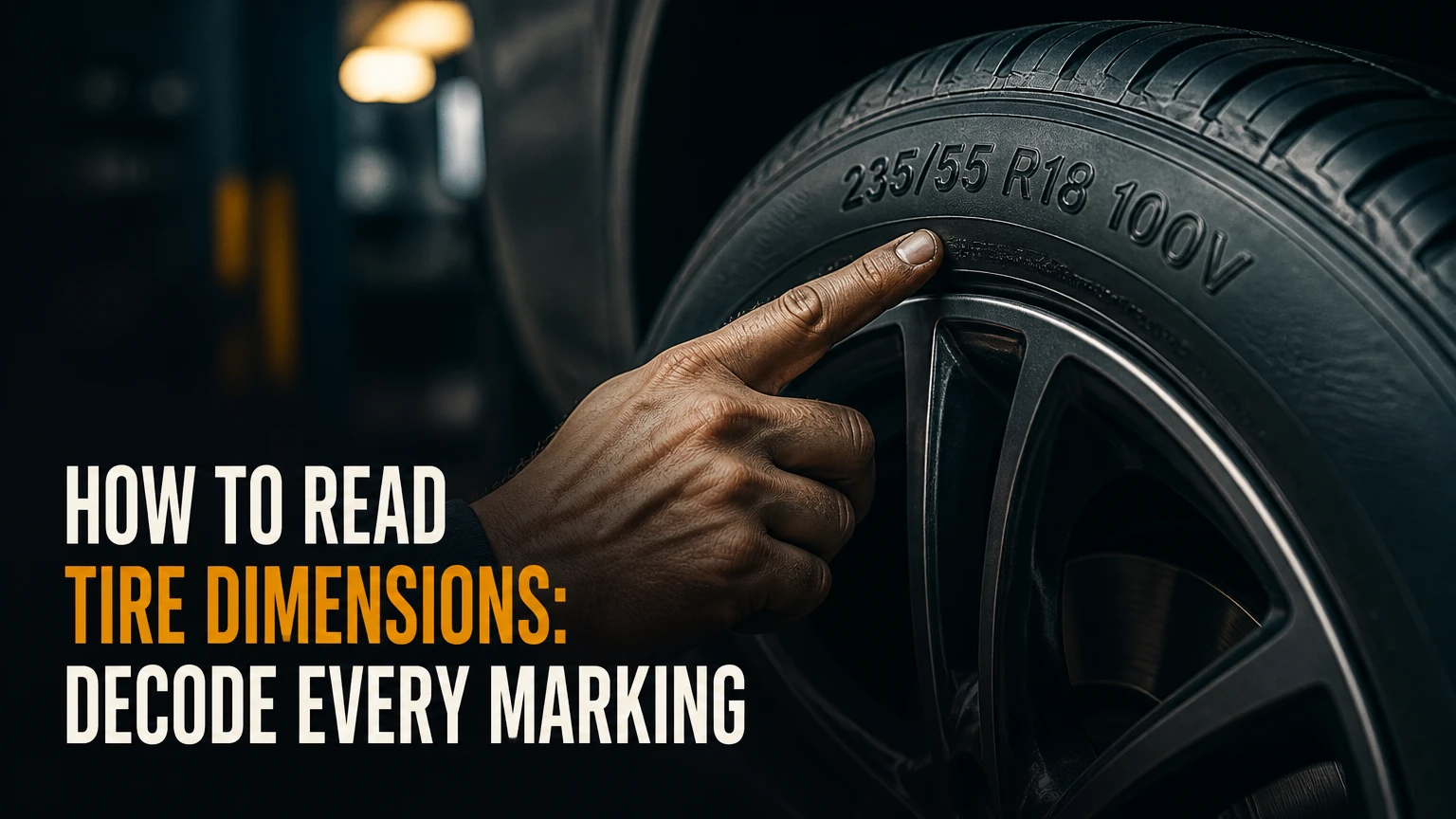
To read tire dimensions, locate the tire size string on the sidewall or vehicle placard, then decode its service type, width, aspect ratio, construction, wheel diameter, load index, and speed rating in that order. For example, P215/65R15 95H describes a passenger tire that is 215 mm wide, has a 65% aspect ratio, fits a 15-inch wheel, carries index 95, and has an H speed rating.
Key Facts at a Glance
P215/65R15 95Hhas a 215 mm section width, a 139.75 mm nominal sidewall, and a 15-inch wheel fitment.The vehicle door-jamb placard specifies recommended cold inflation pressure; the tire sidewall lists the tire’s maximum allowable pressure.
Load index 95 equals 690 kg, or 1,521 lb, per tire under the applicable rating conditions.
Speed rating H corresponds to 210 km/h, or 130 mph, but it does not authorize driving at that speed.
The four-digit DOT date code identifies the production week and year, such as
2425for week 24 of 2025.Tire size alone does not confirm vehicle fitment, brake clearance, load suitability, or all-season or winter performance.
How to Read Tire Dimensions Step by Step
Reading a tire size takes less than a minute once the characters are separated into groups. The most reliable sequence is service type, section width, aspect ratio, construction, wheel diameter, load index, and speed rating, followed by separate sidewall markings such as DOT, UTQG, and maximum pressure.
Use the tire sidewall for the tire’s actual specification, but use the driver’s door placard or owner’s manual for the vehicle’s approved size and inflation pressure. A previous owner may have installed a non-standard tire, so copying the current sidewall without checking the vehicle is unsafe.
Step 1: Find the complete size string
Look on both sidewalls if necessary. The full marking may appear only on the outward-facing side, especially when the DOT code or white lettering is molded on one side.
Common examples include:
P215/65R15 95H225/45R17 94WLT265/70R17 E31X10.50R15LT235/40ZR18 95Y
Record every character, including the letters before the width and the letters after the load index. The brand name, model name, “M+S,” mountain snowflake symbol, run-flat designation, and rotation arrow are separate information.
Step 2: Decode the service type
The first letters identify the tire’s sizing convention or intended service category. The designation does not, by itself, prove that a tire is suitable for a particular vehicle.
| Marking | Meaning | Typical application | Important limitation |
|---|---|---|---|
P |
P-Metric passenger tire | Cars, minivans, crossovers, light SUVs | Passenger-car load assumptions apply |
| No prefix | Euro-Metric tire | European cars and many global vehicles | Load capacity must be checked directly |
LT |
Light Truck tire | Pickups, commercial vans, heavy-duty use | Often heavier and firmer than P-Metric |
ST |
Special Trailer tire | Trailers and caravans | Not intended for passenger vehicles |
T |
Temporary spare | Compact or temporary replacement | Usually has restricted speed and distance |
C |
Commercial van designation in some markets | European commercial vans | Meaning depends on the regional standard |
P-Metric and Euro-Metric sizes can look identical, but their load calculations and test conventions may differ. A 215/65R15 tire without the P prefix should not automatically be treated as interchangeable with a P215/65R15 tire.
LT tires are not automatically better for every SUV or pickup. They can increase unsprung mass, steering effort, noise, fuel consumption, and impact harshness when the vehicle was designed around P-Metric tires.
Step 3: Read the section width
The first three-digit number is the nominal section width in millimeters, measured from the widest point of one sidewall to the widest point of the other sidewall when mounted on the specified measuring rim.
In P215/65R15, the 215 means a nominal width of 215 mm. Converting that figure gives approximately 8.46 inches because 215 divided by 25.4 equals 8.465.
Actual mounted width varies with rim width, tire brand, tread design, and sidewall shape. A 225 mm tire is nominally 10 mm wider than a 215 mm tire, but the measured difference may not be exactly 10 mm on two different wheels.
A wider tire can increase dry-road grip and reduce ground pressure on loose surfaces, but it may also rub the suspension, fender liner, or bodywork. Check clearance at full steering lock and through the complete suspension travel.
Step 4: Calculate the aspect ratio and sidewall height
The number after the slash is the aspect ratio, expressed as a percentage of section width. A 65 aspect ratio means the nominal sidewall height equals 65% of the 215 mm section width.
The calculation is:
215 × 0.65 = 139.75 mm
That value is the height of one sidewall, not the complete tire diameter. The approximate overall diameter is:
(2 × 139.75 mm) + (15 × 25.4 mm) = 647 mm
The example tire therefore has an approximate overall diameter of 647 mm, or 25.5 inches. Manufacturing tolerances and tread wear mean the measured diameter will differ slightly.
| Size | Nominal sidewall | Approximate overall diameter | Difference from 215/65R15 |
|---|---|---|---|
195/65R15 |
126.75 mm | 635 mm | -1.9% |
205/65R15 |
133.25 mm | 648 mm | +0.2% |
215/65R15 |
139.75 mm | 647 mm | Baseline |
225/60R15 |
135.00 mm | 651 mm | +0.6% |
235/55R15 |
129.25 mm | 644 mm | -0.5% |
A lower aspect ratio creates a shorter, stiffer sidewall. That can sharpen steering response, but it reduces impact absorption and leaves the wheel more vulnerable to pothole damage. The number is not a direct measurement in inches.
Step 5: Identify the internal construction
The R in P215/65R15 means radial construction. Radial tires use casing cords arranged approximately perpendicular to the direction of travel, with belts beneath the tread for stability.
Most modern passenger tires are radial. Other markings include:
D: diagonal or bias-ply construction, found on some specialty and vintage applications.B: bias-belted construction.ZR: a high-speed radial designation used with certain performance sizes.RF,RFT,Run Flat, or a manufacturer-specific term: run-flat capability, which must be verified in the tire maker’s documentation.
A ZR marking does not replace the speed rating. Read the complete designation, because the load index and final speed letter still determine the tire’s rated capacity.
Step 6: Read the wheel diameter
The number after the construction letter is the wheel diameter in inches. The 15 in P215/65R15 means the tire is designed for a 15-inch diameter wheel.
This is a bead-seat dimension, not the tire’s outside diameter. A 15-inch tire cannot be safely mounted on a 16-inch wheel, even if the tire’s outside diameter appears close.
Wheel width also matters. Tire manufacturers publish approved rim-width ranges, and a tire mounted on a rim outside that range can have incorrect bead seating, altered handling, or sidewall damage.
Step 7: Decode the load index
The load index is the number immediately before the speed-rating letter. Load index 95 corresponds to a maximum rated load of 690 kg, or 1,521 lb, per tire under the relevant testing conditions.
The four-tire theoretical total is 2,760 kg, or 6,085 lb, but that number does not increase the vehicle’s permitted gross axle weight rating. Vehicle limits, axle ratings, wheel capacity, suspension components, and tire pressure remain controlling.
| Load index | Maximum load per tire | Four-tire theoretical total | Common comparison |
|---|---|---|---|
| 88 | 560 kg, 1,235 lb | 2,240 kg, 4,938 lb | Smaller passenger cars |
| 91 | 615 kg, 1,356 lb | 2,460 kg, 5,425 lb | Compact and midsize cars |
| 95 | 690 kg, 1,521 lb | 2,760 kg, 6,085 lb | Many sedans and crossovers |
| 98 | 750 kg, 1,653 lb | 3,000 kg, 6,614 lb | Heavier cars and SUVs |
| 104 | 900 kg, 1,984 lb | 3,600 kg, 7,937 lb | Some vans and light trucks |
Never select a lower load index than the vehicle manufacturer specifies. Electric vehicles may require higher load capacity because battery packs add substantial mass, although the correct specification depends on the vehicle placard and manufacturer approval.
Load index is different from load range. Load range letters such as C, D, and E describe an LT tire’s casing and pressure-capability category; they do not directly equal a single load-index value.
Step 8: Decode the speed rating
The final letter indicates the maximum rated speed at the tire’s specified load and inflation conditions. An H-rated tire is rated to 210 km/h, or 130 mph.
| Rating | Maximum rated speed | Typical application |
|---|---|---|
T |
190 km/h, 118 mph | Family cars and touring tires |
H |
210 km/h, 130 mph | Sedans, crossovers, and all-season tires |
V |
240 km/h, 149 mph | Performance-oriented passenger vehicles |
W |
270 km/h, 168 mph | High-performance vehicles |
Y |
300 km/h, 186 mph | Very high-performance applications |
ZR(Y) |
Above 300 km/h, 186 mph | Selected ultra-high-performance tires |
A speed rating is not a recommended road speed. It describes laboratory capability under specified conditions, and heat, underinflation, damage, vehicle loading, and road conditions can reduce safety margins.
For replacement, match or exceed the vehicle manufacturer’s speed rating unless the owner’s manual specifically permits an alternative, such as a lower winter-tire rating with an operating-speed warning.
What Other Tire Sidewall Markings Mean
Tire sidewall markings identify age, construction, winter capability, wear testing, and pressure limits in addition to dimensions. These markings help evaluate a replacement tire, but none of them replaces the vehicle manufacturer’s fitment information.
How do you read the DOT date code?
The last four digits of a complete DOT Tire Identification Number show the production week and year. A code of 2425 means the tire was produced in the 24th week of 2025.
The DOT code may be present on only one sidewall. If the outward-facing side ends before the date digits, inspect the inner sidewall or ask a tire technician to locate the full code.
Age guidance requires more precision than a universal “six-year” rule. NHTSA recommends replacing tires at 10 years from manufacture regardless of appearance or tread, while several tire manufacturers recommend professional inspection after five years and replacement around six years. Heat, ultraviolet exposure, underinflation, storage conditions, and ozone damage can shorten useful life.
Inspect for:
- Cracks between tread blocks or in the sidewall.
- Bulges, cuts, punctures, or exposed cords.
- Repeated air loss.
- Hard, brittle rubber.
- Vibration that remains after balancing.
Tread depth cannot reveal all age-related structural deterioration. A tire can have legal tread and still require replacement.
What do UTQG numbers and letters mean?
UTQG, or Uniform Tire Quality Grading, applies primarily to passenger tires sold in the United States. The label includes treadwear, traction, and temperature grades, but the results are not universal cross-brand performance scores.
| UTQG element | Example | What it measures | Proper interpretation |
|---|---|---|---|
| Treadwear | 500 |
Relative wear in a government comparison test | 500 is expected to outlast 400 in the same test system |
| Traction | AA |
Straight-line wet braking | AA ranks above A, B, and C |
| Temperature | A |
Resistance to heat generation | A ranks above B and C |
| Full example | 500 AA A |
Combined UTQG marking | Compare similar tire categories, not unlike designs |
A treadwear grade is not a mileage warranty. Tire life depends on alignment, inflation, rotation, temperature, driving style, road surface, and vehicle weight. Winter tires and specialty tires may not carry the same UTQG information.
Should you use the tire’s maximum PSI?
No. Inflate a road tire to the cold pressure listed on the driver’s door placard, fuel-filler label, owner’s manual, or manufacturer-approved loading chart. The maximum PSI molded on the tire indicates the pressure limit associated with the tire’s maximum rated load, not the vehicle’s normal target pressure.
Pressure changes approximately 1 psi for every 10°F change in ambient temperature, although the exact change varies. Check pressure when the tires are cold, ideally after the vehicle has been parked for at least three hours.
The placard may specify different front and rear pressures. Some vehicles also require a higher pressure when heavily loaded, and temporary spares commonly have a much higher specified pressure than normal tires.
Which Tire Size Formats Are Different?
P-Metric, Euro-Metric, LT-Metric, and flotation tire sizes use related but different conventions. The safest replacement matches the vehicle’s approved size, load capacity, speed rating, construction requirements, and intended service rather than matching only the visible width and wheel diameter.
| Format | Example | Width format | Main use | Primary caution |
|---|---|---|---|---|
| P-Metric | P215/65R15 95H |
215 mm | Passenger cars and crossovers | Verify placard load requirement |
| Euro-Metric | 215/65R15 96H |
215 mm | European and global vehicles | Same-looking size may have different capacity |
| LT-Metric | LT245/75R16 120/116S |
245 mm | Pickups and commercial vehicles | Load depends on single or dual fitment |
| Flotation | 33x12.50R15LT |
12.50 in | Off-road trucks | Diameter and width must be checked separately |
| Trailer | ST205/75R15 |
205 mm | Trailers | Not suitable for a passenger vehicle |
Flotation sizing usually lists approximate overall diameter, section width, wheel diameter, and sometimes an LT suffix. The format does not directly reveal a passenger-style aspect ratio, so diameter comparisons require manufacturer data or calculation.
LT tires can be appropriate for towing, payload, commercial work, or severe off-road use. They are not automatically appropriate for a crossover simply because they have stronger construction.
How Do You Compare Two Tire Sizes?
Compare overall diameter first, then width, load capacity, wheel fitment, and clearance. A practical replacement usually keeps overall diameter within approximately 3% of the original size, but the vehicle manufacturer’s approved-size list is more authoritative than a general percentage rule.
For any metric tire, use:
- Sidewall height:
section width × aspect ratio ÷ 100 - Wheel diameter in millimeters:
wheel diameter × 25.4 - Overall diameter:
2 × sidewall height + wheel diameter
For example, changing from 215/65R15 to 225/60R15 increases nominal diameter from about 647 mm to 651 mm, a difference of approximately 0.6%. That change is small geometrically, but tire width, rim width, tread shape, load index, and suspension clearance still require confirmation.
What happens with plus sizing?
Plus sizing increases wheel diameter while reducing aspect ratio to preserve a similar outside diameter. A common example is moving from a 16-inch wheel with a 60-series tire to a 17-inch wheel with a 55-series tire.
| Original size | Plus-size example | Approximate diameter | Main change |
|---|---|---|---|
215/60R16 |
225/50R17 |
664 mm to 657 mm | Wider tread, shorter sidewall |
225/55R17 |
225/45R18 |
679 mm to 660 mm | Larger wheel, firmer ride |
235/55R18 |
245/45R19 |
716 mm to 703 mm | Wider tire, reduced sidewall |
245/50R20 |
255/45R21 |
752 mm to 738 mm | Larger wheel, lower impact cushion |
The wrong diameter can alter speedometer readings, anti-lock braking behavior, traction-control calibration, gearing, and ground clearance. AWD vehicles are especially sensitive to differences in rolling circumference between tires.
What Should You Check Before Buying Replacement Tires?
Before purchasing, compare the door-placard size with the tire’s complete service description, then verify wheel fitment, load index, speed rating, seasonal marking, and vehicle-specific restrictions. Tire retailers may list several physically similar sizes that are not approved for the same vehicle.
Use this checklist:
- Copy the placard size exactly. Record front and rear sizes separately on staggered vehicles.
- Match or exceed load index. Do not substitute a lower index because the width appears identical.
- Match the speed rating. Check the owner’s manual for approved winter-tire exceptions.
- Confirm the wheel diameter and rim-width range. A correct diameter alone is insufficient.
- Check the load range for LT tires. Confirm single or dual-wheel ratings where applicable.
- Identify the seasonal symbol. The Three-Peak Mountain Snowflake symbol indicates a tire certified for severe snow service;
M+Salone does not mean the tire is a winter tire. - Check directional and asymmetric markings.
Rotationarrows andOutsidelabels affect installation. - Inspect manufacturing age. Avoid treating old unused inventory as equivalent to fresh production.
- Confirm vehicle-specific approvals. Some cars require star, AO, MO, N, or other original-equipment markings.
- Check all four tires on AWD vehicles. Matching model, size, wear, and rolling circumference may be required.
A tire that fits the wheel can still be wrong for the vehicle. Brake clearance, suspension geometry, TPMS compatibility, and fender clearance are separate fitment questions.
Common Mistakes and How to Fix Them
Mistake 1: Treating width as tire diameter
The first number, such as 215, is width in millimeters. The 15 in the same code is wheel diameter in inches, while the tire’s overall diameter must be calculated from both sidewall heights and wheel diameter.
Mistake 2: Inflating to the sidewall maximum
The maximum PSI is not the normal vehicle setting. Reset the cold pressure to the door placard value, then recalibrate the TPMS if the vehicle requires a manual reset.
Mistake 3: Choosing a lower load index
A lower load index can reduce carrying capacity and increase heat buildup when the vehicle is loaded. Replace the tire with the placard index or a higher approved index, while confirming that the replacement tire fits the wheel.
Mistake 4: Assuming every 10-ply tire has the same capacity
“10-ply rating” is an older description associated with LT load range E. Actual capacity depends on tire size, load index, inflation pressure, and single or dual application, not the phrase alone.
Mistake 5: Mixing different tires on an AWD vehicle
Different tread depths or rolling circumferences can keep AWD clutches and differentials working continuously. Follow the vehicle manufacturer’s matching-tire policy; replacing one tire may require shaving the replacement or replacing an axle pair or complete set.
Mistake 6: Using tread depth as the only replacement test
The common legal tread threshold in the United States is 2/32 inch, but legal tread does not eliminate age, cracking, impact damage, or irregular-wear concerns. Replace damaged or aged tires before reaching that threshold.
An experienced technician checks the tire’s shoulder, inner sidewall, and inner tread. The visible outer face often hides the first signs of alignment-related wear.
How Much Do Replacement Tires Cost?
Typical replacement tire prices range from approximately $70-$130 for many 14-16-inch economy passenger tires, $130-$250 for many 17-19-inch passenger and SUV tires, and $250-$500 or more for large performance, EV, and truck applications. Installation commonly adds $20-$ fifty per tire before taxes, disposal, valves, and alignment.
| Tire category | Typical tire price | Typical four-tire set | Typical installation time |
|---|---|---|---|
| Economy passenger, 14-16 inch | $70-$130 each | $280-$520 | 45-90 minutes |
| Touring or crossover, 17-19 inch | $130-$250 each | $520-$1,000 | 60-120 minutes |
| Performance, 19-21 inch | $200-$400 each | $800-$1,600 | 60-120 minutes |
| LT truck or commercial | $180-$450 each | $720-$1,800 | 75-150 minutes |
| Specialty off-road | $250-$500 each | $1,000-$2,000 | 90-180 minutes |
These are typical retail ranges, not fixed prices. Regional labor rates, run-flat construction, tire disposal fees, TPMS service, road-hazard coverage, alignment, and seasonal demand change the final invoice.
A four-tire installation normally includes mounting and balancing. An alignment is separate and should be considered when tires show one-sided wear, the steering wheel is off-center, or the vehicle pulls after installation.
When Should You Choose Different Tire Types?
Choose tire type according to vehicle load, climate, road surface, and speed requirements rather than sidewall appearance. A commuter tire, winter tire, LT tire, and flotation tire solve different problems and create different compromises.
| Driver situation | Suitable tire direction | Specification priority | Trade-off |
|---|---|---|---|
| Daily commuting in mild climates | Touring all-season | Placard size, wet traction, 500+ treadwear where available | Less snow grip than a dedicated winter tire |
| Frequent snow and ice | Winter tire | Three-Peak Mountain Snowflake symbol, cold-weather compound | Faster warm-weather wear |
| High-speed road use | Performance summer or all-season | Vehicle-approved V, W, or Y rating | Higher cost and reduced winter performance |
| Heavy towing or payload | Approved LT-Metric tire | Load index, load range, inflation chart | More mass, noise, and ride firmness |
| EV with high curb weight | EV-approved or high-load tire | Placard load index, noise and rolling resistance | Replacement options may cost more |
| Mud, sand, and rocks | Approved all-terrain or flotation tire | Clearance, sidewall protection, load capacity | Increased noise and fuel consumption |
A high UTQG treadwear number does not guarantee superior wet braking, and an H-rated tire is not automatically safer than a T-rated tire when the vehicle is approved for T. Match the design to the use.
The Bottom Line
To understand how to read tire dimensions, decode the complete sidewall string from left to right, calculate the aspect-ratio sidewall, confirm wheel diameter, and verify load index and speed rating against the vehicle placard. Then check pressure, DOT age, seasonal marking, clearance, and AWD or manufacturer-specific requirements before buying.
The size P215/65R15 95H tells you the tire’s basic dimensions and ratings, but it does not independently prove vehicle compatibility. Use the door placard and owner’s manual as the final authority, and replace tires based on tread, age, damage, pressure history, and wear pattern.
Frequently Asked Questions
Can I install a wider tire if the wheel diameter stays the same?
A wider tire can fit the same wheel diameter, but wheel width, offset, suspension clearance, fender clearance, load capacity, and overall diameter must also remain acceptable. A 225-width tire is not a direct substitute for a 215-width tire unless the vehicle and wheel manufacturer approve the combination.
Does a higher speed rating make a tire better?
A higher speed rating indicates greater rated speed capability under specified conditions, not universally better performance. Higher-rated tires may provide sharper handling, but they can cost more, ride more firmly, wear differently, or perform poorly in cold weather compared with a properly approved touring tire.
How can I read a tire size without the letters?
A marking such as 225/45R17 omits the P service prefix but still provides width, aspect ratio, radial construction, and wheel diameter. The missing prefix generally indicates a Euro-Metric format, but load capacity must be verified from the complete service description and the vehicle placard.
Are tires with the same size interchangeable between vehicles?
Same-size tires are not automatically interchangeable between vehicles. Vehicle weight, axle load, brake clearance, rim width, speed rating, pressure requirement, TPMS system, and manufacturer-specific approvals can differ, even when both vehicles use 225/45R17.
How often should tire pressure be checked?
Check cold tire pressure at least monthly and before long trips, using a reliable gauge. Check pressure after major temperature changes or when the vehicle carries a heavy load, because underinflation increases heat, rolling resistance, shoulder wear, and fuel consumption.