To tell if tire tread is low, inspect the tread-wear bars, perform a penny or quarter test, and measure several grooves with a tread-depth gauge. Replace a tire at or below 2/32 inch where applicable, but plan replacement sooner at 4/32 inch for wet roads and around 5/32-6/32 inches for winter traction.
Key Facts at a Glance
- New passenger tires commonly measure about 10/32-12/32 inch, or 8-9.5 millimeters, although the design varies.
- Tread at 4/32 inch, or approximately 3.2 millimeters, has substantially less wet-weather margin than new tread.
- Tread-wear bars indicate approximately 2/32 inch, or 1.6 millimeters, remaining.
- A penny test can screen for very low tread, but a gauge is needed to identify gradual or uneven wear.
- A tire can be unsafe before its tread reaches the legal limit because cracks, bulges, punctures, age, or uneven wear can cause failure.
- United States tread laws differ by state, and 2/32 inch is a widely used replacement benchmark, not a universal legal rule.
How to Tell if Tire Tread Is Low
A tire has low tread when its grooves are shallow, the tread surface is level with the wear bars, or a measurement shows approximately 4/32 inch or less. Check every tire at multiple locations because one shoulder or inner edge can be dangerously worn while the center still appears acceptable.
Tire tread is the patterned rubber that contacts the pavement. Its grooves and sipes create channels for water, while the tread blocks provide edges that help the tire maintain traction during acceleration, cornering, and braking.
The U.S. National Highway Traffic Safety Administration describes tires as “the only point of contact between your vehicle and the road.” That small contact area must manage steering forces, braking forces, water, temperature, and road debris. Low tread reduces the space available to move water away from the contact patch, especially at highway speed.
A visual inspection takes about five minutes. A tread-depth gauge adds another five minutes and gives a much better answer.
What Tread Depth Is Too Low?
The following values provide a practical safety framework. The legal threshold depends on the country, state, province, tire category, and enforcement rule, so local law and the tire manufacturer’s guidance take priority.
| Remaining tread | Approximate metric value | Practical meaning | Recommended response |
|---|---|---|---|
| 10/32-12/32 inch | 7.9-9.5 mm | Typical new passenger-tire range | Maintain pressure and inspect monthly |
| 6/32-8/32 inch | 4.8-6.4 mm | Usable tread with moderate reserve | Monitor wear and rotate as specified |
| 4/32-5/32 inch | 3.2-4.0 mm | Reduced wet-weather margin | Plan replacement, especially before rainy travel |
| 5/32-6/32 inch | 4.0-4.8 mm | Common winter planning range | Consider replacement before snow season |
| 3/32 inch | 2.4 mm | Very limited remaining tread | Replace soon and avoid severe weather |
| 2/32 inch | 1.6 mm | Common legal replacement benchmark | Replace immediately where the local rule uses it |
| Below 2/32 inch | Below 1.6 mm | Bald or near-bald condition | Do not continue normal driving |
A tread depth of 2/32 inch is not a guarantee of safety until that point. Braking performance on wet pavement can deteriorate before the legal minimum, and winter tires need substantially more tread to move through snow. The Rubber Manufacturers Association, now part of the U.S. Tire Manufacturers Association, has long used 4/32 inch as a practical wet-traction warning point.
Step 1: Perform the Penny Test
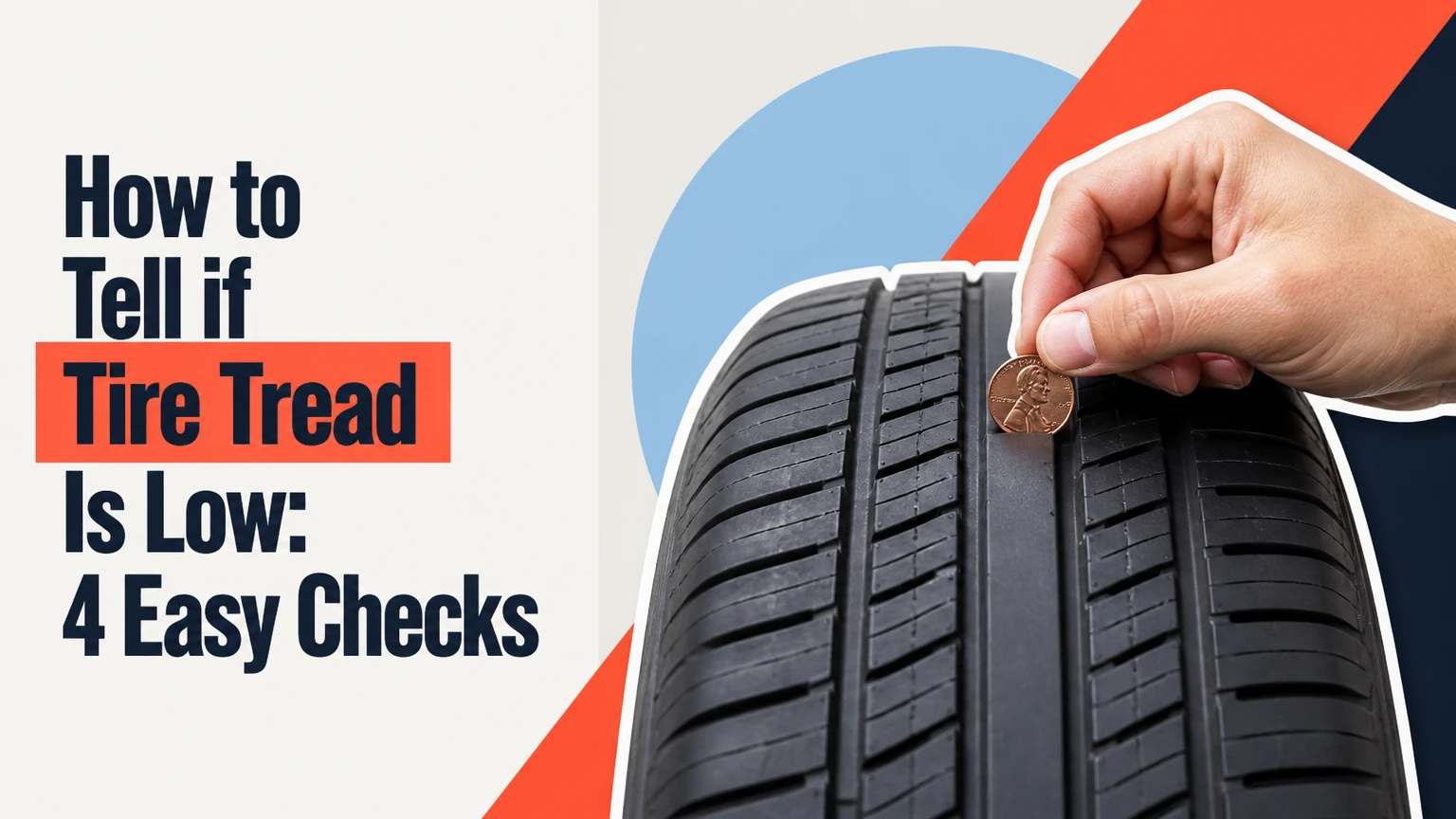
The penny test screens for tread at or below approximately 2/32 inch. Insert a United States Lincoln penny into a main groove with Lincoln’s head facing downward; if the top of Lincoln’s head is fully visible, the tire has reached the common replacement benchmark.
Follow these steps:
- Choose a main circumferential groove, not the shallow shoulder channel.
- Hold the penny so Lincoln’s head points toward the tire.
- Insert the coin into the groove with Lincoln’s head upside down.
- Check whether the tread reaches Lincoln’s hairline or covers part of his head.
- Repeat the test in at least three locations around the tire.
If the entire head is visible, treat the result as a replace-now warning. If part of Lincoln’s head is covered, the penny does not prove that the tire has adequate wet-weather reserve. It only suggests that the tread may be above the common 2/32-inch benchmark at that location.
The penny test is free and useful in an emergency. It is not a calibrated measurement, cannot diagnose uneven wear reliably, and cannot evaluate tire age or structural damage.
Step 2: Use the Quarter Test for an Earlier Warning
The quarter test identifies tread near 4/32 inch, an earlier wet-weather warning level than the penny test. Place a United States Washington quarter into a main groove with Washington’s head facing downward; if the top of his head is visible, begin planning tire replacement rather than waiting for the penny test to fail.
The quarter test works as a rough seasonal screen:
- Use a clean quarter with Washington’s head facing the tire.
- Insert it upside down into the groove.
- Test the center, inner, and outer portions of the tread.
- Look for the top of Washington’s head.
- Record any tire that exposes the top of the head.
A quarter cannot provide the precision of a gauge. Coin wear, viewing angle, groove shape, and the tire’s molding can affect the result. Still, the test is valuable because a tire at approximately 4/32 inch may remain technically above a common legal limit while offering less resistance to hydroplaning.
Drivers who regularly face heavy rain, standing water, mountain roads, or freezing temperatures should use the quarter result as a replacement-planning trigger. Snow traction may justify replacement at 5/32-6/32 inch, depending on the tire design and local conditions.
Step 3: Inspect the Tread-Wear Bars
Tread-wear bars are raised rubber bridges molded across the bottoms of the main grooves. When the surrounding tread becomes level with those bars, the tire has approximately 2/32 inch of remaining tread and should be replaced under the common legal-minimum standard.
Look for several narrow bars running across the groove from one tread block to another. Tire sidewalls often include a small triangle, “TWI” marking, or another symbol that points toward the bars. Rotate the steering wheel to expose the front-tire surface, and use a flashlight for the inside shoulder.
| Finding at the wear bar | Approximate tread condition | Action |
|---|---|---|
| Bar sits well below tread blocks | More than 2/32 inch at that point | Continue measurement and monitoring |
| Bar is nearly level with tread blocks | Near 2/32 inch | Schedule replacement promptly |
| Bar is flush with surrounding rubber | About 2/32 inch | Replace the tire |
| Bar is higher than surrounding tread | Below 2/32 inch | Stop normal use and replace |
| One bar is flush, others are recessed | Uneven wear | Measure all zones and inspect alignment |
Clean stones, mud, and packed snow from the grooves before interpreting the bars. A rock is irregular and removable; a wear bar is a uniform molded bridge repeated around the tire.
Wear bars cannot reveal whether the tire is worn to 4/32 inch. They are a late warning, not an early replacement indicator.
Step 4: Measure Tread With a Gauge
A tread-depth gauge is the most accurate home method because it produces a numerical reading in 32nds of an inch or millimeters. Use a mechanical or digital gauge and measure the inner, center, and outer tread areas on every tire.
To obtain a useful reading:
- Park on level pavement and set the parking brake.
- Check the tires when they are cool and clean.
- Push the gauge probe into a major groove.
- Keep the gauge base flat against the tread blocks.
- Avoid placing the probe on a wear bar, sipe, stone, or groove bottom irregularity.
- Record readings at the inner shoulder, center ribs, and outer shoulder.
- Repeat at four or more positions around each tire.
- Use the lowest repeatable reading when making a safety decision.
A typical mechanical gauge costs about $5-$10. A typical digital gauge costs about $10-$20 and may display millimeters or 32nds, but digital accuracy does not compensate for poor placement.
Which Checking Method Is Best?
The best method depends on the decision being made: coins provide a quick screen, wear bars show a late-stage condition, and a gauge measures the actual remaining tread. A professional tire shop can combine depth readings with inflation, age, damage, alignment, and internal-condition checks.
| Method | Typical cost | Practical resolution | Best use | Main limitation |
|---|---|---|---|---|
| Penny test | $0.01 | Around 2/32 inch | Emergency screening | Cannot quantify gradual wear |
| Quarter test | $0.25 | Around 4/32 inch | Wet-weather planning | Coin geometry is approximate |
| Wear bars | $0 | Around 2/32 inch | Confirming late wear | Difficult to see on inner edges |
| Mechanical gauge | $5-$10 | About 1/32 inch | Home measurement | Requires correct placement |
| Digital gauge | $10-$20 | Often 0.1 mm display | Tracking small changes | Display precision may exceed true accuracy |
| Tire-shop inspection | Often free to $25 | Gauge plus visual checks | Replacement diagnosis | Requires access to a shop |
Use two methods when the result is close to a decision threshold. For example, a quarter test that exposes Washington’s head should be followed by gauge measurements, not dismissed because the wear bars remain below the tread surface.
Step 5: Check for Uneven Wear and Damage
A tire can be unsafe even when its deepest groove measures 6/32 inch. Inspect the full tread width, sidewalls, bead area, and tread surface for wear patterns, bulges, cracks, exposed cords, punctures, and objects lodged in the rubber.
Measure and interpret the pattern as follows:
| Visible pattern | Likely mechanical cause | What to check next |
|---|---|---|
| Center tread lower than shoulders | Overinflation or incorrect load pressure | Door-jamb pressure, tire pressure, load |
| Both shoulders lower | Underinflation or overload | Cold pressure and vehicle loading |
| One inner edge low | Toe or camber alignment problem | Alignment inspection |
| One outer edge low | Cornering load or alignment problem | Alignment and suspension |
| Repeating cups or scallops | Imbalance, worn shocks, or suspension wear | Wheel balance and dampers |
| Diagonal or feathered blocks | Toe misalignment | Alignment measurement |
| One tire much lower than its pair | Pressure loss, alignment, or rotation issue | Leak test and service history |
The lowest reading controls the decision. A tire measuring 6/32 inch in the center and 2/32 inch on the inner shoulder is not a 6/32-inch tire for safety purposes.
Uneven wear also explains why a vehicle may pull, vibrate, drone, or feel unstable even when the tread appears deep from outside the car. On a front-wheel-drive vehicle, the inner shoulder can be hidden from a casual standing inspection.
What Damage Means Replace Now?
Replace a tire immediately when it has a sidewall bulge, exposed cord, deep sidewall crack, tread separation, a large cut, or a puncture outside the repairable central tread area. A tire with visible cords has lost structural protection, regardless of its measured tread depth.
Do not repair a bulge by adding air. A bulge usually indicates damaged casing cords from an impact, underinflation, or a road hazard. A tire with severe cracking may be aged or environmentally degraded even if its grooves remain deep.
A puncture in the central tread may be professionally repairable if it is small, the tire was not driven severely underinflated, and the repair follows the Rubber Manufacturers Association repair guidelines. Repairs to the shoulder or sidewall are generally not considered safe.
Legal Limits and Safety Limits Are Different
The common 2/32-inch replacement benchmark is not a universal legal limit. U.S. states set their own rules, while countries such as the United Kingdom and Canada use different legal or recommended measurements for vehicle classes and operating conditions.
Check the transportation authority where the vehicle is registered and driven. Commercial vehicles, trailers, buses, motorcycles, and winter tires may have separate requirements. A tire may also fail inspection because of damage, exposed cords, an unsafe repair, or an abnormal wear pattern even when its tread exceeds the local numeric minimum.
The practical thresholds are clearer than the legal ones:
- At 4/32 inch, plan replacement for dependable wet-weather performance.
- At 3/32 inch, treat the tire as near the end of its service life.
- At 2/32 inch, replace under the common U.S. benchmark and verify local law.
- Below 2/32 inch, avoid normal driving and replace immediately.
- For snow, replace earlier when the tire approaches 5/32-6/32 inch, because snow traction depends on void depth and flexible tread edges.
Legal compliance is the floor. It is not a promise of equal braking performance in rain.
When Should You Check Tire Tread?
Check tire tread once a month, before a long trip, before the rainy or snowy season, and after striking a pothole or curb. A five-minute inspection is especially important when the vehicle has no tire-pressure warning, when tires are more than three years old, or when rotation intervals have been missed.
The U.S. Tire Manufacturers Association recommends regular tire inspection and proper inflation. Tire age also matters: NHTSA advises owners to follow the tire maker’s replacement guidance, and several manufacturers recommend replacing tires around six years from service or ten years from manufacture, whichever comes first.
Find the four-digit date code on the sidewall. The first two digits identify the production week and the last two identify the year, so “2522” means the 25th week of 2022. Age guidance varies by manufacturer, climate, storage, and use; date alone does not replace a physical inspection.
What Symptoms Need More Than a Tread Check?
Vibration, pulling, rhythmic noise, repeated pressure loss, longer stopping distance, or sliding in rain requires more than a coin test. These symptoms can indicate imbalance, misalignment, suspension faults, tire separation, incorrect pressure, or damage hidden inside the tire.
Stop driving and arrange an inspection when:
- The steering wheel shakes at a particular speed.
- The vehicle pulls strongly after releasing the steering wheel.
- A tire loses pressure repeatedly.
- A thumping sound changes with vehicle speed.
- The tread has a lump, separation line, or exposed fabric.
- The vehicle feels unstable during ordinary braking.
- A tire-pressure warning remains illuminated after inflation.
Low tread can contribute to wet-road sliding, but it does not explain every handling problem. A gauge cannot diagnose a bent wheel or damaged suspension.
Rain, Snow, AWD, and Other Situations
Rain, snow, all-wheel drive, towing, and performance driving change the appropriate replacement decision. A driver who sees only the legal threshold may replace too late for the conditions the vehicle regularly encounters.
| Driving situation | Useful planning threshold | Additional inspection priority |
|---|---|---|
| Dry urban commuting | 3/32-4/32 inch | Age, pressure, uneven wear |
| Frequent heavy rain | 4/32 inch | Hydroplaning resistance and shoulder wear |
| Regular snow driving | 5/32-6/32 inch | Snow voids, sipes, rubber flexibility |
| Highway towing | 4/32 inch or more | Load rating, heat, pressure, sidewalls |
| AWD or 4WD vehicle | Match vehicle-maker limit | Tread-depth difference between tires |
| Performance driving | Manufacturer guidance | Heat cycles, shoulder wear, alignment |
AWD systems may require closely matched tire circumferences. Replacing one tire with a substantially different tread depth can create driveline stress on some vehicles. Follow the owner’s manual, tire manufacturer guidance, and the drivetrain maker’s replacement policy; a tire shop may recommend replacing a pair or the full set.
Winter tires are not automatically safe merely because they have visible grooves. Snow traction depends on tread depth, sipe condition, compound flexibility, temperature, and tire design.
Common Mistakes and How to Fix Them
Several inspection mistakes produce false confidence. The most common error is measuring only the easiest-to-see center groove, which can miss an inner shoulder worn by alignment problems.
- Testing one tire only: Measure all four tires because front and rear axles often wear at different rates.
- Checking one location: Take readings around the circumference because a single damaged section can be lower.
- Using a shallow shoulder groove: Use the major circumferential grooves specified by the tire pattern.
- Reading a gauge on a wear bar: Move the probe to the groove floor beside the bar.
- Testing a dirty tire: Remove stones and mud before identifying bars or taking readings.
- Ignoring pressure: Inflate to the vehicle placard specification before evaluating wear patterns, but never use extra air to conceal a worn shoulder.
- Treating the penny test as a measurement: Use a gauge when the coin result is close or the weather is severe.
- Assuming tread depth proves tire health: Inspect age, sidewalls, punctures, bulges, and separation separately.
An expert rule of thumb is to record the lowest reading, not the average. Average depth can make a badly worn shoulder appear acceptable.
Tools, Time, and Cost
A basic inspection costs nothing beyond a few minutes, while a precise home check usually costs $5-$20 for a gauge. Tire replacement cost varies widely by vehicle, tire size, brand, load rating, region, mounting, balancing, taxes, and disposal fees, so a local quote is more reliable than a universal price.
| Task or item | Typical amount | Typical time | Decision value |
|---|---|---|---|
| Penny screening | $0.01 coin | 2-5 minutes | Finds very low tread |
| Quarter screening | $0.25 coin | 2-5 minutes | Flags approximately 4/32-inch wear |
| Mechanical gauge | $5-$10 | 5-10 minutes | Gives repeatable readings |
| Digital gauge | $10-$20 | 5-10 minutes | Easier unit conversion |
| Shop inspection | $0-$25 | 15-30 minutes | Adds pressure, damage, and alignment review |
| Four-tire replacement | Vehicle-dependent | 1-2 hours | Restores matching tread and casing condition |
Replacement tires should be selected using the size, load index, speed rating, seasonal category, and vehicle-maker requirements printed on the sidewall and door placard. A cheaper tire with the wrong load rating is not an equivalent substitute.
FAQ
Can I drive with 3/32-inch tread?
A tire with 3/32 inch of tread may remain above a common legal minimum, but it has limited reserve and should be replaced soon. Avoid treating it as equivalent to a new tire, particularly if rain is forecast, the tire has uneven wear, or the vehicle carries heavy loads.
Does the penny test work on metric tires?
The penny test works as a rough screen on metric-marked tires because the coin checks a physical groove depth, not the unit printed on the sidewall. A tread gauge is preferable because metric measurements such as 3.2 millimeters are easier to compare directly with the tire manufacturer’s guidance.
Can low tread cause a tire-pressure warning?
Low tread does not directly trigger a tire-pressure monitoring system. A TPMS warning usually indicates low inflation, a sensor fault, or a system-calibration issue, although a worn tire may lose pressure after damage or develop a leak that triggers the warning.
Should I replace tires at the same time?
Replace tires as a set when tread depths differ substantially, the vehicle maker requires matched circumferences, or the other tires are old or damaged. On many two-wheel-drive vehicles, replacing a pair may be appropriate, but the newer tires are generally installed on the rear axle to reduce oversteer risk on wet roads.
How long do tires usually last?
Typical passenger tires may last about 30,000-60,000 miles, but mileage is not a guarantee. Inflation, alignment, rotation, load, climate, road surfaces, driving style, tire compound, and storage can shorten or extend service life; age and condition matter alongside the odometer.
Is a tire safe if the tread-wear bars are not touching?
A tire with wear bars below the tread has more than approximately 2/32 inch at that exact point, but it is not automatically safe. Measure the inner and outer edges, inspect the sidewalls, confirm pressure, check age, and look for cracks, bulges, punctures, and separation.
The Bottom Line
To tell if tire tread is low, start with a penny or quarter, confirm the result with tread-wear bars, and use a gauge across the inner, center, and outer tread areas. Treat 4/32 inch as a wet-weather replacement-planning point and 2/32 inch as a common legal-minimum benchmark, while checking local law. The answer to how to tell if tire tread is low is never just one coin or one groove: the lowest measurement, worst wear pattern, tire age, and visible damage determine the safe decision.