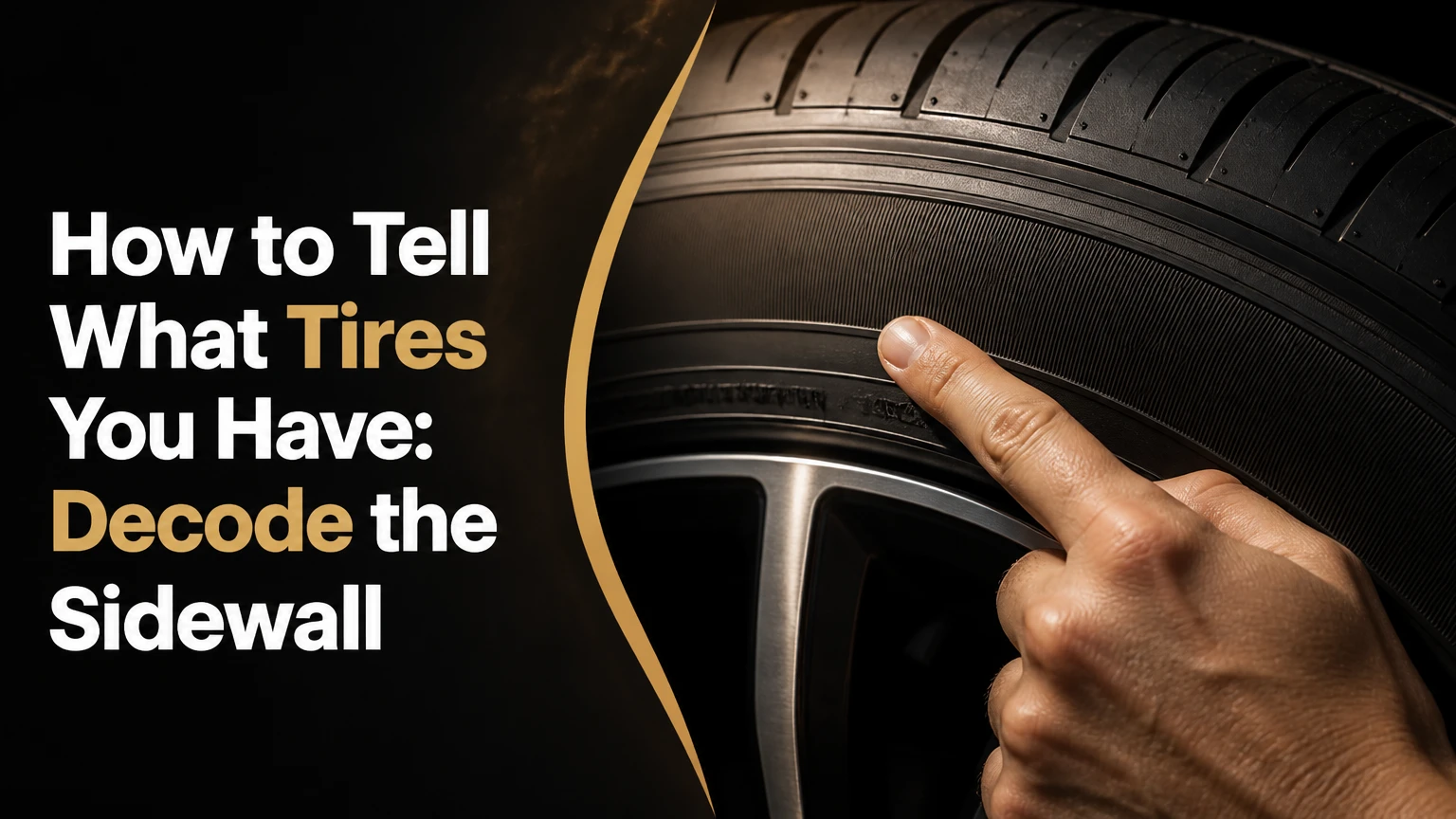
To tell what tires you have, read the tire’s molded sidewall markings and confirm them against the vehicle’s driver-door placard or owner’s manual. The sidewall reveals the tire brand, model, size, construction, load index, speed rating, season or terrain category, and manufacturing date. The vehicle placard determines whether that size and capacity are correct for your car.
Key Facts
A marking such as P225/55R17 97V identifies service type, width, aspect ratio, construction, rim diameter, load index, and speed rating.
The final four digits of a US DOT code identify the manufacturing week and year, such as 3421 for week 34 of 2021.
The driver-door placard is the best reference for the vehicle’s original tire size and recommended cold inflation pressure.
The 3PMSF symbol identifies a tire certified for severe snow conditions; M+S alone does not provide the same certification.
Tire condition depends on age, tread depth, damage, inflation, and wear pattern, not on sidewall size alone.
A replacement tire must meet or exceed the vehicle manufacturer’s required load capacity and speed rating.
What Information Is Printed on a Tire Sidewall?
A tire sidewall contains two types of information: commercial identification and technical specifications. The brand and model name tell you which product is installed, while the alphanumeric service description tells you whether the tire physically matches the wheel and vehicle requirements.
A typical passenger-car marking is P225/55R17 97V. In that sequence, “P” means passenger-car service, “225” is the nominal width in millimeters, “55” is the aspect ratio, “R” identifies radial construction, “17” is the wheel diameter in inches, “97” is the load index, and “V” is the speed symbol.
The opposite sidewall may contain fewer markings. Tire manufacturers commonly mold the full DOT date code on only one side, especially when the tire is mounted with the attractive side facing outward. A partial DOT code is therefore not automatically evidence of an old or noncompliant tire.
Look for the brand, model, size code, DOT string, inflation or load information, treadwear grading, and symbols such as XL, RF, C, M+S, or 3PMSF.
How Do You Find Your Tire Size?
You can find the installed tire size on the outer sidewall, but the driver-door placard and owner’s manual provide the vehicle’s recommended specification. The two sources should agree unless the vehicle has aftermarket wheels, a temporary replacement, or a previous owner installed a non-original size.
Use this order of preference:
- Read the sidewall. Photograph the complete marking because dirt, wheel spokes, and suspension components can hide characters.
- Open the driver’s door. Check the placard on the door jamb, pillar, glove-box door, fuel-door area, or inside the owner’s manual.
- Compare all four tires. Record whether the front and rear sizes differ. Performance vehicles sometimes use a staggered setup.
- Check the spare. A compact spare usually has a different size and speed limitation, so do not treat it as the normal specification.
- Verify the wheel. The final size number must match the wheel diameter, while width and offset also affect physical clearance.
The sidewall tells you what is mounted now. It does not prove that the current setup is approved for your vehicle.
Step 1: Locate the Main Sidewall Marking
Clean the sidewall with water and a soft brush, then turn the steering wheel outward when inspecting a front tire. Use a flashlight rather than scraping the rubber, because aggressive cleaning can obscure shallow molded characters.
Find a sequence containing a slash and a construction letter, such as 205/60R16 or LT265/70R17. The model name may appear in much larger lettering nearby, but the size code is the sequence needed for fitment.
Success checkpoint: You can read every character in the size sequence without guessing.
Common mistake: Reading a raised decorative line or the maximum-pressure statement as the tire size.
What Do the Numbers and Letters Mean?
The sequence P225/55R17 97V means a passenger tire with a 225-millimeter nominal section width, a sidewall height equal to 55% of that width, radial construction, a 17-inch wheel diameter, a load index of 97, and a V speed rating.
Step 2: Identify the Service Type
The first letters identify the tire’s service category. A P tire follows a US passenger-car designation, an LT tire is designed for light trucks, and an ST tire is intended for special trailers rather than powered vehicles.
| Marking | Meaning | Typical application | Important limitation |
|---|---|---|---|
| P | Passenger | Sedan, crossover, minivan | Not automatically suitable for a heavy pickup |
| LT | Light truck | Pickup, cargo van, heavy-duty SUV | Often has higher load capacity and firmer construction |
| ST | Special trailer | Boat, utility, travel trailer | Not designed for a motor vehicle steering axle |
| No prefix | Euro-metric passenger | Cars and many SUVs | Verify load capacity against the placard |
| T | Temporary spare | Compact emergency spare | Usually limited to short distance and reduced speed |
A tire without a P prefix is not necessarily a truck tire. Euro-metric passenger tires commonly omit the service letter, and the load index must be checked rather than inferred from the missing prefix.
Step 3: Decode the Tire Size
The first three-digit number is the nominal section width in millimeters. In 225/55R17, the width is approximately 225 mm from one sidewall edge to the other when mounted and inflated under the relevant standard.
The number after the slash is the aspect ratio. A 55 aspect ratio means the sidewall height is approximately 55% of 225 mm:
225 × 0.55 = 123.75 mm
The construction letter R means radial. Radial tires dominate modern road vehicles because their internal cords run radially across the casing and are stabilized by belts beneath the tread. D indicates diagonal construction, and B indicates belted bias construction, both of which are uncommon on ordinary modern passenger cars.
The final number in the size group is the rim diameter in inches. A tire marked R17 must be mounted on a 17-inch wheel, not a 16-inch or 18-inch wheel.
| Example code | Width | Aspect ratio | Wheel diameter | Approximate sidewall |
|---|---|---|---|---|
| P195/65R15 | 195 mm | 65% | 15 in | 126.75 mm |
| P225/55R17 | 225 mm | 55% | 17 in | 123.75 mm |
| 245/40R19 | 245 mm | 40% | 19 in | 98 mm |
| LT265/70R17 | 265 mm | 70% | 17 in | 185.5 mm |
A lower aspect ratio usually produces a shorter, stiffer sidewall and sharper steering response, but it also leaves less rubber to absorb pothole impacts. A taller sidewall generally improves ride compliance and protects the rim, provided the overall diameter remains appropriate.
Step 4: Read Load and Speed Ratings
The load index is a code, not a direct weight measurement. A 97 load index corresponds to 730 kg, or 1,609 lb, per tire under the applicable rating table. The often-cited 91 index corresponds to 615 kg, or 1,356 lb, per tire.
The speed symbol indicates the tire’s tested speed category under specified conditions. It is not a recommended driving speed, and it cannot compensate for worn tread, low pressure, excessive load, heat, or road hazards.
| Symbol | Rated speed | Common vehicle context | Replacement rule |
|---|---|---|---|
| T | 118 mph, 190 km/h | Family cars and vans | Meet placard requirement |
| H | 130 mph, 210 km/h | Sedans and crossovers | Do not downgrade casually |
| V | 149 mph, 240 km/h | Sport sedans and premium cars | Match axle specifications |
| W | 168 mph, 270 km/h | Performance vehicles | Often paired with low-profile sizes |
| Y | 186 mph, 300 km/h | High-performance applications | Vehicle approval remains necessary |
Michelin’s consumer guidance summarizes the engineering relationship directly: “The tire is the only point of contact between your vehicle and the road.” That contact patch makes load capacity, pressure, and construction more important than choosing a visually similar tire.
An XL or Extra Load tire has a higher load capacity at an elevated pressure than a standard-load tire of the same nominal size. A C marking generally identifies commercial or cargo-van construction. Neither marking alone confirms that the tire is suitable for a particular vehicle.
How Do You Check How Old Your Tires Are?
Check the final four digits of the DOT code on the tire sidewall. The first two digits represent the manufacturing week, and the last two digits represent the year, so 3421 means the tire was manufactured during week 34 of 2021.
Step 5: Find the DOT Date Code
The US Department of Transportation identification begins with DOT, followed by plant and tire-identification characters. The date portion is the final four digits, usually enclosed in a rounded rectangle or separated visually from the earlier code.
Inspect both sidewalls. The complete date may face inward, where it is difficult to see without lifting the vehicle or removing the wheel. Never place any part of your body under a vehicle supported only by a jack.
Age is a risk factor, not a complete replacement diagnosis. NHTSA advises consumers to follow the tire manufacturer’s replacement guidance, and manufacturers commonly recommend professional inspection after five or six years in service, with replacement often advised around ten years from manufacture regardless of remaining tread. Policies vary by brand and operating conditions.
| Date code | Manufacture date | Approximate age in March 2026 | Action |
|---|---|---|---|
| 3421 | Week 34, 2021 | 4.5 years | Inspect condition and service history |
| 0819 | Week 8, 2019 | 7 years | Obtain a professional inspection |
| 5016 | Week 50, 2016 | 9.3 years | Replacement is generally prudent |
| 1200 | Week 12, 2000 | 26 years | Do not use on public roads |
A three-digit date code indicates manufacture before 2000. The exact decade cannot be established from that code, so the tire should not remain in normal service.
How Can You Tell What Type of Tire You Have?
Identify tire type from the model name, sidewall wording, tread pattern, and certification symbols. A tire labeled “Winter,” “Snow,” “Performance,” “All Terrain,” or “Mud Terrain” provides stronger evidence than tread appearance alone.
| Tire category | Sidewall clues | Tread or compound clues | Best operating range | Main limitation |
|---|---|---|---|---|
| All-season | “All Season,” M+S common | Moderate grooves and blocks | Mild climates, roughly 45°F and above | Limited deep-snow and ice grip |
| Summer | “Summer” or performance model name | Large blocks, fewer sipes | Warm weather and dry or wet roads | Compound stiffens in cold |
| Winter | “Winter,” snow, or ice wording | Dense sipes and deep grooves | Freezing temperatures and snow | Faster warm-weather wear |
| All-weather | Often 3PMSF symbol | More winter-oriented tread | Year-round use with winter capability | Usually noisier than touring all-season |
| All-terrain | “A/T” or “All Terrain” | Blocky tread and open shoulders | Highway plus gravel and trails | Noise and fuel-consumption penalty |
| Mud-terrain | “M/T” or “Mud Terrain” | Large voids and reinforced casing | Mud, rocks, severe off-road use | Weak wet-road refinement and braking |
The 3PMSF symbol is a mountain outline containing a snowflake. It indicates that the tire passed a defined severe-snow performance test. M+S, meaning mud and snow, is a manufacturer designation and does not equal 3PMSF certification.
Tread shape can mislead. Some touring all-season tires have aggressive-looking grooves, while some all-weather tires look nearly ordinary from a distance. Read the sidewall model name and symbol before classifying the tire.
What Do UTQG Ratings Tell You?
UTQG ratings provide comparative information for many passenger tires sold in the United States, but they do not predict an exact mileage figure or guarantee wet braking performance across brands. The three elements are treadwear, traction, and temperature.
| UTQG element | Example marking | What it indicates | What it does not prove |
|---|---|---|---|
| Treadwear | 600 | Relative wear compared with a government test tire | 60,000-mile guaranteed life |
| Traction | AA | Wet-braking traction grade | Snow, ice, or cornering performance |
| Temperature | A | Resistance to heat generation | Suitability for every speed or load |
A treadwear number of 600 is theoretically about twice the wear rate of a 300-rated reference under the UTQG system, but driving style, alignment, inflation, climate, pavement, and vehicle weight can overwhelm that comparison. The National Highway Traffic Safety Administration treats tread condition and vehicle maintenance as separate safety concerns.
Treadwear ratings are most useful when comparing tires from the same manufacturer or product family. They are less reliable as a cross-brand mileage promise.
Can You Use a Different Tire Size?
Use a different tire size only when the vehicle manufacturer, wheel manufacturer, or a qualified tire professional confirms the fitment. A replacement must clear suspension and body components, fit the wheel width, maintain adequate load capacity, preserve safe speed capability, and avoid unacceptable changes to electronic systems.
Changing from 225/55R17 to a different size changes overall diameter, gearing, ground clearance, speedometer indication, and possibly ABS or traction-control behavior. A smaller overall diameter makes the vehicle travel fewer feet per wheel revolution; a larger one can create clearance and calibration problems.
Check these items before buying:
- Vehicle placard size and pressure
- Front-to-rear size relationship
- Wheel diameter and width
- Load index and speed rating
- Section width and sidewall clearance
- Rolling circumference, especially on AWD vehicles
- TPMS sensor compatibility
- Tire manufacturer’s approved rim-width range
The owner’s manual may permit several sizes, but the options are not interchangeable in every driving condition. AWD systems can be sensitive to small circumference differences between tires, particularly when tread depths differ substantially.
Do All Four Tires Need to Match?
All four tires should normally match in size, construction, load index, speed rating, brand, and model, especially on an AWD or four-wheel-drive vehicle. At minimum, tires on the same axle should match closely, while the vehicle manufacturer’s replacement policy controls acceptable exceptions.
Replacing one tire can create a tread-depth mismatch. Some manufacturers permit a new tire to be shaved to match the remaining tires, while others recommend replacing a pair or the complete set. A tire shop should measure tread depth and inspect the drivetrain specification before installing a single replacement.
Mixing summer and all-season tires can create different braking and cornering behavior between axles. Mixing winter and non-winter tires is particularly hazardous because the winter tire may generate much more traction in cold conditions.
What Should You Inspect Besides the Markings?
A readable sidewall code identifies the tire, but a physical inspection determines whether the tire remains serviceable. Check tread depth, uneven wear, cracks, bulges, puncture repairs, exposed cords, valve condition, and inflation pressure.
Use a tread-depth gauge at several points across each tire. The legal minimum in many US jurisdictions is 2/32 inch, but wet-weather performance declines before that threshold, and replacement is often sensible around 4/32 inch for rain-prone use or 5/32 inch for winter service.
Inspect for these conditions:
- Shoulder wear: often indicates underinflation or alignment problems.
- Center wear: commonly results from overinflation.
- Cupping or scalloping: may indicate worn suspension components or imbalance.
- Sidewall bulge: suggests impact damage and requires immediate replacement.
- Circumferential cracks: indicate aging, ozone exposure, or storage damage.
- Repair near the shoulder: may fall outside accepted repair zones.
- Visible cords: means the casing is unsafe and must be replaced.
Check pressure when the tires are cold, using the door-placard value rather than the maximum pressure molded into the sidewall. The sidewall maximum is a tire limit, not the normal pressure recommendation for the vehicle.
What Are the Typical Costs and Service Times?
Typical US consumer pricing ranges from about $90-$180 per tire for economy or standard touring products, $150-$280 for mid-tier tires, and $250-$500 or more for premium performance, truck, or specialty products. Installation for four tires commonly takes 45-90 minutes and adds roughly $80-$180 before taxes, disposal fees, alignment, or specialty services.
| Service or product | Typical US range | Typical time | Variables |
|---|---|---|---|
| Economy passenger tire | $90-$140 each | 45-75 minutes for four | Size, retailer, warranty |
| Mid-tier all-season tire | $150-$280 each | 45-90 minutes | Brand, load rating, promotions |
| Premium performance tire | $250-$500+ each | 60-90 minutes | Low-profile size and balancing |
| Mount, balance, disposal | $20-$45 per tire | Included with installation | Package and regional labor rate |
| Four-wheel alignment | $100-$ys? | 30-90 minutes | Vehicle design and adjustment range |
Need fix typo table. use $100-$200.
A tire’s useful life cannot be estimated from price alone. A soft performance compound may wear sooner than a touring tire, while poor alignment can destroy either product in a few thousand miles.
Common Mistakes and How to Fix Them
Mistake 1: Confusing Maximum Pressure With Recommended Pressure
Read the placard inside the driver’s door. Inflate to the placard’s cold-pressure specification unless a qualified manufacturer procedure says otherwise.
Mistake 2: Assuming the Largest Number Is the Tire Size
The largest sidewall number may be the maximum load or pressure. The tire size contains a slash, such as 215/60R16.
Mistake 3: Treating M+S as a Winter-Tire Certification
Look for the 3PMSF mountain-and-snowflake symbol when severe-snow capability matters. M+S alone is insufficient evidence.
Mistake 4: Reading Only the Outward-Facing Sidewall
Inspect the inward-facing sidewall for the complete DOT date. Use safe lifting equipment or ask a tire shop to expose it.
Mistake 5: Replacing Tires by Appearance
Two tires can look similar while differing in load index, speed rating, compound, and rolling circumference. Match the complete specification.
Mistake 6: Ignoring the Vehicle Placard
A sidewall tells you what is installed, not whether a previous owner chose correctly. Confirm the size against the placard and manual before ordering.
What If You Cannot Read the Sidewall?
If the sidewall is damaged, dirty, inward-facing, or partially hidden, photograph the visible code and ask a tire shop to identify the tire from its serial markings. The vehicle placard can provide the correct original size, while the tire’s tread pattern and brand lettering may identify the product family.
A registration document or vehicle-identification-number lookup can sometimes reveal original equipment size, but those records may not reflect factory options, replacement wheels, or a modified vehicle. A dealership parts department can verify the original configuration from the VIN, yet it still cannot confirm what is physically mounted today.
Do not order from a partial code such as 225/55 alone. You still need the wheel diameter, load index, speed rating, service type, and tire model.
FAQ
Can I identify my tire brand without removing the wheel?
Yes. The brand and model are usually molded in large letters on the outward-facing sidewall. The complete DOT date may face inward, but a tire technician can expose it safely if age verification is necessary.
What does ZR mean on a tire?
ZR is a high-speed construction designation historically associated with tires capable of speeds above 149 mph, but the actual capability depends on the accompanying load and speed symbol. Read the complete marking, such as 245/40ZR19 98Y, rather than interpreting ZR alone.
How much tread should a safe tire have?
The US legal limit is commonly 2/32 inch, although local law varies. Replacing near 4/32 inch improves wet-weather margin, and winter tires generally need more remaining tread to retain snow traction.
Can I mix tire brands on my car?
You can sometimes mix brands when the sizes, load ratings, speed ratings, construction, and application match, but identical tires on one axle are the safer baseline. AWD vehicles may require much closer tread-depth matching.
How long can unused tires be stored?
Storage life depends on temperature, humidity, sunlight, ozone, position, and packaging. Store tires indoors in a cool, dry, dark location away from electric motors and chemicals, then have an installer inspect them before use.
Where is the correct tire pressure listed?
The correct cold inflation pressure is usually printed on the driver-door placard or vehicle certification label. The owner’s manual may list separate pressures for normal and heavily loaded operation; the tire sidewall maximum is not the vehicle setting.
The Bottom Line
To answer how to tell what tires you have, photograph the sidewall and decode the service type, width, aspect ratio, construction, wheel diameter, load index, speed rating, model, category symbols, and DOT date. Then compare the installed specification with the driver-door placard, inspect tread and damage, and verify compatibility before replacing or changing size.