Yes, 7/32 tire tread is good for most passenger vehicles and normal driving conditions. It represents light to moderate wear, remains well above the common 2/32-inch replacement limit, and normally provides useful wet-road traction, provided the tire is evenly worn, properly inflated, undamaged, and not excessively old.
Key Facts at a Glance
- A tread depth of 7/32 inch equals approximately 5.56 millimeters.
- Tire Rack classifies 7/32-inch tread as lightly worn and acceptable for most uses.
- A typical new passenger tire starts near 9/32 to 11/32 inch, although designs vary.
- NHTSA advises replacing passenger-vehicle tires when tread reaches 2/32 inch.
- Drivers who regularly encounter heavy rain should begin planning replacement near 4/32 inch.
- Tread depth cannot reveal tire age, internal damage, dry rot, or sidewall weakness.
Is 7/32 Tire Tread Good Enough to Keep Driving?
A tire with 7/32-inch tread generally has enough groove depth for daily commuting, highway travel, and ordinary rain. You do not normally need to replace an otherwise healthy passenger tire solely because it measures 7/32 inch.
Tire Rack’s tread-depth guidance describes 7/32 inch as light wear that remains acceptable for most uses. By comparison, NHTSA identifies 2/32 inch as the point at which passenger tires are no longer considered safe and should be replaced.
The 7/32 measurement is only one part of the inspection. Keep using the tire when all of the following are true:
- The lowest groove measures approximately 7/32 inch.
- Wear is reasonably even across the inner, center, and outer tread.
- The sidewall has no bulges, deep cracks, exposed cords, or impact damage.
- The vehicle does not shake, pull, or produce unusual tire noise.
- The tire pressure matches the vehicle manufacturer’s specification.
- Tire age and condition remain acceptable.
A single 7/32 reading on the outside shoulder does not prove the whole tire is good. The hidden inner edge may be substantially lower if the vehicle has an alignment or suspension problem.
How Much Is 7/32 Inch in Millimeters?
A tread depth of 7/32 inch equals 5.56 mm, rounded to two decimal places.
The calculation is:
7 ÷ 32 × 25.4 = 5.55625 mm
This conversion matters because the supplied AI Overview incorrectly states that 7/32 inch equals 7.14 mm. A depth of 7.14 mm is closer to 9/32 inch, not 7/32 inch.
| Tread Depth | Millimeters | General Interpretation |
| 10/32 in. | 7.94 mm | Common new-tire range |
| 8/32 in. | 6.35 mm | Near-new or lightly used |
| 7/32 in. | 5.56 mm | Good for most normal driving |
| 6/32 in. | 4.76 mm | Serviceable, monitor winter use |
| 5/32 in. | 3.97 mm | Reduced snow capability |
| 4/32 in. | 3.18 mm | Reduced wet-weather margin |
| 2/32 in. | 1.59 mm | Replacement threshold |
New-tire tread varies by model. Performance tires, fuel-efficient tires, all-terrain tires, and winter tires may begin with different groove depths, so remaining tread should be compared with the tire’s original specification rather than one universal starting figure.
How Does 7/32 Compare With a New Tire?
A 7/32-inch tire is usually worn but not close to worn out. Many passenger tires begin around 9/32 to 11/32 inch, which means a 7/32 reading commonly represents the loss of approximately 2/32 to 4/32 inch of original tread.
That does not automatically mean the tire has 70% or 80% of its total mileage remaining. Tire wear is not perfectly linear, and usable tread must be calculated above the intended replacement point rather than above zero.
For example, consider a tire that begins at 10/32 inch:
- Original tread: 10/32 inch
- Current tread: 7/32 inch
- Legal-end tread: 2/32 inch
- Original usable tread: 8/32 inch
- Remaining usable tread: 5/32 inch
On that basis, the tire has used 3/32 of its original 8/32-inch legal wear allowance and retains about 62.5% of that allowance. A driver who plans to replace at 4/32 for frequent rain has only 3/32 inch remaining before the practical replacement point.
| Condition | Typical Depth | Difference From 7/32 | Normal Action |
| Near-new passenger tire | 9/32-11/32 | 2/32-4/32 deeper | No action |
| Current tire | 7/32 | Baseline | Continue inspections |
| Winter planning point | 5/32-6/32 | 1/32-2/32 lower | Monitor before snow season |
| Wet-weather planning point | 4/32 | 3/32 lower | Consider replacement |
| Wear-bar level | 2/32 | 5/32 lower | Replace |
The original tread depth must be known before estimating how much of the tire has been consumed. A 7/32 passenger tire that began at 9/32 is in a different stage of wear from an all-terrain tire that began at 15/32.
Is 7/32 Tire Tread Safe in Rain?
A 7/32-inch tire normally provides a useful wet-weather safety margin, but tread depth alone cannot prevent hydroplaning. Water depth, road speed, tire pressure, tread design, vehicle weight, and rubber condition also determine how well the tire maintains contact with wet pavement.
Tire grooves channel water away from the contact patch. Michelin explains that adequate groove depth delays aquaplaning by helping the tire maintain contact with the road surface.
At 7/32 inch, most healthy all-season tires still have substantially more water-evacuation capacity than tires near 4/32 or 2/32. Drivers should nevertheless slow down in standing water because no tread-depth measurement guarantees grip during a severe downpour.
Tire Rack testing illustrates how sharply wet braking can deteriorate as tread becomes shallow. In one sedan test from 60 mph, the new tire stopped in 205 feet, a tire at 4/32 inch required 270 feet, and a tire at 2/32 inch required 400 feet. The exact distances apply only to the tested vehicle and tires, but the trend demonstrates why legal tread depth and strong wet performance are not the same standard.
Practical Wet-Road Rule
Continue using a healthy 7/32-inch tire in rain, but:
- Reduce speed when water is visibly pooling.
- Increase following distance.
- Avoid abrupt steering and braking.
- Check pressure when the tires are cold.
- Recheck tread monthly as it approaches 5/32 and 4/32 inch.
Tire Rack recommends considering replacement around 4/32 inch when rain and wet roads are frequent concerns.
Is 7/32 Tread Good for Snow and Winter?
A 7/32-inch winter tire is generally usable, but it is no longer at full original depth. The tire should still provide meaningful snow traction when its compound remains flexible and its sipes are intact, although deep-snow mobility may be lower than when the tire was new.
Tire Rack advises drivers to consider winter-tire replacement near 5/32 inch because snow traction declines as the grooves lose the space needed to collect, compact, and release snow.
The type of tire matters more than the number alone. A 7/32 summer tire is not suitable for severe winter driving simply because it has adequate depth. Its rubber compound and tread pattern were not designed for freezing temperatures, ice, or accumulated snow.
| Tire Type at 7/32 | Relative Condition | Suitable Use | Main Limitation |
| All-season tire | Good | Mild winters, rain, dry roads | Limited severe-snow grip |
| All-weather 3PMSF tire | Good | Mixed year-round conditions | Less deep-snow ability than new |
| Dedicated winter tire | Usable to good | Snow and cold weather | Monitor as it approaches 5/32 |
| Summer tire | Tread may be good | Warm dry and wet weather | Compound unsuitable for freezing conditions |
| All-terrain tire | Moderately worn | Road use and light trails | Reduced mud and self-cleaning depth |
For severe winter travel, inspect the tire before the season rather than waiting for the first snowstorm. A 7/32 winter tire may complete another season under light use, while a high-mileage driver or someone in deep-snow regions may need a replacement plan sooner.
How Long Will 7/32 Tire Tread Last?
There is no reliable universal mileage figure for a tire at 7/32 inch. Remaining life depends on the tire’s original depth, compound, treadwear rating, vehicle weight, wheel alignment, inflation, rotation schedule, road surface, temperature, and driving style.
Claims that every 7/32 tire will last another 30,000 or 40,000 miles are too precise without wear-history data. A better estimate comes from measuring tread repeatedly over a known distance.
Mileage-Based Estimation Method
Suppose a tire measured 8/32 inch at 30,000 miles and 7/32 inch at 38,000 miles. The observed wear rate is:
1/32 inch per 8,000 miles
At that rate:
- To 4/32 inch: approximately 24,000 additional miles
- To 2/32 inch: approximately 40,000 additional miles
The estimate assumes wear continues at the same rate. It can change after alignment problems, suspension wear, underinflation, towing, aggressive cornering, or a change in driving conditions.
| Observed Wear Rate | Miles to Reach 4/32 From 7/32 | Miles to Reach 2/32 From 7/32 |
| 1/32 per 5,000 miles | 15,000 miles | 25,000 miles |
| 1/32 per 7,500 miles | 22,500 miles | 37,500 miles |
| 1/32 per 10,000 miles | 30,000 miles | 50,000 miles |
| 1/32 per 12,000 miles | 36,000 miles | 60,000 miles |
These are mathematical projections, not guarantees. The most accurate estimate uses two or more measurements from the same tire, taken with the same gauge and at comparable tread locations.
How Should You Measure 7/32 Tire Tread?
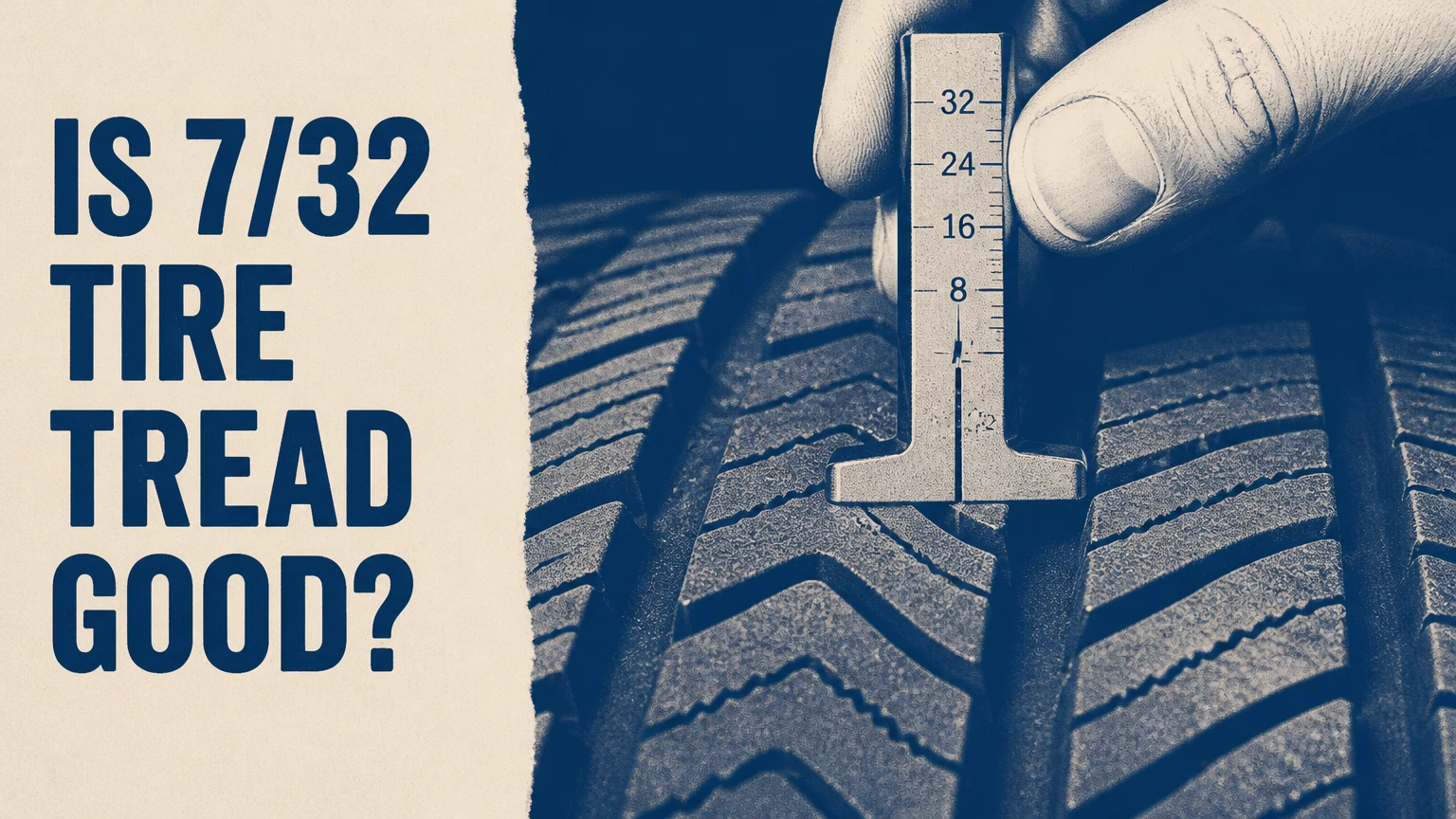
Use a tread-depth gauge and check multiple grooves across and around every tire. A gauge is more useful than a coin test because a coin can identify a broad threshold but cannot reliably distinguish 7/32 from 6/32 or 8/32 inch.
Step 1: Park on a Level Surface
Place the transmission in Park or in gear, engage the parking brake, and switch off the engine. Turn the steering wheel to expose the front-tire tread if necessary.
Step 2: Find the Main Grooves
Use the primary circumferential grooves, not small decorative channels or the raised wear bars. The wear bars become flush with the surrounding tread near 2/32 inch.
Step 3: Position the Gauge Correctly
Extend the gauge probe, place it at the bottom of the groove, and press the gauge base flat against the tread block. A tilted gauge can produce an inaccurate reading.
Step 4: Measure the Full Width
Take readings at the outer shoulder, center, and inner shoulder. The lowest valid measurement is more important than the highest one.
Step 5: Check Several Circumference Points
Move around the tire and repeat the readings. Localized wear, flat spotting, or alignment-related damage may appear in only one section.
NHTSA recommends checking tread at least monthly while checking tire pressure, and Michelin advises measuring several locations across and around the tire.
What If One Part Reads 7/32 and Another Reads Lower?
Use the lowest measurement when judging tire condition. A tire that reads 7/32 on the outer shoulder but 3/32 on the inner shoulder has a serious uneven-wear problem and should not be described simply as a 7/32 tire.
Uneven wear may point to inflation, alignment, balance, or suspension problems. Replacing the tire without correcting the cause can damage the replacement in the same pattern.
| Wear Pattern | Likely Cause | Recommended Response |
| Center wears faster | Chronic overinflation | Verify cold pressure against door label |
| Both shoulders wear faster | Chronic underinflation | Inspect for leaks and correct pressure |
| One edge wears faster | Camber, toe, or suspension issue | Request alignment and suspension inspection |
| Cupped or scalloped areas | Balance, shock, or suspension problem | Inspect wheel balance and dampers |
| One localized flat area | Hard braking or internal issue | Professional tire inspection |
| Irregular high-low ribs | Alignment or component wear | Diagnose before rotation |
Michelin notes that one-sided wear can result from misalignment, worn suspension components, improper rotation, hard cornering, or mounting conditions.
A difference of approximately 1/32 inch across the tread may occur through normal use, but a larger or rapidly developing difference warrants inspection.
Should You Buy a Used Tire With 7/32 Tread?
A used tire with 7/32-inch tread can be a reasonable purchase when its age, condition, repair history, size, load rating, speed rating, and tread pattern are appropriate for the vehicle. Tread depth alone is not enough to establish value or safety.
Before buying, check:
- The four-digit DOT date code
- Sidewall cracking, cuts, bulges, or abrasions
- Inner-liner condition
- Previous puncture repairs
- Uneven or irregular tread wear
- Matching size and service description
- Tread-depth difference from the tire on the same axle
- Evidence of underinflation or run-flat damage
A used 7/32 tire is less attractive when it is old, has an unknown repair history, or creates a major circumference difference on an all-wheel-drive vehicle. Some AWD systems have strict limits for tread-depth differences because unequal rolling circumferences can place stress on drivetrain components. Consult the vehicle manufacturer’s specification before mixing tread depths.
Do not calculate a fair used-tire price by simply multiplying the new price by a claimed percentage of tread remaining. The casing age, warranty status, installation cost, repair history, and remaining tread above the buyer’s replacement threshold all affect real value.
Can a Tire Be Unsafe Even With 7/32 Tread?
Yes. A tire may be unsafe at 7/32 inch if it has structural damage, excessive age, severe cracking, exposed cords, a sidewall bulge, internal separation, an improper repair, or a major uneven-wear condition.
Michelin advises immediate professional inspection for sidewall cuts, cracks, bulges, or blisters because sidewall damage cannot normally be repaired safely.
Tread depth does not reveal:
- Heat damage from prolonged underinflation
- Internal cord damage after a pothole impact
- Separation between structural layers
- Damage caused by driving while flat
- Chemical deterioration
- Improper plug-only repairs
- Age-related hardening of the rubber
NHTSA also notes that some vehicle manufacturers recommend tire replacement after six years regardless of use. Michelin states that original-equipment replacement guidance should be followed and should not exceed ten years.
Age is not an automatic diagnosis, but an older tire deserves closer professional inspection even when it retains 7/32 inch of tread.
When Should You Replace a 7/32 Tire?
You normally should not replace a healthy tire merely because it reads 7/32 inch. Replace it earlier when damage, age, uneven wear, weather demands, or vehicle-specific requirements create a stronger reason than the tread number alone.
| Situation | Suggested Action Point | Reason |
| Normal dry and mixed driving | Monitor until lower depth or condition changes | 7/32 remains serviceable |
| Frequent heavy rain | Plan near 4/32 | Wet braking and water evacuation decline |
| Regular snow driving | Plan near 5/32 | Snow mobility becomes less effective |
| Wear bars become flush | 2/32 | Tire has reached the wear indicator |
| Any groove reaches 2/32 | Replace | Lowest groove controls the decision |
| Sidewall bulge or exposed cords | Replace immediately | Structural failure risk |
| Deep cracks or suspected separation | Professional inspection | Tread depth does not show internal integrity |
NHTSA states that tires should be replaced when tread is worn to 2/32 inch, and federally required wear indicators are molded at that level.
The 2/32-inch threshold is a minimum endpoint, not a promise of strong all-weather performance up to the final fraction. Drivers should use a replacement threshold that reflects their actual environment.
Expert Insights About 7/32 Tire Tread
Remaining Percentage Is Often Miscalculated
A tire at 7/32 inch does not automatically have 70% of its life remaining. Zero tread is not the usable endpoint, and original tread depth varies. Calculate the remaining portion above 2/32, 4/32, or another chosen replacement threshold.
The Lowest Groove Controls the Decision
Averaging 8/32, 7/32, and 3/32 to describe a tire as having 6/32 tread conceals the dangerous section. Tire condition should be judged using the lowest meaningful reading and the pattern that caused it.
Tire Design Still Matters at the Same Depth
Two tires at 7/32 inch can perform differently because tread pattern, rubber compound, width, age, pressure, and construction influence wet braking and hydroplaning resistance. Tread depth is an important measurement, but it is not a complete traction rating.
Frequently Asked Questions
Is 7/32 better than 6/32 tire tread?
Yes, 7/32 inch provides one additional thirty-second of groove depth, equal to approximately 0.79 mm. That generally offers more wear allowance and water-evacuation capacity. The practical difference may be modest when both tires are healthy, but it becomes more relevant as winter or heavy-rain conditions approach.
Is 8/32 tire tread considered good?
Yes. A passenger tire at 8/32 inch is commonly near-new or lightly worn, depending on its original depth. It normally requires no replacement action when wear is even and the tire is free of age-related or structural damage.
Is 7/32 good for a leased-car return?
A 7/32-inch tire normally has substantially more tread than common lease-return minimums, but lease standards vary by finance company. The tire may still fail inspection because of mismatched brands, sidewall damage, improper size, exposed cords, or uneven wear. Review the leasing company’s written return criteria.
Should all four tires have exactly 7/32 tread?
They do not always need to be identical, but major tread-depth differences can affect handling, braking, traction-control operation, and AWD drivetrain requirements. Keep tires on the same axle closely matched and follow the vehicle manufacturer’s allowable circumference or tread-depth difference.
Can the penny test confirm 7/32 tread?
No. The penny test is a rough check for approximately 2/32 inch, not a precise tool for confirming 7/32. Use a tread-depth gauge when comparing specific measurements or evaluating a used tire.
How often should tread depth be checked?
Check tread at least once a month and before long trips, severe-weather seasons, or buying a used vehicle. Measure more often when a tire is wearing unevenly, approaching 5/32 or 4/32 inch, or losing tread faster than expected.
The Bottom Line
Is 7/32 tire tread good? Yes, 7/32 inch is a good and normally serviceable tread depth for most passenger vehicles. It equals approximately 5.56 mm and remains well above the 2/32-inch wear-bar level.
Continue using the tire when wear is even, pressure is correct, and no damage or age-related deterioration is present. Begin planning earlier replacement near 4/32 inch for frequent heavy rain or near 5/32 inch for dependable snow mobility. Most importantly, inspect the lowest groove across the entire tire rather than relying on one convenient measurement.