The safe tire tread depth is a minimum of 1.6 millimeters globally, though automotive safety experts strongly recommend replacing tires at 3 mm for summer driving and 4 mm for winter conditions. Tread depth is the vertical measurement from the top of the tire rubber to the bottom of its deepest grooves, directly determining the vehicle’s ability to grip the road.
Key Facts / At a Glance
- The absolute legal minimum tire tread depth is 1.6 mm in most global jurisdictions.
- Tire manufacturers recommend replacing summer tires at 3 mm and winter tires at 4 mm.
- At 1.6 mm, wet braking distance from 100 km/h increases by up to 50 percent compared to brand new tires.
- A new passenger vehicle tire can displace approximately 30 liters of water per second at highway speeds.
- Rubber compounds degrade over time, meaning tires must be replaced after 6 to 10 years regardless of remaining tread depth.
Why Does Tire Tread Depth Matter?
Tire tread depth dictates how effectively a vehicle channels water away from the contact patch to maintain friction with the road surface. The grooves in a tire act as an engineered evacuation system for water, slush, and physical debris.
When a vehicle travels at 100 km/h in wet conditions, a new tire with optimal tread depth displaces roughly 30 liters of water every second. The remaining rubber blocks compress against the asphalt, creating a squeegee effect that wipes the surface dry and allows the microscopic texture of the tire to grip the road.
As the rubber wears down over time, the total void volume of the grooves decreases. This reduction in volume severely limits the tire’s water displacement capacity. When the grooves become too shallow to channel the standing water, the hydrodynamic pressure builds up in front of the tire. The water forces its way under the rubber, causing the tire to lift entirely off the asphalt surface. This phenomenon is known as aquaplaning. During an aquaplaning event, the driver experiences a total and immediate loss of steering, braking, and acceleration control.
What Are the Key Tread Depth Thresholds in mm?
Tread depth significantly dictates your vehicle stopping distance, especially when braking heavily on wet pavement. The decline in tire performance is not linear. Grip decreases exponentially as the tire approaches the 1.6 mm legal limit.
| Depth Level | Safety Status | Wet Braking Performance (from 100 km/h) |
| 8 mm to 9 mm | Optimal (Brand New) | Baseline reference stopping distance. |
| 4 mm | Caution (Winter Limit) | Stopping distance increases by 10 to 15 percent. |
| 3 mm | Action Advised (Summer Limit) | Stopping distance increases by 25 to 30 percent. |
| 1.6 mm | Critical Danger (Legal Minimum) | Stopping distance increases by up to 45 to 50 percent. |
| Under 1.6 mm | Illegal and Lethal | Extreme aquaplaning risk and likely structural failure. |
Wide tires face an even higher risk at low tread depths. A wider contact patch must evacuate a larger volume of water in the same amount of time, meaning a 275 mm wide performance tire will aquaplane at a lower speed than a 195 mm wide economy tire if both share a 3 mm tread depth.
How Do You Measure Tire Tread Depth?
You should check your tread depth once a month and immediately before embarking on any long road trips. Always measure the depth in three distinct locations across the width of the tire: the outer edge, the center, and the inner edge. This practice ensures you catch uneven wear patterns early.
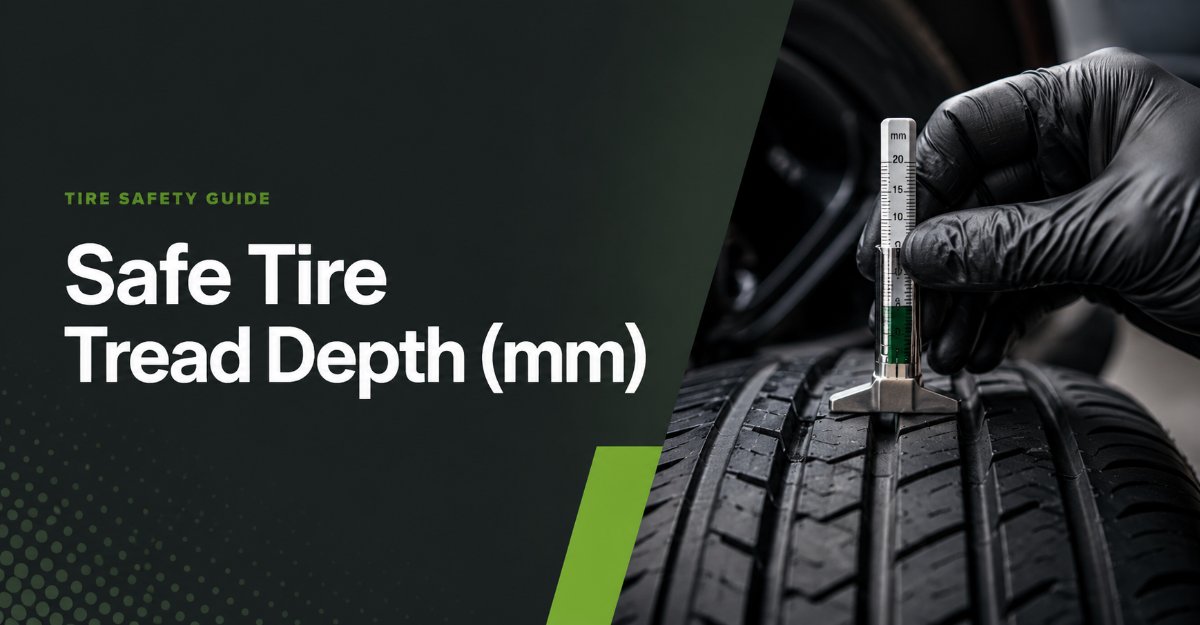
Method 1: Using a Dedicated Tread Depth Gauge
Using a dedicated gauge provides the highest level of accuracy and removes subjective visual guessing from the maintenance process.
- Locate the primary grooves: Find the wide, continuous circumferential grooves running around the center of the tire.
- Insert the measuring probe: Push the metal or plastic measuring pin of your gauge directly into the deepest part of the groove. Make sure you do not place the pin on top of a raised wear bar indicator.
- Press the base down flush: Push the flat outer shoulders of the gauge firmly against the top surface of the surrounding tread blocks.
- Read the metric measurement: Look at the digital screen or read the graduated mechanical scale to find your exact millimeter reading. Repeat this in three different grooves.
Method 2: Inspecting Tread Wear Indicators (TWIs)
Tread wear indicators are raised blocks of rubber molded directly into the longitudinal grooves of every street-legal passenger tire.
- Find the sidewall indicators: Look closely at the upper sidewall of your tire for small embossed triangles, brand logos, or the letters “TWI”.
- Locate the raised bars: Follow an imaginary line from those sidewall marks across the surface of the tire. You will see small, raised horizontal rubber bars sitting inside the deep grooves.
- Assess the physical wear: These internal bars are precisely 1.6 mm high. If the surrounding tread rubber is entirely flush and level with these raised bars, the tire is legally bald and must be replaced immediately.
Which Measurement Tool Should You Choose?
Selecting the right diagnostic tool depends on your required precision, your budget, and how frequently you perform vehicle maintenance.
Digital Tread Depth Gauges
Digital tools feature an electronic LCD readout that provides instant metric and imperial conversions.
- Pros: They offer the absolute highest precision and eliminate human reading errors entirely.
- Cons: They require batteries, are sensitive to being dropped on concrete, and carry a higher upfront cost of 15 to 30 dollars.
- Best for: Automotive technicians and track day enthusiasts who need to track wear down to the tenth of a millimeter.
Mechanical Slide Gauges
Mechanical gauges utilize a springless metal or plastic pin that slides inside a graduated cylindrical barrel.
- Pros: They require no batteries, are highly durable, can be stored in a glovebox indefinitely, and cost only 5 to 10 dollars.
- Cons: They require careful visual alignment to read the scale and are difficult to read accurately in low-light environments.
- Best for: Daily drivers and DIY mechanics who need a reliable, cost-effective tool.
Color-Coded Depth Gauges
These are simplified slide tools divided into Green (Safe), Yellow (Caution), and Red (Replace) zones.
- Pros: They are instantly scannable and completely foolproof for non-technical users.
- Cons: They lack exact millimeter readouts, making it impossible to track subtle uneven wear patterns across an axle.
- Best for: Fleet managers doing rapid visual safety checks on multiple vehicles.
What Are the Most Common Measurement Mistakes?
Failing to measure tire wear correctly can lead to a false sense of security and dangerous driving conditions.
Measuring Directly on the Tread Wear Bar
Placing your gauge probe directly on top of the 1.6 mm TWI bar will yield an inaccurately high safety reading. The gauge will measure the distance from the top of the tread to the top of the bar, subtracting 1.6 mm from your actual remaining tread depth. Always measure in the empty space of the groove.
Ignoring the 3 mm Warning Limit
Waiting until the tire reaches the absolute legal limit of 1.6 mm before shopping for replacements exposes you to severe braking deficits. At 2 mm, your tire has already lost the vast majority of its water evacuation capabilities.
Checking Only One Spot
Measuring only the easily accessible outer edge of the front tires is a dangerous habit. Worn alignment components or improper inflation can easily wear out the inner edge of a tire down to the steel cords while leaving the visible outer edge looking brand new. Always check the inner, center, and outer zones.
Neglecting the Emergency Spare
Drivers frequently fail to check the tread depth, air pressure, and rubber age of their trunk-mounted spare tire. Discovering your spare is dry-rotted or flat during a highway puncture leaves you stranded.
How Does Uneven Tread Wear Indicate Mechanical Problems?
Evaluating exactly how your tire tread is wearing away can reveal underlying mechanical issues with your vehicle’s chassis, suspension, or steering geometry.
Center Wear
If the middle of the tire is significantly more worn than the outer edges, the tire is chronically over-inflated. Excessive air pressure causes the center of the tire carcass to balloon outward, bearing the entire weight of the vehicle on a narrow strip of rubber. Lower your tire PSI to match the manufacturer specification listed on the driver door jamb sticker.
Edge Wear
If both the inner and outer edges are worn flat while the center remains deep, the tire is chronically under-inflated. Low pressure allows the center of the tread to cup inward, transferring the vehicle’s weight to the stiffer outer shoulders. Pump the tires up to the correct specification immediately to prevent dangerous sidewall overheating and eventual blowout.
Cupping Wear
Cupping presents as scalloped dips, hollows, or localized craters in the tread surface. This specific wear pattern indicates worn, failing, or physically damaged suspension dampers (shocks and struts). When a damper fails, the wheel assembly oscillates and bounces rapidly down the road, taking localized “bites” out of the rubber rather than rolling smoothly. It can also indicate a severely out-of-balance wheel assembly.
Camber or Toe Wear
If one single side of the tire (either just the inside or just the outside) is worn completely flat at an aggressive angle, the vehicle’s wheel alignment is out of specification. Incorrect camber or toe angles drag the tire sideways down the road rather than allowing it to roll forward. Seek professional alignment services immediately, as this will destroy a brand new tire in a matter of weeks.
When Should Different Types of Drivers Replace Their Tires?
Tire replacement strategies must change based on your specific driving environment, local climate, and annual mileage.
Daily Commuters and Highway Drivers
If you spend significant time on highways, replace your tires strictly at the 3 mm mark. The high-speed nature of highway driving amplifies aquaplaning risks exponentially. Hitting a pocket of standing water at 110 km/h with 2 mm of tread will almost certainly result in a loss of control.
Winter and Heavy Rain Drivers
If you live in a region with heavy snowfall or torrential monsoon rains, replace your tires once they reach 4 mm. Snow and slush are solid materials that require deep, high-volume grooves to pack the snow in and eject it continuously. Shallow grooves will instantly pack full of ice, turning the tire into a frictionless racing slick.
Low-Mileage and Urban Drivers
If you drive fewer than 8,000 kilometers per year, you must monitor tire age rather than just tread depth. A typical set of passenger tires lasts between 40,000 and 80,000 kilometers. Low-mileage drivers will likely experience rubber dry-rot, sidewall cracking, and compound hardening well before the tread wears down to 3 mm. Replace any tire that reaches 6 to 10 years of age, checking the 4-digit DOT date code on the sidewall to confirm the exact week and year of manufacture.
Frequently Asked Questions (FAQ)
Are front and rear tread depth limits different?
No, the legal minimum of 1.6 mm applies equally to all tires on the vehicle. However, front tires on front-wheel-drive vehicles wear out much faster than rear tires because they handle steering, acceleration, and the majority of the braking force simultaneously.
Can you measure tire tread depth with a coin?
Yes, in the United States, placing a penny upside down into the groove is a common trick. If you can see the top of Lincoln’s head, the tread is below 2/32 of an inch (approximately 1.6 mm). While convenient, dedicated metric gauges offer far superior accuracy and early warning capabilities.
How long does it take to wear down 1 mm of tire tread?
Under normal driving conditions, a standard all-season passenger tire will wear down approximately 1 mm every 10,000 to 15,000 kilometers. High-performance summer tires with softer rubber compounds will wear down 1 mm much faster, often within 6,000 to 8,000 kilometers.
Is 2 mm of tire tread safe for highway driving?
No, 2 mm of tread is not considered safe for highway speeds in wet conditions. While it is technically above the 1.6 mm legal limit, the tire has lost over 80 percent of its original water displacement capability, making high-speed aquaplaning highly probable during sudden rainstorms.
Does tire age matter if the tread is over 4 mm?
Yes, tire age is just as critical as physical tread depth. The chemical compounds in tire rubber oxidize and harden over time, losing their elasticity and grip. A ten-year-old tire with 6 mm of tread will provide significantly less traction than a brand new tire with only 4 mm of tread.