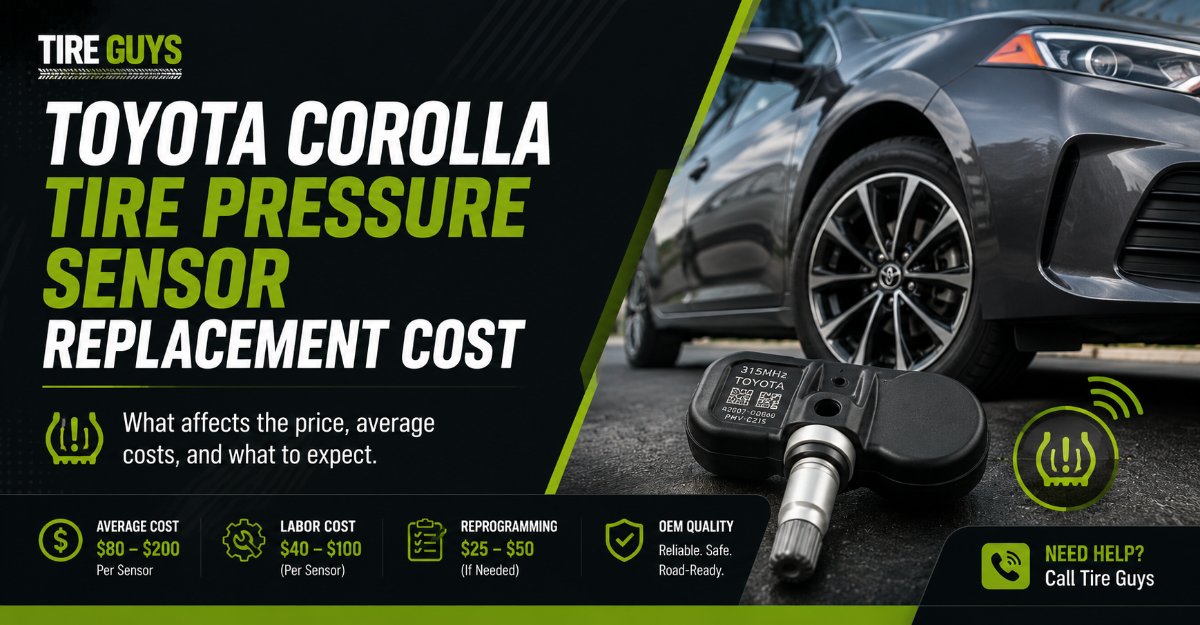
The average Toyota Corolla tire pressure sensor replacement cost ranges from $85 to $250 per wheel. If you replace all four sensors at a dealership, the total bill can reach $560 to $1,080. The final price depends entirely on your choice between authentic OEM Pacific parts and universal aftermarket sensors, as well as the hourly labor rate of your chosen repair shop.
Key Facts / At a Glance
- Sensor Part Price: $25 to $75 for aftermarket options; $80 to $120 for OEM Toyota components.
- Labor and Programming: $50 to $150 per wheel, requiring specialized OBD-II diagnostic tools.
- Operating Frequency: Most North American Toyota Corollas utilize a 315 MHz radio frequency for sensor data transmission.
- Battery Lifespan: Built-in sensor batteries last 5 to 10 years or approximately 100,000 to 150,000 miles.
- Maintenance Rule: Sensor batteries cannot be recharged. Once the battery depletes, the entire sealed unit must be replaced.
How Much Does a Toyota Corolla TPMS Sensor Cost?
The total expenditure for a Toyota Corolla tire pressure sensor replacement breaks down into two distinct categories: hardware costs and installation labor. Dealerships charge premium rates for guaranteed factory parts, while independent shops and warehouse clubs offer significant discounts by utilizing universal programmable blanks.
Per-Wheel Cost Breakdown
| Cost Element | Aftermarket Option | OEM / Dealership Option |
| Sensor Part | $25 to $75 | $80 to $120 |
| Labor & Programming | $50 to $100 | $100 to $150 |
| Total (Per Wheel) | $75 to $175 | $180 to $270 |
Complete 4-Wheel Overhaul Costs
Replacing all four sensors simultaneously is the industry standard recommendation for vehicles over seven years old. Because the internal lithium-ion batteries degrade at the same rate, a single failure usually indicates the remaining three sensors will fail shortly after.
- Big Box and Tire Clubs (Costco, Sam’s Club): $160 to $260 total. These venues often charge a nominal $35 to $60 per wheel, which includes a generic sensor and basic installation during a standard tire rotation.
- Independent Repair Shops: $400 to $600 total. Local mechanics typically source high-quality aftermarket units like Schrader or Autel and charge a standard 0.5 hours of flat-rate labor per wheel.
- Official Toyota Dealerships: $750 to $1,080 total. Dealerships mandate the use of genuine factory parts (like part number 42607-02050 or 42607-12010) and charge premium diagnostic fees.
What Are the Best TPMS Sensor Brands for a Corolla?
Choosing the correct hardware dictates how reliably your dashboard warning light stays off. The market offers two primary paths: exact factory replacements and universal programmable clones.
1. OEM Pacific Industrial and Denso Sensors
Original Equipment Manufacturer (OEM) sensors are identical to the units installed on the Toyota assembly line. Pacific Industrial and Denso manufacture the vast majority of these components for Toyota.
- Quotable Verdict: OEM sensors guarantee flawless electronic communication with your Corolla’s computer, but they command a steep premium.
- Key Specs: 8 to 10 years of battery life, pre-programmed hex-codes, 315 MHz dedicated frequency.
- Drawbacks: High dealership markup pushes the price to $120 per unit.
- Choose this if: You plan to keep your Corolla for another decade and want zero risk of system dropouts.
2. Programmable Aftermarket Sensors (Autel, Schrader)
Aftermarket options are universal blank slates. A technician uses a wireless tool to program Toyota-specific protocols into the blank sensor before installation.
- Quotable Verdict: Programmable sensors provide massive cost savings for budget-conscious drivers, though they carry a minor risk of signal desynchronization.
- Key Specs: 5 to 7 years of battery life, multi-frequency support, $25 to $50 per unit.
- Drawbacks: They require a skilled technician with an updated programming tool. Poorly programmed clones will periodically drop their signal, triggering a flashing dashboard light.
- Choose this if: You are on a strict budget, leasing your vehicle, or having the work done at a high-volume discount tire chain.
Rubber Snap-in vs. Metal Clamp-in Valve Stems
The physical valve stem that protrudes from your wheel comes in two distinct materials. Most modern Corollas utilize rubber snap-in stems. Rubber naturally degrades from UV exposure and ozone, requiring replacement alongside the sensor. Older models or premium alloy wheels may feature metal clamp-in stems. Metal handles high speeds better but suffers from galvanic corrosion. Road salt and moisture cause the metal retaining nut to seize to the stem, sometimes cracking the sensor housing during removal.
How Does the Toyota TPMS System Work?
The Tire Pressure Monitoring System (TPMS) relies on an electronic sensor mounted inside the wheel assembly, hidden behind the tire. This unit combines a mechanical pressure valve, a miniaturized radio transmitter, a pressure transducer, and a built-in watch battery encased in protective silicone.
The sensor continuously measures internal air pressure and broadcasts real-time data via 315 MHz radio frequencies to the Corolla’s electronic control unit (ECU). The ECU monitors these hexadecimal ID codes. If the pressure drops 25 percent below the factory recommendation printed on the driver’s side door placard, the system triggers the horseshoe-shaped dashboard light. For a standard Corolla requiring 32 PSI, a drop to 24 PSI activates the warning.
How to Diagnose a Failing TPMS Sensor
Before paying a mechanic for a diagnostic scan, you can determine the nature of your TPMS failure simply by watching how the dashboard light behaves when you start the engine.
- Solid Dashboard Light: A solid illumination means one or more of your tires are physically under-inflated. The hardware is working perfectly. Check your tire pressures with a manual gauge and inflate them to the door placard specifications.
- Blinking Light (Flashes for 60 Seconds): If the light blinks for one full minute upon startup and then turns solid, the Corolla’s computer has lost radio communication with a sensor. This indicates a dead sensor battery or a physically broken unit. Adding air will not fix this condition.
- The Spare Tire Blind Spot: Older premium trims of the Toyota Corolla occasionally feature a fifth active TPMS sensor located inside the full-size spare tire in the trunk. If your four running tires are perfectly inflated but a solid warning light persists, check the spare tire pressure.
Step-by-Step TPMS Replacement Process
Replacing a tire pressure sensor requires specialized hydraulic machinery. It is not a standard driveway DIY project because the tire bead must be forcefully separated from the rim to access the internal components.
Before You Start
- Time Required: 20 to 45 minutes per wheel.
- Difficulty: Professional level.
- Tools Required: Hydraulic tire machine, Torx T-10 driver, torque wrench, OBD-II relearn tool (e.g., Autel TS508 or Toyota Techstream).
Step 1: Wheel Removal and Deflation
The technician lifts the vehicle, removes the wheel assembly, and extracts the Schrader valve core to bleed out all compressed air rapidly.
Step 2: Breaking the Tire Bead
Using a hydraulic bead breaker shovel on a tire machine, the technician presses the outer rubber tire bead downward. This separates the tire from the metal rim just enough to expose the base of the TPMS valve stem.
Step 3: Sensor Extraction
For rubber stems, the technician cuts the rubber and pulls the unit through the rim. For metal stems, they remove the 11mm or 12mm retaining nut and drop the failed sensor unit into the tire cavity for retrieval.
Step 4: New Unit Installation
A fresh sensor with a clean rubber grommet is mounted through the valve hole. Metal retaining nuts must be tightened to a strict torque specification, usually around 35 inch-pounds (4 Nm), to prevent crushing the internal electronics.
Step 5: Re-inflation and Balancing
The technician re-inflates the tire to the required 32 to 35 PSI. Because breaking the bead shifts the tire’s position on the rim, the wheel must be placed on a spin balancer to apply fresh lead weights.
Step 6: OBD-II Relearn Protocol
The final step is software calibration. The technician plugs a diagnostic tool into the Corolla’s OBD-II port under the steering wheel. The tool forces the ECU into learning mode and writes the unique hexadecimal ID codes of the new sensors directly into the vehicle’s computer, permanently turning off the dashboard light.
What Are the Common TPMS Failure Modes?
Even experienced technicians occasionally make errors when servicing tire pressure monitors. Understanding these failure modes helps you verify the quality of your repair shop’s work.
- Using Green Slime Tire Sealant: Emergency aerosol puncture sealants inject a thick liquid adhesive into the tire. This goo coats the tiny air port on the TPMS sensor, permanently destroying the pressure transducer. If you use Fix-a-Flat, you will almost certainly have to buy a new sensor.
- Skipping Wheel Rebalancing: Breaking the tire bead disrupts the delicate weight distribution of the wheel assembly. Failing to perform a dynamic rebalance after installing a new sensor causes annoying, vibrating steering wheel shakes at highway speeds.
- Buying Ultra-Cheap Online Multipacks: Generic multi-pack sensors purchased from obscure online marketplaces frequently fail to synchronize. They often lose calibration within a few months, forcing you to pay labor fees a second time to replace them.
- Replacing Just One Sensor on an Old Car: If a sensor battery dies from natural age at the eight-year mark, replacing only that single unit is a false economy. The other three batteries are depleted and will fail soon. Replacing them one at a time means paying individual labor and programming fees four separate times.
Which Replacement Strategy Should You Choose?
Your approach to replacing these sensors should align with your budget and how long you intend to keep your vehicle.
The Budget-Conscious DIYer
Purchase a name-brand pre-programmed sensor online, such as a Schrader or Autel unit. Take this part to a local club retailer like Costco or Sam’s Club. You can often pay them a nominal $15 to $20 labor fee to install and sync it during a scheduled tire rotation.
The Long-Term Daily Commuter
If your Corolla is under eight years old and you plan to drive it into the ground, buy a matching set of four OEM Pacific sensors from a certified online Toyota parts wholesale dealer. Have a trusted independent tire specialist handle the installation and calibration. You pay more upfront, but you guarantee a decade of trouble-free performance.
The Lease-Return or Short-Term Owner
Go directly to a high-volume regional tire chain like Discount Tire or Tires Plus. Opt for their house-brand universal programmable sensor package with included labor. This route reliably turns off the dashboard light and clears your vehicle inspection at a highly manageable price point before you turn the keys over to the dealership.
Frequently Asked Questions
Can I replace a TPMS sensor myself without a tire machine?
No, you cannot safely replace a standard TPMS sensor without a hydraulic tire machine. The tire bead is seated against the metal rim with immense pressure. Attempting to break the bead with pry bars or driving over the tire risks severe injury and permanent damage to your alloy wheels.
Does a dead TPMS sensor affect my car’s performance?
A dead sensor will not affect your engine, transmission, or braking performance. However, driving with a malfunctioning system means you will not be warned if a tire is losing air, which increases the risk of a high-speed blowout and decreases your overall fuel economy.
Will disconnecting the car battery reset the TPMS light?
Disconnecting the 12-volt car battery will temporarily clear the dashboard codes, but it will not permanently fix the issue. As soon as you drive the vehicle for a few miles, the computer will search for the radio signals. When it fails to find them, the light will return.
How do I know if my Corolla has indirect or direct TPMS?
All Toyota Corollas sold in North America since the 2007 model year utilize direct TPMS, meaning there is a physical radio sensor inside each tire. Indirect systems, which use ABS wheel speed sensors to guess tire pressure, are rarely used in the modern Toyota lineup.
Do I have to reprogram the system if I rotate my tires?
For most Toyota Corollas, simply rotating the tires does not require an OBD-II relearn procedure. The vehicle’s computer tracks the sensor IDs regardless of which corner of the car they are bolted to. Relearning is only required when introducing a brand-new sensor ID to the computer.