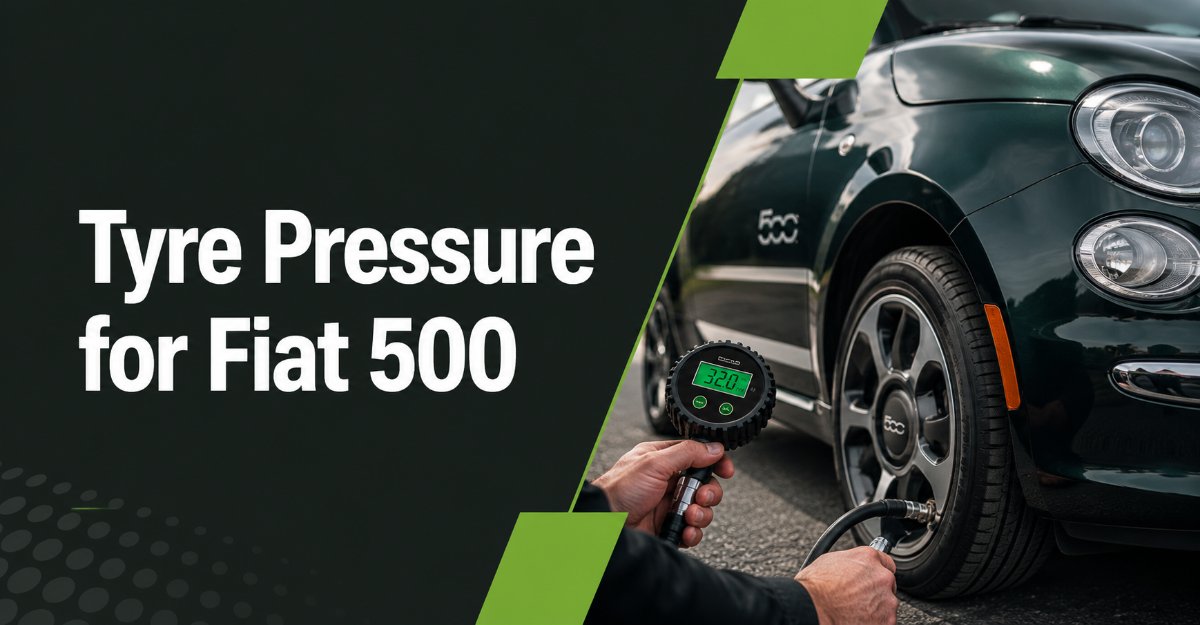
For a standard Fiat 500, the correct tyre pressure is typically 32 PSI (2.2 bar) for the front wheels and 30 PSI (2.1 bar) for the rear wheels under normal driving conditions. Fully loaded vehicles carrying luggage or four passengers require increased pressure, typically 35 PSI (2.4 bar) at the front and 33 PSI (2.3 bar) at the rear. You must always verify these figures against the official tyre placard located on the inside of the driver’s side door pillar.
Key Facts at a Glance
- Front vs Rear: The Fiat 500 requires higher pressure in the front tyres to support the weight of the engine and transmission.
- TPMS Alerts: The orange dashboard warning light triggers when a tyre loses approximately 20 to 25 percent of its optimal air pressure.
- Space Saver Spare: The emergency spare wheel hidden in the boot requires a massive 60 PSI (4.1 bar) to function safely. GripGo Tyre
- Temperature Sensitivity: Tyre pressure drops by roughly 1 PSI for every 10 degrees Celsius drop in ambient air temperature.
- Cold Measurement: You should only check and adjust your pressures when the tyres are completely cold, meaning the car has been parked for at least three hours.
What is the Correct Tyre Pressure by Wheel Size?
While the general rule of 32 PSI front and 30 PSI rear applies to most standard Fiat 500 models (Pop, Lounge, and Star), the exact volume of air required depends on the specific tyre dimensions fitted to your alloy or steel wheels. Engineers calculate these specific values to ensure the sidewall provides the exact stiffness required for the car’s suspension geometry.
Tyre Pressure Guide
The table below outlines the manufacturer specifications for the most common Fiat 500 factory tyre sizes under both normal and fully loaded conditions.
| Tyre Size | Normal Load Front | Normal Load Rear | Full Load Front | Full Load Rear |
|---|---|---|---|---|
| 175/65 R14 | 32 PSI (2.2 bar) | 30 PSI (2.0 bar) | 35 PSI (2.4 bar) | 33 PSI (2.3 bar) |
| 185/55 R15 | 32 PSI (2.2 bar) | 30 PSI (2.1 bar) | 35 PSI (2.4 bar) | 33 PSI (2.3 bar) |
| 195/45 R16 | 33-35 PSI (2.3-2.4 bar) | 30-33 PSI (2.1-2.3 bar) | 35-36 PSI (2.4-2.5 bar) | 33-35 PSI (2.3-2.4 bar) |
How Does Loading the Vehicle Change Pressure Requirements?
A Fiat 500 driven solely by a commuter in the city experiences vastly different physical forces than one carrying four adults and holiday luggage on a motorway.
When you fully load the vehicle, the rear axle compresses downward. If you do not increase the rear tyre pressure to 33 PSI, the tyre sidewalls will bulge outward. This excess flex generates severe heat buildup at high speeds and increases the risk of a blowout. Furthermore, under-inflated rear tyres on a loaded vehicle cause the car to feel sluggish and increase body roll during cornering.
How Do Abarth and 500e Pressures Differ?
The Fiat 500 platform houses several specialized models. Upgraded engines, performance suspension setups, and heavy electric vehicle battery packs fundamentally alter the required tyre pressures.
What is the Correct Tyre Pressure for the Abarth 595 and 695?
Abarth models utilize wider, lower-profile tyres designed to maximize grip and cornering stability. The heat generated by performance driving means Abarth owners must be meticulously precise with their gauges.
For a standard Abarth 595 fitted with 205/40 R17 tyres, the correct pressure is 33 PSI (2.3 bar) for the front and 30 PSI (2.1 bar) for the rear. However, when fully loaded, the Abarth requires a significant increase. The front must be elevated to 38 PSI (2.6 bar) and the rear to 35 PSI (2.4 bar). Failing to run these higher pressures during track days or heavily loaded spirited driving will result in the outer edges of the tyre wearing away prematurely.
Tyre Runner
What is the Correct Tyre Pressure for the Electric Fiat 500e?
The electric Fiat 500e carries a heavy lithium-ion battery pack mounted low in the chassis. This extra weight increases the load on the tyres constantly, regardless of passenger count.
Maintaining exact pressure in the 500e is vital for maximizing battery range. Under-inflated tyres drastically increase rolling resistance, forcing the electric motor to consume more kilowatt-hours to maintain speed. For the 500e fitted with standard 15-inch or 16-inch wheels, the pressure remains close to 32 PSI front and rear. However, models fitted with the larger 205/45 R17 tyres often require a specialized setup of 29 PSI (2.0 bar) across both the front and rear axles.
How to Check and Adjust Fiat 500 Tyre Pressures
Checking your air pressure takes less than five minutes and should be a mandatory part of your bi-weekly vehicle maintenance routine.
Before You Start:
- Time Required: 5 minutes.
- Prerequisites: The car must have been parked for at least 3 hours. Driving heats the air inside the tyre, causing it to expand and give a falsely high reading.
- Tools Required: A digital or analogue tyre pressure gauge, and a 12V portable tyre inflator.
Step 1: Locate the Valve and Attach the Gauge
Unscrew the black plastic dust cap from the wheel rim valve. Push the nozzle of your pressure gauge firmly and squarely onto the threaded metal stem. You will hear a brief hiss of air before the seal engages. Read the resulting number on the digital display or analogue dial.
Step 2: Compare Against the Placard
Compare your reading to the official manufacturer sticker. Open the driver’s side door and look at the B-pillar frame. You will see a white sticker showing a grid of tyre sizes, weights, and the required PSI, Bar, and kPa measurements.
Step 3: Inflate or Deflate as Necessary
If the tyre is under-inflated, connect your air pump and add air in short five-second bursts, checking the gauge frequently. If the tyre is over-inflated, press the small metal pin located directly in the center of the wheel valve to bleed air out until you reach the target PSI.
Step 4: Secure the Dust Caps
Replace the plastic dust caps securely. While these caps do not hold the air pressure in, they prevent dirt, grit, and road salt from entering the valve core and causing microscopic leaks.
Step 5: Calibrate the TPMS
Any time you manually add or remove air from the tyres, you must tell the car’s computer system that the new pressures are the baseline standard. Failing to do this will cause false warning lights later.
How to Reset the TPMS Warning Light on a Fiat 500
The Fiat 500 generally utilizes an indirect Tyre Pressure Monitoring System (TPMS). Instead of placing a physical pressure sensor inside the wheel, the car uses the Anti-lock Braking System (ABS) wheel speed sensors. When a tyre loses air, its overall diameter shrinks slightly. This smaller wheel must spin faster than the fully inflated wheels to cover the same distance. The ABS sensor detects this speed difference and triggers the orange exclamation mark light on your dashboard.
After you have manually inflated all four tyres to the correct PSI, you must reset the system so it can learn the new wheel rotation speeds.
HomeTyre
The Reset Procedure for Standard Dashboards
- Turn the ignition key to the “MAR” position (turning the electrics on without starting the engine).
- Locate the “Menu” button, typically positioned to the right of the steering wheel near the headlight controls or radio.
- Press the Menu button and use the up and down arrows to scroll until the dashboard screen displays “Reset Tyres” or “Tyre Pressure”.
- Press the Menu button once to select this option.
- The screen will prompt you to confirm the reset. Use the arrow keys to highlight “Yes” and press the Menu button to confirm.
- Start the engine and drive the vehicle above 15 miles per hour for approximately ten minutes. The system will calibrate in the background. HomeTyre
The Reset Procedure for Digital TFT Dashboards
- Turn the ignition key to the “MAR” position.
- Using the directional buttons on the right side of the steering wheel, scroll across to the “Vehicle Info” tab.
- Scroll down until you reach the “Tyre Pressure” screen.
- Press and hold the “OK” button in the center of the directional pad for three seconds.
- The screen will display a confirmation message indicating the system has been reset.
Common Mistakes and How to Fix Them
Even experienced drivers fall into traps when managing vehicle maintenance. Avoid these frequent errors to prolong the life of your rubber and suspension.
Relying on the Visual “Kick” Test
Modern radial tyres feature exceptionally stiff sidewalls. A tyre that requires 32 PSI can easily drop down to 20 PSI and still look perfectly normal to the naked eye. Kicking the rubber tells you nothing about the internal air volume. The only way to know your car is safe is to use a calibrated physical gauge.
Ignoring the Space Saver Spare Tyre
The most common mistake Fiat owners make is forgetting the emergency spare wheel located under the boot floor. Because it is incredibly narrow, it requires highly compressed air to support the weight of the vehicle. The space saver demands a staggering 60 PSI (4.1 bar). A spare tyre sitting in a boot for five years will naturally leak air. If you suffer a blowout and discover your spare only has 25 PSI, you will be stranded on the side of the road. Check your spare every six months.
GripGo Tyre
Misinterpreting Flashing Warning Lights
If your TPMS warning light comes on and stays completely solid, it indicates a low-pressure event. However, if you turn the car on and the TPMS light flashes continuously for 60 to 90 seconds before going solid, this indicates a system malfunction. A flashing light usually means an ABS wheel speed sensor has failed, a wire has corroded, or the system computer requires a diagnostic scan. Inflating the tyres will not fix a flashing TPMS light.
Which Tyre Pressure Gauge Should You Choose?
Achieving optimal grip and fuel economy requires accurate measurement tools. You have three primary choices for maintaining your vehicle at home.
- Analogue Pen Gauges: These are cheap, reliable, and require no batteries. They cost under £5 and fit easily into the glovebox. However, the sliding scale can be difficult to read in the dark.
- Digital Handheld Gauges: Costing between £10 and £15, these provide instant, illuminated readouts in PSI, Bar, and kPa. They are the most accurate option for daily use but rely on watch batteries.
- 12V Portable Inflators: Plugging directly into the car’s cigarette lighter socket, these small air compressors allow you to check and fill your tyres anywhere. Costing between £25 and £40, keeping a Ring or Michelin branded pump in the boot is highly recommended.
The Bottom Line
Maintaining the correct tyre pressure for your Fiat 500 is the easiest way to improve fuel economy, extend the life of your tyres, and guarantee safe braking distances. Stick to the 32 PSI front and 30 PSI rear baseline for everyday commuting, remember to add air when carrying heavy loads, and never ignore a dashboard warning light.
Frequently Asked Questions
Can I run higher tyre pressure to get better fuel economy? Technically yes, but within strict limits. Running your tyres 2 PSI higher than the manufacturer recommendation decreases rolling resistance and improves miles-per-gallon slightly. However, over-inflating beyond this narrows the tyre’s contact patch. This causes the center of the tread to wear out rapidly and creates a harsh, bumpy ride that transmits road shock directly into the suspension.
Why does my TPMS light come on during winter mornings? Cold temperatures cause the air molecules inside the tyre to contract, reducing the overall pressure. A sudden overnight frost can easily drop the pressure by 2 to 3 PSI, which is often just enough to push the tyre below the computer’s safety threshold and trigger the warning light.
Should I use PSI, Bar, or kPa? All three are simply different units of measurement for the exact same volume of air. PSI (Pounds per Square Inch) is the most common standard in the UK and USA. Bar is heavily used in Europe. The Fiat 500 handbook and door placard will display both PSI and Bar, and your digital gauge can swap between them with the push of a button.
How do I know if my tyres are under-inflated by looking at the wear? Under-inflated tyres lack the structural support to hold their shape, causing the center of the tyre to bow inward slightly. As a result, the outer shoulders of the tread bear the brunt of the road friction. If both the inner and outer edges of your tyre are bald while the center tread remains deep, you have been driving with low pressure for thousands of miles.
Is it safe to drive with the tyre pressure warning light on? If the light illuminates while you are driving, you should reduce your speed immediately, avoid harsh steering inputs, and pull into the nearest petrol station. Driving on an under-inflated tyre generates immense internal heat that can lead to catastrophic sidewall failure and a high-speed blowout.