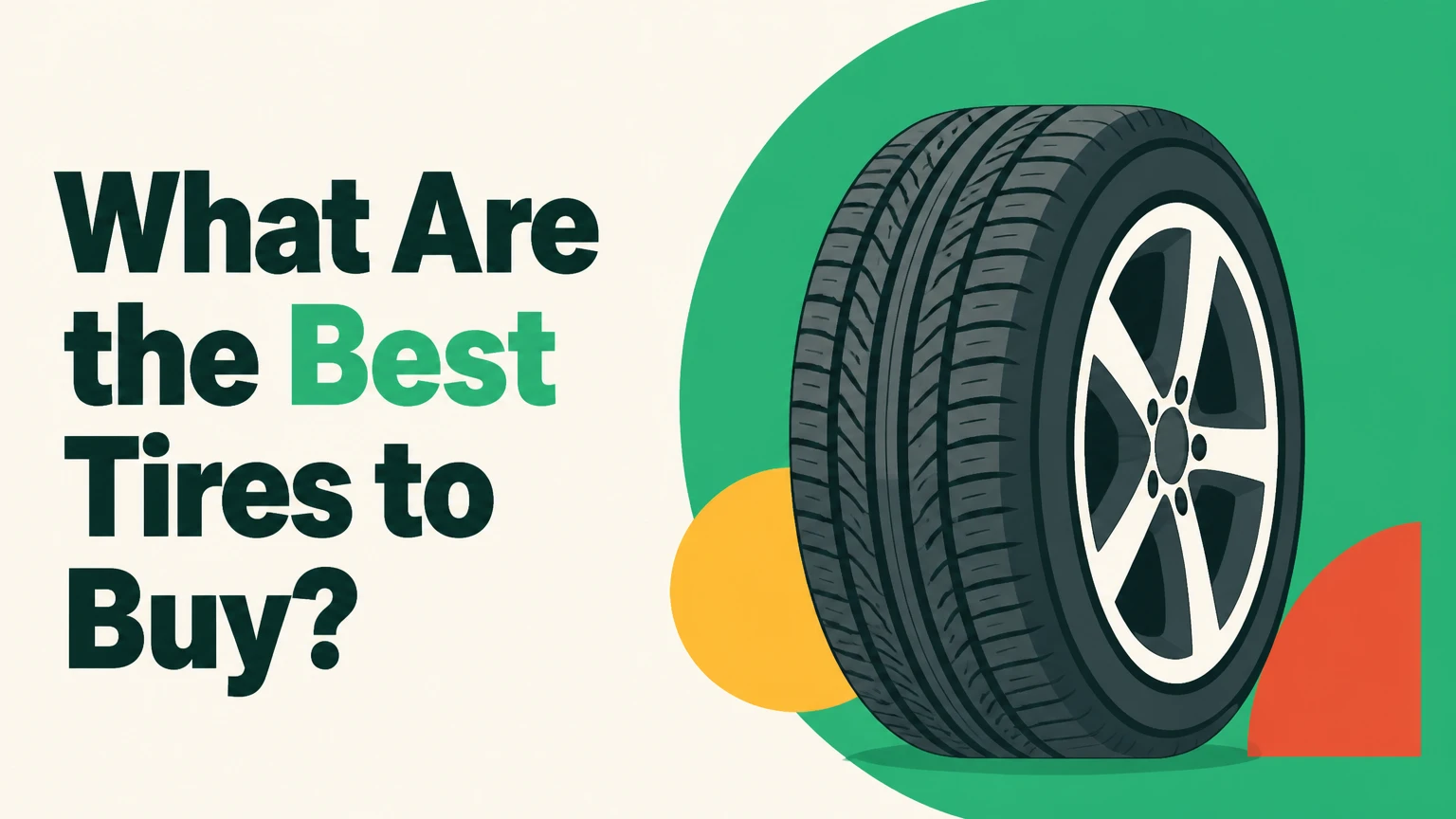
The best tires to buy are tires that match your vehicle’s required size and load rating while providing the right balance of wet braking, climate capability, comfort, tread life, and price. For most year-round drivers, the Michelin CrossClimate2 is the strongest overall choice, while specialized drivers should choose a tire built for their exact conditions.
Key Facts at a Glance
- Michelin CrossClimate2 is the best overall choice for drivers who need strong wet, dry, and winter performance from one tire.
- Continental TrueContact Tour 54 is a better fit for high-mileage commuters who prioritize comfort and tread life.
- General Altimax RT45 offers dependable everyday performance at a lower purchase price.
- Michelin Pilot Sport All Season 4 gives performance cars sharper steering and stronger warm-weather grip.
- Bridgestone Blizzak WS90 remains the better choice for regular ice, packed snow, and severe winter conditions.
- Falken WildPeak A/T4W suits trucks and SUVs that split time between paved roads and rough terrain.
Our Top Picks
| Category | Recommended tire | Best application | Main limitation |
| Best overall | Michelin CrossClimate2 | Year-round driving with rain and snow | Higher purchase price |
| Best for long mileage | Continental TrueContact Tour 54 | Commuting and highway use | Not a severe-snow tire |
| Best budget choice | General Altimax RT45 | Sedans and crossovers | Less winter grip than all-weather models |
| Best performance tire | Michelin Pilot Sport All Season 4 | Sports sedans and performance cars | Faster wear than touring tires |
| Best winter tire | Bridgestone Blizzak WS90 | Ice, packed snow, freezing weather | Must be removed in warm seasons |
| Best all-terrain tire | Falken WildPeak A/T4W | Trucks, SUVs, gravel, trails | Heavier and louder than touring tires |
How We Chose the Best Tires
The best tire cannot be selected by brand reputation alone. A useful evaluation must consider wet braking, hydroplaning resistance, dry handling, snow performance, road noise, tread life, rolling resistance, warranty coverage, available sizes, and price.
Independent testing also matters more than isolated customer ratings. Tire Rack evaluates tires on controlled wet and dry tracks, public-road loops, and winter surfaces. Consumer Reports requires strong performance and safety results before awarding a recommendation, and its 2026 brand evaluation covered approximately 30 tire brands.
The recommendations below assume that the chosen tire is available in the correct OEM size, load index, and speed rating for the vehicle. A highly rated tire with inadequate load capacity is not an acceptable substitute.
1. Michelin CrossClimate2: Best Overall
The Michelin CrossClimate2 is the best tire to buy for most drivers because it combines confident wet braking, capable snow traction, predictable dry handling, and comfortable year-round road manners. Its 3PMSF severe-snow certification also makes it more winter-capable than a conventional all-season tire.
Key specifications
| Attribute | Typical specification |
| Tire category | Grand touring all-season or all-weather |
| Severe-snow rating | 3PMSF |
| Treadwear warranty | Up to 60,000 miles, size dependent |
| Best vehicles | Sedans, crossovers, minivans, compact SUVs |
| Best climate | Rain, changing seasons, moderate snow |
| Typical price | Approximately $180-$300 per tire |
Tire Rack describes the CrossClimate2 as composed and strong across snow, ice, wet, and dry testing. Its long-term survey database also reports high ratings for wet traction, dry performance, winter capability, comfort, and treadwear.
The directional V-shaped tread helps evacuate water and maintain biting edges for snow. That design gives drivers one practical set of tires instead of requiring a seasonal changeover in moderate winter regions.
The limitation is cost. The CrossClimate2 usually costs more than standard touring tires, and drivers in hot climates with no winter exposure may not benefit from its extra snow capability.
Choose this tire if: You want one premium tire for rain, dry roads, highway driving, and occasional snow.
Skip this tire if: You live in a consistently hot climate and care more about maximum tread life or lower cost.
2. Continental TrueContact Tour 54: Best for Mileage
The Continental TrueContact Tour 54 is the best choice for high-mileage commuters because it emphasizes tread life, low road noise, ride comfort, and predictable everyday traction. It is especially suitable for family sedans, crossovers, minivans, and vehicles used for frequent highway travel.
Key specifications
| Attribute | Typical specification |
| Tire category | Standard touring all-season |
| UTQG example | 840 A A |
| Treadwear warranty | Up to 80,000 miles |
| Severe-snow rating | No |
| Best climate | Mild winters and year-round rain |
| Typical price | Approximately $150-$230 per tire |
In a common 225/60R17 size, Tire Rack lists an 840 A A UTQG rating and an 80,000-mile manufacturer warranty. Its consumer survey scores are particularly strong for comfort, dry traction, wet performance, and treadwear.
This tire is a strong cost-per-mile option. A $190 tire lasting 70,000 miles may provide better long-term value than a $130 tire that becomes noisy or loses useful wet performance after 40,000 miles.
The TrueContact Tour 54 is not a replacement for a dedicated winter tire. Tire Rack’s winter comparison recorded substantially shorter ice-braking performance from Continental’s dedicated VikingContact 8 than from the TrueContact Tour 54.
Choose this tire if: You drive long distances and prioritize comfort, low noise, and tread longevity.
Skip this tire if: You regularly encounter packed snow, freezing rain, or icy hills.
3. General Altimax RT45: Best Budget Choice
The General Altimax RT45 is the best budget-oriented tire for ordinary commuting because it delivers respectable wet traction, stable dry-road behavior, a comfortable ride, and broad size availability without premium-brand pricing.
Key specifications
| Attribute | Typical specification |
| Tire category | Touring all-season |
| Treadwear warranty | Approximately 65,000-75,000 miles |
| Best vehicles | Compact cars, sedans, minivans, crossovers |
| Best climate | Mild or moderate conditions |
| Typical price | Approximately $110-$190 per tire |
| Primary advantage | Strong value per installed set |
The RT45 is most appropriate for drivers who use their vehicles for commuting, errands, and highway travel rather than aggressive cornering or severe winter driving. It offers a more balanced purchase than unknown low-cost tires with little independent testing or dealer support.
Budget tire decisions should be based on the installed cost, not the advertised tire-only price. Mounting, balancing, valve stems, disposal fees, road-hazard protection, and alignment can add $100-$300 to a four-tire purchase.
Its limitation is specialization. The RT45 does not provide the snow performance of the CrossClimate2, the handling of a UHP tire, or the rugged construction of an all-terrain model.
Choose this tire if: You need a dependable, sensibly priced replacement for everyday transportation.
Skip this tire if: You drive a powerful performance vehicle or face severe winter conditions.
4. Michelin Pilot Sport All Season 4: Best for Performance
The Michelin Pilot Sport All Season 4 is the best tire for drivers who want responsive steering, strong dry grip, capable wet braking, and usable cold-weather flexibility without switching immediately to a summer tire.
Key specifications
| Attribute | Typical specification |
| Tire category | Ultra-high-performance all-season |
| Treadwear warranty | Up to 45,000 miles |
| Best vehicles | Sports cars, performance sedans, sporty EVs |
| Best climate | Mild winter, wet and dry roads |
| Typical price | Approximately $190-$450 per tire |
| Main strength | Steering response and cornering grip |
Modern UHP all-season compounds use silica and advanced tread designs to retain flexibility across a wider temperature range than older performance tires. Current vehicle testing demonstrates how capable the category has become. A 2026 Chevrolet Corvette E-Ray achieved 1.01 g on all-season Michelin tires, while its summer setup reached 1.08 g.
That capability does not make the Pilot Sport All Season 4 a dedicated winter tire. It remains optimized for drivers who value road feel, braking, and cornering more than maximum tread mileage or deep-snow traction.
The drawback is faster wear. Powerful vehicles, aggressive acceleration, poor alignment, and staggered fitments that prevent normal rotation can reduce service life considerably.
Choose this tire if: Your car has performance-oriented suspension, steering, or power output.
Skip this tire if: Your priorities are maximum mileage, lowest noise, or deep-snow traction.
5. Bridgestone Blizzak WS90: Best for Winter
The Bridgestone Blizzak WS90 is the best tire for repeated driving on ice, packed snow, slush, and freezing pavement. A dedicated winter tire provides a softer cold-temperature compound and a denser network of biting edges than ordinary all-season tires.
Key specifications
| Attribute | Typical specification |
| Tire category | Studless ice and snow |
| Severe-snow rating | 3PMSF |
| Best vehicles | Passenger cars and crossovers |
| Best temperature | Sustained cold conditions |
| Typical price | Approximately $140-$280 per tire |
| Seasonal requirement | Remove during warm weather |
Winter tires are most valuable when temperatures remain consistently low, roads freeze regularly, or travel cannot be postponed during storms. Their benefit is not limited to forward traction. They also improve braking and directional control on winter surfaces.
A dedicated winter tire should be installed as a complete set of four. Using winter tires only on the drive axle can create an unstable grip imbalance during braking or cornering.
The WS90’s soft compound wears quickly on warm pavement and can feel less precise during hot-weather cornering. Storage and seasonal installation also increase ownership cost.
Choose this tire if: Ice and packed snow are routine parts of winter driving.
Skip this tire if: Snow is rare and local temperatures remain mostly mild.
6. Falken WildPeak A/T4W: Best All-Terrain Tire
The Falken WildPeak A/T4W is the best tire for trucks and SUVs that need genuine gravel, dirt, mud, and trail capability without accepting the extreme noise and poor wet-road behavior of a mud-terrain tire.
Key specifications
| Attribute | Typical specification |
| Tire category | Off-road all-terrain |
| Severe-snow rating | 3PMSF on applicable sizes |
| Best vehicles | Pickups, Jeeps, SUVs |
| Best terrain | Highway, gravel, dirt, moderate trails |
| Typical price | Approximately $200-$500 per tire |
| Main compromise | Weight and rolling resistance |
Tire Rack found the WildPeak A/T4W unusually civilized for an off-road all-terrain tire, with refinement and all-weather performance comparable to some more road-focused options.
Its reinforced construction and aggressive tread provide more resistance to cuts and impacts than a standard highway tire. The trade-off is additional mass, possible fuel-economy loss, firmer ride quality, and more tread noise.
Drivers who spend nearly all their time on pavement may be happier with an on-road all-terrain model. Tire Rack’s recent comparison praised the Continental TerrainContact A/T for responsive steering, strong braking, and the best road ride in its test group.
Choose this tire if: Your truck regularly leaves paved roads or travels through rough job sites.
Skip this tire if: You mainly commute on highways and want maximum quietness and efficiency.
Which Tire Type Should You Buy?
| Driving situation | Best category | Why it fits | Avoid when |
| Daily commuting in mild weather | Touring all-season | Quiet, efficient, long-lasting | Regular heavy snow |
| Rain plus moderate winter | All-weather or 3PMSF touring | Better snow grip without seasonal changes | Extreme ice conditions |
| Hot-weather performance | Summer or UHP summer | Maximum warm-road grip | Temperatures near freezing |
| Spirited year-round driving | UHP all-season | Sharp response with wider temperature range | Deep snow and ice |
| Severe winter | Studless winter | Best cold, snow, and ice performance | Warm-season use |
| Highway-focused truck use | Highway all-season | Quiet ride and load capability | Frequent off-road travel |
| Mixed highway and trail use | All-terrain | Reinforced, versatile tread | Maximum fuel economy |
| Deep mud and rocks | Mud-terrain | Large voids and rugged construction | Daily commuting |
Summer tires generally perform best in warm wet and dry conditions, but their compounds can lose flexibility when temperatures fall. All-weather tires occupy the middle ground between conventional all-season and dedicated winter tires. They usually carry the 3PMSF symbol, although that certification does not make them equal to premium winter tires on ice.
How Do You Choose the Correct Tire Size?
Start with the tire information placard on the driver’s door jamb or the vehicle owner’s manual. The replacement tire should normally match the manufacturer’s specified width, aspect ratio, construction, wheel diameter, load index, and speed rating.
For a tire marked P225/50R17 94V:
| Marking | Meaning | Buying rule |
| P | Passenger vehicle tire | Use the specified service type |
| 225 | Width in millimeters | Avoid changing without fitment verification |
| 50 | Sidewall height is 50% of width | Changes affect diameter and ride |
| R | Radial construction | Standard for modern vehicles |
| 17 | Wheel diameter in inches | Must match the wheel |
| 94 | Load index | Do not select a lower rating |
| V | Speed rating | Match or exceed OEM guidance |
Never use sidewall maximum pressure as the normal inflation target. Use the cold-tire pressure listed on the vehicle placard.
Which Tire Ratings Actually Matter?
UTQG includes treadwear, traction, and temperature grades. NHTSA explains that traction grades run from AA to C and indicate wet-pavement stopping capability under the specified test, while temperature grades run from A to C and indicate resistance to heat generation.
UTQG treadwear numbers are relative manufacturer ratings, not guaranteed mileage. A 700-rated tire is not automatically safer or objectively twice as durable as a 350-rated tire from another brand.
Prioritize these specifications in order:
- Correct size and wheel diameter
- Adequate load index
- Appropriate speed rating
- Wet-braking performance
- Climate category and 3PMSF status
- Treadwear warranty and expected mileage
- Comfort, noise, and rolling resistance
- Purchase and installation cost
How Much Should Good Tires Cost?
| Tire level | Typical price per tire | Typical installed set | Suitable use |
| Entry-level | $90-$150 | $500-$850 | Low-mileage commuting |
| Mid-range | $140-$230 | $700-$1,200 | Most family vehicles |
| Premium touring | $190-$320 | $950-$1,600 | High mileage and all-weather use |
| Performance | $200-$450 | $1,000-$2,200 | Sports sedans and coupes |
| Truck all-terrain | $220-$500 | $1,100-$2,500 | Trucks and off-road use |
| Specialty winter | $140-$300 | $750-$1,500 | Severe winter driving |
Prices vary substantially by size. A 16-inch compact-car tire can cost less than half the price of a 21-inch performance SUV tire from the same product family.
Calculate value by expected usable mileage, not warranty mileage alone. A tire’s wet performance may become unacceptable before it reaches the legal minimum tread depth.
When Should Tires Be Replaced?
Replace tires immediately when tread reaches 2/32 inch, cords or belts are exposed, sidewalls show bulges, the tire repeatedly loses pressure, or damage cannot be safely repaired. Drivers who frequently encounter heavy rain should consider replacement around 4/32 inch because wet-road performance declines as grooves become shallower.
AAA testing compared new all-season tires with tires worn to 4/32 inch. On wet pavement, the worn tires increased stopping distance by an average of 87 feet for a passenger car and 86 feet for a light truck.
Age also matters. The final four digits of the DOT identification number show the production week and year. For example, 1225 means the tire was manufactured during the 12th week of 2025. U.S. Tire Manufacturers Association guidance advises owners to consider overall condition, service history, vehicle use, and manufacturer recommendations rather than tread depth alone.
Common Tire-Buying Mistakes
Buying the cheapest available tire
A low purchase price can hide poor wet braking, excessive noise, short service life, weak warranty support, or limited replacement availability.
Choosing by brand without checking the model
Every major manufacturer sells different categories. A premium brand’s economy tire may not outperform a well-tested mid-range model designed for the correct application.
Mixing different tires on one axle
Different tread patterns, compounds, and tread depths can create inconsistent grip. Replace tires in matched axle pairs when a complete set is not practical.
Installing the better tires on the front
When replacing only two tires, many tire manufacturers and installers recommend placing the deeper-tread pair on the rear axle. Greater rear grip reduces the risk of sudden oversteer on wet roads.
Ignoring alignment and suspension problems
New tires will not correct feathering, cupping, pulling, vibration, or one-sided wear caused by mechanical faults. Correct the underlying problem before sacrificing another set.
What Do Tire-Wear Patterns Mean?
| Wear pattern | Most likely cause | Corrective action |
| Center wear | Excessive inflation | Set cold pressure to placard value |
| Both outer edges | Chronic underinflation | Inspect for leaks and correct pressure |
| One outer or inner edge | Camber or toe misalignment | Perform alignment inspection |
| Feathered tread blocks | Incorrect toe setting | Align wheels |
| Cupping or scalloping | Imbalance, worn shocks, or loose suspension | Inspect balance and suspension |
| Flat spot | Hard braking or prolonged parking | Inspect severity and tire structure |
Pressure should be checked monthly and before long trips. Rotate tires at the vehicle or tire manufacturer’s recommended interval, commonly every 5,000-8,000 miles when the fitment permits rotation.
Which Tires Should You Pick?
Choose the Michelin CrossClimate2 when you need one premium tire for changing weather, rain, and moderate snow.
Choose the Continental TrueContact Tour 54 when long tread life, road comfort, and highway mileage matter more than severe-snow capability.
Choose the General Altimax RT45 when you need reliable everyday performance at a controlled price.
Choose the Michelin Pilot Sport All Season 4 when steering response and cornering grip matter more than maximum tread life.
Choose the Bridgestone Blizzak WS90 when winter roads regularly contain ice, packed snow, or freezing slush.
Choose the Falken WildPeak A/T4W when your truck or SUV must handle both paved roads and real off-road surfaces.
Frequently Asked Questions
Are Michelin tires always the best?
Michelin makes several category-leading tires, but no manufacturer is best for every vehicle or use. Continental may offer better touring value, General may cost less, Bridgestone may better suit winter conditions, and Falken may better serve off-road drivers. Compare individual tire models, not company names alone.
Are expensive tires worth buying?
Premium tires are worth the cost when they provide measurably better wet braking, winter traction, comfort, handling, or tread life that matches your driving. They may offer poor value for a low-mileage vehicle used only locally. Compare installed cost, expected mileage, and safety performance before paying more.
Should all four tires be the same?
All four tires should ideally match in model, size, load rating, speed rating, and similar tread depth. Matching tires produce more predictable braking and cornering behavior. Certain performance vehicles use different front and rear sizes by design, but the approved fitment should still be followed exactly.
Are all-season tires good in snow?
Conventional all-season tires can manage light snow, but they are not designed for repeated ice or deep-snow use. All-weather tires carrying the 3PMSF symbol provide stronger snow capability. Dedicated winter tires remain the better choice where freezing temperatures and severe winter surfaces are routine.
Is a higher treadwear rating always better?
A higher UTQG treadwear rating generally suggests a longer-wearing compound within the manufacturer’s comparison system, but it does not guarantee superior safety or mileage. Harder compounds may trade some grip for durability, and UTQG numbers should not replace independent wet-braking, comfort, and winter testing.
What are the best tires to buy for an SUV?
For a road-focused SUV, choose a touring all-season or all-weather tire such as the Michelin CrossClimate2 or Continental TrueContact Tour 54. For mixed pavement and trail use, choose an all-terrain tire such as the Falken WildPeak A/T4W. Always verify the SUV’s required size and load index.
The Bottom Line
The answer to what are the best tires to buy depends on the job the tires must perform. Michelin CrossClimate2 is the strongest general recommendation, Continental TrueContact Tour 54 suits high-mileage comfort, General Altimax RT45 provides budget value, Michelin Pilot Sport All Season 4 supports performance driving, Bridgestone Blizzak WS90 handles severe winters, and Falken WildPeak A/T4W serves mixed road and trail use.
Choose the category first. Then verify size, load rating, speed rating, wet performance, climate capability, total installed price, and tread age before purchasing.