A tire speed rating is a standardized letter indicating the maximum speed a tire can sustain under specified load, inflation, and test conditions. The rating describes the tire’s heat resistance, structural strength, and high-speed stability, not a recommended driving speed. A vehicle’s door-jamb placard and owner’s manual determine the required rating.
Key Facts at a Glance
- The final letter in a tire service description is the speed symbol, such as V in 94V.
- A V-rated tire is certified for speeds up to 149 mph (240 km/h) under its test conditions.
- Speed capability depends on correct inflation, allowable load, tire condition, and suitable mounting.
- A higher speed rating usually changes steering response, ride firmness, tread compound, price, and wear.
- Drivers should match or exceed the vehicle manufacturer’s specified rating unless the manufacturer permits a seasonal exception.
- A tire’s speed rating does not override posted speed limits, weather conditions, road hazards, or safe driving judgment.
What Are Tire Speed Ratings?
Tire speed ratings are letter codes that classify a tire’s tested high-speed capability. The symbol applies to a properly inflated, undamaged tire carrying no more than its rated load under the conditions defined by the applicable tire standard.
The rating is therefore a performance specification, not a permission slip. A 168-mph W-rated tire can lose heat margin quickly when it is underinflated, overloaded, damaged, or operated on a hot road with insufficient pressure.
The U.S. Tire Manufacturers Association and tire makers such as Michelin, Bridgestone, Continental, and Goodyear publish guidance that treats speed symbol and load index as connected parts of the service description. Continental summarizes the concept as the tire’s “maximum speed at which it can carry its maximum load,” a useful distinction because speed capability is conditional rather than absolute.
The rating also belongs to the tire design. Casing materials, belt angles, bead construction, sidewall stiffness, tread compound, and heat-management features all influence the symbol. Two tires with the same size and speed rating can still deliver different wet braking, noise, mileage, or handling because their complete designs differ.
How Does a Speed-Rated Tire Work?
A speed-rated tire manages heat and mechanical stress through its internal construction and rubber formulation. As rotational speed rises, flexing in the sidewall and tread generates heat, while centrifugal forces increase the stress on belts, beads, and the tire’s contact patch.
Manufacturers may use polyester or rayon carcass plies, steel belts, nylon cap plies, specialized tread compounds, and stronger bead assemblies to control those forces. The exact materials vary by model, size, load range, and manufacturer; a speed letter alone does not reveal the tire’s full construction.
The tire must also maintain a stable footprint. Excessive flexing can distort the tread, reduce cornering precision, and accelerate heat buildup. Correct cold inflation pressure limits sidewall deflection, while correct load prevents the casing from working beyond its intended capacity.
How are tire speed ratings tested?
Regulatory and industry procedures test tires on a controlled indoor drum or flywheel under specified load and inflation conditions. The tire is brought to a target speed and held for a defined period while technicians monitor structural integrity, temperature, and failure.
The exact procedure depends on the governing standard and tire category. The commonly described process increases speed in stages, often by approximately 10 km/h, with timed intervals near each target. A laboratory test does not reproduce potholes, road debris, rain, crosswinds, worn suspension parts, or a heavily loaded family vehicle.
That limitation matters. Passing a controlled test means the tire met a defined engineering requirement; it does not guarantee safe operation at the symbol’s maximum speed in ordinary traffic.
What Do the Tire Speed Rating Letters Mean?
The standard passenger-tire speed chart runs from lower symbols used on temporary spares and some specialty tires to Y for very high-performance applications. The values below are maximum test speeds, not legal driving targets.
| Speed symbol | Maximum speed | Typical application | Practical note |
|---|---|---|---|
| M | 81 mph / 130 km/h | Temporary spare | Follow the spare-tire label, often a lower distance limit |
| N | 87 mph / 140 km/h | Specialty spare | Uncommon on ordinary passenger vehicles |
| P | 93 mph / 150 km/h | Specialty passenger tire | Less common in current U.S. passenger fitments |
| Q | 99 mph / 160 km/h | Winter or studless tire | Common where cold-weather compounds take priority |
| R | 106 mph / 170 km/h | Light-truck or heavy-duty tire | Confirm the separate load-range requirement |
| S | 112 mph / 180 km/h | Passenger car | Common on basic sedans and compact vehicles |
| T | 118 mph / 190 km/h | Sedan, minivan, crossover | Frequent original-equipment touring specification |
| H | 130 mph / 210 km/h | Touring and sport sedan | Usually sharper response than S or T |
| V | 149 mph / 240 km/h | Performance touring | Requires attention to load and pressure conditions |
| W | 168 mph / 270 km/h | Ultra-high-performance tire | Often firmer, costlier, and more wear-focused |
| Y | 186 mph / 300 km/h | High-performance vehicle | Used on some extreme performance fitments |
| (Y) | Above 186 mph / 300 km/h | Specialized performance use | Open-ended symbol for tires exceeding 300 km/h |
Is Z a speed rating?
Z is an older, open-ended speed category rather than a complete modern speed specification. A tire marked only Z may indicate capability above 149 mph, but the complete service description normally pairs Z with W or Y, such as 225/45ZR17 94Y.
A ZR marking also contains the construction and size context. It should not automatically be interpreted as a rating higher than Y. Read the complete sidewall code and confirm the tire maker’s specification.
How Do You Read a Tire Speed Rating?
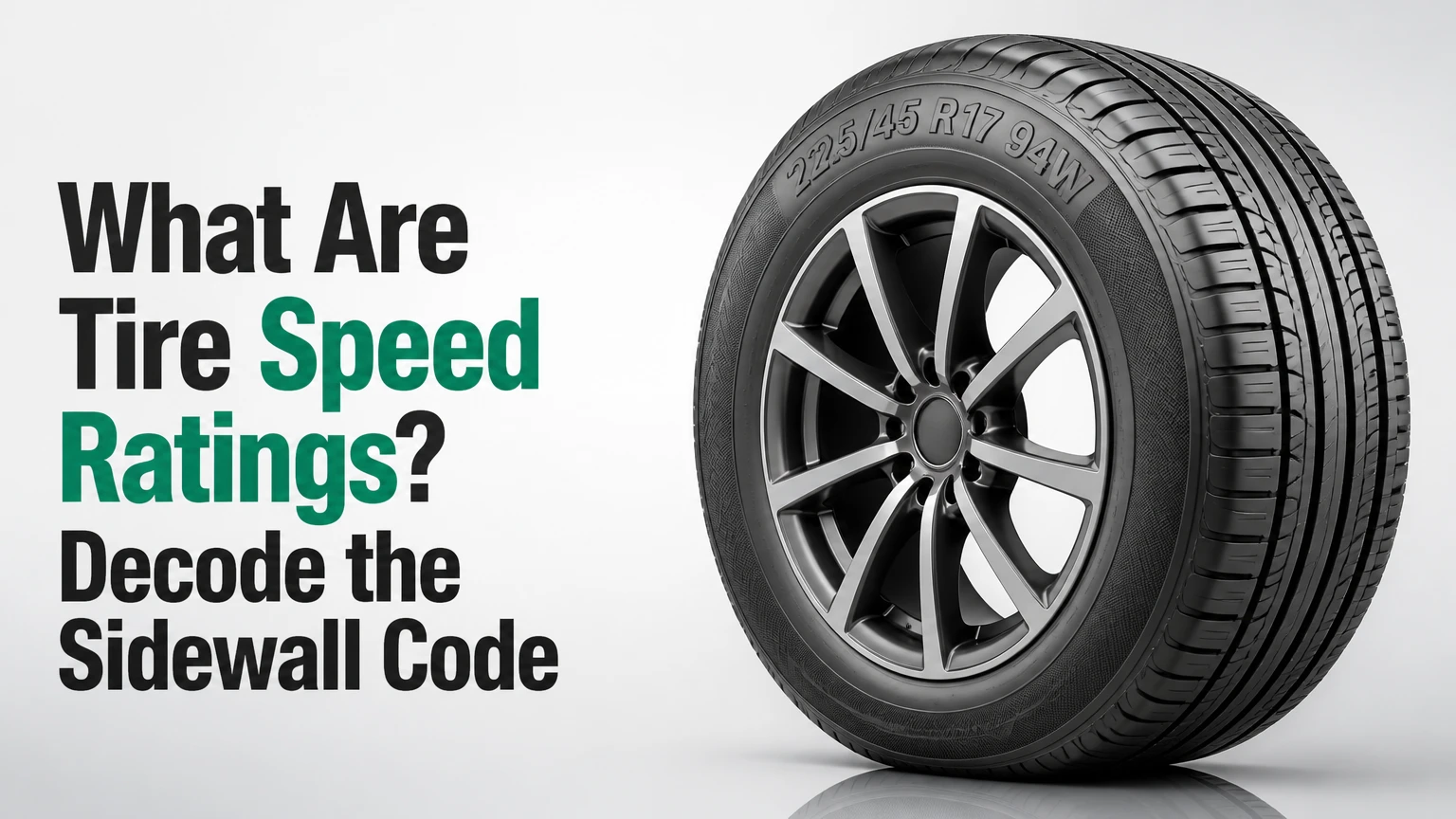
Find the service description at the end of the tire-size code, then separate the load index number from the speed symbol. In P225/50R17 94V, the number 94 is the load index and V is the speed rating.
Use these steps:
- Locate the sidewall code. Look for a string such as P225/50R17 94V.
- Identify the final letter. The last letter, V in this example, is the speed symbol.
- Record the load index. The number before the letter, 94, identifies a specific load capacity in a standard table.
- Check the driver’s door placard. The placard lists the vehicle maker’s recommended tire size, load information, and inflation pressure.
- Compare all four tires. Some vehicles use different front and rear sizes or ratings.
- Confirm the replacement specification. Use the owner’s manual, manufacturer fitment guide, or a qualified tire professional.
The tire sidewall shows what is installed. The placard shows what the vehicle was designed to use. Those details may differ after a wheel or tire modification.
Does a Higher Speed Rating Make a Tire Better?
A higher speed rating is better only when the vehicle, driving conditions, and tire design benefit from its added heat and handling capability. A higher symbol does not automatically mean shorter stopping distance, longer tread life, superior wet grip, or greater durability on rough roads.
Higher-rated tires often use stiffer sidewalls and performance-oriented compounds. Those changes can improve steering response and cornering stability, but they may also transmit more impact harshness, produce more road noise, cost more, and wear faster.
| Rating group | Maximum speed range | Typical tread-life tendency | Typical driving character |
|---|---|---|---|
| S-T | 112-118 mph / 180-190 km/h | 50,000-80,000 miles when touring-oriented | Softer response and smoother ride |
| H | 130 mph / 210 km/h | 40,000-70,000 miles | Balanced response and comfort |
| V | 149 mph / 240 km/h | 35,000-60,000 miles | More precise steering and firmer control |
| W-Y | 168-186 mph / 270-300 km/h | 20,000-45,000 miles on performance designs | Firm response and higher heat capacity |
These are typical market ranges, not guarantees. Alignment, torque delivery, suspension geometry, inflation, temperature, rotation schedule, road surface, and driving style can overwhelm the effect of the speed symbol.
Speed rating, comfort, and tread life
A 2024 replacement set for a vehicle originally fitted with H-rated touring tires might cost approximately $600-$1,000, while a comparable W-rated ultra-high-performance set can cost $800-$1,500. The difference reflects construction and compound choices, not a universal quality ranking.
A high symbol can also reduce comfort when the tire has a lower aspect ratio or reinforced sidewall. Do not blame the letter alone if a new set rides harshly; wheel diameter, sidewall height, tire model, pressure, and suspension condition are equally important.
Can You Use a Lower or Higher Speed Rating?
Use the vehicle manufacturer’s specified speed rating as the minimum for normal replacement unless the owner’s manual explicitly allows an exception. A lower-rated tire can reduce steering precision and high-speed heat margin, even when the vehicle rarely reaches the tire’s laboratory limit.
A higher-rated tire is generally acceptable when it matches the required size, load index, construction, clearance, wheel specification, and seasonal needs. The higher rating may alter ride and wear, so selecting it should be a deliberate fitment decision rather than an automatic upgrade.
| Replacement choice | Safety and fitment result | Cost tendency | Appropriate action |
|---|---|---|---|
| Same rating, same load index | Closest factory match | Baseline | Preferred default |
| Higher rating, same or higher load index | Usually compatible if size and clearance match | 5%-25% higher typically | Confirm ride and winter implications |
| Lower rating, same load index | Reduced design margin | 0%-15% lower typically | Avoid unless manufacturer permits it |
| Different rating by axle | Altered handling balance | Varies by tire set | Follow manufacturer and installer guidance |
| Different rating on AWD vehicle | Potential rolling-diameter mismatch | Varies | Match all four unless vehicle guidance says otherwise |
Vehicle manufacturers sometimes allow lower-rated winter tires because winter compounds and severe-cold performance can outweigh dry-road speed capability. That exception is vehicle-specific. The lower rating should never be assumed acceptable merely because the tires are labeled winter tires.
Can You Mix Different Speed Ratings?
Mixing speed ratings is best avoided because tires with different sidewall stiffness and response can react differently during braking or cornering. If a temporary situation makes mixing unavoidable, the higher-rated tires generally belong on the rear axle, but the vehicle maker’s instructions take priority.
Rear-axle placement helps reduce the risk of sudden oversteer when the front tires have a different response. However, this rule does not solve every fitment issue. Some vehicles require matching tires on each axle, and many all-wheel-drive systems require closely matched rolling circumference across all four positions.
Do not mix different ratings casually on performance vehicles, cars with staggered fitments, or vehicles equipped with sensitive traction-control systems. Replace tires in axle pairs at minimum, and replace all four when the manufacturer requires matched circumference or the remaining tread depths differ substantially.
What Speed Rating Is Best for Winter Tires?
Winter tires commonly carry Q, R, or T symbols because their tread compounds are designed to remain flexible at low temperatures rather than maximize dry-road speed. The correct choice is the highest winter rating that meets the vehicle maker’s winter specification and the driver’s actual conditions.
The three-peak mountain snowflake symbol, marked 3PMSF, indicates that the tire passed a severe-snow traction test. It does not identify the speed rating. A Q-rated tire may provide excellent snow performance, while a T-rated tire may offer a better compromise for frequent highway travel.
Before fitting winter tires, check:
- The vehicle placard and owner’s manual for permitted sizes and ratings.
- Whether the vehicle uses a staggered front and rear arrangement.
- The winter tire’s load index, not only its speed letter.
- The maximum speed printed on the tire or supplied by the manufacturer.
- Whether the tire has the 3PMSF symbol for severe-snow use.
- The recommended cold pressure for the winter fitment.
Never infer snow capability from a lower speed symbol. The speed letter describes heat and structural performance, while tread pattern, compound, siping, and certification govern snow behavior.
What Happens When a Tire Is Underinflated or Damaged?
Underinflation reduces a tire’s speed margin because the sidewall flexes more and generates additional heat. Overloading, overinflation beyond the specified range, impact damage, exposed cords, severe curb strikes, and improper repairs can also make the original speed rating irrelevant.
A puncture repair does not automatically make a tire unsafe, but the repair must meet recognized industry limits and be performed after the tire is removed for internal inspection. A plug inserted from outside cannot reveal run-flat damage caused by driving while severely underinflated.
Replace rather than repair a tire when damage affects the sidewall or shoulder, the puncture exceeds the permitted size, the tire has been driven flat, or internal components show separation. A tire professional should inspect questionable damage.
Why can a new tire feel vague or harsh?
Vague steering after replacement often results from an incorrect pressure, an under-rated or unusually flexible tire, poor alignment, excessive tread depth, or a different tread design. A lower speed symbol is one possible cause, but it should not be blamed before checking pressure, wheel balance, alignment, and tire construction.
Harsh ride can result from excessive pressure, a higher-load or reinforced version, a low-profile size, a stiff performance casing, or worn dampers. Compare the installed tire’s complete code with the placard rather than comparing only the final letter.
How Should You Choose a Replacement Rating?
Choose the factory speed rating first, then evaluate load index, tire category, climate, road use, and comfort. The correct tire is the one that satisfies the vehicle specification while providing an appropriate balance of wet grip, winter traction, mileage, noise, and price.
| Driver situation | Sensible starting point | Priority checks | Avoid |
|---|---|---|---|
| Compact-car commuter | S or T, if factory-approved | Wet braking, warranty mileage, pressure | Lowering below placard rating |
| Family sedan or crossover | T or H, according to placard | Load index, comfort, rain performance | Choosing by speed letter alone |
| Sport sedan driver | H or V | Steering response, heat resistance, dry grip | Mixing performance categories |
| Highway touring driver | Factory rating or one step higher | Noise, tread warranty, wet handling | Assuming higher means quieter |
| Snow-belt vehicle | Q, R, or T winter tire | 3PMSF, load index, cold-weather pressure | Using a summer tire’s rating as a snow measure |
| Track or autocross user | W, Y, or specialist competition tire | Heat cycles, manufacturer limits, track rules | Treating a street rating as a track guarantee |
The most important practitioner rule is to compare the complete service description, not merely the speed letter. A tire marked 94V and one marked 91V share a speed symbol but do not carry the same load index.
Common Tire Speed-Rating Mistakes
- Treating the rating as a target speed. The letter describes a tested capability under controlled conditions, not a safe speed for public roads.
- Ignoring the load index. Matching the speed letter while choosing a lower load index can create a separate fitment problem.
- Reading the tire instead of the placard. An existing tire may already be incorrect, especially after a used-car purchase or wheel modification.
- Assuming Z is the highest rating. Z is incomplete without the complete W or Y designation and the tire manufacturer’s specification.
- Mixing tires on an AWD vehicle. Different rolling circumferences can stress the drivetrain or trigger traction-control faults.
- Using a winter exception without checking the manual. Some manufacturers permit a lower winter symbol; others specify the original rating.
- Comparing only mileage warranties. A 70,000-mile touring tire and a 30,000-mile performance tire serve different design goals.
- Driving on an underinflated tire at highway speed. Pressure loss creates heat and flex before the driver notices obvious handling changes.
A useful shop-floor rule is to photograph the placard and all four sidewalls before ordering. That simple record catches staggered sizes, different load indexes, run-flat markings, and directional fitments that a single front-tire inspection misses.
FAQ About Tire Speed Ratings
Is a V-rated tire safe at 149 mph?
A V-rated tire is tested for up to 149 mph, or 240 km/h, under specified load, inflation, and laboratory conditions. That value does not make 149 mph safe on public roads, in traffic, during rain, or with a damaged or underinflated tire. Vehicle limits and posted laws remain controlling.
Does tire speed rating affect insurance or vehicle inspections?
The effect depends on local law, insurer policy, and inspection rules. A tire below the vehicle manufacturer’s specified rating can create a safety or compliance issue, especially when the vehicle placard requires a higher symbol. Check the local inspection authority and insurer rather than relying on a general rule.
Can I put different speed ratings on the front and rear?
Different front and rear ratings may be acceptable on vehicles designed with staggered fitments, but the arrangement must follow the manufacturer’s specification. For an unavoidable mismatch, higher-rated tires generally go on the rear. AWD vehicles often require matching rolling circumference across all positions.
Does a tire’s speed rating change with age?
The molded speed symbol does not change, but the tire’s real-world performance can decline with age, heat exposure, pressure loss, cracking, and tread wear. Tire makers such as Michelin and Bridgestone recommend regular inspection and replacement according to condition and age guidance, even when tread remains.
Is the highest available speed rating the safest choice?
The highest rating is not automatically safest for ordinary driving. Higher-rated tires may provide sharper response and greater heat capacity, but they can cost more, ride more firmly, wear sooner, and perform worse in cold conditions if the compound is unsuitable. Match the vehicle specification and driving environment first.
The Bottom Line
Tire speed ratings are standardized letter codes that describe a tire’s maximum tested speed under defined load, pressure, and condition limits. Read the final letter in the sidewall service description, verify the load index and size, and compare the result with the driver’s door placard.
For most replacements, matching the original rating is the soundest decision. A higher rating can improve response and heat capacity, while a lower rating can reduce the vehicle’s intended safety margin. The right what are tire speed ratings answer is therefore practical: the letter matters, but it must be evaluated with load, inflation, construction, weather, vehicle fitment, and tire condition.