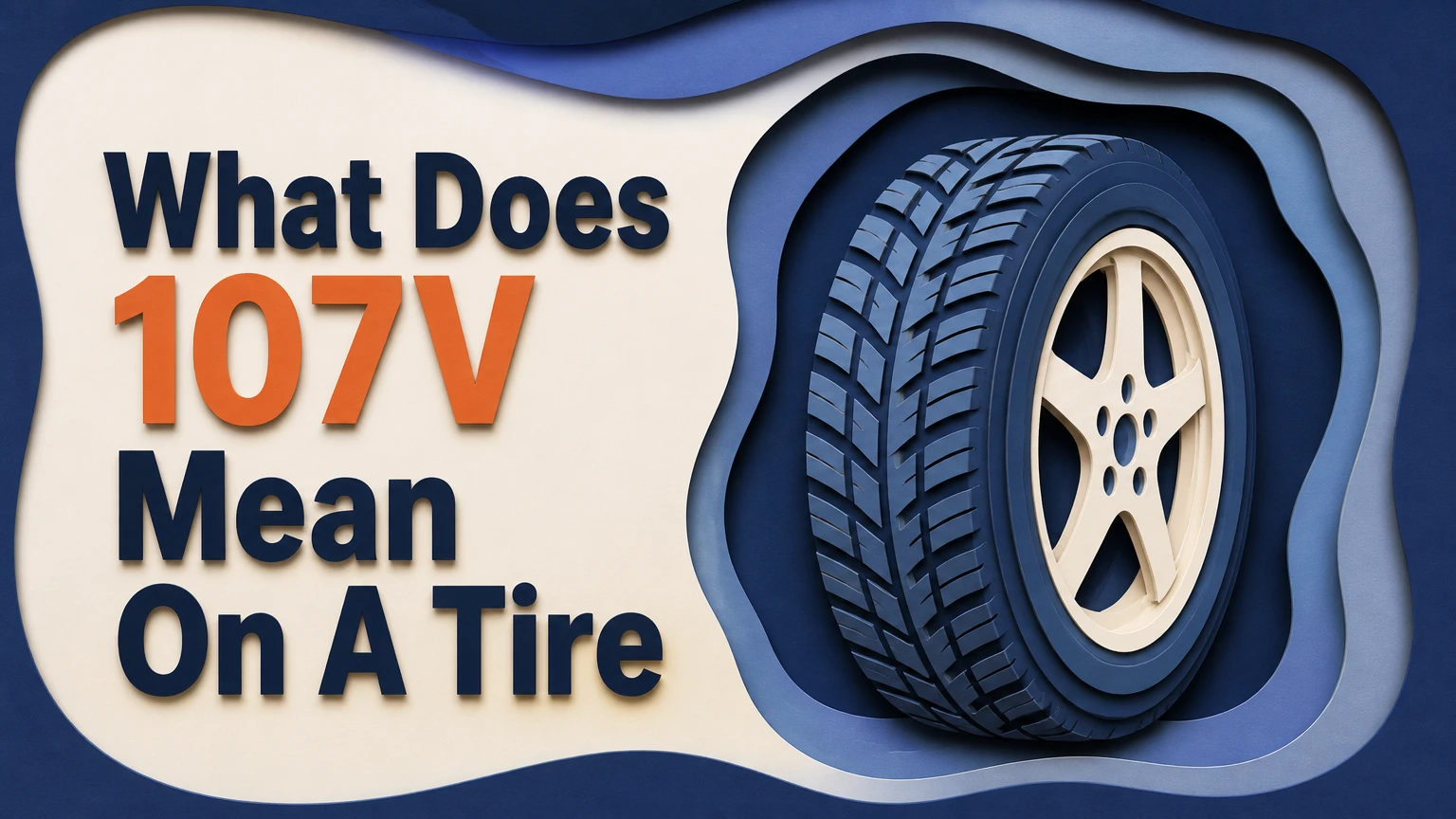
If you are researching replacement parts for your SUV or crossover, wondering what does 107v mean on a tire is a common first step. The code 107V is a service description indicating two distinct maximum safety limits for your vehicle. The “107” means the tire can safely support 2,149 pounds (975 kilograms) of weight, while the “V” means the tire is certified to sustain speeds up to 149 mph (240 km/h) under optimal conditions.
Key Facts At a Glance
- The 107 load index provides a total theoretical maximum weight capacity of 8,596 pounds across a four-tire setup.
- Speed rating V requires advanced silica tread compounds to dissipate high friction heat and prevent blowouts.
- Downgrading a factory 107V requirement to a lower index like 103H can cause dangerous handling instability.
- Heavy electric vehicles frequently require 107V tires to manage their extreme curb weights and instant motor torque.
- Most premium 107V tires cost between $160 and $270 each and last approximately 4 to 6 years with normal driving.
Exactly What Does 107V Mean On A Tire For Daily Driving?
Understanding what does 107v mean on a tire requires separating the number from the letter. This alphanumeric code acts as a contract between the tire manufacturer and the driver. It guarantees that the structural integrity of the rubber will hold up under a specific combination of intense pressure and extreme heat.
A 107V tire is not a recommendation for how you should drive. It is a maximum structural threshold. Operating a vehicle below these thresholds ensures the tire maintains proper contact with the road, resists tread separation, and provides predictable braking distances. Factory engineers select the 107V specification because it provides a massive safety buffer above standard highway driving conditions.
How Is The 107 Load Index Calculated?
The number 107 is an assigned index value, not a direct physical measurement. According to global tire sizing standards, an index of 107 equates to exactly 975 kilograms or 2,149 pounds of weight-bearing capacity per tire.
To determine your vehicle’s total theoretical load capacity, you multiply this number by four. A full set of 107-rated tires can support up to 8,596 pounds. However, this theoretical maximum assumes perfect weight distribution. Engine blocks are heavy, meaning the front axle usually carries more weight than the rear. Automakers mandate a 107 load index for vehicles with a Gross Vehicle Weight Rating (GVWR) between 5,000 and 6,500 pounds to ensure every individual corner of the car has a massive surplus of carrying capacity.
What Does The V Speed Rating Indicate?
The letter V certifies that the tire can run at sustained speeds up to 149 mph (240 km/h) without suffering structural failure. You will likely never drive your family crossover at 149 mph. Speed ratings are actually a measurement of heat dissipation over time.
At high speeds, a tire spins thousands of times per minute. The constant flattening of the rubber against the pavement creates immense internal friction, known in physics as hysteresis. A V-rated tire utilizes specialized aramid fibers, nylon cap plies, and reinforced sidewall shoulders to restrict this expansion. This advanced construction forces heat out of the tire, preventing the internal rubber compounds from melting and causing a catastrophic high-speed blowout.
How Do 107V Tires Compare to Alternatives?
Automakers frequently offer different tire specifications for different trim levels of the same vehicle model. Knowing the differences between load and speed ratings helps you make an informed purchase. Upgrading is generally safe, while downgrading introduces severe risks.
Comparing Common Tire Service Descriptions
| Tire Rating | Load Capacity | Max Speed | Optimal Vehicle Type | Primary Trade-off |
|---|---|---|---|---|
| 103V | 1,929 lbs (875 kg) | 149 mph (240 km/h) | Compact sedans and small crossovers | Cheaper, but dangerous if installed on heavy SUVs. |
| 107H | 2,149 lbs (975 kg) | 130 mph (210 km/h) | Minivans and standard commuter SUVs | Offers a softer ride, but less responsive at high speeds. |
| 107V | 2,149 lbs (975 kg) | 149 mph (240 km/h) | Sporty mid-size SUVs and standard EVs | Excellent heat control, but a slightly stiffer ride quality. |
| 107W | 2,149 lbs (975 kg) | 168 mph (270 km/h) | High-performance luxury SUVs | Elite cornering grip, but faster tread wear and higher cost. |
Where Should You Look to Verify Tire Specifications?
You can find the required tire service description for your specific vehicle in two places. The first is the driver-side door jamb. Opening the door reveals a permanent sticker called the tire and loading information placard. This sticker lists the exact tire size, load index, speed rating, and cold tire pressure required by the factory engineers.
The second location is on the outer sidewall of the tire currently mounted on your vehicle. The 107V code always sits at the very end of the main size sequence. If you see the sequence 235/60R18 107V, the breakdown is entirely standardized. The tire is 235 millimeters wide, has a sidewall height that is 60 percent of that width, features radial internal construction, fits an 18-inch wheel rim, and carries the 107V weight and speed limits.
Are 107V Tires Safe for Heavy Electric Vehicles?
Electric vehicles require specialized tire considerations due to their massive battery packs. A standard mid-size crossover with a gas engine might weigh 3,800 pounds, while its electric equivalent frequently weighs over 4,600 pounds. This added weight places immense strain on the tire contact patch.
A 107V tire is exceptionally common for electric vehicles because of the reinforced sidewalls. Electric motors deliver instant torque to the wheels, which can twist and tear standard rubber compounds. A 107-rated tire often carries an XL (Extra Load) designation. The XL internal structure prevents the tire from folding over on itself during heavy acceleration or sharp cornering, ensuring the heavy electric vehicle remains stable.
Common Vehicles That Frequently Use 107 Load Indexes
| Vehicle Make and Model | Estimated Curb Weight | Factory Recommended Index | Typical Tire Size |
|---|---|---|---|
| Honda Pilot | 4,300 – 4,600 lbs | 107 | 245/50R20 107V |
| Tesla Model Y (Long Range) | 4,398 lbs | 104 or 107 XL | 255/45R19 104W |
| Ford Explorer | 4,345 – 4,700 lbs | 107 | 255/50R20 107V |
| Audi Q5 | 4,079 – 4,619 lbs | 104 to 107 | 235/55R19 105V |
What Is the Impact of Tire Pressure on Load Capacity?
The single most misunderstood fact about the 107 load index is that it requires maximum air pressure to function. A tire rated for 2,149 pounds can only hold that exact amount of weight when inflated to the manufacturer’s maximum specified pressure, which is typically 41 PSI for a standard load tire or up to 50 PSI for an XL tire.
If you underinflate your 107V tire, its weight-bearing capacity drops linearly. A 107 XL tire running at a low 32 PSI might only be capable of supporting 1,800 pounds safely. Driving a fully loaded SUV with underinflated tires causes the sidewalls to over-flex. This generates dangerous thermal degradation, stripping the tire of its V speed rating capabilities and often leading to sudden tread separation.
Can You Use 107V Tires for Towing Trailers?
Towing a trailer places a unique mechanical burden on the rear axle of your vehicle. When you attach a 3,500-pound trailer to a mid-size SUV, the tongue weight pushes down on the rear suspension, adding roughly 350 to 400 pounds of direct vertical mass to the rear tires.
A 107V tire is generally excellent for light to medium towing duties. Because the two rear tires have a combined capacity of 4,298 pounds, they provide a vast safety margin. If your rear axle curb weight is 2,000 pounds, adding 400 pounds of tongue weight and 500 pounds of passenger cargo brings the total to 2,900 pounds. The 107 rating easily absorbs this load without compromising stability.
What Are Common Mistakes When Replacing 107V Tires?
Purchasing the wrong replacement tires can compromise your vehicle’s computer-aided safety systems. Modern traction control, anti-lock braking, and electronic stability control are all calibrated under the assumption that the vehicle is rolling on factory-specified tires.
The most dangerous mistake is downgrading the speed or load rating to save money. Swapping a factory 107V tire for a cheaper 103H tire reduces the load capacity by over 800 pounds across the vehicle. In an emergency lane-change maneuver, the weaker sidewalls of the 103 tire will fold, increasing the risk of a rollover. Furthermore, never mix different service descriptions on the same vehicle. Running a 107H on the left and a 107V on the right creates uneven heat dissipation and unequal cornering grip.
What Should You Expect for Lifespan and Typical Costs?
Replacing a full set of 107V tires is a significant automotive expense. Because V-rated tires require complex rubber mixtures to survive extreme temperatures, they generally cost more than basic T-rated or H-rated commuter tires. The Uniform Tire Quality Grading (UTQG) treadwear rating printed on the sidewall can help you predict how long your investment will last.
Most premium grand-touring tires in this category carry a treadwear rating between 500 and 700. Under average daily driving conditions, this translates to roughly 60,000 to 75,000 miles of reliable service. The rubber will naturally age and harden over time. Even if you rarely drive, a set of tires will legally age out and require replacement after 6 to 8 years due to dry rot.
Estimated Replacement Costs by Tier
| Market Category | Example Tire Model | Average Cost Per Tire | Standard Mileage Warranty |
|---|---|---|---|
| Premium Tier | Continental CrossContact LX Sport | $220 – $270 | 60,000 miles |
| Mid-Range Tier | General Altimax RT43 | $170 – $210 | 65,000 miles |
| Budget Tier | Kumho Crugen HP71 | $140 – $160 | 50,000 miles |
Expert Insights for Tire Buyers
Navigating tire specifications requires practical knowledge. Automotive engineers follow a strict rule when replacing damaged tires: always match or exceed the factory placard. If your vehicle requests a 107V, you can safely install a 107W tire. You gain a higher temperature threshold at the expense of a slightly stiffer ride.
A common rule of thumb among certified technicians is to check the XL designation on heavy vehicles. If your factory 107V tire says “Extra Load” on the sidewall, never replace it with a Standard Load (SL) 107 tire, even if the numbers match. The internal carcass of the XL tire features overlapping belts designed to handle intense cornering forces that an SL tire cannot manage safely.
Frequently Asked Questions
Can I replace a 107V tire with a 107H tire?
You should not replace a 107V tire with a 107H tire unless you strictly adhere to the lower 130 mph speed limit and understand the handling trade-offs. Downgrading the speed rating usually results in softer sidewalls, which causes slower steering response and longer braking distances during emergency maneuvers.
Is a 107V tire always an Extra Load (XL) tire?
A 107V tire is not automatically an XL tire. The load index (107) indicates capacity, while the XL designation indicates the tire requires higher inflation pressures to reach that maximum capacity. You must read the sidewall carefully to see if the letters XL are printed after the 107V code.
Do 107V tires wear out faster than standard tires?
Speed-rated tires generally feature softer, more grip-focused rubber compounds than standard commuter tires. Because a 107V tire is designed to dissipate heat and grip the road tightly at 149 mph, it will usually wear down slightly faster than an H-rated tire built for long-distance highway cruising.
Are 107V tires good for snow and ice?
The 107V rating only specifies weight and speed limits. It tells you absolutely nothing about winter weather traction. To determine if the tire is good for snow, you must look for the Three-Peak Mountain Snowflake (3PMSF) symbol on the sidewall, which guarantees severe snow service certification.
What happens if my 107V tire gets punctured and patched?
When a V-rated tire is punctured and subsequently patched by a mechanic, it usually loses its V speed certification. The physical damage to the internal steel belts compromises the tire’s ability to safely dissipate heat at 149 mph. After a repair, it should be treated as a standard commuter tire.
The Bottom Line
Knowing what does 107v mean on a tire protects your vehicle and your family. The 107 load index guarantees that each corner of your SUV can handle 2,149 pounds, while the V speed rating ensures the rubber will not fail under intense friction heat. Always check your driver-side door placard before purchasing replacements, and never compromise your safety by downgrading to a lesser service description.