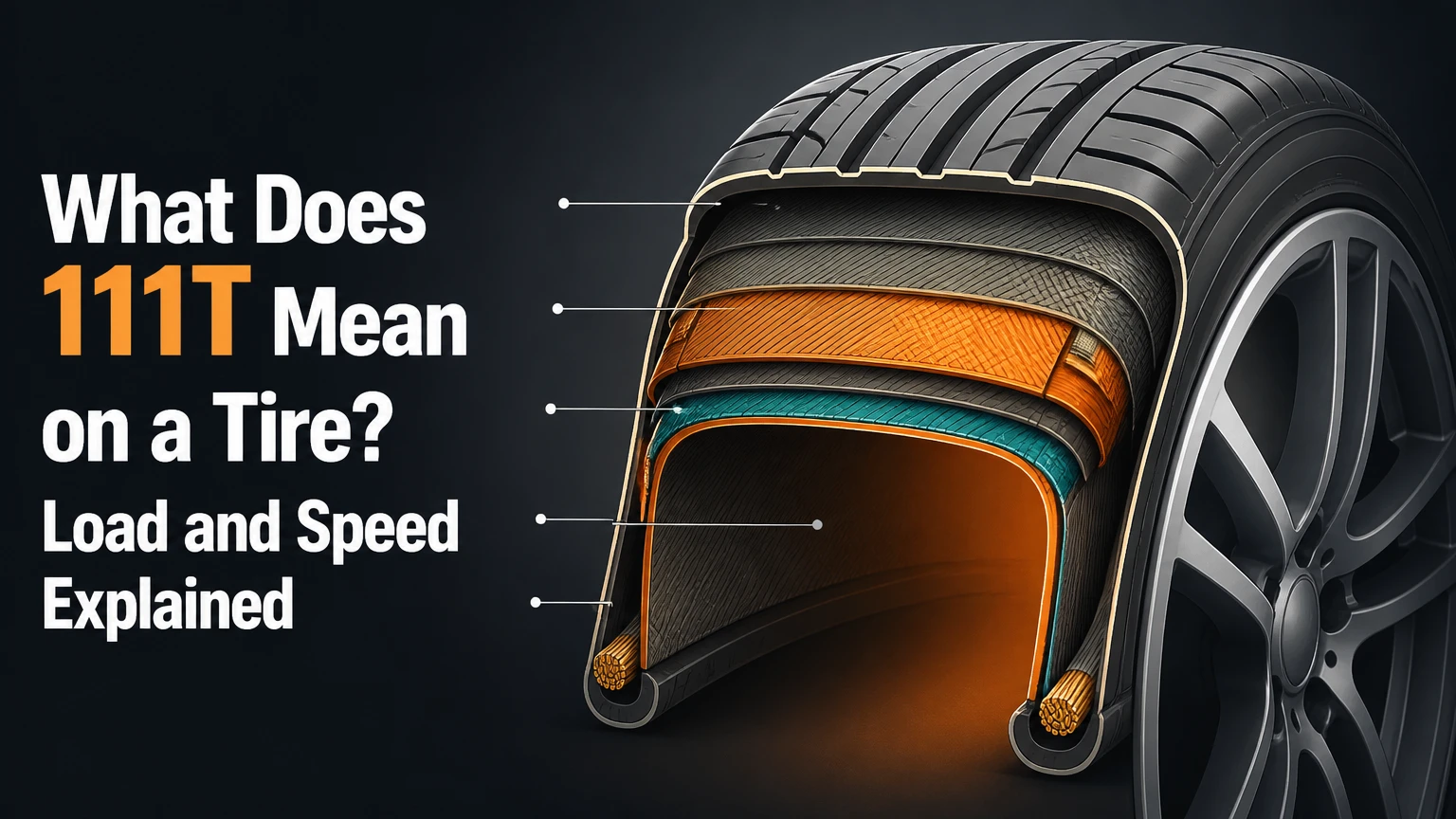
The marking 111T on a tire combines a load index of 111 with a speed symbol of T. Load index 111 means the tire can carry up to 2,403 pounds (1,090 kilograms) under the applicable load and inflation conditions, while speed symbol T indicates a maximum rated speed of 118 mph (190 km/h).
Key Facts at a Glance
- 111 is the tire’s load index, equal to 2,403 lb or 1,090 kg per tire.
- T is the speed symbol, indicating 118 mph or 190 km/h under specified test conditions.
- Four 111-rated tires have a theoretical combined load index capacity of 9,612 lb, but the vehicle’s GVWR and axle ratings remain controlling.
- The correct cold inflation pressure comes from the vehicle placard or owner’s manual, not automatically from the tire sidewall.
- A replacement tire should normally meet or exceed the vehicle manufacturer’s required load index and speed rating.
- The code does not identify tread quality, traction, tire size, load range, or whether the tire is suitable for towing.
What Does 111T Mean on a Tire?
The 111T marking is a standardized service description attached to a tire size. The number describes carrying capacity, and the letter describes heat and speed performance; neither character identifies the tire’s diameter, width, construction type, or tread compound.
For example, a complete marking might read P265/65R18 111T. In that string, P265/65R18 describes the tire size and construction, while 111T describes the service capability. A tire marked 265/65R18 111T without the P prefix may use a different regional or load-calculation standard, so the complete sidewall and vehicle placard matter.
Michelin defines the load index as “a numerical code associated with the maximum load a tire can carry at the speed indicated by its speed symbol under specified service conditions.” That qualification matters: the rating is not a blanket promise that every driving condition, inflation pressure, road surface, or vehicle load is safe.
What does the number 111 mean?
The number 111 means a maximum load of 2,403 lb, or 1,090 kg, for one tire when the tire is operated under the relevant industry load table and inflation conditions. The load-index chart, rather than the number itself, supplies the actual weight value.
The figure is not the recommended cargo weight for your vehicle. A vehicle with four 111 tires may have a tire capacity of 9,612 lb, yet its manufacturer could specify a lower GVWR, lower axle rating, or lower wheel rating.
What does the letter T mean?
The letter T means a maximum rated speed of 118 mph, or 190 km/h. Speed symbols are tested under controlled conditions and account for heat generation, structural stability, and tire endurance.
The T rating is not a recommended cruising speed. Public-road speed limits, weather, tread condition, inflation, road damage, alignment, and vehicle loading can require a much lower speed. A worn or damaged 111T tire cannot safely operate at its original rating simply because the sidewall still displays T.
How Do Load Index and Tire Pressure Work Together?
A 111 tire carries 2,403 lb only at the pressure and conditions associated with its load table; tire pressure determines how much load the casing can support, while the tire structure contains and guides the pressurized air. The maximum sidewall pressure is not automatically the correct operating pressure for the vehicle.
The vehicle manufacturer selects a pressure that balances load capacity, handling, braking, comfort, and tire wear. That pressure appears on the driver-door placard, doorjamb label, fuel-door label, or owner’s manual.
A useful distinction is:
- Vehicle placard pressure: the required cold pressure for the specified original tire and normal rated loading.
- Sidewall maximum pressure: the highest pressure permitted for the tire, often associated with its maximum listed load.
- Actual pressure: the cold pressure measured before driving, when heat has not raised the reading.
Do not increase pressure to the sidewall maximum simply because cargo has been added. For heavy loading or towing, follow the vehicle manufacturer’s loading table and the tire maker’s load-and-inflation table. Some vehicles require additional pressure, but the correct value depends on axle load, tire size, tire construction, and placard instructions.
Why does compressed air carry the vehicle?
Compressed air supports much of the vehicle load because pressure acts over the tire’s footprint and transfers force through the casing to the wheel. Belts, plies, bead wires, and rubber maintain shape, resist deformation, and manage heat, but structural reinforcement does not replace correct inflation.
Underinflation increases sidewall flex and heat. Overinflation reduces the contact patch and can increase impact harshness. Both conditions can reduce braking and cornering performance, although their wear patterns differ.
Which Tire Types Can Have a 111T Rating?
A 111T service description can appear on P-Metric, Euro-Metric, XL, and some SUV-oriented tire designs, but identical 111T lettering does not make every tire interchangeable. Tire size, construction, maximum pressure, wheel rating, vehicle placard requirements, and regional standards must match.
| Tire designation | Typical construction | What to verify | Common application |
|---|---|---|---|
| P-Metric 111T | Passenger-car load calculation | Vehicle placard, P-metric load adjustment, wheel fitment | Crossovers and light-duty SUVs |
| Euro-Metric 111T | European load calculation | Size designation, load table, speed symbol | Imported SUVs and passenger vehicles |
| XL, 111T | Reinforced casing, higher allowable pressure | XL marking, maximum pressure, placard compatibility | Heavier crossovers and EVs |
| LT Load Range C or D | Light-truck construction | Load range, tire pressure, wheel and axle limits | Pickups, vans, work vehicles |
| 111T run-flat | Reinforced sidewall or support structure | Vehicle-approved run-flat specification | Vehicles equipped with TPMS and no spare |
Is an XL 111T better than a standard 111T?
An XL 111T is not automatically better. An Extra Load tire can support its listed load at a higher inflation pressure than a standard-load tire of the same nominal size, but it may deliver a firmer ride and must remain compatible with the vehicle’s approved tire specification.
The load index alone cannot reveal whether the tire is standard load or XL. Look for XL, Reinforced, or the manufacturer’s equivalent marking on the sidewall and product specification.
Can a P-Metric 111T replace an LT tire?
A P-Metric 111T should not replace an LT tire solely because both appear to fit the wheel. P-Metric and LT tires use different load-calculation conventions and often differ in casing strength, pressure capability, sidewall resistance, and intended service.
A truck manufacturer may approve a P-Metric tire for a half-ton pickup, but that approval must come from the placard or owner’s manual. A tire retailer’s physical fitment confirmation is not enough when towing, payload, off-road use, or commercial loading is involved.
How Much Weight Can Four 111T Tires Carry?
Four 111T tires have a theoretical tire-capacity total of 9,612 lb, or 4,360 kg, calculated as 2,403 lb multiplied by four. That arithmetic does not establish the legal or safe payload of the vehicle because the vehicle chassis, wheels, axles, suspension, brakes, and GVWR may be rated lower.
| Rating or limit | Value | What it controls |
|---|---|---|
| One 111 tire | 2,403 lb / 1,090 kg | Maximum tire load under rated conditions |
| Four 111 tires | 9,612 lb / 4,360 kg | Theoretical tire total |
| T speed symbol | 118 mph / 190 km/h | Maximum rated test speed |
| Example 111T replacement | Must meet placard | Vehicle compatibility |
| Vehicle GVWR | Manufacturer-specific | Maximum loaded vehicle weight |
| GAWR | Manufacturer-specific | Maximum front or rear axle load |
The lowest-rated component controls. If the rear axle is rated at 4,000 lb, four tires with a larger theoretical capacity do not raise that axle rating. Likewise, a wheel rated for less than the tire’s capacity limits the assembly.
Is 111T suitable for towing?
A 111T tire may be suitable for light towing when the vehicle manufacturer approves it and the combined vehicle, trailer, tongue-weight, axle, and tire loads remain within their ratings. The service description alone does not establish towing capacity.
Before towing, calculate the loaded vehicle weight, trailer tongue weight, rear-axle load, and tire load on each axle. Inspect the tire’s load-and-inflation table, confirm cold pressure, and account for passengers, cargo, accessories, and hitch hardware.
How Does 111T Compare With 111H and 115S?
The best service description depends on the vehicle placard and operating conditions. A 111H tire keeps the same 2,403 lb load index but raises the speed symbol to H, while a 115S tire increases load capacity to 2,679 lb per tire but lowers the speed symbol to S.
| Service description | Load per tire | Speed symbol | Speed rating | Typical trade-off |
|---|---|---|---|---|
| 111T | 2,403 lb / 1,090 kg | T | 118 mph / 190 km/h | Balanced touring and utility use |
| 111H | 2,403 lb / 1,090 kg | H | 130 mph / 210 km/h | More heat margin, often firmer handling |
| 111V | 2,403 lb / 1,090 kg | V | 149 mph / 240 km/h | Performance-oriented response |
| 115S | 2,679 lb / 1,215 kg | S | 112 mph / 180 km/h | Greater load capacity, lower speed rating |
| 107T | 2,149 lb / 975 kg | T | 118 mph / 190 km/h | Lower load capacity, often unsuitable |
The higher speed symbol does not automatically mean better braking or wet traction. Tread compound, tread design, temperature, road surface, and tire condition often matter more in ordinary legal driving.
Is 111H better than 111T?
111H is appropriate instead of 111T only when the vehicle permits the higher-rated tire and the driver wants its handling characteristics. Both ratings carry 2,403 lb per tire, but H-rated products commonly use construction and compounds designed for greater heat and speed capability.
A higher speed rating can bring a firmer ride, greater purchase price, or shorter tread life, although these effects vary by model. Do not use 111H to compensate for an underinflated tire or an overloaded vehicle.
Is 115S better than 111T?
115S provides more rated load capacity, but its 112 mph speed rating is lower than T’s 118 mph. It is useful only when the vehicle approves the load and speed combination, and the tire’s construction suits the vehicle.
A heavier-duty tire may weigh more, transmit more road impact, and alter steering response. On a passenger crossover, extra load capacity is not necessarily an advantage if the tire changes the approved specification or wheel clearance.
How Should You Choose a Replacement for a 111T Tire?
Choose a replacement by matching the complete original specification, not by matching only 111T. Confirm tire size, load index, speed symbol, construction, load type, rim diameter, seasonal category, and any run-flat or manufacturer-specific approval.
Use this replacement sequence:
- Read the driver-door placard and owner’s manual.
- Record the full size, such as P265/65R18.
- Confirm the required load index and speed symbol.
- Check whether the original is XL, LT, run-flat, or standard load.
- Verify wheel width, diameter, load rating, and clearance.
- Match the axle requirements, especially on AWD vehicles.
- Install the manufacturer’s recommended cold pressure.
- Reset or relearn TPMS if the vehicle requires it.
A replacement with a higher speed symbol is generally acceptable when its load index and construction also meet the vehicle requirements. A lower load index or speed symbol requires explicit manufacturer approval. Mixing different ratings across an axle can change handling and should be avoided.
Can you replace only two 111T tires?
Replacing only two tires can be acceptable when the remaining tires have comparable tread depth, size, construction, and service description. On many vehicles, new tires are installed on the rear axle to reduce oversteer risk, even when the vehicle is front-wheel drive.
AWD and four-wheel-drive vehicles may require closely matched rolling circumference. A difference in tread depth or overall diameter can stress the center differential or clutch pack. Follow the vehicle manufacturer’s replacement policy rather than relying on a universal tread-depth rule.
What Do 111T Tires Typically Cost and How Long Do They Last?
Typical retail pricing for a 111T passenger or SUV tire is approximately $130-$260 per tire, while premium, run-flat, severe-snow, and specialized all-terrain models can cost more. Typical tread life is 40,000-70,000 miles, but alignment, inflation, load, climate, compound, and driving style determine the result.
| Tire category | Typical price per tire | Typical mileage range | Main cost driver |
|---|---|---|---|
| Budget all-season 111T | $100-$150 | 30,000-50,000 miles | Compound and warranty |
| Mid-range touring 111T | $140-$210 | 45,000-65,000 miles | Tread design and casing |
| Premium highway 111T | $180-$280 | 55,000-80,000 miles | Brand, warranty, wet grip |
| All-terrain 111T | $160-$300 | 35,000-60,000 miles | Larger blocks and casing |
| Run-flat 111T | $200-$400 | 30,000-60,000 miles | Reinforced sidewall |
Mileage warranties are not guaranteed mileage. Tire manufacturers typically prorate defects or tread wear according to warranty terms, and irregular wear can exclude coverage.
A properly maintained tire can age out before it reaches its treadwear expectation. The U.S. National Highway Traffic Safety Administration advises inspecting tires regularly and replacing them when they are old, damaged, or worn, while several tire manufacturers recommend careful evaluation at six years and replacement by ten years from manufacture regardless of tread.
What Problems Can an Incorrect 111T Application Cause?
An incorrect 111T application can create inadequate load capacity, excessive heat, unstable handling, irregular wear, or wheel and axle overload. Sidewall appearance alone cannot diagnose the problem because bulging, wear, and heat damage have several possible causes.
| Symptom | Likely causes | Immediate action |
|---|---|---|
| Outer sidewall bulge | Low pressure, overload, impact damage | Stop, inspect, measure pressure |
| Center tread wear | Sustained overinflation | Set cold pressure to placard value |
| Both shoulder wear | Underinflation or overload | Check pressure and axle loading |
| Cupping or scalloping | Poor alignment, worn shocks, imbalance | Inspect suspension and balance |
| Inner-edge wear | Excessive toe or camber | Obtain alignment measurement |
| Cracks or bubbles | Age, impact, ozone damage | Replace tire if structural damage exists |
| Hot smell or discolored rubber | Severe underinflation or overload | Stop driving and inspect immediately |
A bulging sidewall does not prove that the tire exceeds its 2,403 lb rating. Low pressure, a pothole impact, or internal separation can produce a similar appearance. Structural damage requires professional inspection, and a tire with a bubble should not remain in service.
What are the most common maintenance mistakes?
The most damaging mistake is treating the maximum sidewall pressure as the everyday target. The second is checking pressure after driving, when heat has temporarily increased the reading.
Three practitioner rules prevent many failures:
- Check pressure cold at least monthly and before long trips.
- Weigh heavily loaded vehicles by axle when payload or towing approaches the limit.
- Replace a tire after serious impact or visible structural damage, even when tread remains.
Tire pressure changes roughly 1 psi for every 10-degree Fahrenheit change in air temperature, although the exact change varies. Correct pressure after a cold-weather change, but do not bleed a hot tire to the placard value.
Is 111T a Good Tire Rating for an SUV or Electric Vehicle?
111T is a suitable rating for an SUV or electric vehicle only when the vehicle placard specifies it or permits an equivalent service description. Electric vehicles can require high load capacity because battery packs add substantial mass, but the correct rating depends on the exact model, axle loads, tire size, and manufacturer tuning.
A full-size SUV may use 111T for quiet highway comfort, while another version of the same model may require XL, a different load index, or a higher speed symbol. Model year, drivetrain, wheel package, and regional configuration can change the approved tire.
Do not infer fitment from vehicle examples such as Ford F-150, Chevrolet Tahoe, Jeep Grand Cherokee, or a particular EV. Confirm the exact year and trim. The sidewall rating is only one part of the fitment decision.
FAQ About 111T Tires
Can I drive 118 mph on a 111T tire?
The T speed symbol rates the tire for up to 118 mph under specified test conditions, but it does not make 118 mph safe or legal on public roads. Inflation, load, tread depth, damage, temperature, road quality, and vehicle condition can reduce real-world safety well below the laboratory rating.
Does 111T mean the tire is for a truck?
No. The 111T code does not identify a truck tire. Passenger, Euro-Metric, XL, and some SUV tires can carry the same service description, while LT tires use different construction and often show a load range such as C or D.
Can I use a 111S tire instead of 111T?
A 111S tire has the same 2,403 lb load index but a lower 112 mph speed rating. Use it only if the vehicle manufacturer permits the lower speed symbol, because replacing T with S can conflict with the placard, handling requirements, or local regulations.
What does 111T XL mean?
111T XL means the tire has a load index of 111, a T speed symbol, and Extra Load construction. The XL designation indicates a higher load-capacity configuration at an approved higher pressure, but it does not increase the vehicle’s GVWR or automatically improve ride quality.
Should all four tires have the same 111T rating?
The four tires should normally match the vehicle’s approved size, construction, load index, and speed symbol, with matching tires installed across each axle. AWD vehicles can require closely matched circumference and tread depth, so consult the owner’s manual before replacing only one or two tires.
The Bottom Line
What does 111T mean on a tire? It means 2,403 lb of rated load capacity per tire and a T speed rating of 118 mph, subject to the specified pressure, load, test conditions, and vehicle fitment. Use the door-placard pressure, respect GVWR and axle limits, and replace the tire with a complete specification that meets the vehicle manufacturer’s requirements.