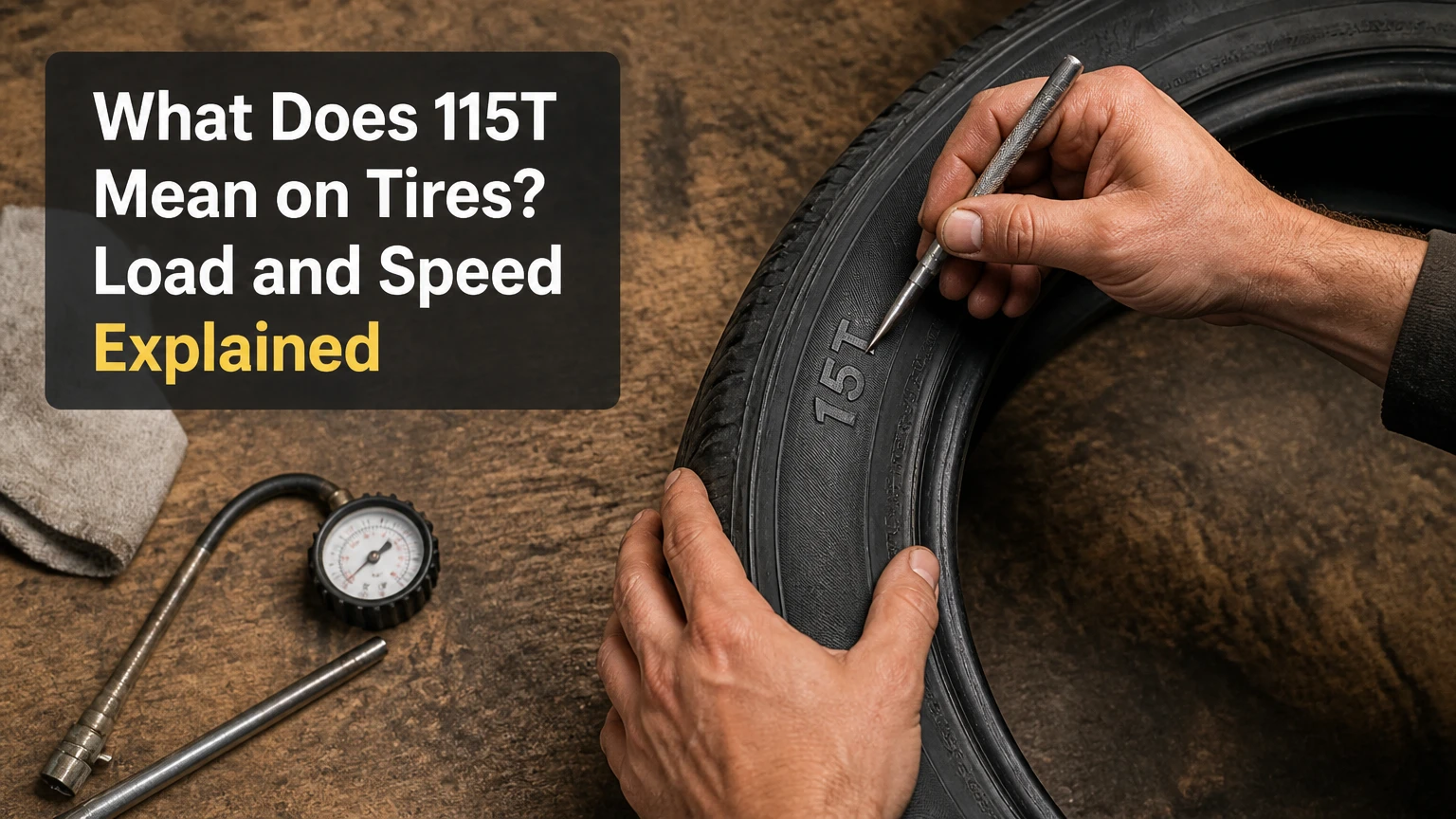
The tire code 115T means the tire has a load index of 115, supporting up to 2,679 pounds (1,215 kilograms) per tire, and a T speed rating, tested for speeds up to 118 mph (190 km/h) under specified conditions. The number and letter describe different capabilities, and neither replaces the vehicle manufacturer’s fitment requirements.
115T at a Glance
- 115 is a standardized load index, not a 1,150-pound weight rating.
- 115 load index: 2,679 pounds or 1,215 kilograms per tire.
- T speed symbol: 118 mph or 190 km/h under specified test conditions.
- Four tires rated 115 provide a theoretical tire-load total of 10,716 pounds.
- The 10,716-pound figure is not automatically the vehicle’s GVWR or safe payload.
- Correct inflation, tire condition, axle loading, and vehicle specifications control real-world safety.
What Does 115T Mean on Tires?
The 115T service description combines a tire’s load index and speed symbol. Load index 115 identifies the maximum load assigned to one tire on the standardized chart, while speed symbol T identifies the tire’s tested maximum speed category when the tire carries its rated load and operates under prescribed conditions.
The code often appears after the tire size, such as 265/70R17 115T. In that example, 265 is the nominal section width in millimeters, 70 is the aspect ratio, R identifies radial construction, 17 is the wheel diameter in inches, and 115T is the service description.
Federal Motor Vehicle Safety Standard No. 139 defines the load index as “a numerical code associated with the maximum load a tire can carry at the speed indicated by its speed symbol under specified service conditions.” That wording matters because the two ratings work together. A tire’s capacity is not a promise that every vehicle using the tire can carry 2,679 pounds at every wheel.
What does the number 115 mean?
The number 115 means a maximum rated load of 2,679 pounds per tire on the standard load-index chart. A vehicle with four identical tires therefore has a theoretical tire capacity of 10,716 pounds, calculated as 2,679 multiplied by four.
That arithmetic is useful for checking whether a tire is broadly suitable for a heavy SUV, pickup, or van. It does not establish the vehicle’s gross vehicle weight rating, axle rating, suspension capacity, wheel rating, braking capacity, or legal payload.
| Load index | Maximum load per tire | Four-tire arithmetic | Common interpretation |
|---|---|---|---|
| 112 | 2, Пред? | Not applicable | Lower than 115; verify carefully |
| 114 | 2,601 lb / 1,180 kg | 10,404 lb / 4,720 kg | Slightly below 115 |
| 115 | 2,679 lb / 1,215 kg | 10,716 lb / 4,860 kg | The rating in question |
| 116 | 2,756 lb / 1,250 kg | 11,024 lb / 5,000 kg | 77 lb more per tire than 115 |
The first row contains an error risk if populated carelessly, so use the verified values that matter: load index 112 is 2,? Actually standard chart: 112=2469 lb/1120kg; 113=2535; 114=2601; 115=2679; 116=2756. Need fix table. Also total metric 1215*4 4860 yes. "theoretical tire-load total" fine.
What does the letter T mean?
The letter T means the tire has a maximum speed rating of 118 mph, or 190 km/h. The rating describes resistance to heat buildup, deformation, and structural stress during standardized testing; it is not a recommendation to drive at 118 mph.
Speed ratings assume a properly inflated, undamaged tire with suitable load, adequate wheel fitment, and specified testing conditions. Underinflation, overloading, road impacts, excessive heat, tread damage, or an overloaded axle can make real-world performance unsafe well below the rating.
| Speed symbol | Rated maximum speed | Approximate metric speed | Typical positioning |
|---|---|---|---|
| S | 112 mph | 180 km/h | Standard passenger and light-truck applications |
| T | 118 mph | 190 km/h | Common all-season and highway applications |
| H | 130 mph | 210 km/h | Higher-speed touring and performance applications |
| V | 149 mph | 240 km/h | Performance-oriented applications |
| W | 168 mph | 270 km/h | High-performance applications |
The letter does not indicate tread quality, braking distance, wet grip, ride comfort, or winter traction by itself. Those characteristics depend on tread design, compound, casing, size, vehicle setup, temperature, and road conditions.
How Do Load and Speed Ratings Work Together?
A 115T tire manages its rated load through casing strength, inflation pressure, heat control, and resistance to repeated flexing. The tire’s contact patch flattens against the road, the sidewall and internal plies deflect, and the tread generates heat as the wheel rotates.
At higher speed, the tire experiences more rapid cyclic flexing and centrifugal forces. Steel belts, body plies, bead construction, tread compounds, and in some designs nylon or aramid overlays help control deformation, but manufacturers do not use one identical internal construction for every 115T model.
A 115T tire’s rating is therefore a system value, not a simple measure of “heavy-duty rubber.” Tire size, load range, inflation table, wheel width, and construction specification also matter.
Why does inflation pressure matter?
Inflation pressure supports the vehicle’s load and controls sidewall flexing. The maximum pressure molded into a tire sidewall is not necessarily the pressure the vehicle should use, because the driver-door placard specifies the pressure selected by the vehicle manufacturer for handling, ride, braking, and load distribution.
NHTSA advises drivers to check tire pressure monthly and before long trips, using the placard or owner’s manual as the reference. Check pressure when tires are cold, because driving heats the air and temporarily increases the reading.
An underinflated 115T tire can flex excessively, create heat, wear its shoulders, and lose load-carrying margin. Overinflation can reduce the contact patch, increase center tread wear, and make impact damage more likely. Pressure is not a substitute for a higher load index.
Which Vehicles Use 115T Tires?
115T tires commonly appear on larger crossovers, SUVs, light trucks, and vans, but the tire size and vehicle placard determine whether a particular application is correct. The same load index can appear on different sizes with different handling, clearance, wheel, and inflation requirements.
Examples include a tire marked 265/70R17 115T, where the size describes physical dimensions and 115T describes service capability. A different tire size with the same 115T service description may not fit the same wheel or vehicle.
How do you verify whether your vehicle needs 115T?
Use the following order:
- Read the driver-door placard. Find the original tire size, recommended cold inflation pressure, and front and rear specifications.
- Check the owner’s manual. Look for alternate sizes, temporary-spare restrictions, towing instructions, and load limits.
- Match the complete size. Confirm width, aspect ratio, construction, wheel diameter, and service description.
- Check axle requirements. Front and rear axles may have different loads or tire specifications.
- Confirm wheel compatibility. Verify approved rim width, diameter, offset, and wheel load rating.
- Check the replacement tire’s load table. The tire must provide the required capacity at the vehicle’s specified pressure.
- Confirm regional rules. Commercial, winter, studded, and inspection requirements vary by jurisdiction.
A tire retailer’s catalog is useful for finding candidates, but the vehicle placard and manufacturer manual take priority over a generic online recommendation.
Are 115T Tires Highway, All-Terrain, or Winter Tires?
A 115T service description does not identify the tread category. Highway-terrain, all-terrain, mud-terrain, all-season, and winter tires can use different service descriptions, and the letters 115T alone do not reveal the tread pattern or rubber compound.
| Tire category | Main road environment | Typical tread characteristic | Main trade-off |
|---|---|---|---|
| Highway terrain, H/T | Asphalt and concrete | Continuous ribs, moderate grooves | Less loose-surface traction |
| All-terrain, A/T | Pavement, gravel, dirt | Open shoulders, deeper grooves | More noise and rolling resistance |
| Mud-terrain, M/T | Mud, rocks, severe loose terrain | Large voids and reinforced blocks | Poorer wet-road refinement |
| All-season touring | Paved roads in varied weather | Dense blocks and circumferential grooves | Limited deep-snow performance |
| Dedicated winter | Cold roads, snow, ice | Flexible compound and dense siping | Faster warm-weather wear |
A 3PMSF symbol, showing a mountain and snowflake, indicates a tire meeting a defined severe-snow performance requirement. An M+S marking alone does not equal the same certification. A 115T all-season tire can carry the correct load and speed rating while still providing inadequate ice or deep-snow traction.
How Does 115T Compare With 115S, 115H, and 116T?
A 115T tire is preferable to a lower-rated replacement when the vehicle placard specifies 115T. A higher speed symbol or load index may be acceptable when the vehicle, wheel, pressure, clearance, and manufacturer guidance permit it, but a higher number is not automatically a performance upgrade.
| Service description | Load per tire | Speed rating | Difference from 115T | Practical issue |
|---|---|---|---|---|
| 115S | 2,679 lb / 1,215 kg | 112 mph / 180 km/h | Same load, lower speed | May fail the vehicle requirement |
| 115T | 2,679 lb / 1,215 kg | 118 mph / 190 km/h | Baseline | Matches the stated code |
| 115H | 2,679 lb / 1,215 kg | 130 mph / 210 km/h | Same load, higher speed | May bring a firmer ride or higher price |
| 116T | 2,756 lb / 1,250 kg | 118 mph / 190 km/h | 77 lb more per tire | Does not increase vehicle GVWR |
| 116H | 2,756 lb / 1,250 kg | 130 mph / 210 km/h | Higher load and speed | Verify complete vehicle compatibility |
A lower load index can reduce the available capacity at the recommended pressure. A lower speed symbol can also conflict with the vehicle manufacturer’s specification, even if the driver never approaches the symbol’s maximum speed.
Can you replace 115T with 115H?
A 115H tire generally preserves the 115 load index and raises the speed category to H, but fitment remains vehicle-specific. The replacement must match the complete size, meet or exceed required load capacity, fit the approved wheel, and comply with the vehicle manufacturer’s guidance.
Higher speed-rated tires may use different compounds or casing designs, which can change ride comfort, rolling resistance, tread life, and wet handling. The H symbol alone does not prove better braking on every road.
Can you replace 115T with 116T?
A 116T tire provides 2,756 pounds per tire, which is 77 pounds more than a 115 tire, but the higher load index does not raise the vehicle’s GVWR. The vehicle remains limited by its placard, axle ratings, suspension, wheels, brakes, and manufacturer-certified configuration.
An extra-load tire may also require a different inflation table or construction. Never inflate beyond the vehicle placard or tire manufacturer’s permitted pressure to pursue extra payload.
Is 115T Suitable for Towing?
A 115T tire can be suitable for towing if its size, pressure, axle capacity, and load rating meet the vehicle manufacturer’s requirements. Towing suitability cannot be determined from 115T alone because tongue weight transfers additional load to the tow vehicle’s rear axle.
Check these limits together:
- Vehicle GVWR
- Front and rear gross axle weight ratings
- Maximum payload
- Hitch receiver and tongue-weight rating
- Trailer maximum loaded weight
- Tire and wheel load ratings
- Recommended cold inflation pressures
- Actual scale weights with the trailer attached
A four-tire theoretical capacity of 10,716 pounds does not mean the tow vehicle can legally carry a 10,716-pound vehicle mass. For example, a vehicle with a 6,800-pound GVWR remains limited to 6,800 pounds even if its replacement tires have a larger theoretical total.
Practitioner rule: weigh the loaded vehicle at a public scale when towing near its limits. Tire capacity should retain a meaningful margin after passengers, cargo, tongue weight, accessories, and fuel are included.
How Much Do 115T Tires Cost and How Long Do They Last?
Typical retail pricing for 115T tires ranges from $130-$170 per tire for budget highway models and $210-$320 or more for premium all-terrain, touring, or winter models. Installation, balancing, disposal fees, taxes, road-hazard coverage, and alignment can add approximately $25-$60 per tire, depending on location and service package.
| Tire type | Typical tire price | Typical treadwear warranty | Typical service pattern |
|---|---|---|---|
| Budget H/T | $130-$170 | 40,000-60,000 miles | Quiet pavement use |
| Premium H/T | $210-$300 | 60,000-80,000 miles | Long highway commuting |
| A/T | $170-$320 | 45,000-60,000 miles | Mixed pavement and gravel |
| Winter | $180-$320 | Often lower or absent | Seasonal installation |
| Commercial van | $180-$330 | 40,000-70,000 miles | Heavy recurring loads |
Typical usable life is four to six years or 45,000-70,000 miles, but mileage depends on alignment, inflation, rotation, driving style, climate, load, and tread compound. A tire can require replacement before its tread is worn out if it has impact damage, cracking, irregular wear, or excessive age.
NHTSA recommends replacing tires when they are worn to 2/32 inch of remaining tread, and many manufacturers advise inspection or replacement around six years, with a ten-year maximum often cited from the date of manufacture. The tire sidewall’s DOT code identifies its production week and year.
What Problems Can a 115T Tire Develop?
The service description does not prevent damage caused by potholes, low pressure, overloading, worn suspension, misalignment, or aging. Inspect the tread and sidewalls monthly, before long trips, and after a severe impact.
| Symptom | Likely cause | Immediate response | Repair outcome |
|---|---|---|---|
| Sidewall bulge | Broken internal cords after impact | Stop using the tire | Replace tire |
| Center tread wear | Sustained overinflation | Check cold pressure and placard | Correct pressure; inspect wear |
| Both shoulder wear | Underinflation or overload | Measure pressure cold | Correct pressure; assess damage |
| Cupping or scalloping | Worn shocks, imbalance, or misalignment | Inspect suspension and balance | Repair cause and rotate |
| Vibration at highway speed | Imbalance, bent wheel, or belt damage | Reduce speed and inspect | Balance, repair, or replace |
| Cracks between tread blocks | Aging, ozone, heat, or storage | Have a technician inspect | Replace if structural |
A sidewall bulge is not safely repairable because it usually indicates broken internal cords. Rapid center wear can indicate overinflation, but it can also result from a mismatch between the tire’s pressure and the vehicle’s load conditions.
Expert insight: rotating tires cannot cure a mechanical problem. Rotation can distribute normal wear, but cupping caused by worn dampers will return until the suspension fault is corrected.
Which Mistakes Should You Avoid?
Avoid installing a tire with a load index below 115 or a speed symbol below T when the vehicle placard requires 115T, unless the vehicle manufacturer explicitly authorizes that configuration. A lower rating removes certified capacity or speed margin and may create inspection, warranty, or insurance complications.
Common mistake 1: Treating 115 as 1,150 pounds
Load-index values are coded chart values. Load index 115 means 2,679 pounds, not 1,150 pounds and not 11,500 pounds per axle.
Common mistake 2: Using four-tire capacity as payload
The four-tire calculation is a theoretical tire limit. It does not override GVWR, axle ratings, wheel ratings, suspension limits, or legal payload.
Common mistake 3: Comparing speed symbols as a driving target
T-rated tires are not intended to encourage 118-mph driving. The rating is a controlled capability category, and tire condition, weather, road surface, pressure, and load can reduce safe performance.
Common mistake 4: Mixing ratings on an axle
Use matching tires on each axle whenever possible. Mixing different tread patterns, load indexes, or speed symbols can alter handling and traction, while AWD vehicles may require closely matched rolling circumference on all four positions.
Common mistake 5: Assuming XL means unlimited capacity
XL, or Extra Load, identifies a reinforced passenger-car tire built to carry more load at a specified pressure than a standard-load version of the same size. XL status does not automatically replace the required service description or increase the vehicle’s certified GVWR.
How Can You Read the Complete Tire Marking?
A complete marking provides more information than 115T. Consider LT265/70R17 115T, although the exact meaning of the prefix and service description depends on the market and tire category.
| Marking | Meaning | Example value | What to verify |
|---|---|---|---|
| LT | Light-truck classification | LT265/70R17 | Vehicle and wheel approval |
| 265 | Section width | 265 mm | Physical clearance |
| 70 | Aspect ratio | Sidewall is about 70% of width | Overall diameter |
| R | Construction | Radial | Standard modern construction |
| 17 | Wheel diameter | 17 inches | Matching rim diameter |
| 115T | Service description | 2,679 lb, 118 mph | Required load and speed |
| DOT date code | Production date | 2324 means week 23 of 2024 | Age and storage history |
Some tires include LT, P, or other prefixes that affect load tables and application. Passenger-car tires and light-truck tires of similar physical size are not interchangeable by appearance alone.
What Should You Check Before Buying 115T Tires?
Confirm the complete fitment rather than searching only for the letters 115T. The following checklist reduces the most common ordering errors:
- Photograph the driver-door placard.
- Copy the entire original tire size.
- Record front and rear cold pressures.
- Identify whether the vehicle is passenger, SUV, light truck, commercial van, or AWD.
- Check whether the original tire is standard load, XL, or LT.
- Match or exceed the required load index and speed symbol.
- Confirm the tire’s seasonal and terrain purpose.
- Check the manufacture date and warranty terms.
- Plan rotation intervals from the tire and vehicle manufacturer.
- Recheck pressure after installation and after the first temperature change.
A tire shop should also inspect wheels, valve stems, TPMS sensors, alignment, and suspension components. A new tire cannot compensate for a bent wheel or a leaking valve.
FAQ About 115T Tires
Does 115T mean each tire carries 2,679 pounds?
Yes. Load index 115 corresponds to 2,679 pounds, or 1,215 kilograms, per tire under the applicable rating conditions. The vehicle’s permissible load remains controlled by its GVWR, axle ratings, wheels, suspension, brakes, recommended pressure, and manufacturer specifications.
Is a 115T tire better than a 115S tire?
A 115T tire has the same 2,679-pound load index as a 115S tire but a higher speed category, 118 mph versus 112 mph. Neither is universally better because ride, wet grip, noise, tread life, and winter performance depend on the tire model and construction.
Can 115T tires go 118 mph continuously?
The T rating identifies a standardized maximum speed capability under specified conditions, not a safe cruising instruction. Damage, underinflation, overloading, heat, weather, road quality, and tire age can reduce the practical safety margin substantially.
Are 115T tires good in snow?
Some 115T tires perform well in light snow, but the service description does not certify winter traction. Look for the 3PMSF symbol for severe-snow qualification, and choose a dedicated winter tire when ice, packed snow, and low temperatures are regular driving conditions.
Do all 115T tires have the same load capacity?
All tires using load index 115 reference the same standardized maximum load value, 2,679 pounds per tire, but their required inflation pressures, construction, size, casing, speed behavior, and vehicle fitment can differ. Read the manufacturer’s load-and-inflation table for the exact tire.
Should I replace only one 115T tire?
Replacing one tire can be acceptable when the remaining tires have similar tread depth, construction, size, and service description, but many vehicles require closer matching. AWD systems can be especially sensitive to rolling-circumference differences, so follow the vehicle manual and tire manufacturer’s guidance.
The Bottom Line
What does 115T mean on tires? It identifies a tire with a 2,679-pound per-tire load index and a 118-mph T speed rating under specified conditions. Use 115T as one part of a complete fitment decision: match the vehicle placard, cold inflation pressure, tire size, axle limits, wheel specifications, terrain needs, and seasonal conditions before buying or installing a replacement.