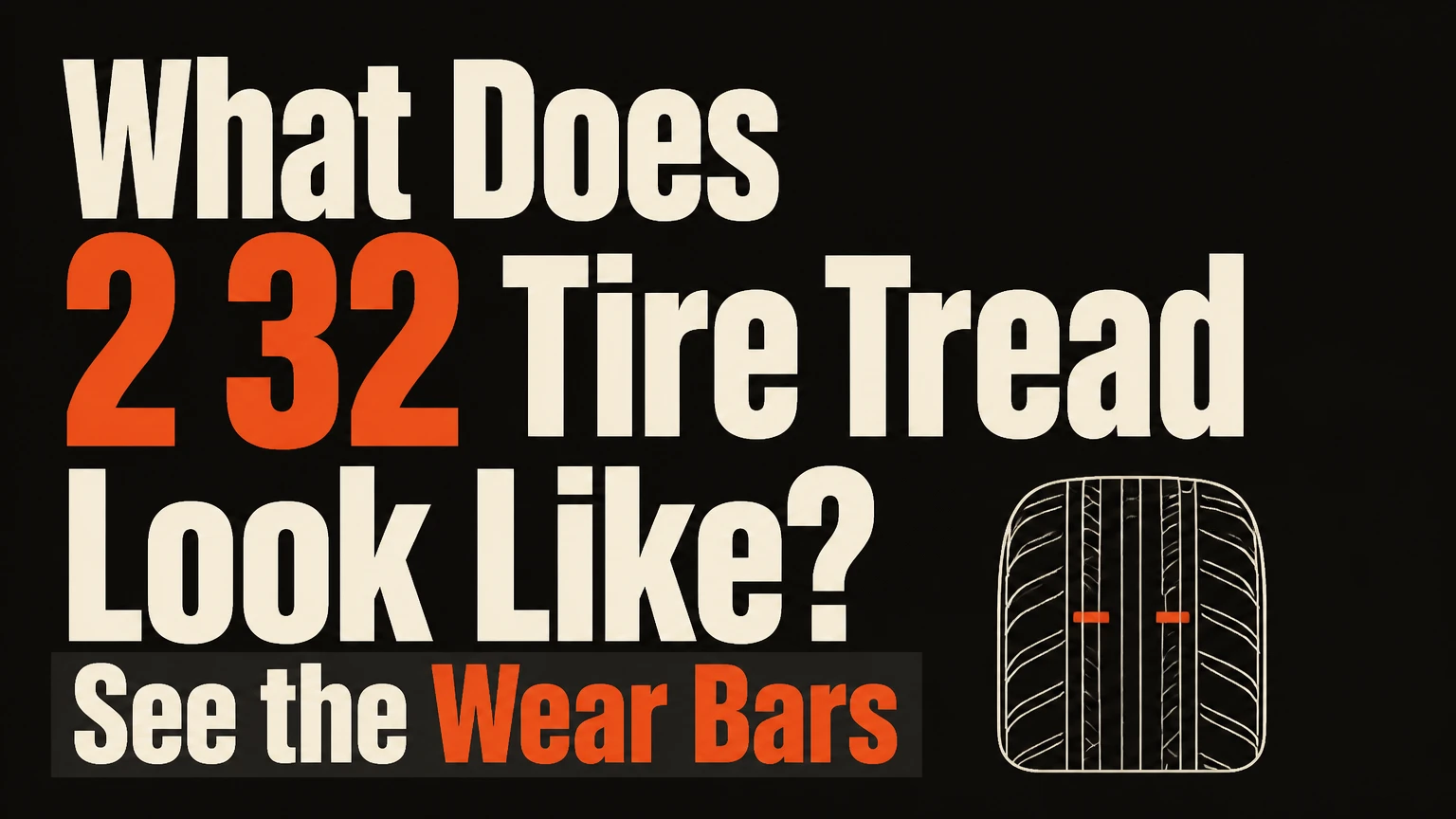
A tire with 2/32-inch tread looks nearly smooth, with shallow grooves and tread blocks worn level with the molded wear bars. The tire may still show pattern lines, but the main channels have little usable depth. In the United States, 2/32 inch, approximately 1.6 mm, is commonly treated as the legal minimum, not a safe target for continued driving.
Key Facts at a Glance
- 2/32 inch equals approximately 1.6 mm of remaining tread depth.
- A tire at 2/32 inch usually has tread blocks flush with its built-in wear indicators.
- A U.S. penny test is a quick screen: if Lincoln’s entire head is visible, the tread is at or below approximately 2/32 inch.
- A tread-depth gauge is more reliable than visual inspection or a coin test.
- Legal minimums vary by jurisdiction, and legal tread depth does not guarantee wet, winter, or emergency-braking performance.
- Replace a tire immediately if it has exposed cords, a sidewall bulge, deep cracking, a belt separation, or a serious puncture, regardless of tread depth.
What Does 2 32 Tire Tread Look Like?
2/32-inch tire tread looks flat and worn, with the tread surface almost level with the bottoms of the grooves and the raised wear bars. From a standing position, the tire can look merely “a little worn,” but a close inspection shows that the grooves are shallow, the block edges are rounded, and the wear indicators form nearly continuous raised sections across the tread pattern.
A new passenger-car tire commonly measures about 10/32 to 12/32 inch, although original tread depth varies by tire model. At 2/32 inch, a tire that began at 10/32 inch has lost about 80% of its original measured depth. That percentage is not universal because some tires start deeper or shallower.
Look directly across the tread rather than only at the outside shoulder. A tire can have visible grooves on its outer edge while the inner shoulder is already bald from incorrect alignment. Rotate the steering wheel to expose the front tires, use a flashlight, and inspect several points around the circumference.
Visual Signs of a 2/32-Inch Tire
A worn tire at the replacement limit commonly shows these features:
- Main grooves appear narrow, shallow, and visually interrupted.
- Tread-block edges lose their sharp, molded shape.
- Wear bars sit level with the surrounding tread.
- Water channels no longer look substantially deeper than the tread blocks.
- Sipes and fine grooves appear shortened or nearly erased.
- Smooth bands may run around the center, shoulder, or one edge.
- The tire can look shiny, especially after heat and repeated exposure to road contaminants.
The surface does not always become perfectly slick. Modern tread patterns retain cosmetic grooves even when their remaining depth is only 2/32 inch. A tire can therefore look patterned in a photograph while still measuring at the replacement limit.
What Do Tire Wear Bars Show?
Tire wear bars are raised rubber bridges molded into several of the tire’s main grooves. When the surrounding tread wears down until it meets the bars, the tire has reached the manufacturer’s molded wear-indicator level, usually approximately 2/32 inch for passenger tires sold in North America.
Wear bars are not one uninterrupted rubber band across the whole tire. They appear at intervals inside selected grooves, often marked by a small triangle, “TWI” marking, or another symbol on the sidewall. Inspect multiple bars because one section may contact the tread before another section.
| Wear-bar relationship | Approximate meaning | Recommended action |
|---|---|---|
| Bars clearly below tread blocks | More than 2/32 inch | Measure before deciding |
| Bars nearly level with blocks | Approximately 2-3/32 inch | Schedule replacement soon |
| Bars flush with surrounding tread | Approximately 2/32 inch | Replace promptly |
| Bars hidden by localized bald spot | Uneven wear | Stop and inspect the cause |
| Rubber below bars or cords visible | Below safe structure | Do not drive; arrange replacement |
Wear bars provide a useful visual warning, but they do not identify every unsafe condition. A tire with a sidewall bubble, severe cracking, exposed steel, belt separation, or an improperly repaired puncture can fail even when its tread remains well above the bars.
How Deep Is 2/32 Inch in Millimeters?
2/32 inch is 0.0625 inch, or approximately 1.59 millimeters. Tire professionals commonly round that value to 1.6 mm. A digital gauge may display 1.6 mm, while a U.S. tread-depth gauge may show “2” on its thirty-seconds-of-an-inch scale.
Tread depth is measured from the bottom of a groove to the top of the adjacent tread block. Measuring from a shallow sipe or from a raised wear bar gives a misleading result. Tire shops normally check the major grooves at the center and both shoulders, then compare readings across the tire and between tires on the same axle.
| Tread depth | Millimeters, approximate | Typical visual condition | Practical interpretation |
|---|---|---|---|
| 10/32-12/32 inch | 7.9-9.5 mm | Deep grooves and crisp blocks | Typical new-tire range |
| 6/32 inch | 4.8 mm | Clearly visible channels | Usable, inspect regularly |
| 4/32 inch | 3.2 mm | Shallow but defined grooves | Wet-weather replacement planning |
| 3/32 inch | 2.4 mm | Rounded blocks and limited channels | Replace soon |
| 2/32 inch | 1.6 mm | Wear bars level with tread | Common legal minimum |
| 1/32 inch | 0.8 mm | Nearly bald or below bars | Unsafe and generally noncompliant |
The 2/32-inch figure is a threshold, not a performance guarantee. Tire construction, rubber compound, groove design, temperature, road water depth, inflation pressure, vehicle weight, and speed all affect actual traction.
How Can You Check for 2/32 Tread?
Use a tread-depth gauge for the most dependable result, and use a penny only as a quick screening method. Check at least three positions across the tread and repeat the measurements at several points around the tire, because a single reading can miss localized wear.
Penny Test: A Quick Screening Method
Use a standard U.S. penny and insert it into a principal tread groove with Abraham Lincoln’s head pointing downward.
- Select a groove that runs around the tire, not a small decorative sipe.
- Insert the penny into the groove at several tread locations.
- View the coin straight on at eye level.
- If the top of Lincoln’s head is completely visible, the tire is approximately at or below 2/32 inch.
- If part of Lincoln’s head is covered, the tire may have more than 2/32 inch, but it still requires a gauge for a precise reading.
The penny test is affected by viewing angle, coin wear, groove shape, and uneven tread. It cannot identify inner-edge wear unless you physically inspect that edge. It also cannot detect cracks, bulges, punctures, or internal belt damage.
The quarter test is a different screening method. A U.S. quarter is commonly used as an approximate 4/32-inch check, with the top of George Washington’s head providing the visual reference. A tire that fails the quarter test may still be above the legal 2/32-inch limit, but it has less wet-weather reserve than a tire with deeper tread.
Tread-Depth Gauge: The Better Confirmation
A mechanical or digital gauge gives a direct reading in thirty-seconds of an inch or millimeters.
- Remove the gauge’s probe or extend it to its measuring position.
- Place the gauge base flat on the tread block beside the selected groove.
- Push the probe to the bottom of the groove without pressing the tread sideways.
- Read the result and record the measurement.
- Repeat at the inner shoulder, center, and outer shoulder.
- Take readings at four or more points around the circumference.
- Use the lowest consistent reading when deciding whether replacement is required.
A result of 2/32 inch, 1.6 mm, or less confirms that the measured section has reached the common replacement limit. If readings differ by more than about 2/32 inch across the tread, ask a technician to inspect alignment, inflation pressure, suspension components, and rotation history.
Where Should You Measure?
Measure the inner edge, center rib or center groove, and outer edge. Front-wheel-drive vehicles often develop shoulder wear, while incorrect toe or camber can remove tread from one extreme edge without making the outside of the tire look worn.
Do not measure over a tread-wear indicator. The gauge probe must reach the groove floor beside the indicator. Compare at least two grooves when the tire uses different groove widths or a directional tread pattern.
Is 2/32 Tread Safe in Rain or Snow?
A tire at 2/32 inch has very little wet-weather reserve and is a poor choice for rain, slush, or snow. Shallow grooves hold less water-displacement capacity, while rounded tread edges and reduced sipe depth reduce the tire’s ability to maintain consistent contact on wet pavement.
Hydroplaning does not begin at one fixed speed. The threshold changes with water depth, inflation pressure, vehicle load, tire width, tread design, road texture, and speed. Claims that every new tire hydroplanes at one speed and every 2/32-inch tire hydroplanes at another oversimplify the physics.
The U.S. Tire Manufacturers Association recommends replacing tires when tread reaches 2/32 inch, but tire manufacturers commonly encourage earlier replacement for drivers facing frequent rain or snow. Michelin, for example, advises replacing tires before the legal minimum when performance has declined and identifies 4/32 inch as a useful wet-weather planning point for many passenger applications.
Snow requires additional tread depth because grooves help capture and compact snow, allowing snow-on-snow contact that contributes to traction. Winter-tire manufacturers and retailers often recommend replacement around 5/32 or 6/32 inch, although the correct threshold depends on the tire and local conditions.
The National Highway Traffic Safety Administration states that “tires are the only part of your vehicle that touches the road.” That simple fact explains why tread depth cannot be considered separately from pressure, temperature, road surface, and tire condition.
How Does 2/32 Compare With Other Tread Depths?
2/32 inch is materially different from 4/32 inch even though both may appear worn from a distance. At 4/32 inch, grooves remain visibly deeper and the tire retains more water-channel capacity; at 2/32 inch, the tread is level with the wear bars and replacement should not be postponed.
| Depth | Appearance from above | Rain performance reserve | Replacement planning |
|---|---|---|---|
| 8/32-12/32 inch | Deep channels, sharp block edges | Highest typical reserve | Routine inspections |
| 5/32-7/32 inch | Moderate grooves, visible sipes | Moderate reserve | Monitor wear rate |
| 4/32 inch | Shallow channels, rounded edges | Reduced reserve | Plan replacement, especially for rain |
| 3/32 inch | Narrow grooves, bars approaching surface | Low reserve | Arrange replacement soon |
| 2/32 inch | Bars flush, nearly flat tread | Minimal reserve | Replace immediately |
A tread-depth number does not predict an exact stopping distance. Independent test results vary by tire model and surface, so a universal claim that 2/32-inch tires always require a particular number of extra feet would be misleading. The defensible conclusion is narrower: reduced tread generally reduces wet traction, and the effect can become severe on standing water.
What Do Uneven 2/32-Inch Wear Patterns Mean?
A tire can reach 2/32 inch in one area while retaining much deeper tread elsewhere, and the uneven pattern usually points to an inflation, alignment, suspension, or rotation problem. The lowest worn section controls the immediate safety decision, while the wear pattern identifies what must be repaired before installing replacement tires.
| Visible pattern | Common mechanical cause | What to inspect |
|---|---|---|
| Center rib worn smooth | Overinflation or incorrect pressure | Cold pressure, load placard, pressure history |
| Both shoulders worn | Underinflation or overload | Inflation leak, valve stem, vehicle load |
| Inner edge bald | Excessive negative camber or toe error | Four-wheel alignment and suspension |
| Outer edge bald | Positive camber, cornering load, or alignment error | Alignment angles and steering parts |
| Alternating cups or scallops | Worn shocks, struts, imbalance, or loose parts | Suspension, balance, wheel bearings |
| Diagonal feathering | Toe misalignment | Alignment measurement |
| One broad smooth band | Locked braking or localized slip | Brake operation and tire structure |
Why Is the Inside Edge Sometimes Bald?
Inside-edge wear is easy to miss because the vehicle’s body hides it during a casual walk-around. A vehicle can pass a visual outer-shoulder inspection while its inner tread has reached the cords.
Turn the steering wheel fully, or have the vehicle lifted safely by a qualified technician. Never place any part of your body under a vehicle supported only by a jack. If steel cords are visible, the tire requires immediate replacement and should not be driven to a shop.
Can a Tire Be Unsafe Above 2/32 Inch?
Yes. Tread depth is only one condition measure. Sidewall cracking, a bulge, exposed cords, a tread separation, a puncture outside the repairable central area, severe vibration, or age-related deterioration can make a tire unsafe above 2/32 inch.
The Rubber Manufacturers Association, now represented by the U.S. Tire Manufacturers Association, and major tire manufacturers advise regular inspections and replacement when structural or aging damage appears. Tire age is identified through the Department of Transportation date code on the sidewall, but age alone does not reveal the tire’s complete condition.
Can You Drive on 2/32 Tread to a Tire Shop?
The safest choice is to replace a 2/32-inch tire before normal driving, especially in rain, snow, at highway speed, or with a heavily loaded vehicle. If the tire has no structural damage and the shop is very close, a driver may choose a slow, direct trip in dry conditions, but towing or mobile installation removes more risk.
Do not drive the tire if any of these conditions exists:
- Steel cords or fabric are visible.
- The sidewall has a bulge, deep crack, or cut.
- The tire is losing pressure.
- A belt separation creates a lump or rhythmic vibration.
- The tread is detached or visibly moving.
- Heavy rain, ice, snow, or standing water is present.
- The vehicle cannot maintain stable steering.
Check the spare before relying on it. A temporary spare may have a speed limit, a mileage limit, and a different handling profile. Follow the vehicle owner’s manual and the spare’s sidewall instructions.
How Long Will 2/32 Tread Last?
There is no dependable mileage estimate for a tire at 2/32 inch, and remaining life may be only a few hundred miles or less. Wear accelerates with low pressure, aggressive cornering, high annual mileage, heavy loads, poor alignment, hot pavement, and repeated hard braking.
A typical passenger tire may lose approximately 1/32 inch over several thousand miles, but that broad planning estimate cannot safely be applied to the final 2/32 inch. Tread wear is not linear, and one shoulder may be nearly bald while the center still appears serviceable.
| Driving condition | Typical effect on remaining tread life | Appropriate decision |
|---|---|---|
| Dry city driving, short distance | Lower immediate water exposure | Replace without routine postponement |
| Highway rain at 60-70 mph | High hydroplaning exposure | Do not delay replacement |
| Mountain snow or ice | Very low traction reserve | Replace before travel |
| Heavy SUV or loaded pickup | Higher tire loading | Replace promptly and check ratings |
| Visible inner-edge wear | Structural risk can be hidden | Stop and obtain inspection |
| Slow trip to nearby shop | Limited exposure if dry and intact | Only if no damage is present |
These are decision categories, not promises of safe mileage. A tire professional can measure the actual condition, inspect the casing, and determine whether the vehicle should be moved.
Common Mistakes When Checking Tread
- Inspecting only the outer shoulder: Inner-edge camber wear can hide from a standing inspection. Turn the wheel or request an under-vehicle inspection.
- Measuring a sipe instead of a main groove: Small channels are not the reference point for tread depth. Use the deepest primary groove beside the wear bar.
- Treating the penny test as a precise measurement: Coins offer an approximate threshold, not a calibrated diagnosis. Confirm borderline results with a gauge.
- Confusing legal with safe: A tire can meet a local minimum while offering poor snow or rain performance. Replace earlier when conditions demand more reserve.
- Checking only one location: Uneven wear makes the lowest reading more important than the average. Measure across the tread and around the circumference.
- Ignoring the tire’s pressure: Incorrect cold inflation can create the wear pattern that destroys a new replacement. Use the pressure on the vehicle placard, not the maximum molded on the sidewall.
- Assuming tread depth reveals tire age: Rubber aging and structural damage can occur without dramatic tread loss. Read the DOT date code and inspect for cracks.
What Should You Do at 3/32 or 4/32 Tread?
At 4/32 inch, begin replacement planning; at 3/32 inch, arrange replacement soon; at 2/32 inch, replace immediately. The earlier decision is particularly sensible for drivers who regularly encounter heavy rain, snow, freezing temperatures, high speeds, or long remote trips.
Measure all four tires and record the lowest value on each. If one tire is substantially lower than its axle mate, identify the cause before replacing only the worn tire. Tire shops may recommend replacing tires in axle pairs, and all-wheel-drive vehicles may require matching circumferences to protect the drivetrain.
Use the tire manufacturer’s guidance for winter tires, performance tires, run-flat tires, and commercial applications. Commercial vehicle rules can differ from passenger-car requirements, and state, provincial, or national regulations may prescribe different minimums.
FAQ
Is 2/32 tread legally bald?
In many U.S. jurisdictions, 2/32 inch is the commonly recognized legal minimum for passenger-car tread, and wear bars are designed around that level. The exact law varies by state or country, and enforcement may consider exposed cords, uneven wear, tire damage, and vehicle class. Verify local requirements rather than assuming one national rule.
What does 3/32 tread look like?
A tire at 3/32 inch usually still has visible grooves, but the channels are narrow and the tread blocks have rounded edges. Wear bars sit slightly below the surrounding tread instead of being fully flush. The tire may pass a penny screening test while offering limited wet-weather reserve, so replacement should be planned.
Is the penny test accurate for tire tread?
The penny test is useful for identifying tread near the 2/32-inch threshold, but it is not a precision measurement. Coin position, viewing angle, groove shape, and uneven wear affect the result. Use a calibrated tread-depth gauge when the penny result is borderline or when different areas of the tire look unlike one another.
Should I replace only one tire at 2/32?
Replacing one tire may be appropriate when the other tires are nearly new and the vehicle manufacturer permits it, but tread-depth and circumference differences can affect handling. Many vehicles are best served by replacing tires in pairs on the same axle. All-wheel-drive vehicles may require a closely matched set.
Does tire pressure change how 2/32 tread looks?
Tire pressure can create a misleading wear pattern without changing the measured depth uniformly. Overinflation commonly wears the center, while underinflation commonly wears both shoulders. Check pressure when tires are cold and correct it using the vehicle door-jamb placard or owner’s manual.
What is the safest action if cords are visible?
Do not drive on a tire with visible steel or textile cords. Exposed reinforcement indicates the tread or shoulder has worn through its protective rubber, creating a high risk of failure. Install the spare if it is properly inflated and permitted for the trip, or arrange roadside assistance or mobile tire service.
The Bottom Line
A 2/32 tire tread typically looks nearly flat, with shallow grooves and molded wear bars level with the surrounding tread blocks. Confirm the condition with a tread-depth gauge across the inner, center, and outer sections, because a tire can hide dangerous localized wear.
Treat 2/32 inch as the replacement limit, not a mileage target. Replace sooner at 4/32 inch when wet-weather reserve matters, and earlier still for snow-focused driving. If the tire has a bulge, crack, puncture, vibration, separation, or exposed cords, do not drive it regardless of the measured tread depth.